

20 Worst Jobs for Dyslexics in 2026: Careers That Can Be More Challenging
Some jobs can place heavier demands on the skills that a person with dyslexia finds most difficult. A role built around fast proofreading, verbatim transcription, dense written documentation, or repeated data checking, for example, may require more effort from someone whose dyslexia affects reading speed, spelling, or written accuracy.
That does not mean people with dyslexia cannot succeed in these careers.
Dyslexia varies considerably from one person to another. Experience, coping strategies, assistive technology, workplace accommodations, and the way a job is organized can all change how manageable a role feels.
Throughout this guide, the term “worst jobs for dyslexics” refers to occupations where common job duties can place unusually heavy demands on reading, spelling, written accuracy, transcription, or text-heavy processing. It does not mean that these careers are automatically unsuitable or unavailable to everyone with dyslexia.
We will look at 20 occupations that may deserve extra consideration, explain which parts of the job can create difficulty, and show why the actual tasks and working environment matter more than the job title alone.
Table of Contents
- How We Chose These Jobs
- What Dyslexia Can Affect at Work
- What Can Make a Job Harder for Someone With Dyslexia?
- 20 Worst Jobs for Dyslexics
- Workplace Accommodations for Dyslexia
- Dyslexia in the Workplace and Your Rights
- How to Tell Whether a Job Is a Good Fit for You
- Better Career Options for People With Dyslexia
- Frequently Asked Questions
- Final Thoughts
How We Chose These Jobs
This list is not a ranking of what people with dyslexia can or cannot do.
We selected occupations by comparing common dyslexia-related literacy difficulties with the core duties of each job. Particular attention was given to roles involving:
- intensive or time-sensitive reading;
- spelling and proofreading as essential job functions;
- verbatim or highly accurate transcription;
- repeated transfer of information between documents or systems;
- detailed written recordkeeping;
- dense legal, medical, technical, or regulatory documentation;
- high-volume text or data entry; and
- limited time to review written work before it is finalized.
Where possible, occupational demands are based on current job-task information from O*NET, rather than assumptions about what a particular profession involves.
The result should therefore be read as a guide to job demands, not as a list of careers that people with dyslexia should be excluded from pursuing.
What Dyslexia Can Affect at Work
The International Dyslexia Association’s 2025 definition describes dyslexia as a specific learning disability characterized by difficulties in word reading and/or spelling involving accuracy, speed, or both. It also emphasizes that these difficulties occur along a continuum of severity.
That variability matters in the workplace.
One employee may read accurately but need considerably more time to process a long document. Another may read relatively quickly but find spelling, proofreading, or producing accurate written text more difficult. Someone else may have developed strategies and tools that make those tasks much less disruptive at work.
Dyslexia can also have secondary effects on reading comprehension and written expression. However, it should not be treated as a shorthand for poor intelligence, weak professional ability, or an inability to perform complex work.
This is why broad statements such as “dyslexic people cannot be accountants” or “people with dyslexia should avoid office jobs” are not useful. Two jobs with the same title can involve very different daily demands, and two people with dyslexia can experience the same task very differently.
For broader career guidance, see our guide to jobs for people with learning disabilities.
Dyslexia Does Not Automatically Mean Difficulty With Math
One particularly important distinction is between dyslexia and dyscalculia.
Dyslexia primarily concerns difficulties related to written language, particularly word reading and spelling. Dyscalculia is a different specific learning difficulty involving the understanding and processing of numbers and quantities.
The two can occur together, and some people with dyslexia also experience difficulties with aspects of mathematics. But having dyslexia does not automatically mean someone is bad with numbers or incapable of working in finance, accounting, banking, or another numerically focused field.
For that reason, occupations involving money or numbers are included in this guide only where their broader task demands — such as document verification, written records, codes, data entry, or rapid cross-checking — may also create a substantial literacy or information-processing load.
What Can Make a Job Harder for Someone With Dyslexia?
Rather than looking only at job titles, it is more useful to examine how the work is actually performed.
A 2022 systematic review examining work participation from the perspective of adults with developmental dyslexia found that workplace participation is influenced by a wide combination of personal and environmental factors. Workload, work pressure, relationships with managers and colleagues, assistive technology, accommodations, and individual coping strategies can all affect the experience of working with dyslexia.
That means a career that is difficult in one workplace may be considerably more manageable in another.
Some job characteristics are nevertheless worth looking at carefully.
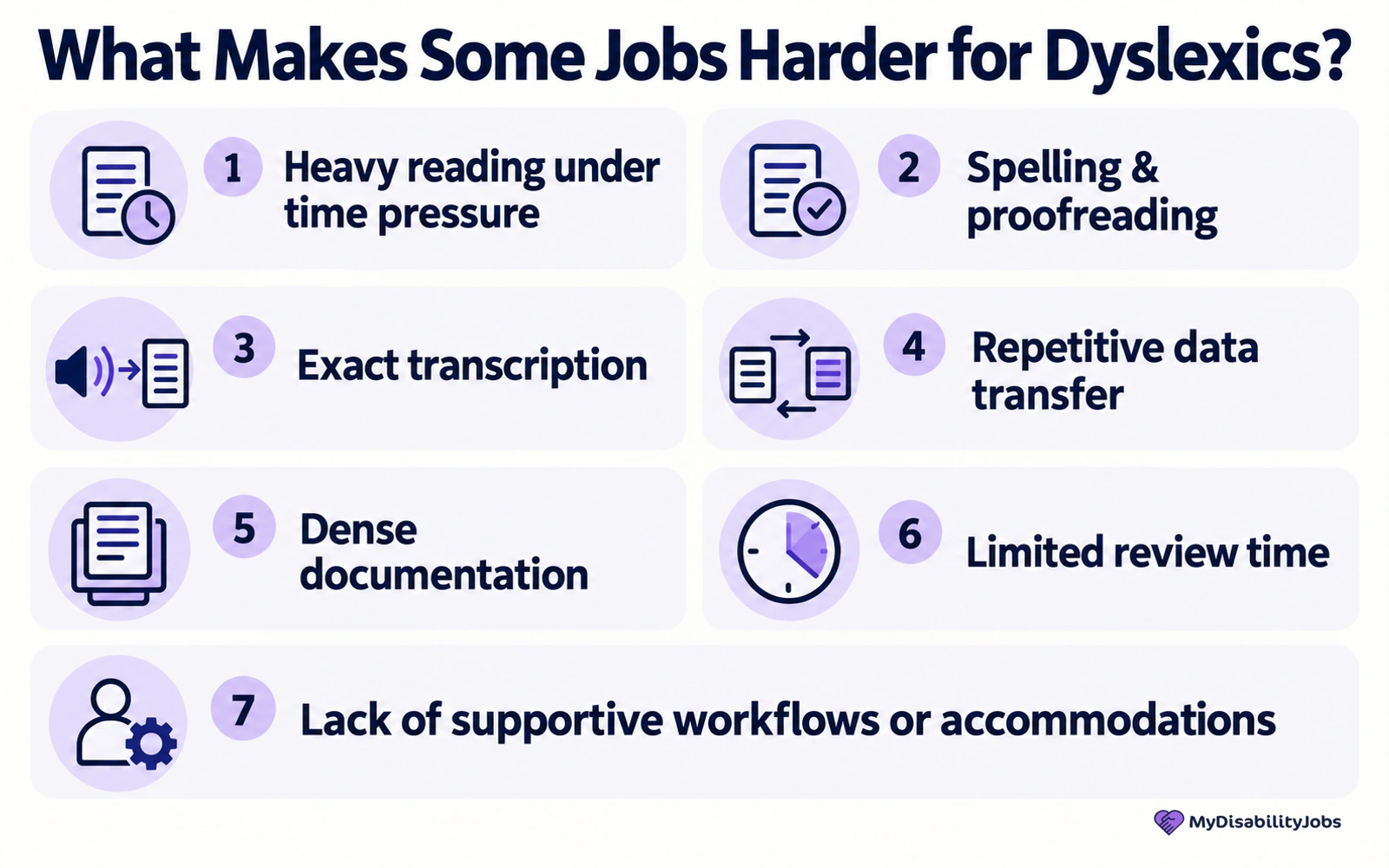
Heavy Reading Under Time Pressure
Reading large amounts of material is different from having to read it quickly and accurately while a deadline is approaching. Jobs in which information must be reviewed immediately can leave less opportunity to re-read text or use slower checking strategies.
Spelling and Proofreading as Core Duties
Assistive technology can help with spelling and writing in many occupations. The situation is different when identifying small written errors is itself the main product being sold, as it is in professional proofreading and some editing roles.
Exact Transcription
Jobs requiring speech to be converted into an accurate written record can combine listening, rapid language processing, spelling, specialized terminology, and quality control within the same task.
Repetitive Data Transfer and Document Checking
Moving names, codes, dates, account information, or other details between documents and computer systems can become demanding when high accuracy is required over long periods.
Dense or Specialized Documentation
Legal, medical, financial, technical, and regulatory work can involve terminology-heavy documents where small differences in wording matter. The difficulty may come not from understanding the profession itself, but from the volume and precision of its written documentation.
Little Time to Check Work
Many people develop effective ways to catch mistakes when they can slow down, review their work, or use assistive tools. Jobs with constant deadlines and immediate output can reduce that opportunity.
A Workplace That Does Not Support Different Ways of Working
The job description is only part of the picture.
Access to assistive technology, clear procedures, appropriate training, supportive management, and reasonable workplace accommodations can substantially change how difficult particular tasks are.
For employers, our guide to inclusive workplace practices covers broader ways to build a supportive work environment.
That is why the 20 careers below should be treated as jobs to examine carefully, not careers to automatically rule out.
20 Worst Jobs for Dyslexics
The following occupations can place particularly heavy demands on reading, spelling, written accuracy, transcription, or document checking. That does not make them impossible careers for people with dyslexia. The important question is whether the specific demands of the role match the way dyslexia affects you and whether appropriate tools and accommodations are available.
1. Proofreader
Proofreaders review written material specifically to identify and correct errors. O*NET describes tasks such as checking grammar, punctuation, spelling, typography, omissions, inconsistencies, and corrected proofs.
Why it may be challenging
This is one of the clearest examples of a job where a difficulty associated with dyslexia can overlap directly with an essential job function. Someone whose dyslexia affects spelling accuracy, rapid recognition of written errors, or distinguishing small differences between similar pieces of text may need considerably more effort to perform continuous proofreading.
Unlike jobs where spelling is only a small part of the work, detecting written mistakes is the product a professional proofreader is being paid to deliver.
Dyslexia-related demands
- detecting spelling, punctuation, and typographical errors;
- comparing corrected text against original material;
- noticing small inconsistencies in dense written content;
- maintaining accuracy during prolonged reading.
What can help
Text-to-speech can make it easier to hear errors that are difficult to spot visually, while automated spelling and grammar tools can provide another checking layer. Customized checklists and separate review passes for spelling, formatting, punctuation, and other error types may also reduce cognitive load. Even with these tools, however, precise written checking remains central to the occupation.
2. Copy Editor or Editor
Editors plan, revise, and improve written material before publication. Depending on the role, they may review drafts, correct language, verify facts, reorganize content, rewrite passages, and make sure material meets editorial standards.
Why it may be challenging
Editing can combine several literacy-heavy tasks at the same time. A copy editor may need to read quickly, identify language errors, notice inconsistencies, check names or facts, and make precise changes without introducing new mistakes.
The difficulty can be greater in deadline-driven environments where several pieces of content need to be reviewed in a short period. Someone whose dyslexia affects reading speed, spelling, or close written comparison may therefore find some types of editing unusually demanding.
Dyslexia-related demands
- sustained reading of draft material;
- spelling, punctuation, and syntax checking;
- comparing different versions of a document;
- identifying small inconsistencies;
- producing accurate revisions under deadlines.
What can help
Editing is a broad profession, so the exact role matters. Developmental editing, for example, may focus more heavily on structure, argument, and organization than line-by-line correction. Text-to-speech, advanced writing software, staged editing passes, style guides, and sufficient review time can also make editorial work much more manageable.
3. Court Reporter or Stenographer
Court reporters and stenographers create accurate records of court proceedings, depositions, hearings, and other spoken events. O*NET describes the occupation as using verbatim methods and specialized equipment to capture, store, retrieve, and transcribe proceedings.
Why it may be challenging
The central requirement is unusually demanding: spoken language must be captured accurately and converted into a reliable written record.
This can combine listening, rapid language processing, specialized terminology, transcription, speaker identification, and later review of the transcript. For someone whose dyslexia significantly affects written-language processing, spelling, or proofreading, maintaining that level of accuracy can require substantial effort.
Real-time court reporting or captioning can be particularly demanding because there is little opportunity to slow down while the proceeding is happening.
Dyslexia-related demands
- verbatim capture of spoken language;
- rapid conversion of speech into written text;
- accurate use of legal terminology and names;
- reviewing transcripts for errors;
- maintaining accuracy while information is arriving continuously.
What can help
Computer-aided transcription software, customized dictionaries, extensive familiarity with legal terminology, audio backup, and structured post-session review can reduce some of the burden. Technology has changed the occupation considerably, but producing an accurate record remains an essential function of the job.
4. Medical Transcriptionist
Medical transcriptionists convert dictated information from physicians and other healthcare professionals into written medical records and reports. Their work can include patient histories, examination notes, procedure reports, consultations, discharge summaries, and other clinical documentation.
Why it may be challenging
Medical transcription requires much more than ordinary typing. The transcriptionist must listen accurately, recognize specialized terminology and abbreviations, produce clear written text, and review the result for spelling, consistency, and meaning.
O*NET specifically identifies tasks such as finding mistakes in reports and distinguishing between similar-sounding terms. That combination can be difficult for someone whose dyslexia affects spelling, written accuracy, or the rapid processing of language.
The consequences of an incorrectly transcribed medical term can also make careful verification especially important.
Dyslexia-related demands
- converting dictated speech into accurate written records;
- spelling specialized medical terminology;
- distinguishing similar-sounding words and terms;
- proofreading for consistency and accuracy;
- working with abbreviations and technical language.
What can help
Speech-recognition systems, medical terminology databases, customized dictionaries, electronic reference tools, and structured quality-control checks can make transcription more accessible. Familiarity with recurring terminology can also reduce the processing burden over time. The key question is whether the employee can maintain the accuracy required by the role at the expected pace.
5. Data Entry Clerk
Data entry clerks transfer information from source documents into databases or other computer systems. O*NET also identifies verifying data, finding errors, comparing entered information with source documents, and correcting inaccurate entries as core parts of the occupation.
Why it may be challenging
The difficulty is often not the complexity of the information but the combination of repetition and precision.
Names, dates, addresses, codes, account details, and other information may need to be copied or compared accurately for long periods. Someone whose dyslexia makes it harder to distinguish similar written strings, track information across documents, or transfer text quickly may find this kind of repetitive verification particularly tiring.
The challenge can increase when productivity targets reward speed while mistakes still need to remain very low.
Dyslexia-related demands
- reading information from source documents;
- transferring written data accurately;
- comparing entered data against original records;
- detecting small differences between similar entries;
- maintaining attention and accuracy during repetitive work.
What can help
Templates, automated validation rules, data-quality checks, clearer screen layouts, text-to-speech, keyboard shortcuts, and a separate verification step can reduce the amount of manual checking required. Workplace expectations also matter: a role that allows careful verification may be much more manageable than one built around aggressive entry-speed targets.
6. Word Processor or Typist
Word processors and typists prepare letters, reports, forms, and other documents from rough drafts, corrected copies, voice recordings, or existing material. O*NET also includes tasks such as compiling text and numerical data, merging documents, and checking completed work for spelling, grammar, punctuation, and formatting.
Why it may be challenging
The job can require sustained reading and typing while preserving the exact information contained in source material. Someone whose dyslexia affects spelling, written accuracy, or transferring information between documents may need more time to check the finished work.
The challenge can become greater when productivity is measured partly by typing speed, since working faster leaves less time to notice errors before a document is sent or finalized.
Dyslexia-related demands
- transferring information accurately from drafts or recordings;
- checking spelling, grammar, punctuation, and formatting;
- compiling or merging information from different documents;
- maintaining written accuracy while working at speed;
- reviewing completed documents before distribution.
What can help
Speech-to-text, text-to-speech review, document templates, spell-checking, text expansion, and automated formatting can remove much of the repetitive work. Modern word-processing systems may therefore make this occupation considerably more manageable than traditional typing-based roles.
7. Legal Secretary or Legal Administrative Assistant
Legal secretaries and administrative assistants support attorneys and legal teams by preparing correspondence, organizing case files, and producing documents such as summonses, complaints, motions, subpoenas, and agreements. O*NET also identifies preparing and proofreading legal documents as part of the occupation.
Why it may be challenging
The main concern is the volume and precision of legal documentation.
Names, dates, case numbers, deadlines, legal terminology, document versions, and filing requirements may all need to be checked carefully. For someone whose dyslexia affects reading speed, spelling, or close comparison of written information, this combination can create a substantial literacy load.
A mistake may also be more consequential than an ordinary typo if it appears in a document being filed with a court or sent to a client.
Dyslexia-related demands
- preparing and proofreading formal legal documents;
- reading specialized legal terminology;
- checking names, dates, case numbers, and filing information;
- organizing and retrieving large numbers of case documents;
- distinguishing between similar versions of legal material.
What can help
Standardized templates, legal case-management systems, automated proofreading, text-to-speech, dictation, consistent file-naming rules, and document checklists can reduce manual checking. The workload also varies significantly between legal practices, so the exact balance between document production and other administrative duties matters.
8. Paralegal or Legal Assistant
Paralegals assist lawyers by researching laws and case information, investigating facts, organizing records, and preparing legal documents. O*NET specifically identifies preparing, editing, or reviewing materials such as briefs, pleadings, appeals, contracts, wills, and legal correspondence.
Why it may be challenging
Paralegal work can involve long periods of reading dense material while moving between statutes, case decisions, evidence, correspondence, and different versions of legal documents.
A person with dyslexia may fully understand the legal issues involved while still needing additional time to process a large volume of written information or identify small differences between documents. Deadlines can make those demands more difficult when several cases are being handled simultaneously.
Dyslexia-related demands
- reading substantial amounts of legal material;
- researching information across multiple written sources;
- preparing, editing, and reviewing complex documents;
- comparing document versions and factual details;
- maintaining accurate case files and written records.
What can help
Searchable digital records, text-to-speech, legal research platforms, document templates, dictation, electronic highlighting, and structured review procedures can reduce some of the literacy burden. Paralegal roles also differ greatly by practice area, so a research- or client-focused position may feel very different from one dominated by document production.
9. Court Clerk
Court clerks perform administrative work for courts and other public agencies. Their duties can include maintaining case records, examining documents for compliance with court procedures, recording court orders and case dispositions, preparing legal documents, and handling official correspondence.
Why it may be challenging
Court administration can require repeated work with similar-looking names, case numbers, dates, orders, forms, and legal language, often across many separate files.
O*NET also identifies examining documents for adherence to requirements and proofreading records for accuracy among the activities associated with this occupation. Someone whose dyslexia makes written comparison slower may therefore need more time to verify that information has been entered or filed correctly.
Dyslexia-related demands
- examining legal documents for required information;
- recording case information accurately;
- proofreading documents and official records;
- distinguishing between similar names, numbers, and case files;
- maintaining large filing or document-management systems.
What can help
Digital case-management systems, standardized forms, automated field validation, document checklists, text-to-speech, clearer layouts, and an established final-verification step can reduce avoidable errors. Court-clerk responsibilities vary considerably between jurisdictions, making the individual job description especially important.
10. Technical Writer
Technical writers create manuals, operating instructions, online help content, reports, and other materials that explain complex products or processes. O*NET describes organizing written material according to standards for order, clarity, conciseness, style, and terminology, as well as editing existing material and maintaining records of revisions.
Why it may be challenging
Technical writing can combine a high volume of reading with precise written production. The writer may need to understand specifications, compare new information with existing documentation, use terminology consistently, and revise material whenever a product or process changes.
Someone whose dyslexia affects written expression, spelling, proofreading, or reading speed may therefore find the language-production side of the role demanding even when they understand the underlying technical subject extremely well.
Dyslexia-related demands
- producing clear and accurate technical documentation;
- maintaining consistent terminology and writing standards;
- reading specifications and other technical source material;
- editing and revising existing documents;
- tracking changes across different document versions.
What can help
Dictation, text-to-speech, terminology databases, reusable templates, automated grammar and style tools, structured authoring systems, and separate technical-review and copy-editing stages can make a substantial difference. Strong subject knowledge can also be a major advantage, which is why technical writing should not be automatically ruled out solely because someone has dyslexia.
11. Regulatory Affairs Specialist
Regulatory affairs specialists help organizations comply with government and industry requirements. O*NET describes tasks such as coordinating and documenting regulatory processes, preparing or reviewing submissions, maintaining records, and communicating with regulatory agencies.
Why it may be challenging
This type of work can involve long and highly technical documents where small differences in wording, dates, requirements, or supporting information matter.
Someone whose dyslexia affects reading speed, proofreading, or close written comparison may need additional time to process regulations and verify that submissions are complete and accurate. The challenge can become greater when several regulatory requirements or document versions need to be tracked at once.
Dyslexia-related demands
- reading dense regulatory and technical documentation;
- preparing or reviewing formal submissions;
- comparing requirements across multiple documents;
- maintaining accurate compliance records;
- detecting omissions or inconsistencies before submission.
What can help
Searchable digital regulations, text-to-speech, standardized submission templates, compliance-management software, terminology lists, and formal review checklists can reduce the amount of manual comparison required. Regulatory affairs also includes communication, strategy, and problem-solving, so the literacy burden can vary substantially between positions.
12. Medical Records Specialist or Medical Coder
Medical records specialists maintain and process patient records, while medical coders classify diagnoses, procedures, services, and other healthcare information using standardized coding systems. O*NET identifies reviewing records for completeness, accuracy, and regulatory compliance as a core part of the occupation.
Why it may be challenging
The main challenge is the need to move accurately between detailed medical documentation, specialized terminology, classifications, and electronic records.
For someone whose dyslexia affects reading accuracy or distinguishing similar written terms, interpreting clinical documentation and assigning the correct information may require additional checking. This is especially important when small differences in terminology can change how a diagnosis or procedure is classified.
Dyslexia-related demands
- reading detailed medical records and clinical terminology;
- distinguishing between similar written terms;
- checking records for completeness and accuracy;
- transferring information into standardized coding systems;
- working consistently with detailed electronic documentation.
What can help
Coding software, searchable medical terminology databases, electronic health-record systems, text-to-speech, structured coding workflows, and separate verification steps can reduce the burden. Familiarity with frequently used terminology and procedures can also make the work considerably easier over time.
13. News Reporter or Journalist
Reporters and journalists gather information through research, interviews, observation, and investigation, then turn that information into stories for publication or broadcast. O*NET includes researching background information and producing accurate news reports among the occupation’s core tasks.
Why it may be challenging
Journalism can combine a large amount of reading and writing with significant time pressure.
A reporter may need to review source material, take notes, verify names and facts, write a story, revise it, and respond to editorial changes within the same deadline. Someone whose dyslexia affects reading speed, spelling, or rapid written production may therefore find some newsroom workflows particularly demanding.
The concern is not interviewing ability, communication skills, or understanding complex events. It is the combination of written accuracy and speed that can make certain journalism roles harder.
Dyslexia-related demands
- researching written background material;
- producing accurate copy under deadlines;
- checking names, dates, quotations, and factual details;
- revising written material quickly;
- switching frequently between research, notes, and draft text.
What can help
Recorded interviews, transcription software, dictation, text-to-speech review, digital note-taking tools, editorial support, and separating reporting from final copy-editing can reduce the literacy burden. Journalism also includes many different formats, so audio, video, investigative, and long-form roles may create very different demands.
14. Correspondence Clerk or Dispute Processing Clerk
Correspondence clerks respond to written requests, complaints, billing disputes, claims, account issues, and other customer communications. O*NET describes reading incoming correspondence, gathering relevant records, checking those records for completeness and accuracy, and preparing appropriate responses.
Why it may be challenging
This work can involve processing many similar cases while identifying the specific details that make each one different.
A person may need to compare an incoming complaint with account records, previous correspondence, billing information, and internal procedures before preparing a response. Someone whose dyslexia affects rapid reading or comparison of written information may find high-volume correspondence processing especially tiring.
Dyslexia-related demands
- reading large amounts of incoming correspondence;
- identifying important details within similar-looking cases;
- comparing correspondence with supporting records;
- preparing clear and accurate written responses;
- maintaining accurate records of previous communications.
What can help
Response templates, case-management systems, text-to-speech, speech-to-text, automated spelling tools, standardized case categories, and checklists can reduce repetitive work. Workplaces that allow responses to be reviewed before they are sent may also be considerably more manageable than environments focused almost entirely on case-processing speed.
15. Insurance Claims or Policy Processing Clerk
Insurance claims and policy processing clerks handle new policies, changes to existing policies, and claims documentation. O*NET describes obtaining information to verify the accuracy and completeness of claims, applications, related documents, and company records.
Why it may be challenging
The job can require repeated comparison of forms, policy information, correspondence, dates, names, claim details, and computer records.
For someone whose dyslexia affects reading speed, written comparison, or transferring information accurately between documents, this type of repetitive verification may require additional effort. The difficulty can increase in high-volume environments where many similar files must be processed within fixed time targets.
Dyslexia-related demands
- reviewing claims and policy documents for completeness;
- comparing information across forms and company records;
- checking names, dates, policy details, and supporting documentation;
- updating records accurately;
- distinguishing between similar claims or policy files.
What can help
Claims-management software, automated form validation, templates, text-to-speech, clearly structured digital forms, and a final verification step can reduce manual checking. Some insurance positions also involve more customer communication and less document processing, so the exact job description matters when deciding whether the role is a good fit.
16. Loan Processor or Loan Clerk
Loan processors and loan clerks collect, verify, and organize information used in lending decisions. O*NET describes tasks such as reviewing applications, examining supporting documentation, preparing loan and closing documents, and recording financial and personal information.
Why it may be challenging
The work often requires several documents to be checked against one another before a loan can move forward.
A processor may need to compare names, addresses, income details, account information, tax documents, insurance forms, and other records while making sure required information is complete and consistent. Someone whose dyslexia affects rapid written comparison or transferring information accurately may therefore find this type of document-heavy work especially demanding.
Dyslexia-related demands
- reviewing detailed loan applications and supporting records;
- comparing information across multiple documents;
- checking names, dates, account details, and financial information;
- preparing or reviewing formal loan documents;
- maintaining accurate records throughout the loan process.
What can help
Loan-origination software, automated field validation, digital document checklists, standardized templates, text-to-speech, and clear file-management procedures can reduce manual comparison. The key challenge is not the financial content itself, but the volume and precision of written information that needs to remain consistent.
17. Tax Preparer
Tax preparers examine financial records, complete tax returns, determine which forms, deductions, or credits apply, and verify that information has been entered correctly. They may also consult tax instructions and other guidance when handling less common situations.
Why it may be challenging
The potential difficulty is not an assumed inability with mathematics. Modern tax software performs many of the calculations automatically.
The literacy demand comes from reading detailed instructions, interpreting categories correctly, transferring information from source documents, and checking that forms and supporting records match. During busy tax periods, time pressure can make repeated review more difficult.
Dyslexia-related demands
- reading detailed tax instructions and guidance;
- transferring information from financial documents to forms;
- distinguishing between similar categories or fields;
- checking names, dates, amounts, and supporting documents;
- reviewing completed returns for missing or inconsistent information.
What can help
Professional tax software can automate calculations and flag many inconsistencies. Searchable tax guidance, document checklists, standardized workflows, text-to-speech, digital document organization, and a separate final-review step can further reduce the reading and verification burden.
18. Bookkeeping, Accounting, or Auditing Clerk
Bookkeeping, accounting, and auditing clerks maintain financial records, record transactions, classify information, reconcile accounts, and check figures, documents, postings, and codes for correct entry.
Why it may be challenging
This is a more precise role to include than making a broad statement that “accounting is bad for people with dyslexia.”
The clerical side of accounting can involve repeated comparison of invoices, transaction descriptions, account names, codes, statements, and other records. Someone whose dyslexia affects written comparison or the transfer of information between systems may need additional time to verify that details have been entered correctly.
Dyslexia-related demands
- checking financial documents and transaction records;
- comparing postings against source information;
- working with account names, codes, and written descriptions;
- identifying discrepancies between records;
- maintaining accuracy across repetitive clerical tasks.
What can help
Modern accounting software can automate many calculations, postings, bank feeds, and reconciliation checks. Document scanning, validation rules, standardized coding systems, templates, and structured review procedures can further reduce manual entry. Dyslexia should therefore not be treated as a reason to rule out the wider accounting profession.
19. Payroll and Timekeeping Clerk
Payroll and timekeeping clerks collect and record information about employee hours, pay, deductions, leave, and other compensation-related details. Their duties can include verifying time records, processing adjustments, resolving discrepancies, and preparing payroll reports.
Why it may be challenging
Payroll combines fixed deadlines with a large amount of detailed information.
Employee names, hours worked, pay codes, deductions, dates, leave records, and other information may need to match across timekeeping systems, payroll software, and supporting documents. Someone whose dyslexia affects written comparison or accurate information transfer may find repeated verification particularly tiring, especially when corrections must be completed quickly before payroll closes.
Dyslexia-related demands
- comparing timekeeping and payroll records;
- checking names, dates, codes, and employee information;
- identifying discrepancies between systems;
- entering or correcting detailed payroll information;
- maintaining accuracy under recurring deadlines.
What can help
Integrated payroll and timekeeping systems, automated validation warnings, standardized employee records, reconciliation reports, templates, and clear payroll checklists can dramatically reduce manual processing. A well-designed automated system may make the role far more manageable than a workplace dependent on spreadsheets and repeated manual entry.
20. Bank Teller
Bank tellers process deposits, withdrawals, checks, payments, and other customer transactions. O*NET describes duties such as verifying signatures, deposit slips, account details, and whether written and numerical amounts on checks agree.
Why it may be challenging
The challenge is not that people with dyslexia are inherently poor with money or numbers.
A busy teller may need to read account information, compare written and numerical details, verify documents, enter transaction information, and communicate with a customer at the same time. For someone who benefits from additional time to check written details, combining these tasks at speed can increase the risk of mistakes.
Dyslexia-related demands
- checking written and numerical information during transactions;
- comparing names, signatures, account details, and deposit information;
- verifying that written and numerical check amounts match;
- recording transactions accurately;
- maintaining accuracy while interacting with customers and working quickly.
What can help
Modern banking systems perform many automated checks and can flag incomplete or inconsistent information before a transaction is finalized. Check scanners, electronic records, standardized transaction prompts, and established verification procedures can further reduce manual comparison. Dyslexia does not prevent someone from becoming a successful bank teller; the relevant issue is whether the role’s pace and checking demands fit the individual.
Workplace Accommodations for Dyslexia
The right accommodation for dyslexia depends on the individual, the tasks they find difficult, and the essential functions of their job. There is no single adjustment that every dyslexic employee needs.
This is especially important when considering the occupations above. A task that is difficult without support may become much more manageable when information is presented differently, assistive technology is available, or the employee has an effective process for checking their work.
Employers can also review our guide to disability and accessibility in the workplace for broader accessibility considerations.
The Job Accommodation Network (JAN) recommends considering accommodations on a case-by-case basis rather than assuming that everyone with the same disability needs the same solution.
Common workplace accommodations for dyslexia can include the following.
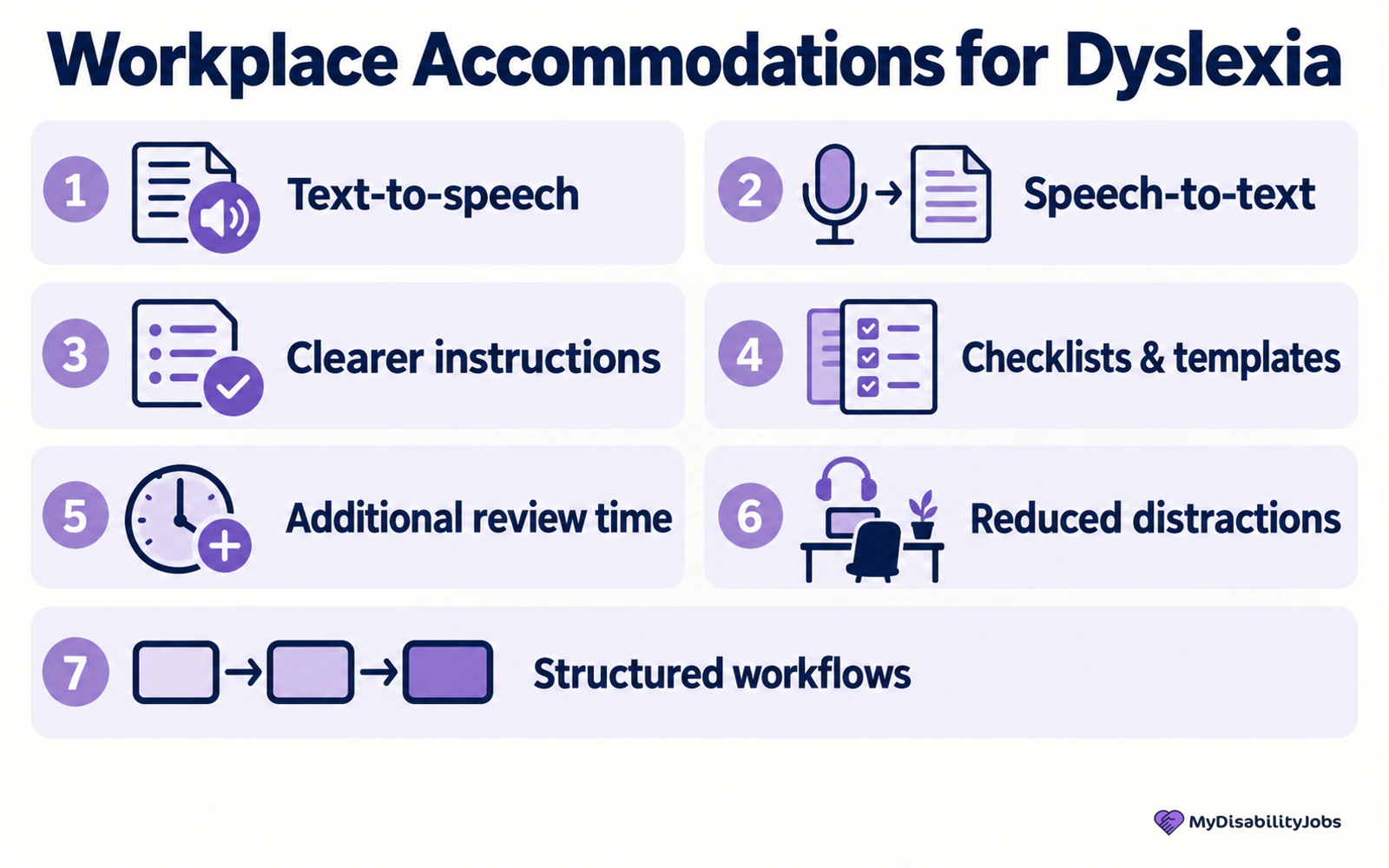
Text-to-Speech and Reading Tools
Text-to-speech software can read digital text aloud while the employee follows it on screen. For someone who reads accurately but more slowly, or who finds it easier to identify mistakes by hearing them, this can reduce the effort required to process long documents.
Depending on the job, other options can include screen-reading software, scanning tools for printed material, adjustable text display settings, or digital documents that are easier to search and navigate.
These tools do not remove the need to understand the material. They provide another way to access the same information.
Speech-to-Text and Writing Support
Speech-to-text software allows spoken words to be converted into written text. It can be particularly useful when an employee knows exactly what they want to communicate but producing the first written draft takes considerably more time.
Spelling and grammar tools, text expansion, terminology databases, templates, and approved writing-support software can also reduce repetitive language tasks.
The appropriate tool depends on the role. In a job where spelling or proofreading is itself an essential function, assistive software may support the employee without eliminating the need to perform that function accurately.
Clearer Instructions and Training Materials
Some employees benefit when important information is available in more than one format.
For example, written instructions can be accompanied by a verbal explanation, demonstration, diagram, flowchart, checklist, or short summary of the most important steps. Long procedures may also be easier to follow when divided into clearly numbered stages.
The British Dyslexia Association lists approaches such as providing verbal as well as written instructions, highlighting key information, presenting information in alternative formats, and using speech-to-text or text-to-speech tools among possible workplace adjustments.
These strategies can be especially useful during onboarding or when an employee is learning a new process.
Checklists, Templates, and Structured Workflows
Not every useful accommodation requires specialized software.
A checklist can reduce the need to remember every stage of a recurring process. Templates can make documents more predictable. Standard file-naming systems can reduce confusion between versions, while a defined review procedure can make it easier to check information consistently.
For jobs involving data entry, legal documentation, payroll, claims, or other detailed records, a structured workflow may be particularly valuable.
Instead of repeatedly asking, “Did I miss anything?”, the employee can follow the same verification sequence each time.
Additional Time for Reading or Reviewing Work
Where the job allows it, additional time to read a document, prepare written material, complete training, or perform a final accuracy check may be a useful accommodation.
This does not necessarily mean removing deadlines or lowering performance standards. In many cases, the goal is to adjust how a task is completed so that an employee can produce the required result accurately.
Whether additional time is reasonable will depend on the nature of the job and the task. A position built around real-time transcription, for example, raises different considerations from a job where a written report is due at the end of the day.
Reducing Distractions During Literacy-Heavy Tasks
Reading, writing, proofreading, or comparing documents can become harder when interruptions are constant.
Depending on the workplace, possible adjustments may include access to a quieter area for concentration-intensive tasks, reducing unnecessary interruptions during specific periods, or organizing the workday so detailed reading can be completed when distractions are lower.
The aim is not to assume that all people with dyslexia have concentration difficulties. It is to recognize that a demanding literacy task can require more effort when the working environment adds competing demands.
Adjusting How Work Is Organized
In some situations, changing the sequence or organization of work may be more useful than adding new technology.
Examples can include:
- breaking a large written task into defined stages;
- using standard templates for recurring documents;
- providing important instructions in both written and verbal form;
- creating a consistent system for checking completed work;
- scheduling uninterrupted time for documentation-heavy tasks;
- using calendars, reminders, or workflow tools for deadlines; and
- modifying nonessential or marginal duties where appropriate.
The most effective accommodations for dyslexia in the workplace are therefore usually based on the particular employee and the particular job, not on a generic list of dyslexia symptoms.
Dyslexia in the Workplace and Your Rights
In the United States, dyslexia may qualify as a disability under the Americans with Disabilities Act (ADA) when it meets the law’s definition of disability.
The ADA defines disability in part as a physical or mental impairment that substantially limits one or more major life activities. Federal law specifically recognizes activities including reading, learning, concentrating, thinking, communicating, and working as major life activities.
Whether a particular person’s dyslexia meets the legal definition is an individualized question. Having the diagnosis does not mean every person will experience the same limitations.
Reasonable Accommodations and Essential Job Functions
For employment purposes, a qualified individual must meet the legitimate requirements of the position and be able to perform its essential functions, with or without reasonable accommodation.
A reasonable accommodation is a change to the job or work environment that can enable a qualified applicant or employee with a disability to participate in the application process, perform essential job functions, or access employment benefits and privileges.
Examples identified by the U.S. Equal Employment Opportunity Commission include modifying equipment, restructuring a job, adjusting training materials or policies, modifying schedules, and providing readers or other forms of assistance.
There is an important limitation: an accommodation does not normally require an employer to remove an essential function of the job.
For example, a professional proofreader cannot necessarily expect proofreading itself to be removed from the position. But appropriate technology, a different workflow, or another effective accommodation may help the employee perform that essential function.
Under Title I of the ADA, covered private employers and state and local government employers generally include those with 15 or more employees. Employers must provide reasonable accommodation to qualified individuals with disabilities unless doing so would impose an undue hardship.
State and local disability laws may provide additional protections, including in some workplaces that are not covered by the federal employee threshold.
If dyslexia is making part of your job difficult, the most useful starting point is usually to identify the specific work task creating the barrier and the change that could help you perform that task effectively. JAN provides free guidance on workplace accommodations and can help employees and employers explore possible solutions.
How to Tell Whether a Job Is a Good Fit for You
A list of difficult jobs can be useful, but the job title alone should not decide your career.
A better approach is to look at the actual tasks you would perform every day and compare them with the areas of work that require the most effort for you.
Before ruling out a position, ask:
- How much reading is required? Reading an occasional email is very different from reviewing technical documents for several hours a day.
- Does reading need to be fast? A role may be manageable when there is time to review information but much harder when written material must be processed immediately.
- Is spelling or proofreading an essential part of the job? This matters more than whether writing appears somewhere in the job description.
- How much written information must be transferred between systems? Repeatedly copying names, codes, dates, or other details can create a different challenge from writing original content.
- How much time is available to check your work? A structured review process can make a major difference.
- How serious are small errors? Some mistakes are easy to correct, while others can affect legal, medical, financial, or regulatory records.
- Can you use assistive technology? Text-to-speech, speech-to-text, templates, automated checks, and other tools can significantly change how demanding a task feels.
- How is training provided? Clear instructions, demonstrations, checklists, and accessible digital materials may make a difficult job much easier to learn.
- How supportive is the workplace? The same occupation can feel completely different in two organizations depending on management, workload, technology, and accommodations.
A useful question is therefore not simply:
“Is this a bad job for dyslexic people?”
It is:
“Which parts of this job would be difficult for me, and can those difficulties be managed without removing the essential functions of the role?”
That distinction can prevent you from rejecting a career that may actually be a good fit.
Better Career Options for People With Dyslexia
There is no universal list of careers that every person with dyslexia will find easy.
Some people prefer work with less intensive reading and documentation. Others enjoy highly technical, analytical, creative, practical, or people-focused careers despite having dyslexia. Experience, interests, education, workplace technology, and individual strengths all matter.
It is also important to avoid replacing negative stereotypes with positive ones. Dyslexia does not automatically make someone artistic, entrepreneurial, creative, or a “big-picture thinker” any more than it automatically makes someone poor at office work.
The best career is usually one where your strongest skills are important, the most difficult tasks do not dominate the working day, and effective tools or accommodations are available when you need them.
If you are looking for the other side of this discussion, our guide to jobs for dyslexics explores careers that may be worth considering based on different working styles and job demands.
Frequently Asked Questions
There is no scientifically established ranking of the worst careers for people with dyslexia.
Jobs may be more challenging when their essential duties depend heavily on rapid reading, spelling accuracy, proofreading, verbatim transcription, detailed written records, or repeated document comparison.
Examples can include professional proofreading, court reporting, medical transcription, some legal-document roles, and high-volume data processing.
Whether a particular job is actually a poor fit depends on how dyslexia affects the individual and how the work is organized.
People with dyslexia do not need to automatically avoid any occupation.
Instead, look closely at the tasks that dominate the job. If the role depends heavily on an area you consistently find difficult and accommodations cannot meaningfully reduce that barrier, it may be worth considering another position.
The same job title can also involve very different responsibilities at different employers.
Yes.
Dyslexia does not automatically prevent someone from working in accounting.
Some bookkeeping and accounting-clerk roles involve a large amount of document checking, coding, data entry, and reconciliation, which can be demanding for someone whose dyslexia affects written comparison or information transfer.
But accounting is a broad profession that also includes analysis, advisory work, management, auditing, taxation, and other specialties. Modern accounting software also automates many tasks that were once performed manually.
Yes.
Dyslexia and dyscalculia are different learning difficulties. Dyslexia primarily affects areas of written language such as word reading and spelling, while dyscalculia involves persistent difficulties with numbers and quantities.
A person can have dyslexia without having significant difficulty with mathematics. Some people have both conditions, but one should not be assumed from the other.
The absence of a college degree does not change which dyslexia-related difficulties a person experiences.
Some jobs that do not require a four-year degree — such as data entry, certain clerical processing roles, payroll support, bank teller work, or some records positions — can still involve heavy reading, document checking, or accurate data transfer.
At the same time, many jobs without degree requirements may be an excellent fit.
The better question is what the daily tasks involve, rather than whether the occupation requires a degree.
Useful accommodations can include text-to-speech, speech-to-text, checklists, templates, clearer written instructions, verbal explanations, alternative training formats, structured review procedures, assistive writing tools, and additional time for certain reading or checking tasks when appropriate.
The most effective accommodation depends on the employee and the essential functions of the job.
Dyslexia may qualify as a disability under the Americans with Disabilities Act when it meets the law’s definition of disability.
Reading, learning, concentrating, thinking, and communicating are among the major life activities recognized under federal disability law.
Whether an individual is legally protected depends on their circumstances, so a diagnosis should not be treated as an automatic determination in every case.
Disclosure is a personal decision, and there is no single answer that is right for everyone.
Some employees decide to disclose because they need a workplace accommodation. Others may not need an accommodation or may prefer not to disclose unless a specific difficulty arises.
If you are considering disclosure, focus on the work-related barrier and the adjustment that would help you perform the job rather than feeling that you need to explain every aspect of dyslexia.
Our guide to declaring a disability during a job application discusses this decision in more detail.
Final Thoughts
The phrase “worst jobs for dyslexics” can make career choices sound more absolute than they really are.
Dyslexia does not determine whether someone can become a journalist, legal professional, accountant, technical writer, bank employee, or anything else on this list.
What matters is the interaction between the person and the job.
A role becomes more difficult when its essential duties repeatedly depend on skills that require unusually high effort for you, especially when there is little time to check your work or little access to appropriate tools and accommodations.
Before crossing a career off your list, look at the actual daily tasks, the working environment, the technology available, and the support the employer can provide.
The goal is not to find a job where dyslexia never matters. It is to find work where your abilities can be used effectively and the difficult parts of the job are manageable.
I’m dyslexic, in my 60’s & my life is hell. I’ve tried.many jobs which was.knew I wasn’t suited to doing in the first place, I had no interest in them.also but I applied as I knew these jobs appeared somewhat ‘ normal ‘ to friends, family, peers, etc. But you can’t hide something your not good at doing, it shows through straight away & it means you have to continually try to hide your failures, mistakes, etc in t jobs your not remotely suited to. With hindsight it’s a complete wasted of your time, your employer’s time / everyone’s time. So I’m doing the job I know I’m.best suited to doing but which I avoided doing re, most of my life as I knew I would be looked down upon, criticized, etc. You can’t avoid your true calling in life. Its inevitable. In my case it’s manual minim wage jobs which require little or no learning at all & you can’t really make a mistake. Its near impossible to make a mistake as I don’t have to apply all the parts of my brain which simply don’t work. Words, reading, maths, memory, etc. The only problem is there’s no future in these types of jobs, so you just work at this low level & you just exist with no great future. You just barely support yourself. That’s it in a nut shell. Manual work & existing at the lowest level on minum wage. No real future. And that’s hell, a living hell.
Ditto no no support because of lack of care and understanding and ignorance in this world. Being open and honest gets you no where, other than more anxiety because people just don’t get that when your dyslexic that you don’t think or do things the way that they do and the some how think that your not doing things right ! And also humiliate you in front of others.
Thank you for sharing Kate, unfortunately this is the truth, but fortunately we’re working on a better world where disabilities will be seen as a super-power! Wishing you the best.
I totally agree. I work at a University and there is no support, they ask what do you need to make the job easier!?! I don’t know what’s available. How about some compassion from managers. That don’t know how to manage and have 0% compassion. The world is full of dyslexics on different scales of dyslexia. We think different so don’t fit into the normal do this do that. We see things on a bigger scale. But get jobs that are too small scale we struggle. Which adds to the anxiety we suffer and people think that its only spelling we struggle with. I hope you all find a job and one that you enjoy.
Hi PHil, thank you for sharing! Yes there is still a lot of room for improvement. But let’s not give up. There are more and more companies that acknowledge the benefits of diversity and inclusion in the workplace and those are investing resources to foster diversity in the workplace.
I can absolutely relate to all these situations above as I too struggle to get a normal job even though I have taken various courses and trainings to prepare me but workplaces do not support on the practical or emotional level. They might give you standard softwares but have no understanding and compassion for dyslexic employees. I think majority of people don’t even understand what the dyslexia entails. At least, when reading these comments makes me feel I am not alone in feeling this way.
Hi Sarah,
Thank you for sharing your thoughts. Unfortunately, the world is evolving without taking in consideration people with dyslexia. But let’s not lose hope and raise our voices. Nowadays it has been proved that having a diverse workforce has great benefits for any business.
My 19 year-old daughter has dyslexia. She went to the local technical school to study Internet Technology for three years while she was in high school. She was an honor student. But because of her dyslexia, she was terrified to go to college after graduation. Instead, she works full-time at a local fast-food restaurant and has panic attacks whenever I try to get her to find a job that will utilize her IT skills. Reading everyone else’s comments, I’m actually re-thinking my approach to encouraging her to find a “better” job. Maybe I should just let her stay where she feels comfortable (even though she admittedly hates this job, because it’s too fast-paced for her sometimes). My heart is breaking for her and for everyone else that has commented
Thank you for sharing Colleen. Your daughter might be a bit young and scared (which is totally understandable). Maybe it will be interesting to work on her self-confidence. In any case, take it step by step.