
Hiring Workers With Disabilities or Special Needs: Benefits & Employer Guide.
Hiring workers with disabilities or special needs can give employers access to qualified candidates who are still significantly underrepresented in the workforce.
In 2025, 38.1% of working-age Americans with disabilities were employed, compared with 74.8% of working-age people without disabilities, according to the U.S. Bureau of Labor Statistics. The unemployment rate for people with disabilities was also about twice that of people without disabilities. These figures point to a substantial employment gap — one explored in more detail in our disability employment statistics — and to a pool of workers that many employers are still failing to reach.
For employers, disability-inclusive hiring is not about lowering standards or hiring someone simply because they have a disability. It is about making sure qualified candidates are not excluded by unnecessary barriers in job descriptions, applications, interviews or the workplace itself.
Research has associated disability-inclusive employment with benefits ranging from employee retention and productivity to workplace culture, innovation and customer relationships. At the same time, employers often overestimate the difficulty or cost of accommodating workers with disabilities.
This guide explains the benefits of hiring workers with disabilities, what employers can do to make their hiring process more accessible, how workplace accommodations work, and the legal and practical issues HR teams should understand.
Employers looking to improve their approach to hiring people with disabilities can also use MyDisabilityJobs to connect their open positions with candidates seeking disability-inclusive employers.
Table of Contents
- Why Hiring Workers With Disabilities Matters
- 7 Benefits of Hiring Workers With Disabilities
- Inclusive Hiring Practices for Workers With Disabilities
- How Much Do Workplace Accommodations Cost?
- Tax Credits and Incentives for Disability-Inclusive Employers
- What Employers Should Know About the ADA
- Section 503 Requirements for Federal Contractors
- Common Myths About Hiring Workers With Disabilities
- Inclusive Hiring Checklist for Workers With Disabilities
- Building an Inclusive Workplace Beyond Hiring
- Frequently Asked Questions
Why Hiring Workers With Disabilities Matters
Disability is a normal part of the workforce, yet employment outcomes remain markedly different for people with and without disabilities.
According to the Bureau of Labor Statistics, people with disabilities represented about 13% of the U.S. civilian noninstitutional population in 2025. Across every age group measured by BLS, people with disabilities were less likely to be employed than people without disabilities.
The gap cannot be explained simply by differences in qualifications.
Among Americans aged 25 and older, higher educational attainment is associated with better employment outcomes for both disabled and nondisabled people. Yet BLS data show that people with disabilities remain less likely to be employed than their nondisabled counterparts across every level of educational attainment.
For HR teams, that makes disability inclusion a talent issue as much as an accessibility or diversity issue.
Employers can unintentionally reduce their candidate pool through barriers such as:
- job descriptions containing requirements that are not essential to the role;
- inaccessible online application systems;
- interview processes that do not offer reasonable accommodations;
- assumptions about what a candidate can or cannot do because of a disability;
- concerns about accommodation costs that are not based on actual cost data;
- workplaces, software or communication processes that have not been designed with accessibility in mind.
Removing these barriers does not mean changing the essential requirements of a job. It means giving qualified applicants a fair opportunity to demonstrate whether they can perform those essential functions, with or without reasonable accommodation.
There is also evidence that the benefits can extend beyond expanding the candidate pool. A systematic review of 39 studies examining the employment of people with disabilities identified reported employer benefits involving retention, productivity, profitability, innovation, company image, customer relationships and inclusive workplace culture.
The evidence does not mean that every worker with a disability will automatically be more productive, loyal or innovative than another employee. Disability encompasses an enormous range of people, skills and experiences. Employers should evaluate candidates individually rather than replace negative stereotypes with positive ones.
The more useful business case is simpler: employers that remove unnecessary barriers can compete for a broader range of qualified talent.
Looking to reach qualified candidates with disabilities? MyDisabilityJobs helps employers connect their open roles with job seekers who are looking for disability-inclusive workplaces.
7 Benefits of Hiring Workers With Disabilities
The benefits of hiring people with disabilities are best understood as outcomes of a more accessible and effective employment process, not as traits that every worker with a disability automatically possesses.
Employing people with disabilities can broaden the available talent pool, support retention, improve workplace accessibility and bring additional perspectives into an organization. The sections below explain seven potential employer benefits while avoiding assumptions about individual workers.
1. Expand Your Talent Pool
One of the most immediate benefits of disability-inclusive hiring is access to candidates who may be overlooked by conventional recruitment practices.
The employment gap remains substantial. In 2025, the employment-population ratio among working-age people with disabilities was 38.1%, compared with 74.8% among those without disabilities.
At the same time, employers can inadvertently screen out qualified candidates before they ever reach an interview.
A job posting may, for example, describe a particular physical method of completing a task when the actual requirement is achieving a specific result. An inaccessible application form may prevent someone using assistive technology from applying. An interview assessment may measure how a candidate interacts with the assessment format rather than whether that person can perform the job.
Disability-inclusive hiring asks employers to separate essential job requirements from unnecessary barriers.
That can expand the number of qualified candidates an organization is able to consider without changing the standard required to perform the job.
2. Support Employee Retention
Recruiting an employee is expensive. Advertising the position, reviewing candidates, interviewing, onboarding and training all require time and resources, making employee retention an important part of the business case for inclusive employment.
Research examining employers that hire people with disabilities has identified retention and reduced turnover among the benefits reported by organizations.
Workplace accommodations can also play an important role in keeping experienced employees in their jobs.
This matters because disability is not limited to people who enter an organization with a known disability. An existing employee may acquire a disability, develop a health condition or experience changing functional needs during their career.
An effective accommodation process can therefore help an employer retain skills and institutional knowledge that would otherwise be lost.
Employers should nevertheless avoid assuming that a person with a disability is inherently more loyal than another worker. Retention depends on factors such as management, compensation, career opportunities, accessibility, working conditions and whether employees have the support they need to perform their roles.
3. Bring Different Perspectives to Problem-Solving
Employees do not all experience products, workplaces, technology or services in the same way.
Workers with disabilities may identify barriers, usability issues or customer needs that would otherwise receive less attention. A workforce that includes people with different lived experiences can therefore broaden the perspectives available when organizations make decisions or solve problems.
Research on disability employment has identified innovation and competitive advantage among the potential organizational benefits reported by employers.
That does not mean employers should assume that disability itself makes someone more creative or innovative. Instead, the value comes from building teams in which people with different experiences can contribute their expertise.
This can be particularly relevant to organizations developing products, services, technology or physical environments used by a diverse population.
Accessibility problems that are invisible to one employee may be immediately apparent to another.
4. Build a More Inclusive Workplace
Many practices that help employees with disabilities also improve how work is organized for the wider workforce.
Examples can include:
- clearer written instructions;
- captions and transcripts;
- accessible digital documents;
- flexible scheduling where the role allows it;
- ergonomic workstations;
- multiple ways to participate in meetings;
- accessible workplace technology;
- clearer processes for requesting support.
A disability-inclusive workplace therefore goes beyond hiring.
It requires employers to consider whether employees can access the tools, information, communication and opportunities they need to perform their jobs and progress in their careers.
Our guide to inclusive workplace practices covers additional ways employers can make day-to-day working environments more accessible and inclusive.
Importantly, accommodations should remain individualized. What helps one employee may be unnecessary or ineffective for another person with the same diagnosis or disability.
The objective is not to create a special set of rules for disabled employees. It is to design workplace processes that allow employees to perform effectively while addressing individual barriers when they arise.
5. Strengthen Employer Reputation and Customer Understanding
Employment practices can influence how an organization is perceived by employees, candidates, customers and business partners.
An employer that makes its recruitment and workplace genuinely accessible can demonstrate that disability inclusion is part of its operating practices rather than simply part of its corporate messaging.
This distinction matters.
Publishing a diversity statement while maintaining an inaccessible careers website or failing to provide interview accommodations is unlikely to create meaningful inclusion. Employers need to align external commitments with the experience candidates and employees actually have.
A disability-inclusive workforce may also give organizations a broader understanding of customers with disabilities and accessibility needs.
Research included in the systematic review of disability employment benefits identified areas such as company image, customer loyalty, customer satisfaction and serving diverse customers among the benefits reported in the literature.
For employers, the strongest approach is therefore not to treat disability hiring as a branding exercise. Reputation should be a consequence of credible employment practices, not the primary reason for adopting them.
6. Accommodations Can Help Employers Retain Productive Employees — and Often Cost Less Than Expected
Cost is one of the most persistent concerns surrounding disability employment, but current employer data from the Job Accommodation Network suggest that many accommodations involve little or no direct expenditure.
JAN’s 2025 Low Cost, High Impact report analyzed responses from employers that had contacted the organization for workplace-accommodation assistance.
Among employers that reported the cost of an accommodation they implemented:
- 61% said the accommodation cost nothing;
- 33% reported a one-time cost, with a median of $300;
- 6% reported an ongoing cost, with a median annual cost of $2,400.
No-cost accommodations can include measures such as adjusting a work schedule or modifying a workplace policy.
Employers in JAN’s survey also reported benefits from accommodations including retaining valuable employees, improving productivity and morale, and reducing some training and workers’ compensation costs.
These findings are especially useful because they challenge the assumption that accommodating a worker with a disability necessarily requires expensive equipment or major alterations.
Some accommodations can, of course, involve significant costs. What is reasonable also depends on the individual employee, the job, the employer and the circumstances.
The practical lesson for HR teams is not that accommodations are always free. It is that employers should assess the actual accommodation needed before making assumptions about its cost.
Later in this guide, we will look more closely at common workplace accommodations and what they can cost.
7. Support Disability Inclusion and Employer Compliance
Disability-inclusive hiring can also help employers build processes that support their responsibilities under U.S. disability employment law.
For covered employers, Title I of the Americans with Disabilities Act prohibits employment discrimination against qualified individuals with disabilities and requires reasonable accommodations when applicable, unless providing an accommodation would create an undue hardship.
Federal contractors and subcontractors covered by Section 503 of the Rehabilitation Act have additional affirmative-action obligations relating to the employment and advancement of qualified individuals with disabilities.
These obligations should not be confused with the broader business benefits of disability-inclusive employment.
An employer should not hire someone merely to satisfy a compliance objective. Candidates still need to meet the legitimate qualifications of the position.
The practical value of building an accessible hiring system is that many of the same practices support both compliance and effective recruitment: identifying essential job functions, providing a way to request accommodations, avoiding disability-based assumptions and giving qualified candidates an accessible way to demonstrate their abilities.
Later sections of this guide explain the ADA and Section 503 separately so employers can understand the distinction.
Inclusive Hiring Practices for Workers With Disabilities
Inclusive hiring means designing recruitment and employment processes so qualified candidates are not excluded by unnecessary barriers.
For workers with disabilities, inclusive hiring practices can include accessible job applications, job-related requirements, reasonable accommodations, accessible interviews and assessments, consistent evaluation criteria and an onboarding process employees can use effectively.
These inclusive hiring best practices do not require employers to lower job standards or create an entirely separate recruitment system. The goal is to make sure the process measures whether a candidate can perform the essential functions of the role rather than whether they can navigate avoidable barriers in the hiring process.
For HR teams, the process can be broken down into eight practical steps.
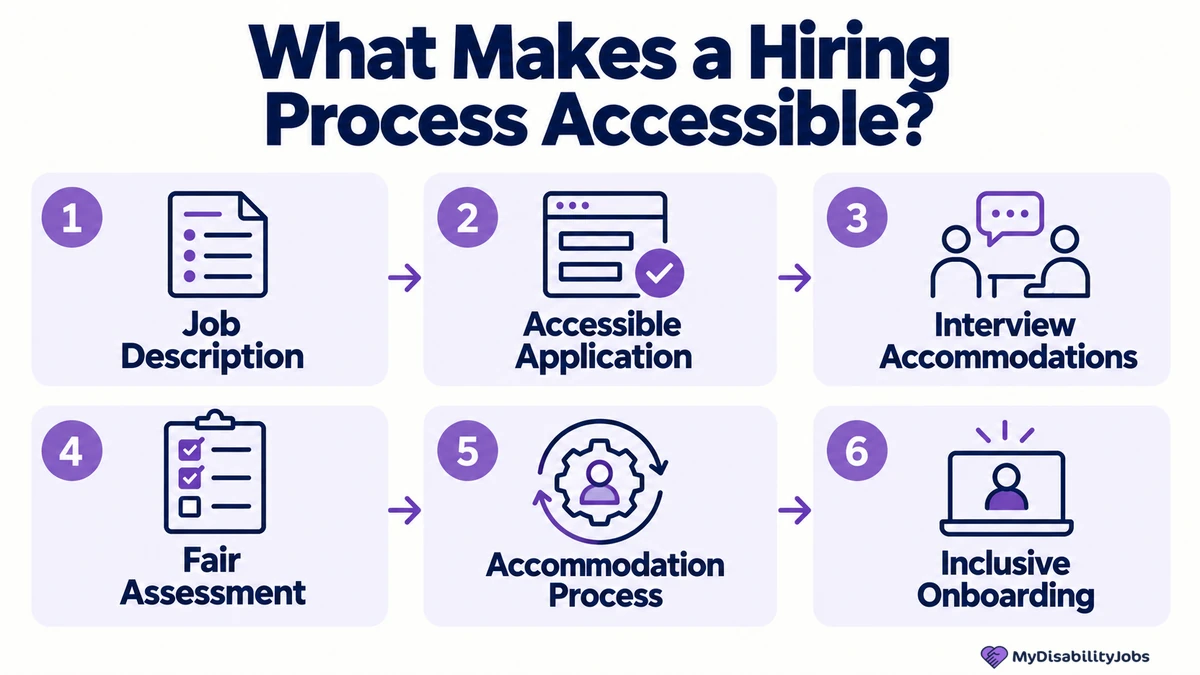
Research commissioned by the U.S. Department of Labor has found that several concrete practices are associated with a greater likelihood of employers hiring people with disabilities. These include accessible online applications, accessible interview locations, partnerships with relevant organizations, active outreach and measurable hiring goals.
1. Identify the Essential Functions of the Job
Start by separating what an employee actually needs to accomplish from the traditional way the work has been performed.
An essential function is a fundamental duty of the position. Employers should be able to explain what outcomes are required and which responsibilities are genuinely necessary.
This matters because job descriptions sometimes include requirements that can unnecessarily exclude qualified candidates.
For example, a role might state that an employee must be able to stand for long periods even though most of the work could also be completed while seated. Another job may specify a particular way of moving materials when the actual requirement is simply that those materials reach the required location.
Before publishing a vacancy, review:
- the main purpose of the position;
- the tasks that are genuinely essential;
- the expected results;
- the skills and qualifications actually needed;
- physical requirements that are genuinely necessary;
- requirements that exist mainly because “the job has always been done that way.”
This does not mean removing legitimate standards.
If a physical, technical or professional requirement is genuinely essential to performing a role, employers can state it clearly. The purpose is to avoid excluding candidates based on requirements that are not actually necessary.
Clear essential functions also make later accommodation discussions easier because both the employer and applicant understand what the job requires.
Defining essential functions is a core inclusive hiring practice because it separates legitimate job requirements from assumptions about how the work must be performed.
2. Remove Unnecessary Barriers From Job Descriptions
Once the essential functions are clear, review the language of the job advertisement itself.
Job descriptions should focus primarily on the skills, qualifications and outcomes required for the position.
Requirements should not unintentionally describe a single way of performing a task when alternative methods could produce the same result.
Employers should also review job advertisements for unnecessarily broad requirements relating to:
- lifting;
- standing or walking;
- driving;
- communication methods;
- working hours;
- educational credentials;
- years of experience;
- use of specific equipment.
For example, if driving is listed because an employee occasionally needs to travel between locations, ask whether driving personally is truly essential or whether reliable transportation is the actual requirement.
Similarly, a job that requires communication with customers does not necessarily require every employee to communicate in exactly the same way.
Job descriptions should also explain how applicants can request an accommodation during the application or interview process.
The U.S. Equal Employment Opportunity Commission permits employers to inform applicants about the hiring process and ask whether they need a reasonable accommodation for that process.
3. Make the Online Application Process Accessible
Accessibility needs to begin before the interview.
An applicant who cannot navigate the careers website, complete an online form or upload a résumé using assistive technology may never enter the candidate pipeline.
Employers should therefore evaluate whether their online recruitment systems can be used by people with different disabilities.
Areas to review include:
- careers pages;
- job-search functions;
- online application forms;
- résumé-upload tools;
- pre-employment assessments;
- digital interview platforms;
- email communications;
- documents sent during recruitment.
An accessible application process may include keyboard navigation, appropriately labeled form fields, sufficient contrast, alternative text for meaningful images and compatibility with screen-reading technology.
Employers should also provide an alternative method of applying or requesting assistance if a candidate encounters an accessibility problem.
This is not merely theoretical. Department of Labor research found that an accessible online application was one of the practices associated with employers being more likely to have hired people with disabilities.
The same research found that only about 30% of surveyed employers reported having an accessible application process, suggesting there is still considerable room for improvement.
Application accessibility is therefore part of inclusive hiring rather than a separate consideration that begins only after a candidate asks for help.
4. Use Disability-Inclusive Sourcing Channels
Making an application accessible helps candidates who find the vacancy, but employers should also consider where those vacancies are being promoted.
Depending only on the same recruitment channels can repeatedly produce the same candidate pool.
Employers can broaden their sourcing through:
- disability-focused employment platforms;
- workforce development organizations;
- vocational rehabilitation programs;
- colleges and universities;
- disability organizations;
- professional associations;
- community employment programs;
- employee referral networks.
The Department of Labor has identified both active recruitment and partnerships with organizations as practices associated with a greater likelihood of hiring people with disabilities.
MyDisabilityJobs is one such channel. Employers can use MyDisabilityJobs to place open positions in front of candidates seeking disability-inclusive employers.
This should complement, rather than replace, a broader recruitment strategy.
For employers reviewing the rest of their candidate-sourcing process, our guide to diversity recruiting strategies covers additional ways to broaden talent pipelines and reduce unnecessary barriers in recruitment.
5. Make Interviews and Assessments Accessible
Accessibility should continue once a candidate reaches the interview stage.
Employers should tell candidates how to request an accommodation and provide enough information about the interview process for someone to identify what support they may need.
Depending on the situation, an interview accommodation could involve:
- an accessible interview location;
- a sign-language interpreter;
- captioning;
- additional time for an assessment;
- an alternative format for written materials;
- assistance completing forms;
- accessible videoconferencing technology;
- a different interview format where appropriate.
The Department of Labor recommends checking that application forms, employment offices and interview locations are accessible and being prepared to provide reasonable accommodations that enable candidates with disabilities to participate in the process.
Employers should also evaluate whether assessments actually measure skills relevant to the job.
A test that creates barriers unrelated to the essential functions of the role may provide a poor measure of whether the applicant can perform the work.
For example, if a timed written assessment is being used to evaluate strategic thinking rather than typing speed, the employer should consider whether the format unnecessarily disadvantages some candidates without improving the quality of the assessment.
Interviewers should focus on the candidate’s qualifications and ability to perform the essential functions of the job.
They should not use the interview as an opportunity to investigate an applicant’s medical history or ask broad questions about their disability.
Under EEOC pre-employment guidance, employers generally may not ask applicants before a conditional job offer whether they have a disability or about the nature or severity of a disability. They may ask whether an applicant can perform particular job functions.
Inclusive hiring practices should ensure that the interview or assessment measures the competencies relevant to the role rather than unrelated barriers created by the format.
6. Train Recruiters and Hiring Managers
Even an accessible application system can fail if the people making hiring decisions rely on inaccurate assumptions about disability.
Recruiters and managers should understand:
- how to focus interviews on essential job functions;
- how candidates can request interview accommodations;
- which disability-related questions should not be asked;
- how reasonable accommodations work;
- why accommodation needs should be considered individually;
- how assumptions about productivity, safety or cost can influence decisions.
Training should be practical.
A recruiter does not need to become an expert on every disability. In fact, attempting to predict what a person can or cannot do based solely on a diagnosis is precisely the type of assumption an inclusive process should avoid.
The better approach is to understand the requirements of the job and evaluate each candidate against those requirements.
Employers should also avoid turning visible disability into the focus of the interview.
The Department of Labor advises interviewers to concentrate on the applicant’s ability to perform the job and not make medical judgments or assume that a workplace would be unsafe simply because an employee has a disability.
7. Create a Clear Process for Requesting Reasonable Accommodations
Candidates and employees should know how to request an accommodation and who is responsible for handling the request.
During recruitment, that can be as simple as clearly providing an HR contact and explaining that reasonable accommodations are available for applicants who need them.
Under EEOC guidance, employers may ask applicants whether they need an accommodation for the hiring process. This allows arrangements to be made in advance without requiring candidates to disclose unnecessary medical information.
Accommodation requests should then be considered individually.
A reasonable accommodation may involve changing the way a process is carried out rather than changing the standard the applicant is expected to meet.
For example, providing a sign-language interpreter for an interview changes how the interview is accessed; it does not change the qualifications required for the job.
Likewise, making an assessment accessible does not require the employer to overlook whether the candidate possesses the skill the assessment is legitimately designed to measure.
Employers should also protect medical and disability-related information appropriately. The Department of Labor advises that disability-related information should remain confidential and only be shared when there is a legitimate need to know.
We will examine reasonable accommodations, their costs and common examples in more detail in the next section.
8. Make Onboarding, Retention and Career Development Accessible
A disability-inclusive hiring strategy should not end once an applicant accepts the job.
An employer can successfully recruit a person with a disability and still create barriers during onboarding, training, performance management or promotion.
Review whether new employees can access:
- onboarding documents;
- training materials;
- workplace software;
- internal communication systems;
- meetings;
- employee benefits information;
- professional-development programs;
- performance-management processes.
Managers should also know where employees can go if an accommodation becomes necessary later.
Accommodation needs can change over time, and employees can acquire disabilities during their careers. A worker who did not need an accommodation when hired may need one later.
Retention also means ensuring that employees with disabilities have access to development and advancement opportunities rather than viewing disability inclusion purely as an entry-level recruitment initiative.
Employers should therefore examine promotion, leadership development, mentoring and training opportunities alongside recruitment metrics.
Creating inclusive workplace practices throughout the employee lifecycle helps ensure that accessibility continues after the hiring process is complete.
Inclusive hiring should therefore connect recruitment with the employee experience that follows it.
How Much Do Workplace Accommodations Cost?
One of the most common concerns employers have about disability inclusion is the potential cost of workplace accommodations.
In practice, many accommodations are inexpensive, and a substantial share have no direct cost at all.
Accommodations for employees with disabilities vary widely depending on the individual, the job and the workplace. Some involve equipment or technology, while others involve changes to scheduling, communication, policies or how work is organized. For example, workplace accommodations for depression and anxiety may involve scheduling, communication, or workspace changes.
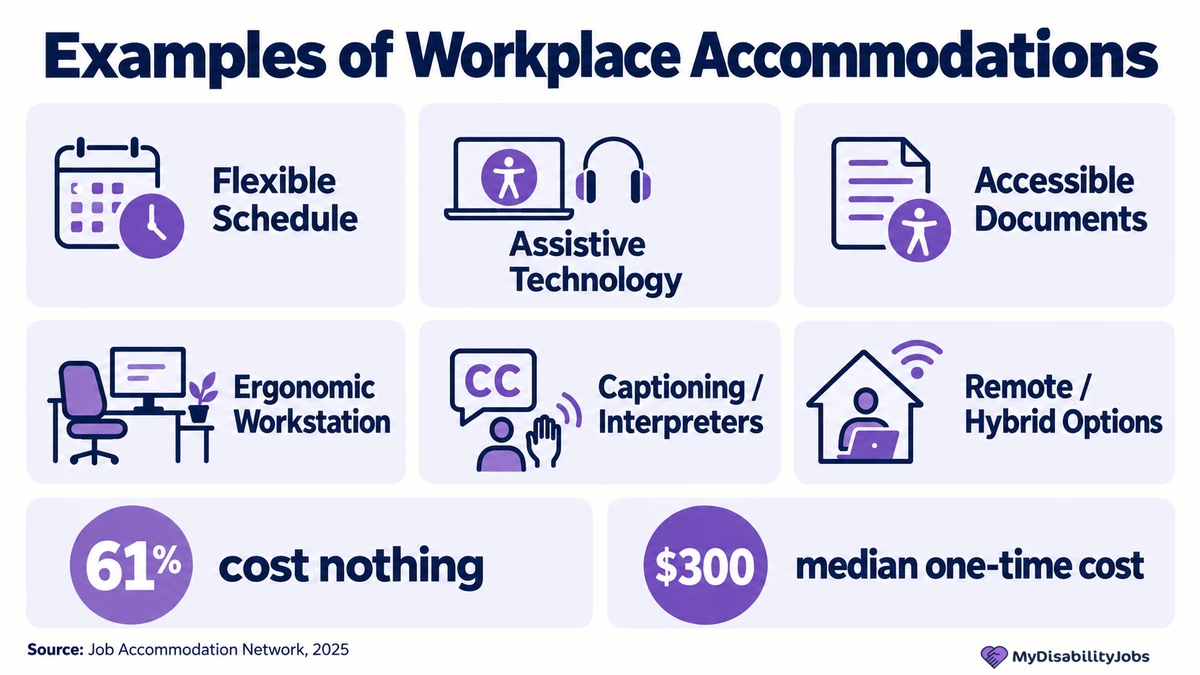
According to the Job Accommodation Network’s 2025 Low Cost, High Impact report, 61% of employers that reported the cost of an accommodation said the accommodation cost nothing. Among employers reporting a one-time expense, the median cost was $300.
Common accommodations can include changes to schedules, equipment, communication methods, workplace policies or the physical work environment.
| Type of accommodation | Examples |
|---|---|
| Work schedule | Flexible start times, modified breaks or adjusted schedules |
| Technology | Screen readers, speech-to-text software or other assistive technology |
| Communication | Captions, interpreters or accessible document formats |
| Workspace | Ergonomic equipment or modified workstations |
| Work process | Changes to training, instructions or communication methods |
| Location | Telework or hybrid arrangements when appropriate for the role |
Not every accommodation is inexpensive. Some changes to facilities, specialized equipment or ongoing services can involve significant costs.
The important point is that employers should determine what an individual employee actually needs before assuming that an accommodation will be expensive.
Under the Americans with Disabilities Act, reasonable accommodations can include modifications to equipment, job restructuring, modified work schedules, accessible facilities, changes to examinations or training materials, and qualified readers or interpreters.
Employers looking more broadly at accessibility can also review our guide to disability in the workplace and developing accessibility.
Tax Credits and Incentives for Disability-Inclusive Employers
Employers sometimes hear that businesses automatically receive a tax credit simply for hiring a worker with a disability.
That is not accurate.
Federal tax incentives relating to disability employment and accessibility have different eligibility requirements, and some programs apply to accessibility expenses rather than to the act of hiring a disabled employee.
Disabled Access Credit
The Disabled Access Credit is a federal, nonrefundable tax credit designed to help eligible small businesses offset qualified expenses associated with providing access to people with disabilities.
According to the Internal Revenue Service, an eligible small business generally must have had either:
- gross receipts of $1 million or less in the previous taxable year; or
- no more than 30 full-time employees during the previous year.
The credit equals 50% of eligible access expenditures above $250, subject to the applicable limit. The maximum Disabled Access Credit is $5,000 for a taxable year.
Eligible expenditures can include certain costs associated with improving accessibility or providing services, equipment or other accommodations that meet the requirements of the credit.
Businesses claim the credit using IRS Form 8826.
The Disabled Access Credit should therefore not be described as a general reward for employing a person with a disability. It is tied to qualifying accessibility expenditures.
Architectural Barrier Removal Tax Deduction
Businesses may also be able to deduct certain expenses incurred to remove architectural and transportation barriers.
The IRS currently states that businesses of any size may claim a deduction of up to $15,000 per year for qualifying barrier-removal expenses that would normally need to be capitalized.
Examples may involve modifications intended to make business facilities more accessible to people with disabilities.
In some situations, the Disabled Access Credit and the barrier-removal deduction can both apply during the same tax year, although the same expense cannot simply be counted twice.
Employers should review current IRS guidance or consult a qualified tax professional before claiming either benefit.
What Happened to the Work Opportunity Tax Credit?
The Work Opportunity Tax Credit, or WOTC, historically provided a federal tax incentive for employers hiring individuals belonging to certain designated groups.
One of those groups included certain vocational rehabilitation referrals with disabilities.
However, this information needs an important update.
As of 2026, the U.S. Department of Labor states that Congress has not extended the authority for employers to claim WOTC for new employees who begin work after December 31, 2025.
Employers may still see older articles describing WOTC as a currently available incentive for new hires with disabilities, but those articles may be relying on rules that expired at the end of 2025.
Because tax law can change, employers should verify the current status directly with the IRS or Department of Labor before making hiring or tax decisions.
What Employers Should Know About the ADA
The Americans with Disabilities Act is one of the central federal laws governing disability discrimination in employment.
Title I of the ADA generally prohibits covered employers from discriminating against qualified individuals with disabilities in areas such as recruitment, hiring, advancement, compensation, training and other terms and conditions of employment.
The law does not require an employer to hire an applicant simply because that person has a disability.
According to the Equal Employment Opportunity Commission’s employer guidance, a qualified individual must meet the legitimate education, experience, skill, licensing and other job-related requirements of the position and be able to perform its essential functions, with or without reasonable accommodation.
Essential Job Functions
Essential functions are the fundamental duties of a position.
When deciding what qualifies as an essential function, employers may consider factors such as:
- why the position exists;
- how much time employees spend performing the function;
- the consequences of not performing it;
- the number of other employees available to perform related tasks;
- the level of expertise required.
A written job description prepared before advertising or interviewing candidates can also serve as evidence of which functions the employer considers essential.
This is one reason employers should review job descriptions carefully before beginning recruitment.
Requirements that are merely traditional or convenient should not automatically be treated as essential job functions.
Reasonable Accommodation
A reasonable accommodation is a modification or adjustment that enables a qualified applicant or employee with a disability to participate in the hiring process, perform essential job functions or access the benefits and privileges of employment.
According to the EEOC, accommodations can include:
- modifying equipment or devices;
- restructuring certain job tasks;
- changing work schedules;
- modifying tests or training materials;
- providing readers or interpreters;
- making facilities accessible;
- reassignment to a vacant position in appropriate circumstances.
Accommodations are considered individually.
Two employees with the same disability may require completely different accommodations — or one may require no accommodation at all.
What Is Undue Hardship?
An employer does not have to provide an accommodation that would impose an undue hardship.
Under the ADA, undue hardship generally means significant difficulty or expense when considered in relation to factors such as the employer’s size, resources, operations and the nature and cost of the accommodation.
It is not enough simply to say that an accommodation has a cost.
The employer should evaluate the actual accommodation and circumstances.
If one requested accommodation would create an undue hardship, employers may also need to consider whether another effective accommodation is available.
Medical Information and Confidentiality
Disability-related medical information obtained by employers is subject to confidentiality requirements.
The EEOC states that medical information obtained through disability-related inquiries or examinations must generally be kept confidential and maintained separately from ordinary personnel records.
HR teams should therefore have clear processes for receiving, storing and limiting access to disability-related information.
Section 503 Requirements for Federal Contractors
Section 503 of the Rehabilitation Act applies to covered businesses that contract or subcontract with the federal government. It is separate from the ADA and is enforced by the U.S. Department of Labor’s Office of Federal Contract Compliance Programs (OFCCP).
Under the current OFCCP jurisdictional thresholds, a business with a federal contract of more than $20,000 is generally covered by Section 503’s nondiscrimination and affirmative-action requirements. A contractor with at least 50 employees and a single federal contract of $50,000 or more must also develop a Section 503 affirmative action program.
Section 503 requires covered contractors to treat qualified individuals with disabilities without discrimination and to take affirmative action to employ and advance qualified individuals with disabilities.
The rules changed significantly in 2026. On August 21, 2026, the Department of Labor published a final rule modifying the Section 503 regulations. Effective September 21, 2026, the rule removed the regulatory requirement for contractors to invite applicants and employees to voluntarily self-identify as having a disability, along with related data-collection requirements and the former disability utilization goal and analysis.
The Department of Labor confirms that the voluntary disability self-identification form was discontinued effective September 21, 2026. Employers should therefore be cautious about relying on older Section 503 guidance that still refers to mandatory self-identification procedures or the former utilization goal.
The 2026 changes did not eliminate Section 503 itself. Covered contractors remain subject to the statute’s nondiscrimination and affirmative-action requirements, and other regulatory obligations continue to apply.
Section 503 also does not require contractors to hire an unqualified candidate or select a less-qualified candidate solely because that person has a disability. Job-related qualifications and the ability to perform essential job functions remain relevant.
Because the Section 503 regulations changed recently, federal contractors should use the current OFCCP Section 503 guidance rather than relying on older compliance summaries.
Common Myths About Hiring Workers With Disabilities
Misconceptions about disability can influence recruitment decisions before employers ever assess an individual candidate.
Several of the most common concerns do not reflect how disability-inclusive employment works in practice.
Myth 1: Workplace Accommodations Are Always Expensive
They are not.
The Job Accommodation Network’s employer data show that many accommodations cost nothing, while many others involve relatively modest one-time expenses.
An accommodation might be as simple as adjusting a schedule, changing how instructions are provided or modifying a workplace policy.
Other accommodations can involve equipment, services or modifications that cost more.
The right question is therefore not:
“Are accommodations expensive?”
It is:
“What accommodation does this particular applicant or employee need, and what would it actually cost?”
Myth 2: Every Employee With a Disability Will Need an Accommodation
Not every disabled employee needs a workplace accommodation.
Some people can perform their jobs without any modification, while others may need accommodations only for certain tasks or at particular points in their employment.
Employers should not attempt to predict accommodation requirements based on a diagnosis or visible disability.
The accommodation process should focus on the individual employee and the barriers affecting the performance of essential job functions.
Myth 3: Disability-Inclusive Hiring Means Lowering Job Standards
Removing unnecessary barriers is not the same thing as lowering performance standards.
The ADA does not require an employer to eliminate essential job functions or ignore legitimate qualifications.
A candidate still needs to be qualified for the position and able to perform its essential functions, with or without reasonable accommodation.
Providing an interpreter during an interview, for example, changes how a candidate accesses the interview. It does not change the qualifications required for the position.
Similarly, assistive technology may change how an employee completes a task without changing the required result.
Myth 4: Employers Cannot Discuss Accommodations With Candidates
Employers should be cautious about disability-related questions during recruitment, but that does not mean accommodations cannot be discussed.
Employers can explain that reasonable accommodations are available for the application and interview process and tell candidates how to request one.
What employers generally should not do before a conditional job offer is use the interview to investigate whether a candidate has a disability, ask about its nature or severity, or seek unnecessary medical information.
The focus should remain on whether the applicant can perform the essential functions of the job and whether an accommodation is needed to make the hiring process accessible.
Myth 5: Disability Inclusion Ends Once Someone Is Hired
Hiring is only one part of disability inclusion.
Employees also need equitable access to:
- onboarding;
- workplace technology;
- training;
- performance management;
- professional development;
- promotion opportunities;
- workplace communication;
- accommodations when needs change.
An organization can successfully attract workers with disabilities while still losing them if the workplace itself creates unnecessary barriers.
For that reason, disability-inclusive employers should evaluate the entire employee lifecycle rather than measuring success only by the number of disabled candidates they hire.
Inclusive Hiring Checklist for Workers With Disabilities
A disability-inclusive hiring process is easier to maintain when accessibility is built into standard recruitment procedures rather than handled only when a problem arises.
Employers can use this inclusive hiring checklist to review accessibility and consistency across recruitment, interviews, accommodations, onboarding and retention.
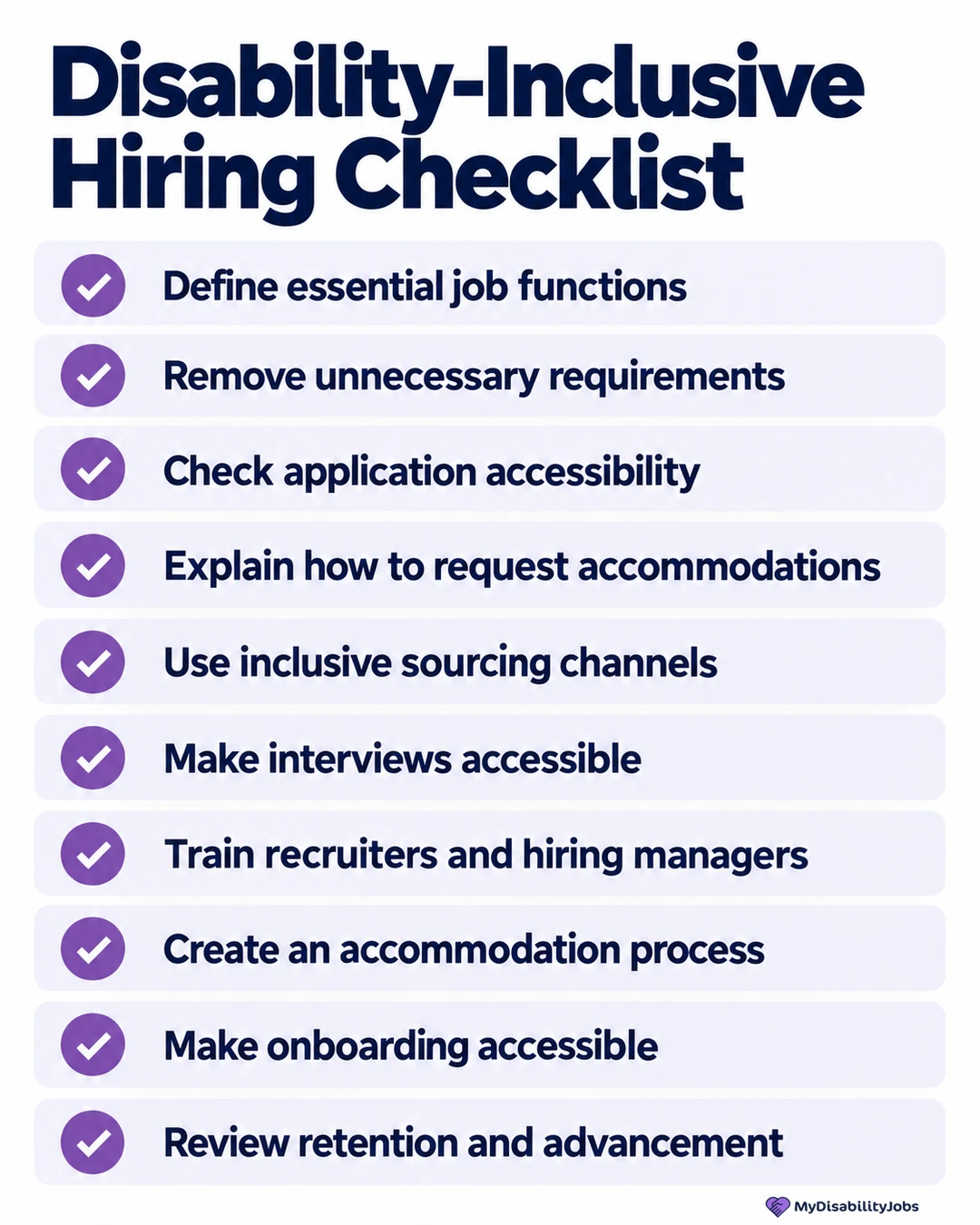
- Define the essential functions of each role before writing the job advertisement.
- Remove unnecessary physical, educational or procedural requirements that do not affect successful job performance.
- Review careers pages and application systems for accessibility, including compatibility with assistive technology.
- Explain clearly how applicants can request an accommodation during the application or interview process.
- Use a broader range of sourcing channels, including disability-focused employment platforms and relevant community or workforce organizations.
- Make interview locations, video platforms and assessments accessible.
- Train recruiters and hiring managers to focus on qualifications and essential job functions rather than assumptions about disability.
- Establish a consistent process for accommodation requests and protect disability-related medical information.
- Make onboarding materials and workplace technology accessible.
- Review retention, training and promotion practices, not only recruitment.
- Revisit job descriptions periodically as roles, technology and working practices change.
Accessibility does not mean every candidate must go through an identical process. The goal is to ensure that qualified candidates have an equitable opportunity to demonstrate whether they can perform the essential functions of the position.
Building an Inclusive Workplace Beyond Hiring
Successfully hiring workers with disabilities is only the beginning.
An employee can enter through an accessible recruitment process and still encounter barriers in training, communication, workplace technology, performance management or career advancement.
Employers should therefore look at disability inclusion across the entire employee lifecycle.
Make Workplace Information Accessible
Important information should be available in formats employees can use.
Depending on the workplace, this can include:
- accessible digital documents;
- captions or transcripts for video content;
- accessible internal websites and software;
- alternative document formats;
- clear written instructions;
- accessible meetings and presentations.
Accessibility should not be treated as something that applies only to public-facing websites or recruitment pages.
Internal systems matter just as much once an employee starts work.
Make the Accommodation Process Easy to Understand
Employees should know:
- who handles accommodation requests;
- how to make a request;
- what information may be required;
- how the interactive process works;
- how disability-related information will be protected.
A process that technically exists but is difficult to find or understand can discourage employees from seeking the support they need.
Managers should also know where to direct an employee who raises an accommodation issue rather than trying to make medical or legal judgments themselves.
Include Employees With Disabilities in Development and Promotion
Disability inclusion should extend to:
- professional training;
- mentoring;
- leadership development;
- internal mobility;
- promotions;
- conferences and company events.
Employers should consider whether these opportunities are accessible and whether workers with disabilities are being unintentionally excluded from activities that contribute to advancement.
This is one reason a broader approach to inclusive workplace practices matters. Recruitment can bring more people into an organization, but workplace practices influence whether employees are able to contribute, develop and remain there.
Final Thoughts
Hiring workers with disabilities or special needs should not be treated as a separate charitable initiative or a way to lower hiring standards.
For employers, the practical objective is to make sure qualified candidates are not unnecessarily excluded from recruitment, employment or advancement because of inaccessible systems, assumptions about disability or barriers that can reasonably be addressed.
That starts with clear job descriptions and accessible applications, but it continues through interviews, accommodations, onboarding, workplace technology, management and career development.
Employers that improve these processes can broaden their talent pool while building a workplace that is better prepared to support employees with different needs and ways of working.
For organizations ready to put those practices into action, MyDisabilityJobs helps employers reach candidates through a platform focused on disability-inclusive employment.
Ready to put disability-inclusive hiring into practice? Publish your open roles on MyDisabilityJobs and reach candidates who are looking for inclusive employers.
Frequently Asked Questions
Hiring workers with disabilities can expand an employer’s talent pool and reduce barriers that may otherwise exclude qualified candidates. Research on disability employment has also identified reported employer benefits involving retention, productivity, innovation, workplace culture, customer relationships and organizational reputation. These benefits should not be treated as traits that every disabled employee automatically possesses; candidates should be evaluated individually based on their qualifications and ability to perform the essential functions of the job.
Employers can make recruitment more accessible by reviewing job descriptions, ensuring online application systems work with assistive technology, providing a clear way to request accommodations, making interviews and assessments accessible, and training recruiters to focus on essential job functions.
Not necessarily. The Job Accommodation Network’s 2025 employer data found that 61% of employers reporting accommodation costs said the accommodation cost nothing. Among accommodations involving a one-time expense, the median reported cost was $300. Some accommodations can cost more, so employers should evaluate the actual needs of the employee and workplace.
There is no universal federal tax credit automatically awarded simply because an employer hires a worker with a disability. Some businesses may qualify for incentives tied to accessibility expenditures, including the Disabled Access Credit and Architectural Barrier Removal Tax Deduction. Employers should check current IRS guidance because eligibility requirements and tax rules can change.
Under the ADA, a reasonable accommodation is a modification or adjustment that allows a qualified individual with a disability to participate in the application process, perform essential job functions or access employment benefits and privileges. Examples can include modified schedules, accessible equipment, interpreters or readers, changes to training materials or examinations, job restructuring, accessible facilities, or reassignment to a vacant position in appropriate circumstances.
Before making a conditional job offer, employers generally may not ask an applicant whether they have a disability or ask about its nature or severity. Employers may ask whether an applicant can perform specific job functions and may explain how to request reasonable accommodations during the hiring process.
Section 503 of the Rehabilitation Act applies to covered federal contractors and subcontractors. It prohibits disability discrimination and requires affirmative action relating to qualified individuals with disabilities. The regulations changed in 2026: effective September 21, 2026, the Department of Labor removed the former disability self-identification requirement, related data collection, and utilization-goal requirements. Federal contractors should use the current OFCCP Section 503 guidance.
No. Employers can continue to require candidates to possess legitimate qualifications and perform the essential functions of a position. Disability-inclusive hiring focuses on removing barriers that are not genuinely necessary to perform the job and providing reasonable accommodations when required. The ADA does not prevent employers from selecting the best-qualified candidate.
Inclusive hiring is the practice of designing recruitment and selection processes so qualified candidates have equitable access to opportunities and are evaluated against job-related criteria. For candidates with disabilities, this can include accessible applications, reasonable accommodations, accessible interviews and assessments, and removing requirements that are not essential to the role.
Inclusive hiring practices for workers with disabilities can include defining essential job functions, removing unnecessary requirements, making applications and interviews accessible, offering reasonable accommodations, training hiring managers, using consistent evaluation criteria and making onboarding accessible.