
20 Best Jobs for Blind and Visually Impaired People in 2026: Career & Employment Guide

Blind and visually impaired people work across technology, finance, education, healthcare, communications, government, professional services, customer support, entrepreneurship and many other fields. The better question is not simply what jobs a blind person can do, but whether the essential duties of a particular role, the employer’s technology and the working environment are accessible to that individual.
The right career will depend on your skills, interests, education, experience and preferred working conditions. It can also depend on practical factors such as whether workplace software works with a screen reader or magnification, whether documents and training materials are accessible, whether travel or driving is an essential job duty, and whether reasonable accommodations can remove barriers that are not essential to the work itself.
This guide covers 20 career paths to explore in 2026, including professional, technology, communication, analytical and service-based roles. For each job, we will look at the work involved, useful skills, how to get started, current salary data and where to look for openings. The guide also covers assistive technology, remote and part-time work, entry-level opportunities, employers, accommodations and practical guidance for recruiters and hiring managers.
Table of Contents
- What Jobs Can Blind and Visually Impaired People Do?
- What Makes a Job Accessible for Blind or Low-Vision Workers?
- Assistive Technology at Work: Screen Readers, Magnification, Braille and OCR
- Remote, Part-Time and Flexible Work for Blind and Visually Impaired People
- 20 Jobs for Blind and Visually Impaired People
- Entry-Level Jobs for Blind and Visually Impaired People
- Companies That Hire Blind and Visually Impaired People
- How to Find Jobs for Blind People Near You
- Workplace Accommodations for Blind and Low-Vision Employees
- Should You Tell an Employer About a Visual Disability?
- How Employers Can Make Hiring and Workplaces More Accessible
- Employment and Career Resources for Blind and Low-Vision People
- Final Thoughts
- Frequently Asked Questions
What Jobs Can Blind and Visually Impaired People Do?
Blind and low-vision professionals are not limited to a small group of occupations. Many jobs can be performed using nonvisual or adapted methods, provided the person has the required qualifications and can perform the essential functions of the role with or without reasonable accommodation.
That can include computer-based work such as software development, writing, finance and customer support, as well as education, counseling, healthcare, management, government, self-employment and skilled service roles. The accessibility of the specific employer and its technology often matters as much as the occupation itself.
Avoid assuming that a job is suitable or unsuitable based only on its title. For example, two employers hiring for the same position may use very different software, application systems, physical layouts or travel requirements. A useful job search therefore looks at both the occupation and the actual working conditions.
For employers and recruiters, the same principle applies during hiring: evaluate whether the applicant can perform the essential functions of the job rather than making assumptions based on blindness or low vision. The U.S. Equal Employment Opportunity Commission states that qualified people with visual disabilities should not be denied employment opportunities based on stereotypes or incorrect assumptions about their ability to perform the work safely or effectively.
What Makes a Job Accessible for Blind or Low-Vision Workers?
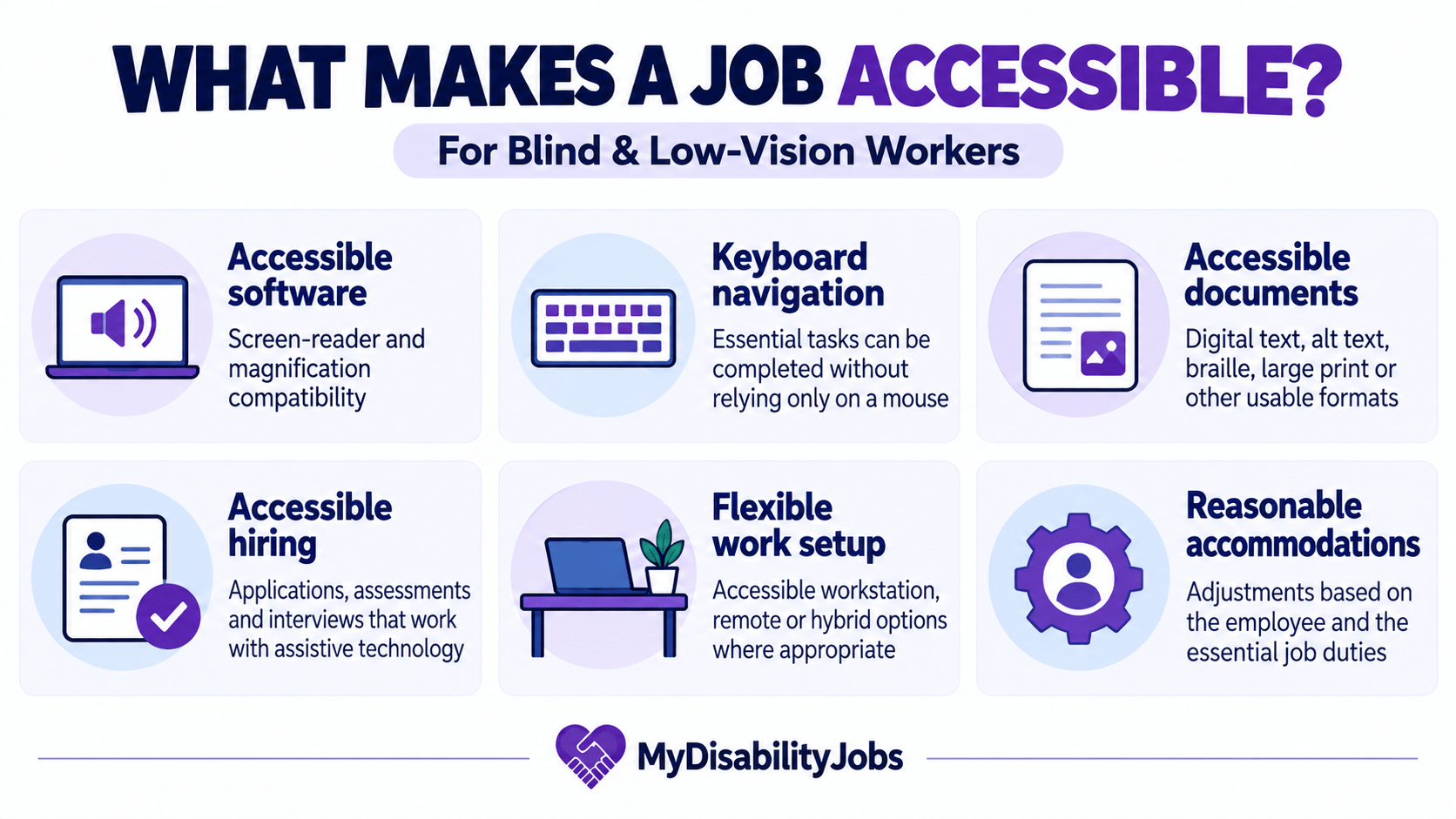
There is no universal list of “blind-friendly jobs.” Accessibility depends on the person, the essential duties of the position and how the employer has designed its technology, hiring process and workplace.
When comparing opportunities, consider factors such as:
- whether the main software, website, intranet and communication tools work with screen readers or magnification;
- whether documents, forms and training materials are available in accessible digital formats, large print, braille or other formats when needed;
- whether charts, dashboards, images or other visual information have an accessible alternative;
- whether driving is genuinely an essential function or whether transportation and travel requirements can be handled another way;
- whether the physical workplace can be navigated safely and independently with appropriate orientation, wayfinding or environmental adjustments;
- whether interviews, assessments and onboarding systems are accessible;
- whether the employer has a workable process for requesting and implementing reasonable accommodations.
Accessibility needs are individual. One employee may primarily use a screen reader, another may use magnification and high-contrast settings, while another may use braille, OCR, a combination of tools or no specialized technology for many parts of the job.
For HR teams, accessibility should begin before someone is hired. An inaccessible careers site, online assessment, interview platform or onboarding system can create a barrier even when the actual job would otherwise be accessible. Learn more about developing accessibility in the workplace.
Assistive Technology at Work: Screen Readers, Magnification, Braille and OCR
Accessible technology can make information that would otherwise be visual available through speech, magnification, braille or other formats. The exact tools used vary considerably from one person to another.
Common examples include:
- screen readers that convert on-screen text and controls into speech or output to a refreshable braille display;
- screen magnification and operating-system display settings for larger text, contrast and other visual adjustments;
- refreshable braille displays and braille keyboards;
- optical character recognition (OCR) for converting printed or image-based text into accessible digital information;
- accessible mobile apps and document formats;
- large or adjustable monitors, task lighting and anti-glare or filtering solutions for some people with low vision;
- accessible navigation, labeling or wayfinding tools where needed.
Technology alone does not make a workplace accessible. The software and documents used by the employer must also be designed so assistive technologies can interact with them. A screen reader, for example, cannot fully solve an application or internal system that has been built with inaccessible controls or unlabeled content.
The EEOC and Job Accommodation Network both list assistive technology and accessible materials among possible workplace accommodations for employees with visual disabilities. Appropriate accommodations should be based on the employee’s needs and the actual job tasks rather than assuming that every blind or low-vision employee uses the same tools.
- Job Accommodation Network — Blindness
- Job Accommodation Network — Low Vision
- U.S. Equal Employment Opportunity Commission — Visual Disabilities in the Workplace and the Americans with Disabilities Act
Remote, Part-Time and Flexible Work for Blind and Visually Impaired People
Remote and flexible work can be useful options for some blind and visually impaired job seekers, particularly when commuting or transportation creates an additional barrier. Working from home can also allow someone to use a familiar workstation and accessibility setup.
Remote work is not automatically accessible, however. Employers may rely on collaboration software, virtual meeting platforms, remote desktops, dashboards, time-tracking tools or internal systems that need to work properly with screen readers, magnification and keyboard navigation. Before assuming a remote job will be easier, consider the accessibility of the actual technology as well as the schedule, workload and job duties.
Part-time work can be another useful option for people looking for fewer hours or a gradual transition into a new field. Availability varies substantially by occupation and employer, so part-time status should be treated as a working arrangement rather than as a characteristic of a particular career.
You can explore our guides to work-from-home jobs for people with disabilities and part-time jobs for disabled people for additional options.
20 Jobs for Blind and Visually Impaired People
The careers below are starting points rather than a list of occupations that every blind or low-vision person should pursue. We selected roles to represent different education levels, industries, work settings and skill sets. In the next phases, each occupation will be evaluated for its real job requirements, accessibility considerations, training pathway, current salary data and employment options.
Technology, Finance & Professional Careers
These careers rely heavily on professional knowledge, communication, analysis, structured information or computer-based work. Depending on the employer and role, they may offer accessible digital workflows, office-based work, hybrid arrangements or remote opportunities.
Accessibility still needs to be evaluated at the employer level. Financial platforms, applicant-tracking systems, development tools, dashboards, document systems and other workplace software vary considerably in how well they work with screen readers, magnification and keyboard navigation. Job seekers should consider the actual technology and essential duties rather than assuming that all desk-based work is automatically accessible.
1. Software Developer
Software developers design, build, test and maintain applications, systems and other software. They work across technology companies, financial services, healthcare, government, education, retail, manufacturing and many other industries.
Much of the core work involves text-based code, documentation, command-line tools, version control and structured problem-solving. However, development environments vary, and some visual design tools, debugging interfaces or inaccessible internal systems can create barriers. The accessibility of the employer’s tools and workflows should therefore be evaluated alongside the occupation itself.
Why it may be a good fit for blind and visually impaired people
Software development can be compatible with screen readers, braille displays, keyboard-driven workflows and other assistive technologies because much of the work is based on text and structured information.
Some roles also offer remote or hybrid arrangements. That can provide more control over the workstation and commuting environment.
The main caveat is that not every development tool is equally accessible. Integrated development environments, graphical debugging tools, diagrams, dashboards and collaboration platforms can vary widely. Blind and low-vision developers may use different combinations of accessible editors, command-line tools, keyboard shortcuts, screen readers, magnification and adapted workflows.
Main tasks include:
- Writing and maintaining software code
- Testing applications and fixing defects
- Reviewing and improving existing code
- Working with databases, APIs or other software systems
- Collaborating with developers, designers, product teams and other stakeholders
- Documenting technical decisions and software functionality
Skills needed:
- Programming in one or more relevant languages
- Logical reasoning and problem-solving
- Debugging and testing
- Version control such as Git
- Ability to learn technical systems and documentation
- Communication and teamwork
How to get started:
The U.S. Bureau of Labor Statistics lists a bachelor’s degree as the typical entry-level education for software developers, quality assurance analysts and testers. Common fields include computer science, information technology and related disciplines, although hiring practices vary by employer.
A portfolio can help demonstrate practical ability. Useful projects may include web applications, command-line tools, APIs, accessible applications, automation scripts or open-source contributions.
Useful resources include:
Expected salary:
The U.S. Bureau of Labor Statistics reports a median annual wage of $135,980 in May 2025 for software developers.
Pay varies by experience, technical specialty, industry, location and employer. This national median should not be interpreted as an entry-level salary.
Source: U.S. Bureau of Labor Statistics — Software Developers, Quality Assurance Analysts, and Testers
Where to find jobs:
- Search Software Developer Jobs on MyDisabilityJobs
- LinkedIn — Software Developer Jobs
- Indeed — Software Developer Jobs
- Dice — Software Developer Jobs
2. Accountant or Auditor
Accountants and auditors prepare, examine and interpret financial records. Depending on the position, they may handle financial statements, taxes, internal controls, compliance, budgeting support or audits.
They work for accounting firms, businesses, government agencies, nonprofit organizations and financial institutions. The work is usually office- or computer-based, although some audit roles involve travel to client locations.
Why it may be a good fit for blind and visually impaired people
Accounting relies on numerical analysis, rules, documents, communication and structured financial information rather than on physical activity. Many tasks can be performed using accessible spreadsheets, accounting software, screen readers, magnification and keyboard-based workflows when the employer’s systems are compatible.
Accessibility can vary substantially between accounting platforms, PDF documents, spreadsheets and financial dashboards. Some roles also have demanding seasonal workloads, particularly around tax deadlines, reporting periods or audits.
Main tasks include:
- Preparing and reviewing financial records
- Reconciling accounts and transactions
- Preparing financial statements or reports
- Reviewing records for accuracy and compliance
- Supporting tax, audit or regulatory processes
- Explaining financial findings to clients or managers
Skills needed:
- Numerical and analytical skills
- Attention to detail
- Understanding of accounting principles
- Spreadsheet and financial-software skills
- Organization and recordkeeping
- Written and verbal communication
How to get started:
BLS lists a bachelor’s degree as the typical entry-level education for accountants and auditors. Accounting, finance and related business degrees are common.
Certification can improve opportunities in some areas. Becoming a Certified Public Accountant requires meeting state-specific education, examination and licensing requirements.
Useful resources include:
- American Institute of CPAs and CIMA — CPA Career Information
- NASBA — CPA Examination
- Microsoft — Excel Accessibility
Expected salary:
The U.S. Bureau of Labor Statistics reports a median annual wage of $83,680 in May 2025 for accountants and auditors.
Pay varies by specialization, certification, employer, industry, experience and location.
Source: U.S. Bureau of Labor Statistics — Accountants and Auditors
Where to find jobs:
- Search Accounting Jobs on MyDisabilityJobs
- LinkedIn — Accountant Jobs
- Indeed — Accountant Jobs
- AICPA & CIMA Global Career Hub
3. Personal Financial Advisor
Personal financial advisors help individuals make decisions about investments, retirement, insurance, taxes, estate planning and other financial goals. Their work combines financial analysis with client communication and relationship management.
Advisors work for investment firms, banks, insurance companies, financial-planning businesses and independent practices. Some roles involve business development, networking, travel or meetings outside standard office hours.
Why it may be a good fit for blind and visually impaired people
The role centers on financial knowledge, analysis, planning and communication. Many core tasks can be completed using accessible documents, spreadsheets, financial platforms and client-management tools when those systems support assistive technology.
The role should not be assumed to be low stress or fully desk-based. Some advisors are responsible for finding clients, meeting sales or asset targets, attending networking events and working evenings or weekends. Accessibility of financial software and data visualizations also needs to be checked with the specific employer.
Main tasks include:
- Discussing financial goals with clients
- Reviewing income, assets, liabilities and investments
- Recommending financial strategies or products
- Monitoring portfolios and financial plans
- Explaining investment, retirement and risk-management options
- Maintaining client records and regulatory documentation
Skills needed:
- Financial and analytical skills
- Clear verbal communication
- Client relationship management
- Attention to detail
- Ethical judgment and regulatory awareness
- Ability to explain complex information clearly
How to get started:
BLS lists a bachelor’s degree as the typical entry-level education for personal financial advisors. Relevant study may include finance, business, economics, accounting or related fields.
Depending on the services provided, advisors may need securities, insurance or other licenses. The CFP® certification is a recognized professional credential, but it has its own education, examination, experience and ethics requirements and should not be presented as an entry-level requirement for every financial-advisor job.
Useful resources include:
- CFP Board — Certification Process
- FINRA — Securities Industry Essentials Exam
- Investor.gov — Financial Professional Resources
Expected salary:
The U.S. Bureau of Labor Statistics reports a median annual wage of $105,070 in May 2025 for personal financial advisors.
Compensation varies considerably. Some advisors receive salaries, while others may also receive commissions, incentive pay or other performance-related compensation.
Source: U.S. Bureau of Labor Statistics — Personal Financial Advisors
Where to find jobs:
- Search Financial Advisor Jobs on MyDisabilityJobs
- LinkedIn — Financial Advisor Jobs
- Indeed — Financial Advisor Jobs
- CFP Board Career Center
4. Human Resources Specialist
Human resources specialists support recruiting, hiring, employee records, benefits, training, workplace policies and other employment functions. Specific duties vary widely between recruiting-focused, employee-relations, benefits and generalist roles.
HR specialists work in nearly every major industry, including government, healthcare, professional services, education, manufacturing and technology.
Why it may be a good fit for blind and visually impaired people
HR is primarily an information, communication and office-based occupation. Many tasks involve documents, interviews, email, employee systems and meetings rather than physically demanding work.
For blind or low-vision professionals, accessibility depends heavily on the employer’s HR information system, applicant-tracking software, digital forms and collaboration tools. Recruiting roles may also involve busy interview schedules, events or occasional travel.
A blind or low-vision HR professional should not be expected to act as the organization’s disability expert merely because of personal experience. The role should be evaluated on the same professional knowledge and competencies required of other HR specialists.
Main tasks include:
- Recruiting and screening job applicants
- Coordinating interviews and hiring processes
- Maintaining employee records
- Explaining policies, benefits or workplace procedures
- Supporting onboarding and training
- Assisting with employee-relations or compliance processes
Skills needed:
- Communication and interpersonal skills
- Organization and confidentiality
- Knowledge of employment policies and HR procedures
- Interviewing and recruiting skills
- Recordkeeping and HR-software proficiency
- Judgment and attention to detail
How to get started:
BLS lists a bachelor’s degree as the typical entry-level education for human resources specialists. Common fields include human resources, business, communications and related subjects.
Professional certification is optional for many entry-level jobs but may become useful as a career develops.
Useful resources include:
- SHRM — HR Certification
- HRCI — Certifications
- U.S. Department of Labor — Employment Laws Assistance
- American Foundation for the Blind — Steps for Success for HR Managers
Expected salary:
The U.S. Bureau of Labor Statistics reports a median annual wage of $75,940 in May 2025 for human resources specialists.
Pay varies by industry, location, specialization, experience and level of responsibility.
Source: U.S. Bureau of Labor Statistics — Human Resources Specialists
Where to find jobs:
- Search Human Resources Jobs on MyDisabilityJobs
- LinkedIn — Human Resources Specialist Jobs
- Indeed — Human Resources Specialist Jobs
- SHRM HR Jobs
5. Rehabilitation Counselor
Rehabilitation counselors help people with physical, mental, developmental or emotional disabilities pursue employment, education, independent living and other personal goals. They may assess needs, develop rehabilitation plans, coordinate services and connect clients with vocational, educational or community resources.
Employers include state vocational rehabilitation agencies, community organizations, healthcare providers, schools and rehabilitation services.

Why it may be a good fit for blind and visually impaired people
Rehabilitation counseling is primarily based on counseling, assessment, planning, communication and case management. Many duties can be performed using accessible digital records, office technology and assistive tools when the employer’s systems are compatible.
A blind or low-vision counselor may bring relevant professional or personal perspectives to disability services, but blindness itself does not make someone more empathetic or more qualified to counsel other people. Professional training, communication ability, ethics and counseling skills remain the basis of the occupation.
Some positions involve travel, community visits or high caseloads, so applicants should review the actual transportation, scheduling and workload requirements.
Main tasks include:
- Assessing clients’ employment, educational or independent-living needs
- Developing individualized rehabilitation plans
- Providing counseling and career guidance
- Coordinating services with employers, healthcare providers and agencies
- Helping clients identify training or employment options
- Maintaining case records and documenting progress
Skills needed:
- Counseling and active-listening skills
- Clear verbal and written communication
- Case-management and organizational ability
- Understanding of disability and rehabilitation services
- Problem-solving
- Professional ethics and confidentiality
How to get started:
Educational and licensing requirements vary by role and state. BLS reports that rehabilitation counselors typically need a master’s degree in rehabilitation counseling or a related field, although some positions may accept a bachelor’s degree.
Clinical or counseling roles may have additional state licensing requirements.
The Certified Rehabilitation Counselor credential also has specific education, experience and examination requirements and should not be presented as automatically required for every rehabilitation-counselor position.
Useful resources include:
- Commission on Rehabilitation Counselor Certification — Get Certified
- CACREP — Find an Accredited Program
- Rehabilitation Services Administration
Expected salary:
The U.S. Bureau of Labor Statistics reports a median annual wage of $46,850 in May 2025 for rehabilitation counselors.
Pay varies substantially by employer. BLS reports different wage levels across state government, local government, vocational rehabilitation services and other settings.
Source: U.S. Bureau of Labor Statistics — Rehabilitation Counselors
Where to find jobs:
- Search Rehabilitation Counselor Jobs on MyDisabilityJobs
- LinkedIn — Rehabilitation Counselor Jobs
- Indeed — Rehabilitation Counselor Jobs
- USAJOBS
Writing, Research & Information-Based Careers
These careers center on written information, research, analysis, records, problem-solving or communication. Several are primarily computer-based and may be available in office, hybrid or remote settings depending on the employer.
For blind and low-vision professionals, the main accessibility question is often not the occupation itself but whether the employer’s documents, databases, dashboards, customer systems and other digital tools work effectively with screen readers, magnification, keyboard navigation or other assistive technology. Some roles also involve deadline pressure, large amounts of screen-based information or frequent communication, so the actual workflow should be reviewed carefully.
6. Technical Writer
Technical writers create clear instructions, guides, documentation and other materials that explain complex products, systems or processes. They work in software, engineering, manufacturing, healthcare, government and other technical industries.
Depending on the role, technical writers may produce user manuals, online help, software documentation, knowledge-base articles, procedures, API documentation or internal technical content. Many positions are computer-based, and some are remote or hybrid.
Why it may be a good fit for blind and visually impaired people
Technical writing is primarily based on reading, research, interviewing, writing and organizing information. Much of that work can be performed using screen readers, braille displays, magnification, keyboard navigation and accessible documentation tools.
Accessibility depends heavily on the authoring platform and source material. Diagrams, screenshots, visual interfaces and inaccessible documentation systems can create additional work. Some roles also involve tight release schedules and deadline pressure.
Main tasks include:
- Writing user guides, procedures and technical documentation
- Interviewing engineers, developers or subject-matter experts
- Organizing complex information into clear instructions
- Editing and updating existing documentation
- Testing instructions for accuracy
- Maintaining documentation standards and version history
Skills needed:
- Clear written communication
- Ability to explain complex information simply
- Research and interviewing skills
- Editing and proofreading
- Attention to detail and consistency
- Ability to learn technical concepts and documentation tools
How to get started:
The U.S. Bureau of Labor Statistics lists a bachelor’s degree as the typical entry-level education for technical writers. Employers often value backgrounds in English, communications, journalism, science, engineering, computer science or another field related to the material being documented.
A portfolio is especially useful. Samples might include a software tutorial, product guide, process document, knowledge-base article or API tutorial.
Useful resources include:
- Google for Developers — Technical Writing Courses
- Write the Docs — Software Documentation Guide
- Microsoft Writing Style Guide
Expected salary:
The U.S. Bureau of Labor Statistics reports a median annual wage of $90,390 in May 2025 for technical writers.
Pay varies by industry, experience, location, technical specialization and whether the work is salaried, contract or freelance.
Source: U.S. Bureau of Labor Statistics — Technical Writers
Where to find jobs:
- Search Technical Writer Jobs on MyDisabilityJobs
- LinkedIn — Technical Writer Jobs
- Indeed — Technical Writer Jobs
- Dice — Technical Writer Jobs
7. Market Research Analyst
Market research analysts study consumers, competitors, industries and market conditions to help organizations understand demand for products and services. They may analyze surveys, sales information, demographic data, website metrics and other business information.
They work across consulting, technology, finance, healthcare, retail, media, manufacturing and many other industries.
Why it may be a good fit for blind and visually impaired people
The occupation is largely computer-based and centers on research, data interpretation, writing and presenting findings. Many tasks can be performed with accessible spreadsheets, databases, statistical tools and reporting systems when the employer’s technology is compatible with assistive technology.
Charts, dashboards and data-visualization software may require accessible alternatives or adapted workflows. Project deadlines and requests from clients or internal teams can also create periods of higher workload.
Main tasks include:
- Researching consumers, competitors and market conditions
- Collecting and analyzing survey or business data
- Evaluating marketing and sales trends
- Preparing reports and recommendations
- Presenting findings to managers or clients
- Measuring the effectiveness of marketing strategies
Skills needed:
- Analytical thinking
- Research and data interpretation
- Spreadsheet and statistical skills
- Clear written communication
- Presentation skills
- Attention to detail
How to get started:
BLS lists a bachelor’s degree as the typical entry-level education for market research analysts. Relevant fields include market research, business, communications, social science, statistics and related subjects.
Coursework in statistics, research methods, data analysis and marketing can be especially useful. Building projects that demonstrate survey design, market analysis or data interpretation can help new candidates show practical skills.
Useful resources include:
Expected salary:
The U.S. Bureau of Labor Statistics reports a median annual wage of $78,760 in May 2025 for market research analysts.
Pay varies by industry, employer, location, experience and level of analytical responsibility.
Source: U.S. Bureau of Labor Statistics — Market Research Analysts
Where to find jobs:
- Search Market Research Analyst Jobs on MyDisabilityJobs
- LinkedIn — Market Research Analyst Jobs
- Indeed — Market Research Analyst Jobs
- American Marketing Association Job Board
8. Operations Research Analyst
Operations research analysts use mathematics, statistics, data and analytical models to help organizations solve complex problems and make better decisions. They may work on logistics, scheduling, pricing, resource allocation, supply chains, healthcare systems, finance or government operations.
The role is found in professional services, manufacturing, finance, government, technology and other data-intensive industries.
Why it may be a good fit for blind and visually impaired people
Operations research is primarily analytical and computer-based. The work often involves structured data, mathematical models, programming and written recommendations, which may be compatible with screen readers, braille displays, keyboard-based tools and other accessible workflows.
However, data-visualization platforms, dashboards and graphical modeling tools vary in accessibility. Some jobs also require communicating complex findings through presentations and working under project deadlines.
Main tasks include:
- Defining business or operational problems
- Collecting and analyzing data
- Building mathematical or statistical models
- Testing alternative scenarios
- Interpreting results and recommending actions
- Presenting findings to decision-makers
Skills needed:
- Mathematics and statistics
- Analytical problem-solving
- Data analysis
- Programming or modeling tools
- Written and verbal communication
- Ability to translate technical findings into practical recommendations
How to get started:
BLS reports that operations research analysts typically need at least a bachelor’s degree. Common fields include operations research, applied mathematics, statistics, engineering, computer science and analytics. Some employers prefer a master’s degree.
Students and career changers can strengthen their applications by building projects involving optimization, forecasting, simulation or decision analysis.
Useful resources include:
- INFORMS — Career Resources
- INFORMS — Certified Analytics Professional
- MIT OpenCourseWare — Mathematics
Expected salary:
The U.S. Bureau of Labor Statistics reports a median annual wage of $88,940 in May 2025 for operations research analysts.
Pay varies by industry, education, technical specialization, experience and location.
Source: U.S. Bureau of Labor Statistics — Operations Research Analysts
Where to find jobs:
- Search Operations Research Analyst Jobs on MyDisabilityJobs
- LinkedIn — Operations Research Analyst Jobs
- Indeed — Operations Research Analyst Jobs
- INFORMS Career Center
9. Medical Records Specialist
Medical records specialists organize, review and maintain patient health information. They may assign medical codes, check records for completeness, manage electronic health records and ensure information is handled according to healthcare and privacy requirements.
Unlike many healthcare occupations, this role usually does not involve direct hands-on patient care. Work is primarily performed using computers and health-information systems.
Why it may be a good fit for blind and visually impaired people
Medical records work centers on structured information, documentation, accuracy and computer-based systems rather than physical patient care. Some tasks may be compatible with screen readers, magnification, keyboard navigation and accessible electronic records systems.
The accessibility of electronic health-record platforms and scanned documents varies. Medical coding also requires sustained concentration and careful interpretation of detailed information.
Main tasks include:
- Reviewing medical records for completeness and accuracy
- Assigning diagnostic or procedure codes where required
- Entering and maintaining health information
- Protecting confidential patient data
- Resolving documentation inconsistencies
- Working with healthcare staff on record requirements
Skills needed:
- Attention to detail
- Knowledge of medical terminology
- Organization and recordkeeping
- Understanding of coding or health-information standards
- Computer and database skills
- Confidentiality and accuracy
How to get started:
BLS reports that medical records specialists typically need a postsecondary certificate, although some positions may require an associate’s or bachelor’s degree. Certification may be required or preferred by some employers.
Relevant programs commonly cover medical terminology, health data, coding systems and healthcare information management.
Useful resources include:
- AHIMA — Certified Coding Associate
- AHIMA — Registered Health Information Technician
- AAPC — Medical Coding Training
Expected salary:
The U.S. Bureau of Labor Statistics reports a median annual wage of $51,140 in May 2025 for medical records specialists.
Pay varies by employer, certification, experience, location and type of healthcare organization.
Source: U.S. Bureau of Labor Statistics — Medical Records Specialists
Where to find jobs:
- Search Medical Records Jobs on MyDisabilityJobs
- LinkedIn — Medical Records Specialist Jobs
- Indeed — Medical Records Specialist Jobs
- AHIMA Career Assist
10. Digital Accessibility Tester
Digital accessibility testers evaluate websites, web applications, mobile apps, documents and other digital products to identify barriers that can prevent people with disabilities from using them effectively.
Depending on the employer, the role may be called accessibility tester, accessibility QA analyst, digital accessibility specialist, accessibility consultant or a similar title. Testers may work for technology companies, accessibility consultancies, government contractors, universities, financial institutions and organizations with dedicated accessibility programs.
Why it may be a good fit for blind and visually impaired people
Digital accessibility testing combines technical evaluation, structured testing and clear reporting. Some testing specifically involves determining whether digital products work effectively with screen readers, keyboard navigation, magnification and other assistive technologies.
A blind or low-vision tester can contribute direct experience using assistive technology, but lived experience alone does not replace professional accessibility knowledge. Effective testers also need to understand accessibility standards, testing methodology, web technologies, defect reporting and how different disabilities affect digital interaction.
The work can involve long periods of computer use, repetitive testing, detailed documentation and collaboration with developers and designers. Some roles also require testing with tools or visual interfaces that may themselves need accessible workflows.
Main tasks include:
- Testing websites and applications for accessibility barriers
- Evaluating keyboard navigation and screen-reader behavior
- Checking forms, headings, labels, images and interactive controls
- Comparing products against accessibility standards such as WCAG
- Documenting defects clearly for developers and product teams
- Retesting fixes and helping teams understand accessibility issues
Skills needed:
- Understanding of digital accessibility principles
- Familiarity with WCAG
- Screen-reader and keyboard-navigation testing
- Attention to detail
- Clear technical writing and defect reporting
- Basic understanding of HTML, ARIA and web interfaces
How to get started:
There is no single required degree for digital accessibility testing. People enter the field from quality assurance, web development, UX, disability services, assistive technology and other backgrounds.
Practical testing ability is especially important. Build experience evaluating real websites and applications, learning WCAG, documenting accessibility defects and testing with more than one type of assistive technology where possible.
Useful resources include:
- W3C Web Accessibility Initiative — WCAG
- Deque University — Web Accessibility Curriculum
- International Association of Accessibility Professionals — CPACC
- WebAIM — Introduction to Web Accessibility
Expected salary:
There is no separate U.S. Bureau of Labor Statistics wage category specifically for digital accessibility testers.
For a broader benchmark, BLS reports a median annual wage of $104,300 in May 2025 for software quality assurance analysts and testers.
This is a broader software-testing occupation and is not the median salary specifically for digital accessibility testers. Actual compensation varies by employer, technical scope, accessibility specialization, experience and location.
Source: U.S. Bureau of Labor Statistics — Software Developers, Quality Assurance Analysts, and Testers
Where to find jobs:
- Search Accessibility Jobs on MyDisabilityJobs
- LinkedIn — Digital Accessibility Jobs
- Indeed — Accessibility Tester Jobs
- IAAP Career Center
Communication, Education & Client-Service Careers
These careers focus on communication, teaching, language, written content or helping customers and learners solve problems. They include both degree-based professions and more accessible entry points, as well as occupations that may offer part-time, freelance, hybrid or remote arrangements depending on the employer.
For blind and low-vision workers, accessibility may depend on the communication platforms, learning-management systems, customer-service software, documents and digital content used in the role. Some jobs in this group also involve frequent interaction, deadlines, evening work or variable schedules, so the actual working conditions should be evaluated along with the job title.
11. Customer Service Representative
Customer service representatives help customers with questions, orders, account problems, complaints and other requests. They may communicate by phone, email, chat, messaging systems or a combination of channels.
The occupation exists in banking, insurance, healthcare, utilities, technology, retail, professional services and many other industries. Some positions are remote, while others are based in offices or contact centers.
Why it may be a good fit for blind and visually impaired people
Many customer-service roles rely on communication, typing, listening and retrieving structured information rather than on physically demanding work. BLS lists a high school diploma or equivalent as the typical entry-level education, making this one of the more accessible entry points in the broader career list.
The main accessibility question is often the employer’s customer relationship management, call-center and knowledge-base software. Some systems work effectively with screen readers and keyboard navigation, while others may create significant barriers.
Customer service should not be assumed to be low stress. Depending on the employer, the work may involve continuous calls, difficult conversations, strict performance metrics, shift schedules and limited control over break timing.
Main tasks include:
- Answering customer questions
- Resolving account or service problems
- Processing orders, requests or account changes
- Documenting customer interactions
- Explaining products, services or policies
- Escalating complex cases when needed
Skills needed:
- Clear verbal and written communication
- Listening skills
- Problem-solving
- Typing and computer skills
- Patience and professionalism
- Ability to learn company products and procedures
How to get started:
BLS lists a high school diploma or equivalent as the typical entry-level education for customer service representatives. Most workers receive short-term on-the-job training.
Experience in retail, hospitality, office support or another customer-facing environment may help, but many employers focus heavily on communication skills, reliability and the ability to learn their systems.
For a blind or low-vision applicant, it is worth asking how the employer’s call-center, CRM and knowledge-base tools work with the assistive technology you use.
Useful resources include:
- CareerOneStop — Customer Service Representatives
- Microsoft Support — Accessibility
- Job Accommodation Network — Blindness
Expected salary:
The U.S. Bureau of Labor Statistics reports a median hourly wage of $21.53 in May 2025 for customer service representatives.
Actual earnings vary by industry, location, schedule and experience. Because many customer-service positions have different weekly hours, use the BLS hourly figure as the primary pay benchmark rather than presenting a calculated annual figure as an official median.
Source: U.S. Bureau of Labor Statistics — Customer Service Representatives
Where to find jobs:
- Search Customer Service Jobs on MyDisabilityJobs
- LinkedIn — Customer Service Representative Jobs
- Indeed — Customer Service Representative Jobs
- USAJOBS — Customer Service
12. Editor
Editors review, revise and prepare written content for publication. Depending on the role, they may improve clarity and organization, correct grammar and style, verify facts, develop content ideas, coordinate writers or manage material through an editorial workflow.
Editors work for publishers, news organizations, websites, marketing departments, nonprofits, educational organizations, professional associations and companies that publish large amounts of digital content. Freelance and remote editing opportunities also exist.
Why it may be a good fit for blind and visually impaired people
Editing is primarily computer-based and revolves around language, structure, accuracy and communication. Accessible word processors, screen readers, braille displays and keyboard-driven editing workflows may make many core tasks workable for blind and low-vision editors.
The accessibility of publishing platforms and document formats still matters. Editors may need to review comments, tracked changes, visual layouts, PDFs, images or content-management systems that vary in accessibility.
Deadline pressure is another consideration. BLS notes that editors commonly work under pressure to meet production deadlines, so this should not be described as an automatically low-stress occupation.
Main tasks include:
- Reviewing drafts for clarity, organization, grammar and style
- Revising content while preserving the writer’s intended meaning
- Checking facts, sources, names and other details when required
- Applying publication or organizational style guidelines
- Coordinating revisions with writers and subject-matter experts
- Managing content through editorial and publication deadlines
Skills needed:
- Excellent grammar and language skills
- Strong reading comprehension
- Attention to detail
- Editing and proofreading
- Research and fact-checking
- Time management and deadline awareness
How to get started:
BLS lists a bachelor’s degree as the typical entry-level education for editors. Common fields include English, communications, journalism and related subjects, although subject-matter expertise may also be valuable in specialized editing.
Practical experience is important. Aspiring editors can build a portfolio by editing newsletters, websites, nonprofit content, student publications, independent publications or freelance projects.
Useful resources include:
- ACES — Certificate Programs in Editing
- Editorial Freelancers Association — Education
- Purdue OWL — Writing Process
Expected salary:
The U.S. Bureau of Labor Statistics reports a median annual wage of $77,920 in May 2025 for editors.
Pay varies significantly according to industry, experience, editorial specialty, location, level of responsibility and whether the editor is employed or works independently.
Source: U.S. Bureau of Labor Statistics — Editors
Where to find jobs:
- Search Editor Jobs on MyDisabilityJobs
- LinkedIn — Editor Jobs
- Indeed — Editor Jobs
- Editorial Freelancers Association — Job List
13. Tutor
Tutors provide individual or small-group instruction to help students understand a subject, improve academic skills or prepare for examinations. They may work for schools, colleges, tutoring companies, educational organizations or directly with private clients.
Many tutors work part time, and online tutoring has expanded the range of possible work settings. Schedules often include afternoons, evenings or weekends.
Why it may be a good fit for blind and visually impaired people
Tutoring centers on subject knowledge, explanation, communication and adapting instruction to the learner. Depending on the subject and platform, tutoring may be performed in person or online using accessible documents, communication tools and learning materials.
This role can be particularly relevant to job seekers looking for part-time work because BLS reports that most tutors work part time.
Accessibility still depends on the subject matter and technology. Visual subjects, inaccessible online whiteboards, scanned worksheets, charts or poorly designed learning platforms may require alternative materials or adapted methods.
Main tasks include:
- Explaining academic concepts
- Identifying areas where a student needs additional support
- Preparing lessons, exercises or practice materials
- Reviewing assignments and giving feedback
- Helping students develop study strategies
- Tracking learning progress
Skills needed:
- Strong knowledge of the subject being taught
- Clear communication
- Ability to explain concepts in different ways
- Organization and lesson planning
- Patience
- Time management
How to get started:
BLS reports that tutors typically need some college coursework in the subject they teach, although requirements vary. Some employers do not require formal credentials, while others prefer tutors with a bachelor’s degree.
A tutor should be able to demonstrate strong subject knowledge and explain material clearly. Experience helping classmates, mentoring, teaching, training or volunteering can provide useful evidence of instructional ability.
Useful resources include:
- National Tutoring Association — Certification
- College Reading and Learning Association — Certifications
- Khan Academy
Expected salary:
The U.S. Bureau of Labor Statistics reports a median annual wage of $43,350 in May 2025 for tutors.
Because most tutors work part time and schedules vary, annual earnings can differ substantially from the national occupational median depending on hours, employer, subject area and whether the tutor works independently.
Source: U.S. Bureau of Labor Statistics — Tutors
Where to find jobs:
14. Interpreter or Translator
Interpreters convert spoken or signed communication from one language into another, while translators primarily work with written material. These are related but distinct forms of language work.
Interpreters and translators work in government, healthcare, education, legal services, international organizations, professional services and freelance settings. Some translation work can be performed remotely.
Why it may be a good fit for blind and visually impaired people
Many translation tasks center on language, research and text-based information, which may be compatible with screen readers, braille displays, accessible word processors and keyboard-based workflows.
Interpreting can rely heavily on listening and spoken communication, but blindness should not be framed as creating superior listening ability. Professional language proficiency and interpreting skill are what qualify someone for the work.
Accessibility challenges may include scanned source documents, visually complex formatting, computer-assisted translation tools, video platforms or specialized terminology systems. Some interpreting assignments also require travel or working in unfamiliar physical environments.
Main tasks include:
- Translating written material between languages
- Interpreting spoken communication in real time
- Researching terminology and subject-specific vocabulary
- Preserving meaning, tone and context
- Reviewing translated content for accuracy
- Maintaining confidentiality where required
Skills needed:
- High proficiency in at least two languages
- Excellent writing or spoken communication
- Cultural and contextual knowledge
- Research skills
- Attention to accuracy
- Ability to work with terminology and specialized subject matter
How to get started:
BLS reports that interpreters and translators typically need at least a bachelor’s degree and must be proficient in English and at least one other language. Requirements vary by specialization and employer.
Professional certification may be useful or required in particular settings, such as some court or medical interpreting roles, but no single credential applies to every interpreter or translator.
Useful resources include:
- American Translators Association — Certification
- American Translators Association — Getting Started as a Translator
- National Center for State Courts — Court Interpreter Resources
Expected salary:
The U.S. Bureau of Labor Statistics reports a median annual wage of $60,170 in May 2025 for interpreters and translators.
Pay varies by language combination, specialization, industry, location, certification, workload and whether the person is employed or self-employed.
Source: U.S. Bureau of Labor Statistics — Interpreters and Translators
Where to find jobs:
- Search Translation and Interpreter Jobs on MyDisabilityJobs
- LinkedIn — Translator Jobs
- Indeed — Interpreter and Translator Jobs
- ATA — Language Services Directory / Career Resources
15. Postsecondary Teacher
Postsecondary teachers teach students beyond high school in colleges, universities, community colleges and other higher-education settings. Depending on the institution and subject, they may teach courses, prepare materials, assess student work, conduct research or advise students.
The occupation spans a very wide range of subjects, from business and languages to computing, social sciences, law, healthcare and the arts.
Why it may be a good fit for blind and visually impaired people
Postsecondary teaching combines subject expertise, communication, course planning and student support. Many teaching, research and administrative tasks are computer-based and may be compatible with screen readers, magnification, braille and accessible document workflows.
Accessibility depends on the subject and institution. Learning-management systems, textbooks, research databases, classroom technology, charts, laboratory activities and grading platforms vary considerably in accessibility.
Teaching also involves preparation, meetings, grading and deadlines outside scheduled class time. Some faculty roles combine teaching with research and publication requirements.
Main tasks include:
- Preparing and teaching courses
- Creating assignments and instructional materials
- Assessing student work
- Advising or mentoring students
- Maintaining subject expertise
- Conducting research or service activities where required
Skills needed:
- Deep knowledge of the subject area
- Clear communication
- Teaching and presentation skills
- Course planning and organization
- Research or professional expertise where required
- Ability to provide useful feedback to students
How to get started:
Educational requirements vary by institution and subject. BLS reports that postsecondary teachers typically need a Ph.D., although a master’s degree may be sufficient for some community-college positions. In some applied fields, institutions may value professional experience as well as academic credentials.
Someone considering this path should review the requirements for the specific subject and institution rather than assuming that one degree pathway applies to all postsecondary teaching jobs.
Useful resources include:
- HigherEdJobs — Career Resources
- Chronicle of Higher Education — Career Resources
- U.S. Department of Education — College Navigator
Expected salary:
The U.S. Bureau of Labor Statistics reports a median annual wage of $85,330 in May 2025 for postsecondary teachers overall.
Pay varies substantially by academic field, institution type, rank, employment status and location. This overall figure should not be presented as the expected salary for every subject or institution.
Source: U.S. Bureau of Labor Statistics — Postsecondary Teachers
Where to find jobs:
- Search Teaching Jobs on MyDisabilityJobs
- HigherEdJobs
- LinkedIn — Postsecondary Teacher Jobs
- Indeed — College Instructor Jobs
Technical Support, Office & Independent Careers
These careers offer a mix of technical support, financial recordkeeping, office administration, legal support and hands-on client services. Several have entry routes that do not necessarily require a four-year degree, while others can lead to specialized professional or self-employed work.
Accessibility depends on the actual tools and duties. Office and technology roles may rely on customer-service platforms, spreadsheets, document systems or case-management software that need to work with assistive technology. Massage therapy involves different considerations, including training, licensing, physical stamina, navigation and a safe, accessible treatment environment.
16. Computer User Support Specialist
Computer user support specialists help people solve problems with computers, software, devices and workplace technology. They may provide support by phone, chat, email, remote-access tools or in person.
These roles are found in technology companies, schools, government agencies, healthcare organizations, financial institutions and internal IT departments. Some positions are fully remote, although others require on-site support.
Why it may be a good fit for blind and visually impaired people
User support work often involves troubleshooting, verbal communication, documentation and keyboard-based computer work. Many tasks can be performed using screen readers, magnification, command-line tools and accessible remote-support systems when the employer’s technology is compatible.
BLS notes that entry requirements vary. Some computer user support positions may be available to candidates with some college coursework, a high school diploma plus relevant IT certifications, or demonstrated technical skills rather than a four-year degree.
Accessibility still depends on the support software and duties. Some roles involve graphical remote-control tools, hardware setup, physical equipment or on-site travel, and some support teams operate evenings or weekends.
Main tasks include:
- Diagnosing computer and software problems
- Helping users resolve technical issues
- Installing or configuring software and devices
- Documenting support requests and solutions
- Guiding users through troubleshooting steps
- Escalating complex technical problems when needed
Skills needed:
- Computer and operating-system knowledge
- Troubleshooting
- Clear verbal and written communication
- Customer-service skills
- Documentation
- Ability to learn new hardware and software
How to get started:
BLS reports that educational requirements for computer support specialists vary. Computer user support specialists typically need some college coursework, but candidates may qualify with a high school diploma plus relevant IT certifications.
Hands-on practice is valuable. Build experience installing software, troubleshooting operating systems, configuring accounts, supporting common productivity tools and documenting technical problems.
Useful resources include:
Expected salary:
The U.S. Bureau of Labor Statistics reports a median annual wage of $61,860 in May 2025 for computer user support specialists.
This figure applies specifically to computer user support specialists. Pay varies by industry, certification, experience, schedule, location and level of technical responsibility.
Source: U.S. Bureau of Labor Statistics — Computer Support Specialists
Where to find jobs:
- Search IT Support Jobs on MyDisabilityJobs
- LinkedIn — IT Support Jobs
- Indeed — IT Support Jobs
- Dice — Technical Support Jobs
17. Bookkeeping, Accounting, or Auditing Clerk
Bookkeeping, accounting and auditing clerks maintain financial records and help organizations track transactions accurately. Duties may include recording payments, reconciling accounts, preparing reports, processing invoices and checking financial information for errors.
They work across nearly every industry, including professional services, healthcare, construction, retail, nonprofit organizations and government.
Why it may be a good fit for blind and visually impaired people
Bookkeeping is primarily computer- and information-based. Core duties can be performed with accessible spreadsheets, accounting software, screen readers, magnification and keyboard-based workflows when the employer’s systems are compatible.
BLS reports that entry requirements vary. Some employers prefer college coursework in accounting, while others hire workers with a high school diploma and provide additional training.
The accessibility of spreadsheets, scanned invoices, accounting systems and financial dashboards should be checked with the specific employer. The occupation also requires sustained accuracy and attention to detail.
Main tasks include:
- Recording financial transactions
- Reconciling accounts
- Processing invoices or payments
- Maintaining ledgers and financial records
- Checking records for accuracy
- Preparing routine financial reports
Skills needed:
- Numerical accuracy
- Attention to detail
- Basic accounting knowledge
- Spreadsheet and bookkeeping-software skills
- Organization
- Confidentiality and reliability
How to get started:
BLS reports that entry requirements vary. Some employers require or prefer college coursework or a degree in accounting, while others hire candidates with a high school diploma and provide on-the-job training.
For candidates without a degree, coursework in bookkeeping, accounting fundamentals and spreadsheet software can help demonstrate readiness for entry-level positions.
Useful resources include:
- AIPB — American Institute of Professional Bookkeepers
- NACPB — National Association of Certified Public Bookkeepers
- Intuit Academy — Bookkeeping
- Microsoft — Excel Accessibility
Expected salary:
The U.S. Bureau of Labor Statistics reports a median annual wage of $50,670 in May 2025 for bookkeeping, accounting and auditing clerks.
Pay varies by industry, experience, location and the complexity of the accounting work.
Source: U.S. Bureau of Labor Statistics — Bookkeeping, Accounting, and Auditing Clerks
Where to find jobs:
- Search Bookkeeping Jobs on MyDisabilityJobs
- LinkedIn — Bookkeeper Jobs
- Indeed — Bookkeeper Jobs
- AIPB Job Board
18. Administrative Assistant
Administrative assistants help organizations manage everyday office operations. They may schedule meetings, prepare documents, organize records, respond to correspondence, coordinate appointments and support managers or teams.
The occupation exists across healthcare, education, government, professional services, nonprofits, technology companies and many other industries.
Why it may be a good fit for blind and visually impaired people
Administrative work is largely based on communication, documents, schedules and computer systems rather than physically demanding activity. Many duties can be completed with accessible email, word-processing, calendar and office applications.
Some administrative positions are available with a high school diploma and on-the-job training, which can make the occupation a useful entry-level pathway.
Accessibility varies by employer. Scheduling systems, scanned PDFs, digital forms, document-management platforms and office equipment may require accessible alternatives or adapted workflows. Some positions also include reception, event coordination or other on-site responsibilities.
Main tasks include:
- Managing calendars and appointments
- Preparing and editing documents
- Handling email and correspondence
- Organizing records and files
- Coordinating meetings
- Supporting routine office operations
Skills needed:
- Organization
- Written and verbal communication
- Word-processing and office-software skills
- Time management
- Attention to detail
- Professionalism and confidentiality
How to get started:
BLS reports that high school graduates who are comfortable using word-processing and spreadsheet programs typically qualify for entry-level secretary and administrative-assistant positions. Requirements vary for specialized roles such as legal, medical or executive support.
Developing strong skills in accessible office applications, email, calendars, spreadsheets and document management can improve entry-level readiness.
Useful resources include:
- International Association of Administrative Professionals
- IAAP — Certified Administrative Professional
- Microsoft 365 Training
- Google Workspace Learning Center
Expected salary:
The U.S. Bureau of Labor Statistics reports a median annual wage of $48,310 in May 2025 for secretaries and administrative assistants overall.
BLS reports different median wages for executive, legal, medical and other administrative-assistant specialties, so this overall figure should not be presented as the salary for every administrative role.
Source: U.S. Bureau of Labor Statistics — Secretaries and Administrative Assistants
Where to find jobs:
- Search Administrative Assistant Jobs on MyDisabilityJobs
- LinkedIn — Administrative Assistant Jobs
- Indeed — Administrative Assistant Jobs
- IAAP
19. Paralegal or Legal Assistant
Paralegals and legal assistants support lawyers by researching legal issues, organizing case information, preparing documents, maintaining files and helping manage cases.
They work primarily in law firms, corporate legal departments and government agencies. The role is heavily document- and information-based, although duties vary by practice area and employer.
Why it may be a good fit for blind and visually impaired people
Legal-support work relies heavily on reading, research, writing, organization and structured documents. Many core tasks may be performed with screen readers, braille displays, magnification and keyboard-based document workflows when the employer’s legal software and document systems are accessible.
Potential barriers include scanned evidence, inaccessible PDFs, document-review platforms, visual exhibits and court systems that may not be fully accessible. Some positions also involve deadline pressure and large volumes of material.
Main tasks include:
- Conducting legal and factual research
- Organizing case files and evidence
- Drafting or preparing legal documents
- Maintaining calendars and filing deadlines
- Communicating with clients and other professionals
- Assisting attorneys with case preparation
Skills needed:
- Research and reading comprehension
- Clear written communication
- Organization
- Attention to detail
- Confidentiality
- Familiarity with legal terminology and procedures
How to get started:
BLS reports that paralegals and legal assistants typically need an associate’s degree or certificate in paralegal studies. Some employers hire candidates with a bachelor’s degree and provide legal training on the job.
Requirements vary considerably by employer and jurisdiction, and professional certification is not universally required.
Useful resources include:
- American Bar Association — Paralegal Education Programs
- NALA — Paralegal Certification
- National Federation of Paralegal Associations
- Legal Information Institute — Cornell Law School
Expected salary:
The U.S. Bureau of Labor Statistics reports a median annual wage of $62,890 in May 2025 for paralegals and legal assistants.
Pay varies by employer, location, practice area, education and experience. Federal government and finance-sector positions may have different wage levels from legal-services firms.
Source: U.S. Bureau of Labor Statistics — Paralegals and Legal Assistants
Where to find jobs:
- Search Paralegal Jobs on MyDisabilityJobs
- LinkedIn — Paralegal Jobs
- Indeed — Paralegal Jobs
- NALA Career Center
20. Massage Therapist
Massage therapists use structured hands-on techniques to work with muscles and other soft tissues. They may work in massage practices, spas, healthcare offices, hotels, fitness settings or independently with their own clients.
Many massage therapists are self-employed, and part-time work is common. BLS notes that schedules and weekly hours can vary considerably because therapists often work by appointment.
Why it may be a good fit for blind and visually impaired people
Massage therapy can offer flexible scheduling, part-time work and self-employment opportunities. For some blind or low-vision professionals, working from a consistent treatment environment may also reduce the need to navigate constantly changing workplaces.
Blindness itself does not create superior touch or make someone naturally better at massage. The occupation requires professional training, knowledge of anatomy, safe technique, communication and the ability to perform physically demanding hands-on work.
Applicants should also consider the physical requirements of standing, repetitive hand and arm movement, moving around a treatment space, managing equipment and maintaining a safe environment for clients.
Main tasks include:
- Discussing client needs and relevant health information
- Applying appropriate massage techniques
- Monitoring client comfort and response
- Maintaining treatment notes where required
- Preparing and cleaning treatment areas
- Managing appointments and client communication
Skills needed:
- Knowledge of anatomy and massage techniques
- Manual technique and physical stamina
- Communication
- Professional boundaries
- Time management
- Safety and hygiene awareness
How to get started:
BLS reports that massage therapists typically complete a postsecondary education program combining classroom study and hands-on experience.
Most states regulate massage therapy and require a license or certification. Requirements vary by state, so candidates should check the rules where they plan to work.
Useful resources include:
- Federation of State Massage Therapy Boards
- Massage & Bodywork Licensing Examination
- American Massage Therapy Association
- National Certification Board for Therapeutic Massage & Bodywork
Expected salary:
The U.S. Bureau of Labor Statistics reports a median annual wage of $58,450 in May 2025 for massage therapists.
Because part-time work and self-employment are common, individual annual earnings can differ substantially according to hours, location, client volume, setting and business expenses.
Source: U.S. Bureau of Labor Statistics — Massage Therapists
Where to find jobs:
- Search Massage Therapist Jobs on MyDisabilityJobs
- LinkedIn — Massage Therapist Jobs
- Indeed — Massage Therapist Jobs
- American Massage Therapy Association
Entry-Level Jobs for Blind and Visually Impaired People
Not every career in this guide requires a bachelor’s degree or several years of professional experience. Some occupations offer entry-level routes through a high school diploma, short-term training, a certificate, college coursework or demonstrated technical skills.
Good entry-level options depend on the applicant’s existing skills and the accessibility of the employer’s systems. A job that has a low formal education requirement can still be difficult to access if the application process, training materials or workplace software do not work with the assistive technology the employee uses.
Among the careers in this guide, examples with comparatively accessible entry routes include:
- Customer Service Representative — typically a high school diploma or equivalent plus employer training
- Administrative Assistant — many entry-level roles accept a high school diploma and office-software skills
- Computer User Support Specialist — some roles accept relevant coursework, certifications or demonstrated technical skills instead of a four-year degree
- Bookkeeping, Accounting, or Auditing Clerk — requirements vary, and some employers provide on-the-job training
- Medical Records Specialist — many roles begin with a postsecondary certificate rather than a four-year degree
- Massage Therapist — usually requires a postsecondary training program and state licensing or certification where applicable
How to strengthen an entry-level application
For candidates with limited work history, the goal is to show evidence of skills rather than simply emphasizing the absence of experience. Depending on the field, useful evidence can include coursework, certifications, volunteer work, internships, portfolio projects, freelance work or experience using relevant workplace technology.
Blind and low-vision candidates may also want to test whether online applications, assessments and interview platforms work with their assistive technology before a deadline. If part of the hiring process is inaccessible, applicants can request a reasonable accommodation for the application process.
You can also explore part-time jobs for disabled people.
If you are also exploring roles with simpler entry requirements, our guide to easy jobs for disabled adults focuses on accessibility and realistic requirements rather than assuming that any occupation is easy for everyone.
Companies That Hire Blind and Visually Impaired People
There is no reliable permanent list of companies where every role is accessible to blind or low-vision applicants. Large employers may have strong accessibility practices in one team and inaccessible systems in another, and hiring needs change constantly.
A better approach is to look for employers that demonstrate accessible recruiting practices, use compatible workplace technology and have a clear process for requesting accommodations.
Useful places to explore include:
National Industries for the Blind and NSITE
National Industries for the Blind works with a nationwide network of organizations and provides employment and talent-development services for people who are blind. Its NSITE talent-management services also connect employers with blind and visually impaired candidates.
AbilityOne employers
The AbilityOne Program works through a nationwide network of nonprofit agencies that provide employment for people who are blind or have significant disabilities. Opportunities vary by organization and location.
Federal government employers
Federal agencies hire people with disabilities through competitive hiring and, for eligible applicants, may also use Schedule A hiring authority.
Schedule A does not guarantee a job. Applicants must still meet the qualifications for the position.
- USAJOBS — Individuals With Disabilities
- U.S. Office of Personnel Management — Disability Employment Hiring
Mainstream employers
Blind and visually impaired professionals also work for ordinary private-sector employers across technology, finance, education, healthcare, government contracting, professional services, retail, nonprofits and other sectors.
Do not assume that an employer is accessible merely because it publicly supports disability inclusion. Review the actual application system, job duties, workplace software and accommodation process for the specific role.
For more on employer practices, see our guides to hiring people with disabilities and developing accessibility in the workplace.
How to Find Jobs for Blind People Near You
If you are searching for “jobs for blind people near me,” you do not need to limit yourself to employers that advertise positions specifically for blind applicants. Start with jobs that match your qualifications, then evaluate whether the essential duties and working environment are accessible.
A practical local search can combine mainstream job boards with disability-employment services, vocational rehabilitation and organizations that specialize in blindness or low vision.
Search current openings
Use location filters on major job boards and employer career sites, and search by the occupation you want rather than only using terms such as “blind jobs.”
You can also search current jobs on MyDisabilityJobs.
Contact your state vocational rehabilitation agency
State vocational rehabilitation agencies may provide eligible people with disabilities with services related to career planning, training, assistive technology, job placement and workplace support. Services and eligibility vary by state.
Use Ticket to Work if you receive eligible Social Security disability benefits
Social Security’s Ticket to Work program can connect eligible SSDI or SSI beneficiaries ages 18 through 64 with employment services such as career counseling, job placement, training and benefits counseling.
Ticket to Work is an employment-support program, not a guarantee of a job.
Explore federal opportunities
USAJOBS allows applicants to search federal openings and identify jobs open to applicants with disabilities. Eligible applicants may also be able to use Schedule A as one hiring path.
Workplace Accommodations for Blind and Low-Vision Employees
Workplace accommodations are individualized. Two employees with similar levels of vision may use completely different tools or work methods, and not every blind or low-vision employee needs an accommodation for every part of the job.
In the United States, qualified applicants and employees with disabilities may be entitled to reasonable accommodations under the Americans with Disabilities Act when the accommodation does not create an undue hardship for the employer. The appropriate accommodation depends on the individual and the essential functions of the job.
Possible accommodations for blind and low-vision employees can include:
- screen-reading software or text-to-speech tools;
- screen magnification or larger monitors;
- refreshable braille displays or braille materials;
- accessible electronic documents;
- large-print or high-contrast materials;
- optical character recognition tools;
- accessible versions of workplace software or forms;
- keyboard-accessible workflows;
- changes to lighting or glare;
- tactile or accessible labels;
- accessible maps or wayfinding support;
- qualified readers or other assistance for specific inaccessible material;
- modifications to training or testing formats;
- permission to use a guide dog where applicable;
- adjustments to policies or procedures where needed for equal access.
How to request an accommodation
An accommodation request does not require special legal wording. An applicant or employee can explain that a medical condition or disability is creating a workplace barrier and describe the change or support that may help.
The employer and employee may then take part in an interactive process to identify an effective accommodation. When the disability or need for accommodation is not obvious, an employer may sometimes request reasonable supporting documentation, but the EEOC states that employers generally should not request unrelated medical information or an entire medical record.
Accessible technology needs to remain accessible
Accessibility is not a one-time setup. If an employer changes its software, communication platform or internal systems, a previously accessible workflow may stop working.
Employers should include accessibility in technology procurement and testing rather than waiting until an employee encounters a barrier. Blind and low-vision employees should also have a clear way to report accessibility problems and request effective alternatives.
- U.S. Equal Employment Opportunity Commission — Visual Disabilities in the Workplace and the Americans with Disabilities Act
- Job Accommodation Network — Blindness
- Job Accommodation Network — Low Vision
The decision to disclose a disability and the decision to request an accommodation are related but not identical. Our guide to disability disclosure during a job application discusses that question in more detail.
Should You Tell an Employer About a Visual Disability?
Deciding whether to tell an employer that you are blind, have low vision or have another visual disability is a personal decision. There is no single disclosure strategy that is right for every applicant or employee.
In the United States, the Equal Employment Opportunity Commission explains that an applicant generally does not have to disclose a visual disability before accepting a job offer unless they need a reasonable accommodation for some part of the application process.
For example, an applicant might choose to request an alternative application format, an accessible assessment, additional time to work with assistive technology or another adjustment needed to participate equally in the hiring process.
Disclosure can also happen later. An employee may request an accommodation after starting work even if they did not disclose a disability during the hiring process.
Reasons someone may choose to disclose
Some applicants or employees choose to disclose because they need an accommodation, want to address an accessibility barrier or prefer to discuss how they will perform a particular job task.
Disclosure may also become relevant when inaccessible software, workplace procedures, travel requirements or other working conditions create a barrier that was not apparent during the application process.
The goal does not need to be to provide a detailed medical history. In many situations, the practical conversation is about the workplace barrier and the accommodation or adjustment that may help.
Reasons someone may wait
Other applicants may decide that disclosure is unnecessary during recruitment if they can complete the hiring process and perform the job without an accommodation at that stage.
A person may also prefer to wait until they better understand the employer’s systems, workplace and actual job requirements.
The EEOC states that employers generally may not ask applicants disability-related questions before making a conditional job offer. Employers may ask whether an applicant can perform the essential functions of the job, with or without reasonable accommodation.
Keep the conversation focused on work
When requesting an accommodation, focus on the barrier and what would make the work or hiring process accessible.
For example, someone might explain that an online assessment does not work with their screen reader and request an accessible alternative, rather than providing unrelated medical information.
The EEOC also explains that medical information obtained by an employer must generally be kept confidential, subject to limited exceptions.
For more on this decision, see our guide to disability disclosure during a job application.
How Employers Can Make Hiring and Workplaces More Accessible
Recruiting blind and low-vision professionals successfully is not mainly about creating special jobs. It is about removing unnecessary barriers from ordinary jobs, hiring systems and workplace technology.
Accessibility should begin before an applicant submits a résumé. A position may be fully suitable for a blind professional, but an inaccessible career site, application form, assessment or interview platform can prevent that person from reaching the interview stage.
Make recruitment accessible from the start
Employers should review whether career pages, application systems, job descriptions and assessments work with keyboard navigation, screen readers, magnification and other common assistive technologies.
Job descriptions should clearly distinguish essential duties from marginal or optional tasks. Avoid adding requirements such as a driver’s license or “good eyesight” unless they are genuinely necessary to perform an essential function of the job.
Make it easy for applicants to find out how to request an accommodation during recruitment.
The American Foundation for the Blind recommends incorporating accessibility and accommodation information into recruitment instead of treating it as an afterthought.
Run accessible interviews and assessments
Interviewers should focus on qualifications and the applicant’s ability to perform the job rather than making assumptions about what a blind or low-vision person can do.
If an interview includes a test, presentation, document review or online assessment, the employer should be prepared to provide an accessible format or reasonable accommodation where required.
Do not assume that a candidate needs help navigating, reading materials or using technology. Ask what is useful when assistance or an accommodation is relevant.
Prepare accessible onboarding
Accessibility should continue after an offer is accepted.
Before the employee starts, identify the software, hardware, documents, training platforms and authentication systems they will need to use. This creates time to test compatibility and arrange any approved assistive technology or accommodations.
Training materials should be available in formats that work with the employee’s tools. A PDF, presentation or video is not automatically accessible simply because it is digital.
Include accessibility in technology decisions
A common workplace barrier is software that becomes inaccessible after a procurement decision or product update.
Employers can reduce this risk by including accessibility requirements when purchasing or developing technology, testing key systems with assistive technologies and providing a clear process for reporting accessibility problems.
Accessibility should be part of normal technology governance rather than something addressed only after a blind or low-vision employee encounters a barrier.
Support career development, not just hiring
Inclusion does not end after onboarding. Blind and low-vision employees should have equal access to training, mentoring, professional development, promotion opportunities and workplace information.
Managers should evaluate performance based on the job’s essential functions and results rather than assumptions about disability. Employees should not automatically be steered away from travel, management, client-facing assignments or advancement opportunities because of blindness or low vision.
- American Foundation for the Blind — Steps for Success: Hiring, Onboarding, and Retaining People Who Are Blind or Have Low Vision
- U.S. Equal Employment Opportunity Commission — Visual Disabilities in the Workplace and the Americans with Disabilities Act
- Job Accommodation Network — Blindness
Explore our guides to hiring people with disabilities and developing accessibility in the workplace for more on inclusive employment practices.
Employment and Career Resources for Blind and Low-Vision People
Job seekers do not have to navigate employment, training, assistive technology and accommodation questions alone. Several national organizations and government programs provide employment information or services for blind, low-vision and disabled workers.
Availability and eligibility differ between programs, so use the resources that match your situation.
American Foundation for the Blind
The American Foundation for the Blind provides research, employment information and accessibility resources focused on people who are blind or have low vision.
National Federation of the Blind
The National Federation of the Blind provides advocacy, education, training information and resources for blind people across the United States.
American Council of the Blind
The American Council of the Blind provides advocacy, information, affiliates and programs for people who are blind or have low vision.
State vocational rehabilitation services
State vocational rehabilitation agencies may provide eligible people with disabilities with services such as career counseling, vocational training, assistive technology, job placement and workplace support.
Ticket to Work
Social Security’s Ticket to Work program provides free employment-support services to eligible SSDI and SSI beneficiaries ages 18 through 64 who want to work.
Services may include career counseling, vocational rehabilitation, job placement, training and benefits counseling through approved providers.
Job Accommodation Network
The Job Accommodation Network provides free guidance about workplace accommodations and employment issues related to disability. Its blindness and low-vision resources include examples of assistive technology, accessible materials and workplace modifications.
MyDisabilityJobs
You can use MyDisabilityJobs to search current openings and explore additional career guides for disabled job seekers.
Explore our guides to work-from-home jobs, part-time jobs and sit-down jobs.
Final Thoughts
There is no single best career for every blind or visually impaired person. The strongest choice is a job that fits your skills, interests and qualifications and can be performed effectively with the working methods, technology and accommodations you use.
That means looking beyond the job title. Consider the essential duties, software, documents, transportation requirements, physical environment, schedule, training systems and whether the employer treats accessibility as part of normal workplace practice.
The 20 careers in this guide demonstrate how broad the possibilities can be. Some require advanced education, while others offer entry routes through a high school diploma, certificate, technical training or demonstrated skills. Some are primarily computer-based, some involve extensive communication, and others provide opportunities for part-time or self-employed work.
For employers and recruiters, the same principle applies: focus on qualifications and essential job functions rather than assumptions about vision. Accessible recruiting, compatible technology and an effective accommodation process can remove barriers that have nothing to do with whether someone can perform the work.
If you are ready to explore current opportunities, search jobs on MyDisabilityJobs.
Frequently Asked Questions
Yes. Blind and visually impaired people work across technology, finance, education, healthcare, government, communications, professional services, customer support, self-employment and many other fields.
The important question is whether the person has the qualifications for the role and can perform its essential functions, with or without reasonable accommodation. Accessibility of workplace software, documents, transportation requirements and the physical environment can also affect whether a specific position works well for an individual.
Blind and low-vision professionals can work in many occupations rather than a small set of “blind jobs.” Examples in this guide include software development, accounting, financial advising, human resources, technical writing, market research, customer service, editing, tutoring, translation, IT support, bookkeeping, legal support and massage therapy.
A job title alone does not determine accessibility. The employer’s technology, essential duties, training systems, workplace environment and willingness to provide reasonable accommodations can matter just as much as the occupation itself.
There is no single best career for every blind person. A strong choice depends on your skills, interests, education, experience, preferred working conditions and the assistive technology or accommodations you use.
Computer-based and information-focused careers may work well for some people, while others prefer teaching, counseling, client services, self-employment or hands-on work. Compare the actual duties and accessibility of each position rather than assuming that one occupation is suitable for everyone with a visual disability.
Some occupations have entry routes that do not always require a four-year degree. Examples can include customer service representative, administrative assistant, some computer user support positions, bookkeeping roles and certain other jobs where employers accept training, certifications, coursework or demonstrated skills.
Requirements vary by employer. Other careers in this guide, such as massage therapy or medical records work, may require specialized postsecondary training, certification or licensing even when a bachelor’s degree is not required.
Yes. Remote opportunities exist in fields such as software development, technical writing, editing, customer support, bookkeeping, research and some administrative or professional roles.
Remote work is not automatically accessible, however. Collaboration platforms, remote desktops, virtual meeting tools, dashboards and other workplace systems still need to work with screen readers, magnification, keyboard navigation or other assistive technology the employee uses.
Blind and visually impaired people work for private companies, government agencies, nonprofits, educational institutions and many other employers. Organizations connected with National Industries for the Blind and the AbilityOne network also provide employment opportunities, and eligible applicants may explore federal hiring paths such as Schedule A.
Rather than relying on a fixed company list, evaluate the specific position, application system, workplace technology and accommodation process. Accessibility can vary between teams and roles within the same employer.
Accommodation needs are individual. Depending on the employee and job, examples may include screen-reading software, magnification, refreshable braille displays, accessible electronic documents, large-print or high-contrast materials, OCR tools, keyboard-accessible workflows, changes to lighting or glare, accessible labels, wayfinding support, alternative training formats or other effective adjustments.
In the United States, the Job Accommodation Network and the U.S. Equal Employment Opportunity Commission provide guidance about accommodations for blind and low-vision applicants and employees.