

Neurodiversity Statistics 2026: Workplace, Employment & Population Data
Neurodiversity statistics are increasingly used to understand how neurodivergent people experience employment, recruitment, workplace inclusion, career progression, leadership, and emerging technologies such as artificial intelligence.
This statistics roundup brings together recent data from government agencies, peer-reviewed research, major workplace studies, and employer programs. It includes global and U.S. neurodiversity statistics, neurodivergent population estimates, workplace and employment data, autism employment statistics, productivity findings, disclosure and masking data, leadership research, and recent statistics on AI use among neurodivergent professionals.
One important limitation applies throughout the data: there is no single standardized global measure of neurodivergence. Neurodiversity covers a range of neurological and developmental differences, and individual conditions are often measured separately. For that reason, broad figures such as the frequently cited estimate that 15% to 20% of the population is neurodivergent should be treated as estimates rather than precise global prevalence rates.
In workplace research, the same caution applies. Results from specific neurodiversity employment programs, national surveys, or individual conditions should not automatically be generalized to every neurodivergent worker.
For readers looking specifically at autism and employment, see our separate guide to autism employment statistics.
Neurodiversity Statistics and Numbers: (Editor Picks)
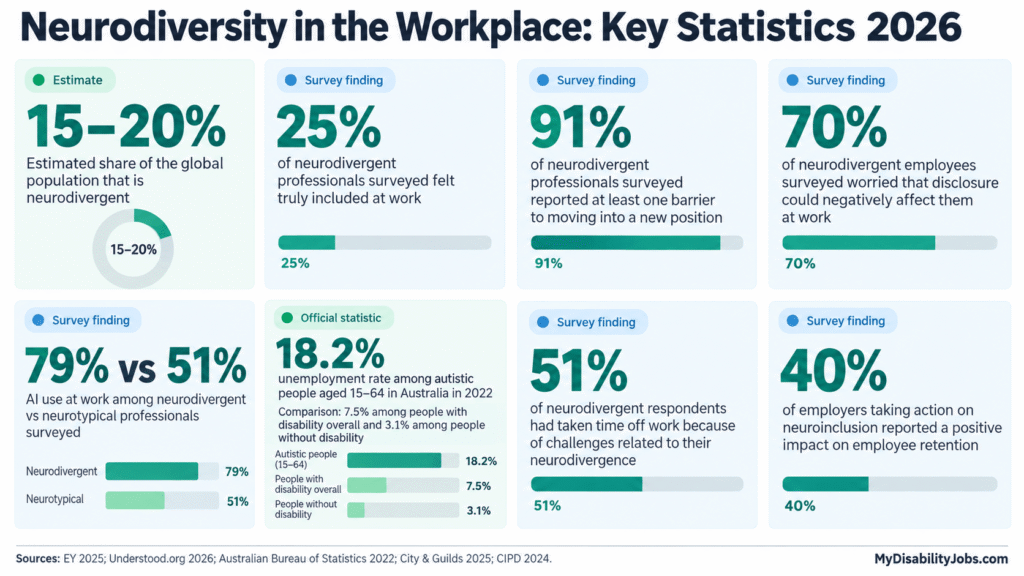
- Worldwide prevalence: An estimated 15% to 20% of the global population is neurodivergent.
- Workplace inclusion: Only 25% of neurodivergent professionals surveyed felt truly included at work.
- Return-to-office: 38% of neurodivergent employees surveyed had experienced a return-to-office mandate, and 53% of those employees said it made them reconsider their current job.
- Career progression: 91% of neurodivergent professionals surveyed reported at least one barrier to moving into a new position.
- Disclosure and masking: 70% of neurodivergent employees surveyed worried that disclosure could negatively affect them at work, while 72% felt pressure to mask or conform to neurotypical behaviors.
- Leadership visibility: 41% of neurodivergent leaders surveyed had never disclosed their neurodivergence to anyone at work.
- AI adoption: 79% of neurodivergent professionals surveyed were using AI at work, compared with 51% of neurotypical professionals.
- Flexible work: 72% of neurodivergent employees surveyed said flexible or home working helped them do their best work.
- Productivity: Software-testing teams in HPE’s Dandelion neurodiversity program were reported to be approximately 30% more productive than comparison teams.
- Autism at Work: Employees in parts of JPMorgan Chase’s Autism at Work initiative were reported to achieve 90% to 140% higher productivity than comparison employees in the same roles.
- Autism employment gap: Autistic people ages 15 to 64 in Australia had an 18.2% unemployment rate, compared with 7.5% among people with disability overall and 3.1% among people without disability.
- Workplace absence: 51% of neurodivergent respondents had taken time off work because of challenges related to their neurodivergence.
- Business impact: Among employers taking action on neuroinclusion, 63% reported a positive impact on employee wellbeing, 55% on organizational culture, 53% on people management, and 40% on employee retention.
In this Statistics Roundup About Neurodiversity in the Workplace, you’ll learn:
- General Neurodiversity Statistics
- Neurodiversity in the United States
- Neurodiversity in the Workplace Statistics
- Career Progression and Neurodivergent Leadership
- Neurodiversity, AI and the Future of Work
- Employment and Neurodiversity
- Profits and Costs of Neurodiversity
Is your company offering jobs for people with disabilities? As an employer, you can publish your job offers on MyDisabilityJobs and reach thousands of qualified candidates.
General Neurodiversity Statistics
- Around 15% to 20% of the population is estimated to be neurodivergent, although there is no single standardized global measure covering every form of neurodivergence.
- Developmental dyslexia affects an estimated 7.1% of primary-school children worldwide, based on a systematic review and meta-analysis of 58 studies across 16 countries. Earlier research has often placed prevalence in the 5% to 10% range depending on the population and diagnostic criteria used.
- The World Health Organization estimates that approximately 1 in 127 people worldwide are autistic, representing nearly 62 million people globally.
- Intellectual ability among autistic people varies widely. Some autistic people have an intellectual disability, while others have average or above-average intellectual ability.
- Research suggests that some neurodivergent people may show strengths in areas such as problem-solving, pattern recognition, creativity, memory, technical skills, or analytical thinking. These strengths vary considerably by individual and should not be treated as universal traits.
There is no single global database that measures “neurodivergence” as one population. The term covers several neurological and developmental conditions, each with its own diagnostic criteria, prevalence estimates, and level of research coverage. Reported rates can also vary according to country, age group, diagnostic access, methodology, and the definitions used.
For this reason, global neurodiversity figures should generally be treated as estimates rather than precise population counts.
Sources: Doyle – Neurodiversity at Work, Systematic Review and Meta-Analysis of Developmental Dyslexia, World Health Organization – Autism, Harvard Business Review – Neurodiversity as a Competitive Advantage.
Neurodiversity in the United States
There is no single U.S. estimate for the total number of neurodivergent people because neurodivergence includes several conditions that are measured separately. Autism and ADHD, however, are among the neurodevelopmental conditions for which national or large-scale U.S. data are available.
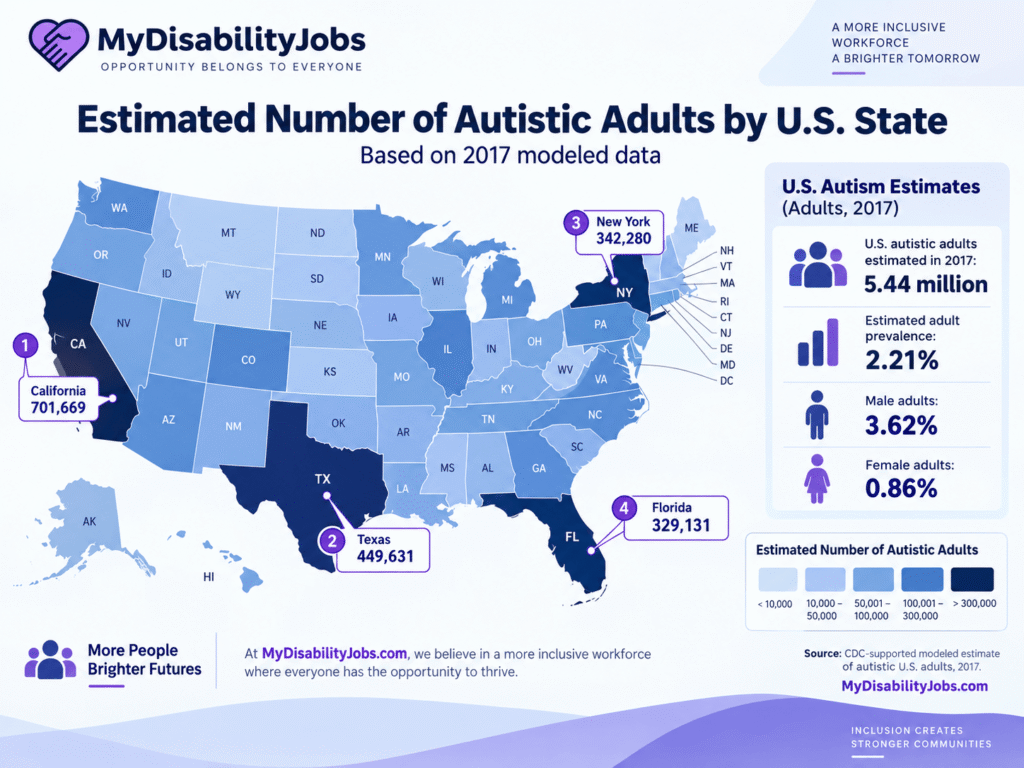
- A CDC-supported study estimated that 2.21% of U.S. adults aged 18 and older were autistic in 2017, equivalent to approximately 5.44 million adults. This was a modeled estimate because the United States does not have a nationwide surveillance system that directly counts autistic adults.
- The states with the largest estimated numbers of autistic adults in that study were California (701,669), Texas (449,631), New York (342,280), and Florida (329,131).
- The same study estimated autism prevalence at approximately 3.62% among male adults and 0.86% among female adults.
Autism Statistics Among U.S. Children
More recent CDC surveillance provides updated estimates for children.
- In 2022, approximately 1 in 31 8-year-old children (3.2%) were identified with autism across 16 communities participating in the CDC’s Autism and Developmental Disabilities Monitoring Network.
- Autism prevalence in those monitored communities was 3.4 times as high among boys as among girls.
- Identified autism prevalence varied substantially between locations, ranging from approximately 1 in 103 8-year-olds in the Texas-Laredo site to 1 in 19 in the California site.
- Among 8-year-old children identified with autism who had information available about cognitive ability, 39.6% also had an intellectual disability.
- The median age of the earliest known autism diagnosis among 8-year-olds in the 2022 surveillance data was 47 months.
These CDC figures come from specific monitoring communities and should not be interpreted as a precise prevalence estimate for every child in the United States.
Autism by Race and Ethnicity
Autism is identified across all racial, ethnic, and socioeconomic groups in the United States. In the CDC’s 2022 monitoring data, autism prevalence among 8-year-olds was higher among Asian or Pacific Islander, American Indian or Alaska Native, Black, Hispanic, and multiracial children than among White children.
This differs from older surveillance patterns in which some racial and ethnic minority groups were less likely to be identified. Changes in awareness, screening, access to evaluation, and identification practices are likely to influence these differences.
ADHD Statistics in the United States
ADHD is also one of the most commonly diagnosed neurodevelopmental conditions in U.S. children.
- CDC data show that 12.0% of U.S. children ages 3 to 17 had ever been diagnosed with ADHD in 2024.
- Among boys, 15.6% had ever received an ADHD diagnosis, compared with 8.2% of girls.
- A separate national survey estimated that approximately 7 million U.S. children ages 3 to 17, or 11.7%, had a current ADHD diagnosis in 2024.
Autism, ADHD, dyslexia, Tourette syndrome, and other neurodevelopmental conditions can also occur together in the same person. Because definitions, diagnostic practices, and data sources differ, prevalence figures for one condition should not be used as an estimate for neurodivergence as a whole.
Sources: CDC – Autism Data and Statistics, CDC – Autism in Teenagers and Adults, CDC – 2022 Autism Surveillance Report, CDC – ADHD Data, CDC/NCHS – ADHD FastStats.
Neurodiversity in the Workplace Statistics
Neurodiversity in the workplace affects far more than recruitment. Recent research examines how neurodivergent employees experience hiring, workplace inclusion, management support, reasonable adjustments, disclosure, career progression, and day-to-day working conditions. Employers are also increasingly studying how neuroinclusive practices can affect retention, performance, innovation, and organizational culture.
The Companies’ Perspective
A growing number of employers are changing recruitment, management, and workplace practices to better include neurodivergent employees. These initiatives range from dedicated hiring programs to manager training, workplace adjustments, employee resource groups, and broader neuroinclusion strategies.
Major employers that have developed or publicly supported neurodiversity initiatives include:
- SAP;
- Hewlett Packard Enterprise;
- Microsoft;
- EY;
- JPMorgan Chase;
- IBM;
- Ford;
- Dell Technologies;
- Deloitte;
- UBS.
Some of the most frequently cited business results come from specific employer programs:
- Hewlett Packard Enterprise reported that software-testing teams in its Dandelion neurodiversity program were approximately 30% more productive than comparison teams.
- JPMorgan Chase reported that employees in parts of its Autism at Work initiative achieved 90% to 140% higher productivity than comparison employees in the same roles. Earlier cohorts in the program also showed higher productivity and strong quality results.
- Research from EY’s 2025 Global Neuroinclusion at Work Study found that neurodivergent professionals who felt truly included reported, on average, 10% higher proficiency across a set of fast-growing workplace skills than neurodivergent colleagues who did not feel truly included.
These results should not be interpreted as evidence that neurodivergent employees are universally more productive or possess the same strengths. Most of these figures come from specific programs, roles, or self-reported workplace studies. They are better understood as examples of what can happen when recruitment, job design, management, and support are aligned with individual needs.
Employer interest is also expected to continue growing. Gartner predicts that by 2027, 20% of sales organizations within Fortune 500 companies will actively recruit neurodivergent talent as part of efforts to improve business performance.
Recruitment and Workplace Barriers
Despite greater awareness, many neurodivergent workers still report barriers during recruitment and employment.
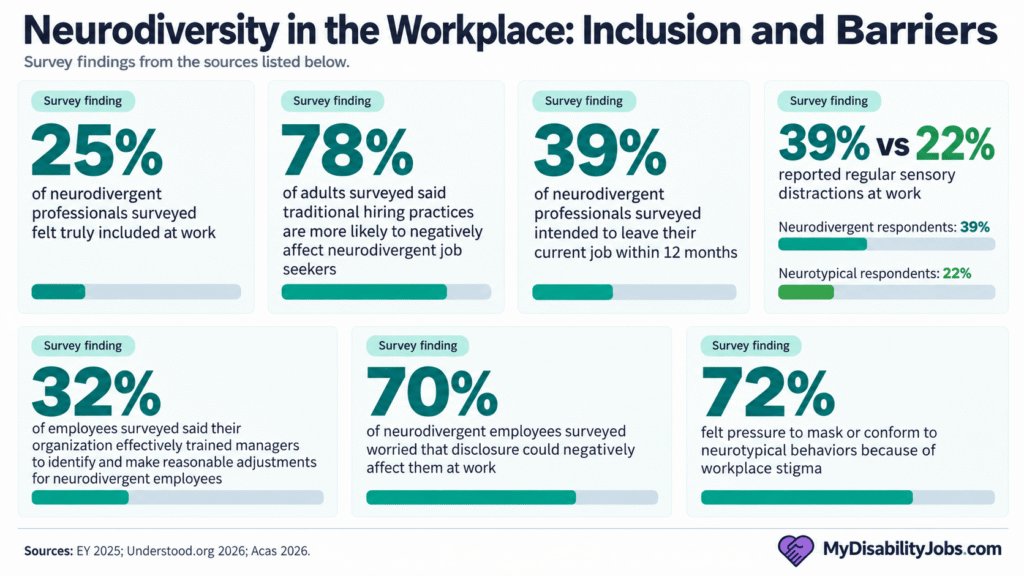
- In a 2026 U.S. survey by Understood.org and The Harris Poll, 78% of adults said traditional hiring practices are more likely to negatively affect neurodivergent job seekers.
- Pearn Kandola’s 2024 study of 601 employed neurodivergent people in the UK found that 48% disagreed that recruitment processes were fair to neurodivergent candidates.
- EY also found that 39% of neurodivergent professionals surveyed intended to leave their current job within the following 12 months.
- When asked about barriers to reaching their full potential, 37% cited insufficient support with workload and task prioritization, while 34% said adjustments or other support were not provided in a timely manner.
Manager knowledge remains another issue. In a 2026 Acas/YouGov survey of employees in Great Britain, only 32% said their organization effectively trained managers to identify and make reasonable adjustments for neurodivergent employees, while 35% rated their employer as ineffective.
Employer Barriers to Providing Workplace Adjustments
Birkbeck University of London’s 2026 Neurodiversity in Business report also examined the employer side of workplace support. The study included 55 employer representatives; because this was a relatively small, self-selected sample, the figures should be treated as survey findings rather than estimates for all employers.
- 85% of employer representatives surveyed said demand for neurodiversity support had increased over the previous 18 months.
- 64% identified a lack of understanding of neurodiversity among managers or decision-makers as a challenge when implementing adjustments.
- 51% cited lack of disclosure as a challenge.
- 40% cited the cost of adjustments, while 38% cited a lack of centralized procedures and 36% a lack of centralized budget.
The findings complement employee-side evidence on manager capability by showing that employers themselves report knowledge, process, disclosure, and resourcing barriers when trying to implement neurodiversity support.
Workplace Inclusion and Support
Greater awareness of neurodiversity does not automatically translate into a fully inclusive workplace.
EY’s 2025 global study of more than 2,000 professionals found that only 25% of neurodivergent respondents felt truly included at work, despite much larger shares reporting that they were engaged with their jobs.
The study identified line-manager behavior and psychological safety as particularly important influences on neuroinclusion. Neurodivergent professionals who felt truly included were much more likely to report supportive management, clear communication, recognition of their skills, and psychologically safe teams.
Sensory and environmental factors can also affect workplace experience. EY found that neurodivergent respondents were more likely than neurotypical respondents to report regular sensory distractions at work, with an average of 39% versus 22% across the measures studied.
Support with reasonable adjustments remains inconsistent. In a 2026 Acas survey, 35% of employees said their employer was ineffective at training managers to support neurodivergent colleagues, while nearly one-third said they did not know how effective their employer was in this area.
Flexible Work and Return-to-Office
Flexible work was a prominent part of the 2026 Birkbeck and Neurodiversity in Business findings. Among 428 neurodivergent employees surveyed, most were working in arrangements that included some degree of remote work:
- 75% worked in a hybrid setup;
- 16% worked entirely remotely;
- 9% worked entirely in an office or on site;
- 38% had experienced a return-to-office mandate;
- among employees who had experienced a return-to-office mandate, 53% said it made them reconsider their current employment.
The report’s employee sample was not representative of the UK workforce as a whole, so these figures should not be read as national prevalence estimates. They do, however, provide recent evidence about the role of work location and flexibility in the experience of neurodivergent employees.
What Helps Neurodivergent Employees Perform at Their Best
The same 2026 research asked neurodivergent employees what enabled them to do their best work. Multiple responses were allowed.
- 72% selected work-structure support such as flexible or home working;
- 68% selected line-manager support;
- 64% selected colleague or peer support;
- 61% selected informal relational adjustments, such as colleagues understanding how they work best;
- 45% selected informal technological adjustments, including the use of AI tools.
These findings reinforce the importance of work design and day-to-day relationships: the most frequently selected enablers were not limited to formal accommodations or specialist programs.
Psychological Safety in Neurodiverse Teams
A 2026 peer-reviewed study examined psychological safety in 357 employees nested within 70 teams across 19 organizations in the Netherlands and seven sectors. The researchers found an important difference between individual and team-level experiences.
- Neurodivergent team members reported lower psychological safety than neurotypical colleagues within the same teams.
- Teams with a higher proportion of neurodivergent members reported higher psychological safety at the group level.
- Greater neurodiversity awareness was associated with higher psychological safety at the group level, but awareness alone did not significantly reduce the lower psychological safety reported by neurodivergent team members.
The findings suggest that simply increasing awareness of neurodiversity may not be enough to address the relational and workplace factors that shape whether individual neurodivergent employees feel safe speaking up, taking interpersonal risks, or participating fully in a team. The study was observational and based on self-reported neurodivergence, so the findings should not be interpreted as proof that team composition alone causes higher or lower psychological safety.
Birkbeck University’s 2026 research provides additional evidence on this issue. In its analysis of neurodivergent employees, higher psychological safety was the strongest protective factor against burnout and was also the most important factor associated with career satisfaction. The report also found that job crafting was the strongest driver of work engagement, while return-to-office mandates were negatively associated with engagement and were linked with higher burnout. These findings describe associations within the study sample rather than proving that any single workplace practice causes the outcomes measured.
Impact on Disclosure
Disclosure remains a sensitive issue for many neurodivergent employees.
A 2026 U.S. survey from Understood.org found that 70% of neurodivergent employees worried that disclosing their neurodivergence could have a negative impact on them at work. The same study found that 72% felt pressure to mask or conform to neurotypical behaviors because of workplace stigma.
Pearn Kandola’s 2024 UK study found that 69% of respondents had disclosed their neurodivergence to someone at work, and most of those who disclosed described the experience positively. At the same time, 63% said they had masked their neurodivergence in the workplace.
EY’s 2025 global study found that 63% of neurodivergent professionals surveyed openly discussed their neuroidentity with a manager or colleague. Disclosure was much more common in highly inclusive environments: 81% of respondents who felt truly included discussed their neuroidentity at work, compared with around half of those reporting a less inclusive experience.
These findings help explain why internal company data may understate the number of neurodivergent employees. Disclosure depends not only on personal preference, but also on trust, psychological safety, perceived career risk, and confidence that support will be available.
Sources: EY Global Neuroinclusion at Work Study 2025, Understood.org Neurodiversity at Work Survey 2026, Pearn Kandola Neurodiversity at Work Report 2024, Acas – Neurodiversity at Work Research 2026, Gartner – Neurodivergent Hiring Forecast, Harvard Business Review – Neurodiversity as a Competitive Advantage, Autism @ Work Playbook, van Rijswijk et al. – A Relational Perspective on Neurodiverse Teams (2026), Birkbeck University of London & Neurodiversity in Business – Research Report 2026.
Career Progression and Neurodivergent Leadership
Getting hired is only one part of workplace inclusion. Neurodivergent professionals can also face barriers when seeking promotions, changing roles, accessing development opportunities, or moving into leadership positions.
Career Progression Barriers
EY’s 2025 Global Neuroinclusion at Work Study found that career mobility remains a significant challenge for many neurodivergent professionals.
- 91% of neurodivergent professionals surveyed reported at least one barrier to moving into a new position.
- 36% cited a lack of clear career progression pathways.
- 34% reported limited opportunities for job shadowing or exploring other roles.
- 31% said anxiety about adapting to new team dynamics was a barrier to changing positions.
- 28% feared losing their existing support systems when moving into a new role.
- 24% reported direct or indirect prejudice against diverse candidates.
- 13% identified performance evaluations that failed to recognize different strengths as a barrier to progression.
Professional development can also affect whether neurodivergent employees are able to realize their potential. In the same EY study, 32% of neurodivergent respondents reported insufficient professional development opportunities, while 31% said managers had limited understanding of different strengths and working styles and 28% cited inadequate mentorship programs.
Workplace inclusion appears closely connected with expectations about career advancement. Among neurodivergent professionals who EY classified as “truly included,” 87% believed they could advance their career within their current organization. Among those classified as “ambivalent observers,” that figure fell to 46%.
These findings do not prove that inclusion alone causes career progression, but they show a strong relationship between employees’ workplace experience and whether they believe advancement is possible.
Neurodivergent Leadership May Be Less Visible Than It Appears
Measuring neurodivergent representation in leadership is particularly difficult because many leaders do not disclose their neurodivergence at work.
A 2026 Center for Creative Leadership study examined neurodiversity among 416 leaders in the United States and United Kingdom.
- 41% of neurodivergent professionals said they had never disclosed their neurodivergence to anyone at work.
- 42% had disclosed to their manager.
- Fewer than one in five had disclosed their neurodivergence to human resources.
- Fewer than one in four participants reported knowing of a neurodivergent manager or senior leader within their organization.
These figures are important when interpreting claims about how many neurodivergent people hold senior positions. A company may employ neurodivergent managers and executives without formally knowing that they are neurodivergent.
Later diagnosis can make leadership representation even more difficult to measure. In the CCL study, the average age at first diagnosis was 27, and 40% of participants were diagnosed after age 30. Some leaders may therefore have reached management positions before identifying or being diagnosed as neurodivergent.
Leadership Identity, Masking and Career Development
CCL’s research also found that neurodivergent leaders were less likely to identify themselves as leaders and reported lower confidence in their leadership abilities, despite nearly all study participants having held leadership roles.
The research also identified masking — suppressing or modifying behaviors to conform to workplace expectations — as an important issue among neurodivergent leaders. Higher levels of masking were associated with lower wellbeing and fewer psychological resources over time.
This suggests that leadership representation cannot be measured only by counting disclosed diagnoses. Promotion systems, leadership-development programs, mentorship, psychological safety, performance evaluation, and workplace culture can all influence whether neurodivergent professionals pursue leadership roles and whether they remain in them.
Current research therefore points to a distinction between having neurodivergent leaders in an organization and having neurodivergent leaders who feel safe enough to be visible, supported, and included.
Sources: EY – Global Neuroinclusion at Work Study 2025, Center for Creative Leadership – Neurodiversity in the Workplace, Center for Creative Leadership – Neurodiversity in Leadership: Identity, Masking, and Wellbeing.
Neurodiversity, AI and the Future of Work
Artificial intelligence is emerging as an important part of the workplace experience for many neurodivergent professionals. Recent studies suggest that neurodivergent employees report particularly high levels of AI adoption and are using these tools for information access, communication, organization, and other workplace tasks.
AI Adoption Among Neurodivergent Employees
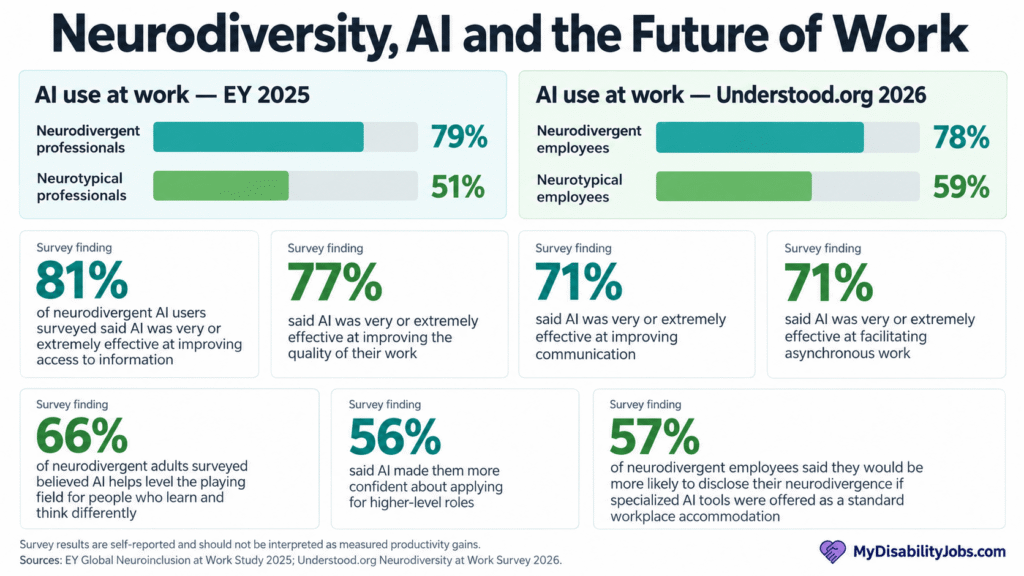
EY’s 2025 Global Neuroinclusion at Work Study found a substantial difference in reported AI use between neurodivergent and neurotypical professionals.
- 79% of neurodivergent professionals surveyed said they were already using AI at work, compared with 51% of neurotypical professionals.
A separate 2026 U.S. survey from Understood.org and The Harris Poll found a similar pattern:
- 78% of neurodivergent employees reported using AI tools at work, compared with 59% of neurotypical employees.
The two surveys used different populations and methodologies, so their percentages should not be treated as directly comparable. However, both found substantially higher reported AI use among neurodivergent employees than among neurotypical employees.
How Neurodivergent Professionals Are Using AI at Work
EY also asked neurodivergent AI users how effective they found the technology for different workplace activities.
Among neurodivergent professionals surveyed who used AI:
- 81% said AI was very or extremely effective at improving access to information;
- 77% said it was very or extremely effective at improving the quality of their work;
- 71% reported that AI was very or extremely effective at improving the quality of their communication;
- 71% said it was very or extremely effective at facilitating asynchronous working practices.
These are self-reported assessments of usefulness rather than independently measured changes in productivity or work quality. They nevertheless provide evidence about the areas in which neurodivergent professionals themselves perceive AI tools as most valuable.
Understood.org’s 2026 U.S. survey similarly found that 66% of neurodivergent adults believed AI helps level the playing field for people who learn and think differently.
AI Cognitive Co-Regulation: 2026 Experimental Study
A 2026 peer-reviewed study tested an AI productivity-assistant prototype designed to provide cognitive co-regulation support to 24 neurodivergent professionals. During AI-assisted tasks, the researchers reported:
- a 48.3% reduction in measured cognitive load;
- goal completion increasing from 45% to 75%;
- average task-completion time falling from 65.4 minutes to 45.2 minutes, a reduction of approximately 30.8%.
These findings provide early experimental evidence that AI tools designed around executive-function support may help some neurodivergent professionals manage cognitive load and complete tasks more efficiently. However, the study involved a small sample and a specific prototype. It did not establish that similar gains would occur across neurodivergent employees, job types, or commercial AI tools, and it did not measure whether performance improvements persisted when the AI support was removed.
AI, Career Progression and Disclosure
AI may also influence how some neurodivergent people approach career opportunities.
In the 2026 Understood.org survey:
- 56% of neurodivergent adults said the availability of AI tools made them more confident about applying for higher-level roles they had previously avoided because of administrative or organizational requirements, compared with 45% of neurotypical adults.
- 24% said they were choosing or changing their career path based on the ability to use AI to work around workplace challenges such as administrative tasks, compared with 10% of neurotypical adults.
- 57% of neurodivergent employees said they would be more likely to disclose their neurodivergence if their employer provided specialized AI tools, such as AI assistants or copilots, as a standard workplace accommodation.
- 56% of neurodivergent adults said they would feel more fairly judged by an AI tool analyzing their skills during a job interview than by a human recruiter who might misinterpret their body language or social cues, compared with 46% of neurotypical adults.
These findings do not establish that AI-based recruitment is inherently fairer or that AI should replace human decision-making. They reflect respondents’ perceptions of how AI could affect specific barriers they experience during hiring and employment.
What AI Could Mean for the Future of Neuroinclusive Work
The emerging data suggest that AI may become increasingly relevant to neuroinclusive workplace design. Tools that support writing, information retrieval, task organization, communication, and asynchronous work may help some employees manage tasks that otherwise create unnecessary friction.
At the same time, neurodivergent employees are not a single group, and the usefulness of AI will vary substantially between individuals, roles, and types of neurodivergence. AI tools can also introduce their own accessibility, privacy, accuracy, and bias concerns.
For this reason, AI is better viewed as an additional workplace tool rather than a substitute for reasonable adjustments, supportive management, accessible recruitment, psychological safety, or inclusive job design.
The current evidence is particularly notable because two recent workplace surveys — one global and one U.S.-based — independently found higher reported AI adoption among neurodivergent workers than among their neurotypical peers.
Sources: EY – Global Neuroinclusion at Work Study 2025, Understood.org – Neurodiversity at Work Survey 2026, Obinwanne et al. – Designing AI Productivity Assistants for Neurodiverse Professionals (2026).
Employment and Neurodiversity
Neurodivergent people continue to face substantial barriers to employment and career progression. However, there is no single official unemployment rate for the entire neurodivergent population because most national labor-market datasets measure individual conditions or disability more broadly rather than neurodivergence as one category.
- The University of Connecticut has cited estimates suggesting that unemployment among neurodivergent adults can run as high as 30% to 40%. Exact figures remain difficult to establish because employment outcomes are not measured consistently across autism, ADHD, dyslexia, dyspraxia, dyscalculia, dysgraphia, and other forms of neurodivergence.
- This figure should therefore be treated as a broad estimate from the neurodiversity-employment literature rather than a definitive national or global unemployment rate.
Autism and Employment: International Data
More precise employment statistics are available for autistic people in several countries.
- Australia: In 2022, the unemployment rate among autistic people aged 15 to 64 was 18.2%, compared with 7.5% among people with disability overall and 3.1% among people without disability. The Australian Bureau of Statistics also found that 42.2% of autistic people of working age were employed.
- Canada: A 2026 peer-reviewed analysis of the nationally representative 2022 Canadian Survey on Disability found that 29% of autistic Canadians were employed, 11% were classified as unemployed, and 60% were outside the labour force. Employment had increased from 22% in 2017 to 29% in 2022, although the increase was not statistically significant.
- United Kingdom: In 2024/25, 31.4% of working-age disabled people who reported autism as their main health condition were employed, according to the UK Department for Work and Pensions.
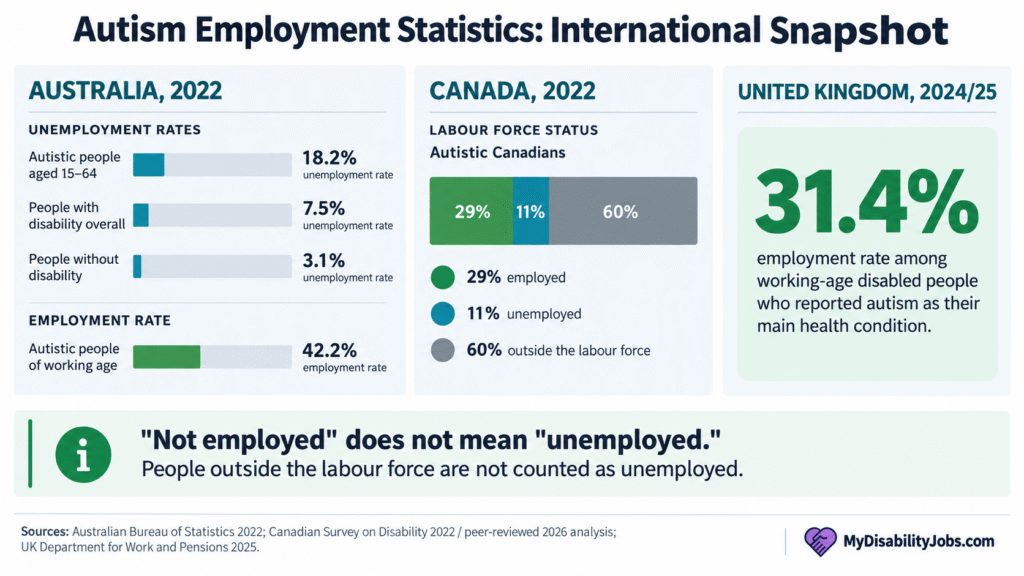
These figures show why employment statistics need to be interpreted carefully. Someone who is not employed is not necessarily unemployed in the statistical sense.
An unemployed person is generally someone who does not have a job but is participating in the labour market and looking for work. Someone who is outside the labour force is not currently counted as employed or unemployed.
Canada illustrates the distinction particularly clearly: although only 29% of autistic people in the study were employed, it would be incorrect to conclude that the remaining 71% were unemployed. The study classified 11% as unemployed and 60% as outside the labour force.
This distinction is important because widely repeated statements such as “80%” or “85% of autistic adults are unemployed” often combine unemployment with economic inactivity or originate from older, narrowly defined studies.
Employment Gaps Remain Substantial
Even where employment has improved, autistic people continue to experience substantial employment gaps.
In Australia, autistic people of working age had an unemployment rate almost six times that of people without disability in 2022. In Canada, fewer than one in three autistic people in the 2022 survey were employed. In the UK, the 31.4% autism employment rate remained far below the employment rate for the working-age population overall.
Comparisons between countries should nevertheless be made cautiously. National surveys use different definitions, age ranges, disability criteria, sampling methods, and labor-market measures. An employment rate reported in one country cannot be directly compared with an unemployment rate reported in another without considering those differences.
Why Exact Neurodivergent Employment Figures Are Difficult to Measure
Employment data are much stronger for some individual conditions, particularly autism, than for neurodivergence as a whole. ADHD, dyslexia, autism, Tourette syndrome, dyspraxia, and other conditions are often studied separately, and many neurodivergent people have more than one condition.
Diagnosis and disclosure also affect the available data. Some people identify as neurodivergent without a formal diagnosis, while others may choose not to disclose a diagnosis to employers or surveys.
For these reasons, broad figures such as the 30% to 40% neurodivergent unemployment estimate can be useful indicators of employment barriers, but they should not be presented as a precise unemployment rate applying to every neurodivergent population.
Sources: University of Connecticut – Center for Neurodiversity and Inclusive Employment, Australian Bureau of Statistics – Autism in Australia, 2022, Journal of Autism and Developmental Disorders – Canadian Survey on Disability 2017 and 2022, UK Department for Work and Pensions – The Employment of Disabled People 2025.
Profits and Costs of Neurodiversity
The economic impact of neurodiversity is difficult to reduce to a single number. Costs may include healthcare, workplace absence, inadequate support, employee turnover, and lost opportunities when people cannot work at their full potential. At the same time, employers that invest in neuroinclusive practices report benefits in areas such as retention, wellbeing, management, and organizational culture.
Workplace Costs and Absence
- The City & Guilds Neurodiversity Index 2025 found that 51% of neurodivergent respondents had taken time off work because of challenges related to their neurodivergence.
- In the same study, 41% said workplace challenges affected them on most days.
- Burnout, workplace conflict, emotional wellbeing, work-life balance, and time management were among the recurring issues reported by respondents.
These figures do not mean neurodivergence itself inevitably causes absence. Workplace conditions, management, access to adjustments, workload, and individual support can all influence whether a neurodivergent employee is able to work sustainably.
Autism-Related Health Expenditures in the United States
Recent U.S. government data also provide a clearer picture of healthcare expenditures associated with autism.
An analysis published in 2025 by the U.S. Agency for Healthcare Research and Quality used Medical Expenditure Panel Survey data collected between 2018 and 2022.
- Average annual health expenditures for children with treated autism spectrum disorder were $20,122, compared with $2,201 for children without treated autism.
- Of the average spending for children with treated autism, approximately $14,048 — or 69.8% — was attributed to autism-specific healthcare expenditures.
- Home healthcare represented approximately 35.6% of total health expenditures for children with treated autism, while ambulatory care accounted for around half.
These figures cover U.S. children ages 3 to 17 with reported autism-related healthcare events. They do not include every autistic child, school-based services, or institutional care, so they should not be interpreted as the total societal cost of autism.
Older estimates forecasting hundreds of billions of dollars in annual U.S. autism costs are still widely cited, but many were projections rather than measured expenditures. Current government expenditure data provide a more transparent basis for discussing healthcare costs.
Business Benefits of Neuroinclusion
The business case for neuroinclusion is not limited to productivity figures from individual employer programs.
The CIPD’s 2024 Neuroinclusion at Work study surveyed employers about the effects of actions they had taken to create more neuroinclusive organizations. Among 723 employers taking some form of action:
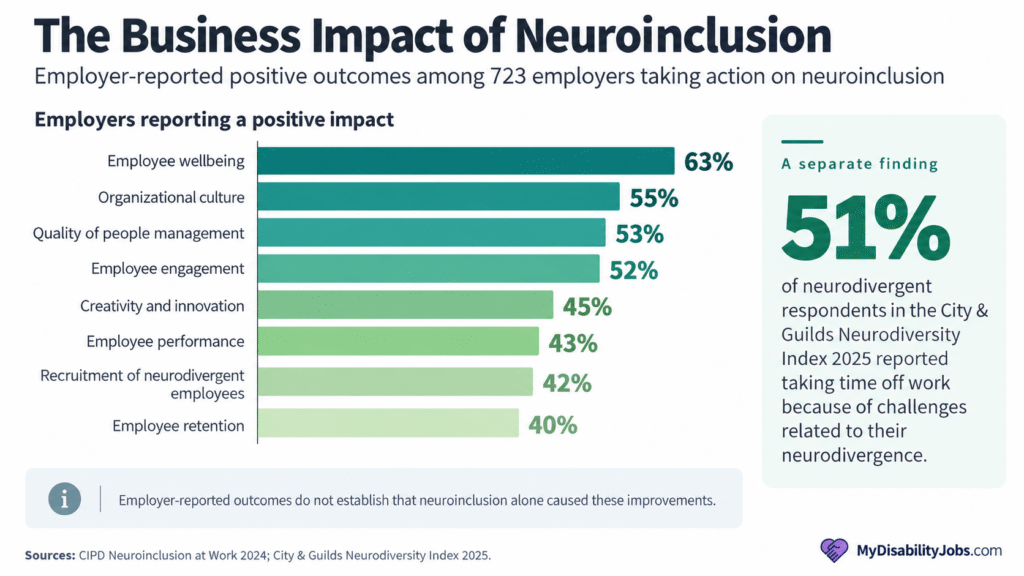
- 63% reported a positive impact on employee wellbeing;
- 55% reported a positive impact on organizational culture;
- 53% reported improvements in the quality of people management;
- 52% reported a positive impact on employee engagement;
- 45% reported a positive impact on creativity and innovation;
- 43% reported a positive impact on employee performance;
- 42% reported a positive impact on recruitment of neurodivergent employees;
- 40% reported a positive impact on employee retention.
These are employer-reported outcomes rather than proof that neuroinclusion alone caused each improvement. However, they provide evidence that organizations taking practical steps toward neuroinclusion frequently perceive benefits extending beyond the neurodivergent employees directly affected.
CIPD also found that flexible working, clear access to reasonable adjustments, and education and awareness about neurodiversity were among the practices most commonly associated with positive organizational and people-management outcomes.
Taken together, the research suggests that the financial discussion around neurodiversity should not focus only on costs. Poorly designed workplaces can contribute to absence, burnout, turnover, and underused skills, while better support and more inclusive working practices can improve employee experience and organizational outcomes.
Sources: City & Guilds – Neurodiversity Index 2025, U.S. Agency for Healthcare Research and Quality – Treatment and Health Expenditures Among Children With Autism Spectrum Disorder, 2018–2022, CIPD – Neuroinclusion at Work Report 2024.
Conclusion
Research on neurodiversity in the workplace has expanded significantly, but the available statistics still need to be interpreted carefully. Neurodivergence covers multiple conditions and identities, and prevalence, employment, disclosure, and workplace outcomes can vary considerably depending on the population, country, methodology, and definitions used.
Recent studies nevertheless show several consistent themes. Neurodivergent professionals continue to report barriers in recruitment, workplace inclusion, career progression, disclosure, and access to support. At the same time, employers that adopt more neuroinclusive practices report benefits in areas such as wellbeing, retention, organizational culture, employee engagement, and management.
The evidence also shows why broad claims about neurodivergent workers should be avoided. Productivity results from programs such as HPE’s Dandelion initiative and JPMorgan Chase’s Autism at Work program are important case studies, but they do not mean every neurodivergent employee will perform in the same way. Similarly, estimates such as the 15% to 20% global neurodivergent population figure and the 30% to 40% unemployment estimate are useful indicators rather than precise universal rates.
As workplace research improves, more recent data on career progression, leadership, AI use, disclosure, and neuroinclusion are providing a more detailed picture of how neurodivergent people experience work and what organizations can do to reduce unnecessary barriers. These findings also sit within broader trends affecting disability and employment and the wider discussion around diversity in the workplace.
FAQ
Around 15% to 20% of the population is estimated to be neurodivergent. This should be treated as an estimate rather than a precise global prevalence rate because there is no standardized worldwide measure covering every form of neurodivergence.
There is no single official unemployment rate for all neurodivergent people. The University of Connecticut cites estimates suggesting that unemployment among neurodivergent adults can run as high as 30% to 40%, but this is a broad estimate from the employment literature rather than a standardized national or global rate.
More precise figures are available for individual conditions. For example, the Australian Bureau of Statistics reported an 18.2% unemployment rate among autistic people ages 15 to 64 in 2022.
There is no evidence that neurodivergent employees are universally more productive than neurotypical employees.
Some specific employer programs have reported substantial productivity gains. Hewlett Packard Enterprise reported that software-testing teams in its Dandelion program were approximately 30% more productive than comparison teams, while JPMorgan Chase reported 90% to 140% higher productivity for employees in parts of its Autism at Work initiative.
These findings relate to specific roles and programs and should not be generalized to every neurodivergent employee or workplace.
EY’s 2025 Global Neuroinclusion at Work Study found that only 25% of neurodivergent professionals surveyed felt truly included at work.
The same study found substantial differences in career expectations depending on workplace experience: 87% of neurodivergent professionals classified as truly included believed they could advance their career within their organization, compared with 46% among those EY classified as ambivalent observers.
Recent surveys suggest higher reported AI adoption among neurodivergent employees.
EY’s 2025 global study found that 79% of neurodivergent professionals surveyed were using AI at work, compared with 51% of neurotypical professionals. A separate 2026 U.S. survey from Understood.org and The Harris Poll found a similar pattern, with 78% of neurodivergent employees reporting AI use at work, compared with 59% of neurotypical employees.
Related articles:
Disability and Depression Statistics
Workplace Bullying Statistics Research & Facts
Costs of Bullying and Harassment in the Workplace
Statistics on Employees Burnout in the Workplace
Disability and Employment Discrimination Statistics
Mental Health and Employment Statistics
Intellectual Disability Employment Statistics
Bipolar Disorder and Employment Statistics
Autism and Employment Statistics
leave your comment