
20 Best Jobs for Dyslexic People in 2026: Careers, Pay & Training

Dyslexia can affect reading, spelling, written processing, working memory, sequencing, or the speed at which someone works with text, but it does not determine what career a person can succeed in.
The best jobs for dyslexic people are therefore not one fixed group of occupations. A good career fit depends on the individual, the actual tasks involved, how information is communicated, the level of reading and writing required, the work environment, and the tools or support available.
This guide explores practical careers for adults with dyslexia across creative work, skilled trades, technical roles, business, sales, design, construction, and other fields. It also covers high-paying jobs for dyslexics without a degree, college majors worth exploring, and practical questions to ask before deciding whether a job is a good fit.
Some of the careers below emphasize visual, practical, verbal, hands-on, or problem-solving work, while others require more reading, writing, organization, or formal education. The goal is not to avoid every difficult task. It is to find work where your strongest skills are useful and where challenging tasks can be managed effectively.
If you are exploring related career options, you may also want to read our guides to jobs for people with learning disabilities and easy jobs for disabled adults.
We invite you to have a look at our list of jobs for people with disabilities to find and apply to jobs for someone with dyslexia that might interest you.
Table of Contents
- How to Tell if a Job Is Dyslexia-Friendly Before You Apply
- High-Paying Jobs for Dyslexics Without a Degree
- Best Degrees and College Majors for Dyslexic Students
- Best Jobs for Dyslexic People
- Quick Checklist: Is This Job a Good Fit for You?
- Frequently Asked Questions
How to Tell if a Job Is Dyslexia-Friendly Before You Apply
A job title alone does not tell you whether a role will be a good fit. Two people can have the same job in different companies and have completely different experiences depending on the workload, communication style, technology, management, and amount of reading or documentation involved.
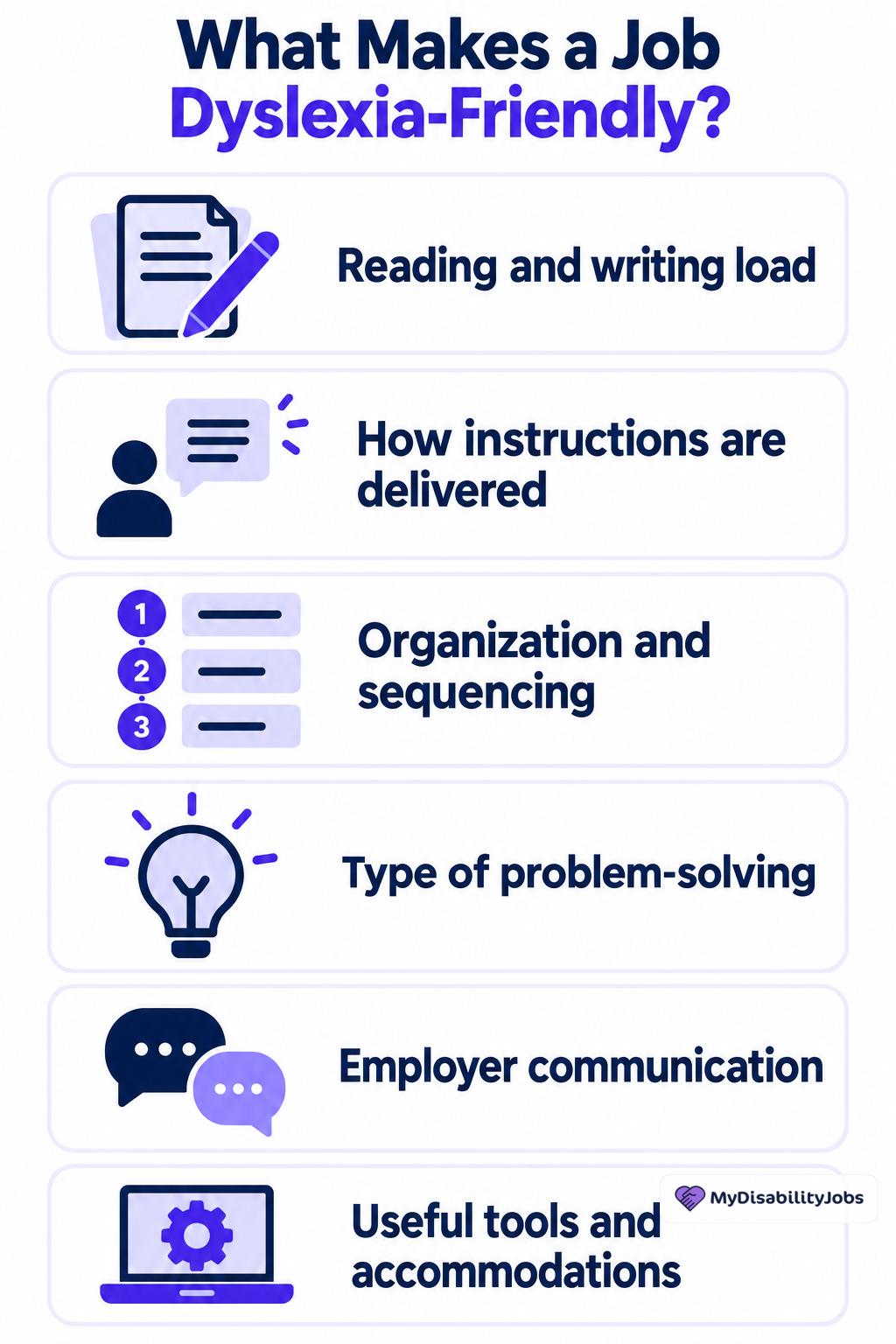
When comparing jobs for people with dyslexia, look beyond the occupation itself and pay attention to how the work is actually performed. The goal is not to find a job with no reading or writing. Most careers involve some written communication. Instead, look for a role where the main responsibilities match the way you work best and where difficult tasks can be supported with practical tools or accommodations.
1. Look at how much reading and writing the job really requires
Job descriptions can make almost every position sound paperwork-heavy, but the amount and type of written work varies considerably.
Ask what reading and writing actually look like during a normal day. There is a big difference between occasionally reading instructions or writing emails and spending most of the day proofreading documents, processing dense reports, or entering written information quickly and accurately.
For some dyslexic adults, a role with substantial written work may still be a good fit when there is enough time to review it and tools such as text-to-speech, dictation, spellcheck, or templates are available.
2. Find out how instructions and information are provided
Some workplaces rely almost entirely on long emails and written procedures. Others combine written instructions with demonstrations, meetings, diagrams, videos, checklists, or hands-on training.
If you learn more easily by seeing, hearing, or practicing a task, look for employers that use more than one way to communicate important information.
This can matter as much as the career itself. A technically suitable job may become unnecessarily difficult if every task is explained through dense written documentation, while the same role may work much better in a team that uses clear instructions and visual or verbal support.
3. Consider whether the work matches your preferred way of solving problems
Many good careers for dyslexics involve practical, visual, verbal, creative, or problem-solving work, but no single working style applies to everyone with dyslexia.
Think about the tasks that have worked well for you in school, previous jobs, hobbies, or personal projects. You might prefer designing something visually, repairing equipment, explaining ideas verbally, working directly with customers, building physical objects, or solving larger strategic problems.
The useful question is not “What are dyslexic people naturally good at?” but “Which types of tasks allow me to do my best work consistently?”
4. Check how much organization and sequencing the role requires
Dyslexia can affect more than reading and spelling. Some people also find multi-step instructions, sequencing, working memory, or managing large amounts of written information demanding.
Before applying, look at how the job is organized. Does the role have clear priorities and repeatable workflows, or are employees expected to constantly keep track of many changing tasks without much structure?
Calendars, checklists, visual project boards, reminders, templates, and task-management software can make complex jobs much easier to organize. A position does not need to be simple to be dyslexia-friendly; it needs to provide a workable way to manage its complexity.
5. Evaluate the employer, not just the career
This is especially important when comparing careers for people with dyslexia.
A graphic designer at one company might spend most of the day creating visual work, while another designer could spend hours documenting projects and responding to written feedback. A construction role might include extensive technical documentation at one employer and much more hands-on training at another.
During your research or interview, try to understand:
- how employees receive instructions;
- how much documentation the role involves;
- whether work is performed independently or collaboratively;
- how deadlines and priorities are communicated;
- which software and productivity tools are used;
- and how flexible the employer is about different ways of completing the work.
The work environment can sometimes have a greater effect on job fit than the job title.
6. Consider whether useful workplace accommodations are available
Some employees with dyslexia benefit from relatively simple changes to the way information is presented or tasks are completed.
Depending on the role and individual needs, useful support may include text-to-speech software, speech-to-text tools, written instructions combined with verbal explanations, additional time for some reading-heavy tasks, diagrams or flowcharts, proofreading tools, or clearer task prioritization.
The Job Accommodation Network (JAN) provides free guidance about workplace accommodations in the United States. If you are deciding whether to mention dyslexia or another disability during the hiring process, you may also want to read our guide on whether to disclose a disability during a job application.
The best jobs for dyslexic people are therefore not defined by one industry or one set of supposed strengths. A good fit usually comes from the combination of the work itself, the way information is communicated, the level of structure available, the employer’s practices, and the tools or support that help you work effectively.
With those factors in mind, the following careers are worth exploring as possible options for adults with dyslexia.
Some roles may involve heavier reading, written documentation, repetitive paperwork, rapid text processing, or other demands that some people with dyslexia find more difficult to manage. If you want to compare the careers in this guide with roles that may present more challenges, see our guide to worst jobs for dyslexics.
High-Paying Jobs for Dyslexics Without a Degree
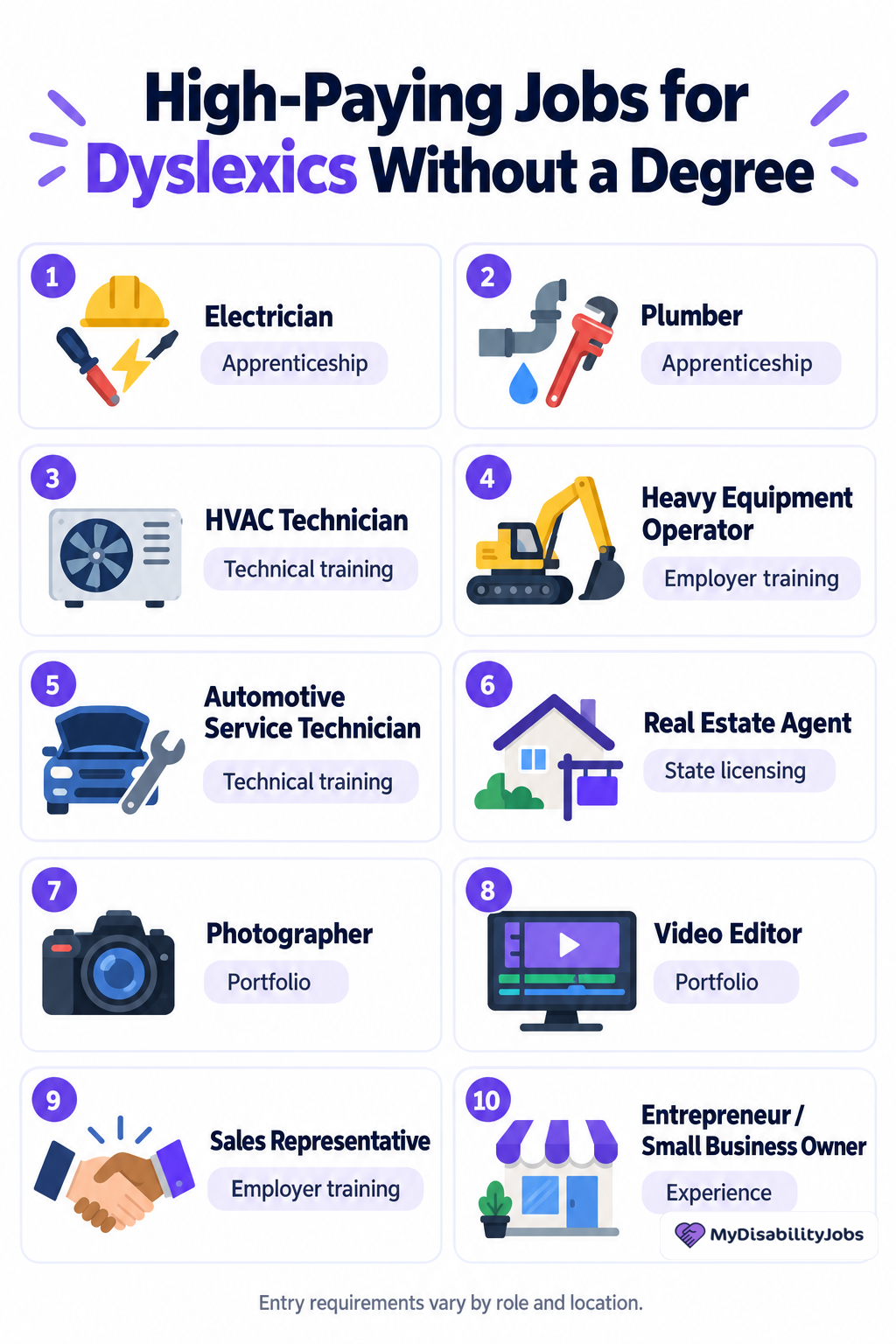
A four-year college degree is not required for every well-paid career. Some high-paying jobs for dyslexics can be entered through an apprenticeship, trade school, technical program, professional license, portfolio, employer training, or practical experience.
Whether one of these careers is a good fit depends on the individual. A job should not be considered suitable simply because it involves less academic reading or does not require a bachelor’s degree. Technical documentation, safety procedures, licensing exams, customer communication, scheduling, and written records can still be part of the work.
Examples of careers with pathways that may not require a bachelor’s degree include:
| Career | Typical Entry Path | Work Style |
|---|---|---|
| Electrician | Apprenticeship, technical training, and licensing where required | Hands-on, technical, troubleshooting |
| Plumber | Apprenticeship and licensing where required | Practical, hands-on, problem-solving |
| HVAC Technician | Technical or vocational training; certification may be required | Mechanical, diagnostic, hands-on |
| Heavy Equipment Operator | Employer training, apprenticeship, or vocational training | Spatial, practical, equipment-based |
| Automotive Service Technician | Vocational training, employer training, or certification | Diagnostic, mechanical, hands-on |
| Real Estate Agent | State-approved education and licensing | Client-facing, verbal, sales-focused |
| Photographer | Portfolio, practical experience, and technical skills | Visual, creative, client-facing |
| Video Editor | Portfolio and editing-software skills | Visual, project-based, technical |
| Sales Representative | Requirements vary by employer and industry | Verbal, relationship-based, results-focused |
| Entrepreneur / Small Business Owner | No fixed degree requirement; depends on the business | Independent, strategic, varied |
These pathways can still involve significant training, exams, documentation, or experience. “No degree required” should not be interpreted as “no qualifications required.”
Earnings also vary significantly by occupation, location, experience, licensing, industry, and employment arrangement. The detailed career sections below will include current salary information and entry requirements for each occupation.
Best Degrees and College Majors for Dyslexic Students
Some dyslexic students prefer to enter a trade or build skills through work experience, while others choose college or university. There is no single “best degree for dyslexia,” because students differ in their interests, strengths, support needs, and preferred ways of learning.
When comparing college majors, look beyond the subject name. Consider how the course is taught, how much reading and written assessment it involves, whether learning is practical or project-based, and what academic support or assistive technology is available.
Majors that may be worth exploring include:
- Graphic Design — combines visual communication, creative projects, and portfolio development;
- Architecture — combines visual design, spatial planning, technical work, and project development;
- Engineering Technology — often emphasizes applied technical skills and practical problem-solving;
- Film and Media Production — combines visual storytelling, production, editing, and collaborative projects;
- Photography — emphasizes visual communication, technical camera skills, and portfolio work;
- Interior Design — combines spatial planning, design, materials, and client-focused projects;
- Construction Management — combines practical construction knowledge with planning, coordination, and leadership;
- Business or Entrepreneurship — can support careers in management, sales, business ownership, or operations;
- Marketing — combines communication, creative strategy, customer understanding, and data;
- Hospitality or Culinary Arts — may offer practical, service-based, or hands-on learning depending on the program.
These subjects should be treated as examples rather than a ranking. A degree that suits one dyslexic student may be a poor fit for another.
Before choosing a program, compare the course modules, teaching methods, assessment format, placement opportunities, technology requirements, and academic-support services. The career you want after graduation should remain the main reason for choosing a major.
Best Jobs for Dyslexic People
The careers below represent different combinations of creative, technical, practical, visual, verbal, and hands-on work.
A job is included because certain aspects of the work may suit some adults with dyslexia, not because people with dyslexia all share the same strengths or difficulties.
This guide includes 20 careers. Each one explains why it may be worth considering, the main tasks involved, the skills required, how to get started, expected pay where a reliable occupation-wide figure is available, and places to look for opportunities.
1. Graphic Designer
Graphic designers turn messages into visual materials for brands, organizations, and clients. Projects may include logos, marketing assets, reports, packaging, or digital layouts that combine images, color, typography, and text.
Why it may be a good fit for some people with dyslexia:
Someone who enjoys project-based visual communication may like developing concepts and refining them into finished designs. That preference is individual, not a trait shared by everyone with dyslexia. The role still involves reading creative briefs, arranging and proofreading text, tracking versions and deadlines, and interpreting client feedback. Ask how briefs are delivered, who reviews copy, and how the team handles revisions before judging whether a particular position fits.
Main tasks include:
- Discuss goals, audience, and specifications with a client or creative team.
- Develop concepts, layouts, logos, illustrations, and digital or print assets.
- Select and arrange typefaces, images, colors, and other design elements.
- Edit images and prepare files for publication or production.
- Present drafts, incorporate feedback, and check final work for errors.
Skills needed:
- Visual communication, layout, typography, and image-editing skills.
- Competence with Adobe or equivalent design software and file formats.
- Attention to detail when checking text, dimensions, and export settings.
- Collaboration, client communication, organization, and deadline management.
How to get started:
The U.S. Bureau of Labor Statistics (BLS) says graphic designers usually need a bachelor’s degree in graphic design or a related field and a portfolio that shows their work. Technical training, certificates, and self-directed practice can help build software skills, but hiring requirements vary. Build a portfolio with varied briefs, typography, image editing, and examples of how you handled revisions; check the requirements of the specific roles you want.
Expected salary:
The BLS Graphic Designers profile reports a U.S. median annual wage of $62,960 in May 2025 for graphic designers. This figure describes the graphic-designer occupation, not a starting salary or a guarantee for freelance projects.
Source: U.S. Bureau of Labor Statistics — Graphic Designers
Where to find jobs:
- Search graphic design jobs on MyDisabilityJobs
- Explore AIGA Design Careers
- Search graphic designer jobs on Indeed
- Search graphic designer jobs on LinkedIn
2. Mechanical Engineering Technician
Mechanical engineering technicians support engineers who design, develop, test, or manufacture machines and other devices. They may work with drawings, test equipment, prototypes, and production processes in a laboratory, engineering office, or factory; this is distinct from a mechanical engineer or an automotive service technician.
Why it may be a good fit for some people with dyslexia:
A person who enjoys applied technical work may value the combination of equipment, diagrams, testing, and troubleshooting. Fit still depends on the assignment and work environment. Precise measurements, written test procedures, safety rules, and accurate records can be central to the job, so ask how results are documented and how instructions are communicated.
Main tasks include:
- Review drawings and specifications with engineers before a test or build.
- Prepare layouts or technical drawings using appropriate design software.
- Set up instruments, equipment, or prototypes for testing.
- Measure performance, record results, and flag unexpected findings.
- Help troubleshoot mechanical systems and recommend practical changes.
- Assist with manufacturing or laboratory processes while following safety procedures.
Skills needed:
- Technical drawing, measurement, applied mathematics, and mechanical fundamentals.
- Testing, troubleshooting, data recording, and careful documentation.
- Safe use of equipment and adherence to written procedures.
- Clear communication with engineers, technicians, and production staff.
How to get started:
BLS says this occupation typically uses an associate’s degree or other postsecondary training. Community-college and vocational-technical programs may offer an associate’s degree or certificate; employers may prefer particular programs or additional credentials. A bachelor’s degree is not a universal entry requirement. Compare programs in mechanical technology, CAD, measurement, and laboratory work with local job postings.
Expected salary:
The BLS Mechanical Engineering Technologists and Technicians profile reports a U.S. median annual wage of $74,510 in May 2025. BLS combines mechanical engineering technologists and technicians in this pay category, which is broader than this article’s technician heading.
Source: U.S. Bureau of Labor Statistics — Mechanical Engineering Technologists and Technicians
Where to find jobs:
- Search engineering technician jobs on MyDisabilityJobs
- Search mechanical engineering technician jobs on Indeed
- Search mechanical engineering technician jobs on LinkedIn
3. Electrician
Electricians install, maintain, inspect, and repair electrical power, lighting, communications, and control systems. Work can take place in homes, commercial buildings, factories, and construction sites, with duties ranging from new wiring to diagnosing faults in existing systems.
Why it may be a good fit for some people with dyslexia:
Someone who prefers practical technical work and systematic troubleshooting may find this occupation worth exploring. The fit depends on the person, employer, and type of electrical work. Reading diagrams and electrical code, making accurate measurements, following safety procedures, and preparing for licensing exams are essential parts of many roles; these requirements should not be minimized.
Main tasks include:
- Read blueprints and technical diagrams to locate circuits and equipment.
- Install or maintain wiring, lighting, fixtures, and control systems.
- Inspect electrical components and test circuits with suitable instruments.
- Trace faults and repair or replace defective wiring or equipment.
- Follow applicable electrical codes and jobsite safety procedures.
Skills needed:
- Electrical fundamentals, practical mathematics, and precise measurement.
- Blueprint reading, testing, and methodical fault diagnosis.
- Safe use of hand tools, power tools, and protective equipment.
- Communication with customers, supervisors, and other trades.
How to get started:
BLS says most electricians learn through an apprenticeship, although some begin with technical school. Apprenticeships combine paid work with technical instruction and commonly last four or five years. Most states require licensing, but the rules and exams vary by state and locality; check the relevant electrical licensing board rather than assuming one national license.
Expected salary:
The BLS Electricians profile reports a U.S. median annual wage of $63,190 in May 2025 for electricians. Apprentices and new entrants may earn less than the occupation-wide median. BLS projects 9% employment growth for electricians from 2025 to 2035.
Source: U.S. Bureau of Labor Statistics — Electricians
Where to find jobs:
- Search electrician jobs on MyDisabilityJobs
- Find electrician apprenticeships on Apprenticeship.gov
- Search electrician jobs on Indeed
- Search electrician jobs on LinkedIn
4. Plumber
Plumbers install, inspect, maintain, and repair piping systems and fixtures in homes, businesses, and other buildings. They may diagnose leaks, fit new pipework, test systems, and work with plans, building systems, and customers.
Why it may be a good fit for some people with dyslexia:
A person who enjoys hands-on troubleshooting and varied worksites may find plumbing worth considering. Suitability is not determined by dyslexia alone. Reading plans and codes, calculating measurements and estimates, writing invoices or service notes, explaining repairs to customers, and completing licensing exams can be demanding parts of the work.
Main tasks include:
- Read plans and determine suitable materials and equipment.
- Measure, cut, fit, and install pipes and fixtures.
- Inspect systems, test for leaks or other faults, and diagnose problems.
- Repair damaged or malfunctioning plumbing components.
- Prepare estimates or service records and follow plumbing and safety codes.
Skills needed:
- Accurate measurement, practical mathematics, and blueprint reading.
- Tool use, pipe fitting, testing, and systematic troubleshooting.
- Knowledge of applicable codes and safe work procedures.
- Customer communication, documentation, and scheduling.
How to get started:
BLS says most plumbers, pipefitters, and steamfitters learn through an apprenticeship, and some first attend a vocational-technical school. Apprenticeship training combines paid work with instruction in safety, codes, blueprint reading, and related subjects. Most states and some localities require plumbers to be licensed; check the rules and exams where you plan to work.
Expected salary:
The BLS Plumbers, Pipefitters, and Steamfitters profile reports a U.S. median annual wage of $63,800 in May 2025. This BLS pay category combines plumbers with pipefitters and steamfitters, so it is broader than this article’s plumber heading. Apprentices typically earn less than fully trained workers.
Source: U.S. Bureau of Labor Statistics — Plumbers, Pipefitters, and Steamfitters
Where to find jobs:
- Search plumbing jobs on MyDisabilityJobs
- Find plumbing apprenticeships on Apprenticeship.gov
- Search plumber jobs on Indeed
- Search plumber jobs on LinkedIn
5. Carpenter
Carpenters build, install, and repair structures and fixtures made from wood and other materials. The work can range from building frameworks and fitting doors to installing finishes or repairing damaged parts of a building, often on active construction sites.
Why it may be a good fit for some people with dyslexia:
Someone who prefers tangible, project-based work may find carpentry appealing, but the role is not a low-reading shortcut. Accurate measurements, plans, building codes, safety documentation, estimates, scheduling, and client communication can all matter. Ask whether the position focuses on framing, finish work, repairs, or another specialty, and how the employer organizes instructions and quality checks.
Main tasks include:
- Interpret plans and check dimensions before starting work.
- Measure, cut, and shape wood or other construction materials.
- Build frameworks or install structures, fixtures, and finishes.
- Repair damaged framework or fittings and check alignment.
- Use hand and power tools while following site safety requirements.
Skills needed:
- Accurate measuring, practical mathematics, and plan reading.
- Safe tool handling, construction methods, and attention to alignment.
- Knowledge of relevant building codes and site procedures.
- Teamwork, scheduling, and clear communication with clients or supervisors.
How to get started:
BLS says carpenters typically need a high school diploma or equivalent and learn on the job or through an apprenticeship; vocational-technical programs are another route. Apprenticeship content may include blueprint reading, mathematics, codes, and safety. Licensing rules depend on the work and jurisdiction: California, for example, lists separate C-5 framing and C-6 finish-carpentry contractor classifications. Check the relevant state or local authority before taking independent contracting work.
Expected salary:
The BLS Carpenters profile reports a U.S. median annual wage of $60,580 in May 2025 for carpenters. This is an occupation-wide median, not the pay an apprentice or new entrant should expect.
Source: U.S. Bureau of Labor Statistics — Carpenters
Where to find jobs:
- Search carpentry jobs on MyDisabilityJobs
- Find carpentry apprenticeships on Apprenticeship.gov
- Search carpenter jobs on Indeed
- Search carpenter jobs on LinkedIn
6. HVAC Technician
HVAC technicians install, inspect, maintain, and repair heating, ventilation, air-conditioning, and refrigeration equipment in homes and other buildings. They test systems, diagnose faults, replace components, and explain service work to customers or supervisors.
Why it may be a good fit for some people with dyslexia:
Someone who enjoys equipment-based work, practical technical troubleshooting, and varied service tasks may find HVAC worth exploring. The fit depends on the person and the role. Reading technical manuals and wiring diagrams, taking accurate measurements, following refrigerant and safety rules, recording service work, and passing certification exams can all be important.
Main tasks include:
- Install heating, cooling, ventilation, or refrigeration systems and components.
- Inspect equipment, test performance, and diagnose electrical or mechanical faults.
- Repair or replace defective parts and perform preventive maintenance.
- Check system operation and document the work completed.
- Discuss problems, repairs, and maintenance with customers or supervisors.
Skills needed:
- Mechanical and electrical fundamentals, measurement, and diagnostic testing.
- Reading technical diagrams, manuals, and equipment specifications.
- Safe tool use and compliance with refrigerant-handling rules.
- Service documentation and clear customer or team communication.
How to get started:
BLS says HVACR workers typically complete a postsecondary nondegree program and then learn extensively on the job, although entry paths vary. Technical or vocational programs, employer training, and apprenticeships are possible routes. Technicians whose work could release refrigerants generally need EPA Section 608 certification. Check state and local licensing rules for the specific work; there is no single universal U.S. HVAC license.
Expected salary:
The U.S. median annual wage was $61,010 in May 2025 for the BLS category heating, air conditioning, and refrigeration mechanics and installers. That category is broader than this HVAC technician heading and is not a starting-pay guarantee.
Where to find jobs:
- Search HVAC technician jobs on MyDisabilityJobs
- Find HVAC apprenticeships on Apprenticeship.gov
- Search HVAC technician jobs on Indeed
- Search HVAC technician jobs on LinkedIn
7. Heavy Equipment Operator
Heavy equipment operators drive and control machines such as excavators, loaders, graders, and bulldozers to move materials and prepare construction sites. They inspect equipment, follow site plans and signals, and coordinate with other workers.
Why it may be a good fit for some people with dyslexia:
Some people who prefer equipment-based, site-based work may find this occupation worth considering. It is not automatically a good fit for anyone with dyslexia. Operators must follow strict safety instructions, interpret plans and measurements, communicate through radio or hand signals, and complete equipment checks, work orders, and inspection records accurately.
Main tasks include:
- Inspect machinery and perform routine checks before and after use.
- Operate excavators, loaders, graders, bulldozers, or similar equipment.
- Move earth or materials and grade or prepare construction sites.
- Follow site plans, signals, and safety procedures.
- Coordinate machine movements with site crews and record work or defects.
Skills needed:
- Safe machine operation, attention to surroundings, and equipment inspection.
- Understanding site plans, grades, measurements, and hand or radio signals.
- Basic mechanical checks and practical problem solving.
- Clear coordination with supervisors and other construction workers.
How to get started:
BLS describes on-the-job learning after a high school diploma or equivalent, apprenticeships, and vocational training as common paths. Some workers train with experienced operators or union programs. A commercial driver’s license may be needed for a position that hauls equipment between jobsites, and certain state or local rules apply to particular machines; do not assume one credential covers every operator role.
Expected salary:
The U.S. median annual wage was $59,600 in May 2025 for the broader BLS category construction equipment operators. The figure covers more than the heavy-equipment roles described here and does not represent guaranteed entry-level pay.
Source: U.S. Bureau of Labor Statistics — Construction Equipment Operators
Where to find jobs:
- Search heavy equipment operator jobs on MyDisabilityJobs
- Find equipment-operator apprenticeships on Apprenticeship.gov
- Search heavy equipment operator jobs on Indeed
- Search heavy equipment operator jobs on LinkedIn
8. Automotive Service Technician
Automotive service technicians inspect, maintain, diagnose, and repair cars and light trucks. They use diagnostic equipment, service information, and tools to address mechanical and electronic problems, then document repairs and discuss findings with service advisors or customers. This role is distinct from mechanical engineering, diesel repair, and auto-body work.
Why it may be a good fit for some people with dyslexia:
Someone who likes practical diagnostic work and troubleshooting vehicle systems may find this role appealing. Fit still depends on the tasks and employer. Service manuals, digital diagnostics, technical bulletins, written work orders, parts records, customer information, and safety procedures require careful reading and documentation.
Main tasks include:
- Inspect vehicles and identify maintenance or repair needs.
- Use diagnostic equipment to investigate mechanical or electronic faults.
- Repair or replace components and perform routine maintenance.
- Test vehicles or systems after service to check the result.
- Record repairs and explain findings to service advisors or customers.
Skills needed:
- Automotive mechanical and electrical fundamentals.
- Diagnostic testing, tool use, and systematic fault finding.
- Reading service manuals, bulletins, and digital work orders.
- Accurate repair records, safe work practices, and customer communication.
How to get started:
BLS says many workers complete an automotive service technology program, while some enter with a high school diploma and learn on the job. Employers may provide further training. ASE certification is a voluntary professional credential involving a test and relevant experience; employers may prefer or require it for some roles. It is not a universal legal requirement for every automotive technician.
Expected salary:
The U.S. median annual wage was $50,620 in May 2025 for the BLS category automotive service technicians and mechanics. This occupation-wide median is not a starting salary and should not be confused with diesel or auto-body pay.
Source: U.S. Bureau of Labor Statistics — Automotive Service Technicians and Mechanics
Where to find jobs:
- Search automotive service technician jobs on MyDisabilityJobs
- Search automotive service technician jobs on Indeed
- Search automotive service technician jobs on LinkedIn
9. Photographer
Photographers plan shoots and use cameras, lighting, and editing tools to make images of people, products, events, or places. They select and edit photographs, organize files, communicate with clients, and deliver finished work.
Why it may be a good fit for some people with dyslexia:
Some people who enjoy visual projects, camera work, or client-based creative work may find photography worth exploring. Dyslexia does not determine creative ability. The occupation can also require written briefs, contracts, emails, invoices, schedules, file naming, marketing, and firm deadlines, especially for self-employed work.
Main tasks include:
- Plan assignments and discuss goals with clients or employers.
- Set up cameras, lighting, and other equipment for shoots.
- Photograph people, products, events, or locations.
- Select, edit, label, and organize images.
- Deliver finished files and manage client feedback or records.
Skills needed:
- Camera operation, lighting, composition, and image editing.
- File organization and reliable digital delivery.
- Client communication, scheduling, and deadline management.
- Business recordkeeping where the role involves independent work.
How to get started:
BLS says photographers typically need a high school diploma for entry; a degree is not universally required. Classes, certificates, or a photography degree can develop technique, and assisting an experienced photographer provides practice. Build a portfolio suited to the work you want, learn editing software, and check employer or client requirements.
Expected salary:
The BLS median hourly wage for photographers was $21.47 in May 2025. This wage measure does not include self-employed earnings, even though many photographers work for themselves; it is not a universal freelance rate or a prediction of individual income.
Source: U.S. Bureau of Labor Statistics — Photographers
Where to find jobs:
- Search photographer jobs on MyDisabilityJobs
- Search photographer jobs on Indeed
- Search photographer jobs on LinkedIn
10. Video Editor
Video editors focus on post-production: organizing footage, assembling sequences, adjusting sound and visuals, and exporting finished videos. They work from creative briefs and collaborate with clients or production teams on revisions. This is distinct from producing a film or operating a camera.
Why it may be a good fit for some people with dyslexia:
Someone who enjoys project-based digital production and assembling visual material may find video editing worth exploring. The work can also be demanding: editors need to manage files and naming conventions, interpret written briefs and revision notes, learn complex software, maintain timelines, communicate clearly, and meet deadlines.
Main tasks include:
- Organize and label source footage, audio, and project files.
- Select shots, assemble sequences, and trim clips on an editing timeline.
- Adjust audio, transitions, graphics, effects, and color where appropriate.
- Interpret briefs and collaborate with clients or production teams.
- Make revisions and export deliverables to the required specifications.
Skills needed:
- Professional editing software and digital media workflows.
- Audio, pacing, sequencing, and basic graphics or color adjustments.
- File management, version control, and technical export checks.
- Communication, organization, and deadline management.
How to get started:
BLS says film and video editors typically need a bachelor’s degree in film, broadcasting, or a related field. Coursework, internships, entry-level production work, and hands-on software practice can build experience. A demo reel showing editing decisions and revisions can help demonstrate skills; check the education and software requirements of each position. Independent projects may also develop a portfolio, but they do not replace every employer’s degree requirement.
Expected salary:
The U.S. median annual wage for film and video editors was $75,420 in May 2025. BLS publishes this editor-specific figure within a broader page covering film and video editors and camera operators; this is not a producer or camera-operator salary.
Source: U.S. Bureau of Labor Statistics — Film and Video Editors and Camera Operators
Where to find jobs:
- Search video editor jobs on MyDisabilityJobs
- Search video editor jobs on Indeed
- Search video editor jobs on LinkedIn

11. Film and Video Producer
Film and video producers plan and coordinate productions, from a project idea through filming and delivery. They bring together people, budgets, schedules, locations, and equipment, and work with directors, editors, clients, or executives to keep a production moving. This is a different role from editing finished footage.
Why it may be a good fit for some people with dyslexia:
Someone who enjoys coordinating creative projects, solving production problems, and working with teams may find producing worth exploring. The fit depends on the person and the production. Reading scripts and contracts, tracking budgets and call sheets, writing emails, managing approvals, and meeting overlapping deadlines are important parts of many producer roles.
Main tasks include:
- Develop or evaluate project ideas, scripts, and production plans.
- Build budgets and schedules and coordinate cast, crew, locations, and equipment.
- Work with directors, editors, clients, or executives during production and postproduction.
- Review progress, manage changes, and approve deliverables.
Skills needed:
- Production planning, budgeting, and schedule management.
- Clear team communication and coordination under deadlines.
- Reviewing scripts, contracts, call sheets, and project documentation.
- Solving logistical problems while maintaining quality and safety.
How to get started:
BLS describes a typical path involving a bachelor’s degree and several years of related experience, although individual productions and employers differ. Film or media study, production assistant roles, internships, entry-level production work, and credits on smaller projects can help build practical experience. Project-management skills are also useful.
Expected salary:
The U.S. median annual wage was $90,360 in May 2025 for the BLS category producers and directors. That broader category includes more than film and video producers, so the figure is not a producer-only or entry-level salary.
Source: U.S. Bureau of Labor Statistics — Producers and Directors
Where to find jobs:
- Search producer jobs on MyDisabilityJobs
- Search film and video producer jobs on Indeed
- Search film and video producer jobs on LinkedIn
12. Web Designer / UX Designer
Web designers create website layouts and interfaces, while UX designers focus more broadly on how people use a digital product or service. The roles overlap in research, information organization, prototyping, and usability, but their responsibilities vary by employer.
Why it may be a good fit for some people with dyslexia:
Someone who enjoys digital design, interface problems, and improving a product through feedback may find these roles worth exploring. The work can also demand careful reading of written requirements, accessibility standards, user-research notes, design systems, and detailed specifications, along with documentation and deadlines.
Main tasks include:
- Design page layouts, navigation, and digital interfaces.
- Organize information and create wireframes or interactive prototypes.
- Test usability and accessibility and respond to user or stakeholder feedback.
- Collaborate with developers, content specialists, and product teams.
Skills needed:
- Interface and interaction design tools and prototyping.
- Usability testing, information architecture, and accessibility fundamentals.
- Reading requirements and documenting design decisions.
- Collaboration, iteration, and attention to detailed specifications.
How to get started:
Routes can include web design, graphic design, or UX/UI programs, certificates, internships, self-directed software training, and a portfolio of practical projects. BLS says education requirements for web developers and digital designers range from a high school diploma to a bachelor’s degree; some employers also value demonstrated work or projects. A degree is not universally required for every design role.
Expected salary:
The U.S. median annual wage was $104,000 in May 2025 for the specific BLS category web and digital interface designers. This is a related official category, not a blended salary for all web designers and UX designers; pay depends on the role and employer.
Source: U.S. Bureau of Labor Statistics — Web Developers and Digital Designers
Where to find jobs:
- Search web and UX design jobs on MyDisabilityJobs
- Search web and UX design jobs on Indeed
- Search web and UX design jobs on LinkedIn
- Explore AIGA Design Careers
13. Interior Designer
Interior designers plan functional, safe, and appealing indoor spaces. They discuss client needs, develop layouts and drawings, select materials and furnishings, and coordinate details with contractors, suppliers, and other design professionals.
Why it may be a good fit for some people with dyslexia:
Some people who enjoy planning spaces, working with materials, and collaborating with clients may find interior design worth exploring. The job also calls for accurate measurements, reading plans and building codes, writing specifications and client emails, and managing contracts, budgets, and schedules.
Main tasks include:
- Discuss project needs and prepare layouts, drawings, or models.
- Select finishes, furniture, lighting, and other materials.
- Use design software and coordinate plans with contractors or suppliers.
- Track costs, schedules, installation, and client feedback.
Skills needed:
- Space planning, drawing, and computer-aided design tools.
- Accurate measurements and knowledge of relevant building and accessibility rules.
- Materials selection, budgeting, and project coordination.
- Client communication and clear design documentation.
How to get started:
BLS says interior designers typically need a bachelor’s degree, and programs may include interior design, drawing, and computer-aided design. Build a portfolio and check the requirements for the state and type of work you want to do. Licensure and title rules vary by state; an examination or credential may be relevant in some jurisdictions, but no one credential is required for every interior-design role.
Expected salary:
The U.S. median annual wage for interior designers was $67,190 in May 2025. Individual pay varies by employer, location, experience, and type of project.
Source: U.S. Bureau of Labor Statistics — Interior Designers
Where to find jobs:
- Search interior designer jobs on MyDisabilityJobs
- Search interior designer jobs on Indeed
- Search interior designer jobs on LinkedIn
14. Real Estate Agent
Real estate sales agents help clients buy, sell, or rent property. They prepare listings, arrange showings, communicate with buyers and sellers, coordinate offers, and work through the steps of a transaction under the applicable state rules.
Why it may be a good fit for some people with dyslexia:
Someone who enjoys client interaction, negotiation, relationship-building, and varied daily work may find this path worth exploring. Contracts, disclosures, listings, licensing exams, emails, CRM notes, scheduling, and accurate transaction records are substantial parts of the work.
Main tasks include:
- Find clients, prepare listings, and show properties.
- Discuss client needs, market conditions, and offers.
- Coordinate negotiations, contracts, inspections, and closing steps.
- Maintain records, schedules, and follow-up with clients and other parties.
Skills needed:
- Client service, negotiation, and knowledge of the local market.
- Reading contracts and disclosures and maintaining accurate records.
- Scheduling, follow-up, and written communication.
- Understanding state real estate rules and ethical obligations.
How to get started:
Every U.S. state requires real estate sales agents to be licensed. State-approved prelicensing education and a state licensing exam are generally required, but details vary by state; check your state real estate licensing commission. A sales agent typically works with a licensed broker. There is no single national real estate license.
Expected salary:
The U.S. median annual wage for real estate sales agents was $52,830 in May 2025. This is the sales-agent figure, rather than the combined brokers-and-agents figure. Earnings can vary considerably, especially where compensation depends on commissions.
Source: U.S. Bureau of Labor Statistics — Real Estate Brokers and Sales Agents
Where to find jobs:
- Search real estate agent jobs on MyDisabilityJobs
- Search real estate agent jobs on Indeed
- Search real estate agent jobs on LinkedIn
15. Sales Representative
Sales representatives identify potential customers, explain products or services, prepare quotes, and follow up to build business. The daily work, pay structure, and entry requirements vary widely across industries; the salary below refers to a specific wholesale and manufacturing category.
Why it may be a good fit for some people with dyslexia:
Some people who enjoy conversation, relationship-building, persuasion, and goal-oriented work may find sales worth exploring. A particular role may also require substantial reading and writing, including product information, proposals, emails, CRM notes, pricing, contracts, and sales reports, as well as meeting targets and schedules.
Main tasks include:
- Identify prospects and contact potential or existing customers.
- Learn customer needs and present relevant products or services.
- Prepare quotes or proposals and negotiate terms where appropriate.
- Record activity in a CRM, follow up, and work toward sales targets.
Skills needed:
- Product knowledge, customer service, and clear communication.
- Accurate pricing, proposals, and CRM documentation.
- Follow-up, organization, and time management.
- Negotiation and understanding of sales goals and ethics.
How to get started:
Entry requirements depend on the industry and product. Some nontechnical sales roles may accept a high school diploma, employer training, sales experience, and product knowledge. Technical or scientific sales positions may require a bachelor’s degree or specialized knowledge. Review the actual role before choosing a training path.
Expected salary:
The U.S. median annual wage was $72,080 in May 2025 for BLS wholesale and manufacturing sales representatives, except technical and scientific products. This does not represent every sales job; pay can also include commissions or bonuses.
Source: U.S. Bureau of Labor Statistics — Wholesale and Manufacturing Sales Representatives
Where to find jobs:
- Search sales representative jobs on MyDisabilityJobs
- Search sales representative jobs on Indeed
- Search sales representative jobs on LinkedIn
16. Chef / Cook
Cooks prepare and cook food according to recipes and service standards. Chefs and head cooks may also plan menus, oversee kitchen operations, order supplies, and supervise staff. Responsibilities vary by role and workplace; a cook position is not automatically a chef position.
Why it may be a good fit for some people with dyslexia:
Some people who enjoy practical, fast-paced kitchen work and seeing the results of their efforts may find culinary work worth exploring. The fit depends on the person and setting. Written recipes, labels, food-safety rules, measurements, timing, inventory records, orders, and high-pressure service can all be important.
Main tasks include:
- Prepare ingredients and cook food to recipes or production standards.
- Organize workstations and coordinate timing during service.
- Maintain food safety, sanitation, and equipment cleanliness.
- Track supplies or orders; in chef roles, plan menus and supervise kitchen staff.
Skills needed:
- Food preparation, safe equipment use, and sanitation.
- Reading recipes and labels and measuring ingredients accurately.
- Coordinating multiple orders and working with a kitchen team.
- Inventory and scheduling skills for senior or supervisory roles.
How to get started:
Many cooks learn through entry-level kitchen work and on-the-job training; some attend culinary or vocational programs. Chefs and head cooks usually build substantial kitchen experience, and some complete culinary programs or apprenticeships. Check local food-safety certification requirements for the setting. Culinary school is not required for every kitchen role.
Expected salary:
The U.S. median annual wage was $36,640 for cooks and $62,470 for chefs and head cooks in May 2025. These are separate BLS occupational categories, not a single blended Chef / Cook salary or an entry-level pay guarantee.
Sources: U.S. Bureau of Labor Statistics — Cooks; U.S. Bureau of Labor Statistics — Chefs and Head Cooks
Where to find jobs:
- Search culinary jobs on MyDisabilityJobs
- Search chef and cook jobs on Indeed
- Search chef and cook jobs on LinkedIn
17. Landscape Designer / Grounds Maintenance Worker
Grounds maintenance workers care for lawns, trees, shrubs, and other outdoor areas, often using tools and equipment to install or maintain landscapes. Landscape design or planning roles can involve more client, layout, technical, and project work. The responsibilities and qualifications are not identical.
Why it may be a good fit for some people with dyslexia:
Some people who prefer outdoor, practical, project-based work may find these roles worth exploring. They still require accurate measurements, reading plant or equipment instructions and plans, following pesticide and other safety rules, keeping schedules or estimates, and communicating with clients or supervisors. Weather and seasonal demands also matter.
Main tasks include:
- Maintain lawns, trees, shrubs, planting areas, and outdoor features.
- Operate equipment and install or maintain irrigation where the role requires it.
- Plan outdoor layouts or work from drawings and measurements in design-focused roles.
- Coordinate work schedules, record completed tasks, and communicate with clients or supervisors.
Skills needed:
- Plant and landscape care, equipment operation, and safety.
- Measuring sites and reading plans or product instructions.
- Scheduling outdoor work around weather and site conditions.
- Client communication and design or estimating skills where relevant.
How to get started:
Entry-level grounds maintenance roles commonly provide employer training and may not require a formal credential. Landscaping or horticulture study and practical experience can help; design-focused roles may call for additional design study and a portfolio. Check state rules before applying pesticides or fertilizers, because licensing requirements vary by activity and state.
Expected salary:
The U.S. median annual wage was $40,080 in May 2025 for BLS grounds maintenance workers. This figure describes maintenance work and does not represent every landscape-design role or the separate licensed landscape architect profession.
Source: U.S. Bureau of Labor Statistics — Grounds Maintenance Workers
Where to find jobs:
- Search landscaping jobs on MyDisabilityJobs
- Search landscape design and grounds jobs on Indeed
- Search landscape design and grounds jobs on LinkedIn
18. Personal Trainer / Fitness Coach
Personal trainers and fitness coaches help clients work toward exercise goals. Depending on the setting, they assess needs, demonstrate exercises, design sessions, monitor form and progress, and adjust plans while following health and safety procedures.
Why it may be a good fit for some people with dyslexia:
Someone who enjoys direct client interaction, movement, and practical instruction may find fitness work worth exploring. The role also involves client notes, written programs, anatomy and safety knowledge, scheduling, certification study and exams, and sometimes marketing and business administration for self-employed trainers.
Main tasks include:
- Discuss client goals and assess fitness levels within the role’s scope.
- Plan and demonstrate exercises and monitor technique and safety.
- Track progress, adapt sessions, and motivate clients.
- Schedule appointments and maintain accurate client records.
Skills needed:
- Exercise technique, anatomy fundamentals, and safe instruction.
- Clear coaching and communication with clients.
- Program writing, records, and scheduling.
- Customer service and business skills when working independently.
How to get started:
BLS says education and training vary by specialty and employer. Many employers prefer certification, and personal trainers usually need an applicable credential before working with gym clients; CPR, first-aid, and AED credentials are also commonly needed. Compare the requirements of the employers and settings you want to work in. No single private fitness certification is a nationwide legal requirement for all roles.
Expected salary:
The U.S. median annual wage for BLS fitness trainers and instructors was $47,160 in May 2025. This category includes more than one kind of trainer or instructor and is not a guaranteed personal-trainer salary.
Source: U.S. Bureau of Labor Statistics — Fitness Trainers and Instructors
Where to find jobs:
- Search fitness jobs on MyDisabilityJobs
- Search personal trainer jobs on Indeed
- Search personal trainer jobs on LinkedIn
19. Construction Manager
Construction managers plan, coordinate, budget, and supervise building projects from start to finish. They work with clients, architects, engineers, contractors, subcontractors, and site crews. This is a management role with different responsibilities from carpenter, laborer, or equipment-operator work.
Why it may be a good fit for some people with dyslexia:
Some people who enjoy coordinating practical projects, solving site problems, and working with teams may find this work worth exploring. It also carries substantial responsibility for contracts, budgets, schedules, plans, permits, safety records, reports, emails, and multiple deadlines.
Main tasks include:
- Plan project phases, budgets, staffing, and schedules.
- Coordinate contractors and subcontractors and monitor site progress.
- Read plans and specifications and track safety and quality.
- Communicate with clients and technical teams and maintain project records.
Skills needed:
- Construction methods, plan reading, and cost control.
- Scheduling, contractor coordination, and site safety.
- Accurate contracts, reports, permits, and budget records.
- Team leadership and clear written and spoken communication.
How to get started:
BLS says a bachelor’s degree in construction or a related field is typical, often paired with on-the-job training and construction experience. Some people move from skilled trades into management after many years of relevant experience; large firms may prefer degree holders. Check employer expectations and state licensing rules for the particular role.
Expected salary:
The U.S. median annual wage for BLS construction managers was $114,990 in May 2025. This is an occupation-wide median, not an entry-level salary.
Source: U.S. Bureau of Labor Statistics — Construction Managers
Where to find jobs:
- Search construction manager jobs on MyDisabilityJobs
- Search construction manager jobs on Indeed
- Search construction manager jobs on LinkedIn
20. Entrepreneur / Small Business Owner
Entrepreneurs and small business owners develop a product or service and manage the work needed to deliver it. Depending on the business, that may include customers, marketing, sales, budgets, bookkeeping, hiring, operations, contracts, taxes, and compliance. Business ownership is not inherently suited to any one group of people.
Why it may be a good fit for some people with dyslexia:
Some people who value autonomy, varied responsibilities, or building a business around their interests may find ownership worth exploring. It can also involve substantial reading, invoicing, financial and tax records, contracts, email, scheduling, documentation, and legal or regulatory tasks. Software, tools, and delegation can help with administration, but the owner remains responsible for the work.
Main tasks include:
- Research customer needs and test a product or service.
- Set prices, market the business, sell, and serve customers.
- Manage finances, invoices, operations, records, and suppliers.
- Handle contracts, tax and compliance tasks, and hiring where applicable.
Skills needed:
- Market research, planning, and customer service.
- Budgeting, bookkeeping, and reliable recordkeeping.
- Sales, marketing, and day-to-day operations.
- Knowing when to seek qualified financial, legal, or technical help.
How to get started:
Start small by testing an idea and learning the basics of pricing, finances, operations, and legal requirements for your type of business. The U.S. Small Business Administration’s planning resources and local Small Business Development Centers can help with early decisions; SCORE also offers mentoring. Industry experience and advice from qualified professionals may be useful before committing substantial money.
Expected salary:
There is no meaningful universal salary for “entrepreneur” or “small business owner,” and BLS does not publish one median for all owners as a single occupation. Owner income depends on industry, business size and stage, revenue, expenses, profitability, business structure, and how the owner is paid.
Where to find opportunities and support:
- Explore SBA business planning resources
- Find SBA local assistance and Small Business Development Centers
- Find SCORE business mentoring
Quick Checklist: Is This Job a Good Fit for You?
Before applying for a role, take a few minutes to look beyond the job title and consider how the position actually works day to day.
Ask yourself:
- How much reading and writing will I need to do each day?
- Are instructions mainly written, verbal, visual, or demonstrated?
- Will I need to manage several deadlines or tasks at the same time?
- Does the role include practical, visual, creative, verbal, or hands-on work that I enjoy?
- Are there clear workflows, checklists, templates, or other systems to help organize the work?
- Can I use tools such as text-to-speech, speech-to-text, spellcheck, reminders, or visual task boards if needed?
- How does the employer communicate priorities and feedback?
- Does the work environment suit the way I concentrate and learn best?
- Would I feel comfortable asking about reasonable workplace accommodations if I needed them?
- Do I like the actual responsibilities of this role, not just the job title or salary?
You do not need every answer to be perfect. The goal is to identify whether the combination of responsibilities, work environment, communication style, and available support makes the role sustainable for you.
A job that works well for one person with dyslexia may not suit another. Use this checklist as a starting point when comparing jobs for dyslexic people, preparing questions for an interview, or deciding between different career opportunities.
Conclusion
Dyslexia does not point to one ideal career path. The best job depends on the person, the actual responsibilities, the level of reading and writing involved, the work environment, the training required, and the tools or support available.
The 20 careers in this guide cover creative, technical, skilled-trade, client-facing, outdoor, business, and management work. Some may be accessible without a four-year degree, while others require college education, licensing, certification, or substantial experience.
When comparing options, focus on the day-to-day work rather than the job title alone. A role that fits one person with dyslexia may not suit another, and the same occupation can feel very different across employers.
Use the checklist above to compare roles, research the actual requirements, and look for employers whose communication, tools, and work environment support the way you work best.
Related articles:
– Best Jobs for Adults with Slow Processing Speed
– Part-Time Jobs for Disabled Person
– Easy Jobs for Disabled Adults
– Jobs For Adults With Special Needs
Frequently Asked Questions
Good jobs for people with dyslexia are roles where the actual duties, communication style, work environment, and tools match the individual. Some people may prefer practical, technical, creative, client-facing, or project-based work, while others are comfortable in roles with substantial reading and writing. Examples in this guide include graphic design, skilled trades, automotive work, photography, video editing, sales, construction management, and many other careers.
There is no single list of jobs that is best for every dyslexic adult. A strong career fit depends on the person’s interests, training, preferred work style, reading and writing demands, organization requirements, and the employer’s communication and support. This guide compares 20 careers across creative, technical, skilled-trade, business, outdoor, client-facing, and management work.
Some well-paid careers can be entered without a four-year bachelor’s degree through apprenticeships, vocational training, licensing, certification, employer training, or a strong portfolio. Examples can include electricians, plumbers, HVAC technicians, heavy equipment operators, automotive service technicians, real estate agents, photographers, video editors, sales representatives, and small business owners. Entry requirements and earnings vary by occupation, location, experience, and employer.
People with dyslexia can work in almost any occupation if they have the required skills, training, and support. Dyslexia does not limit someone to creative or hands-on careers. The useful question is whether the day-to-day responsibilities, reading and writing demands, communication methods, organization requirements, and work environment are a good match for the individual.
There is no single best college major for dyslexic students. Possible options include graphic design, architecture, engineering technology, film and media production, photography, interior design, construction management, business, marketing, and hospitality or culinary arts. Students should compare course content, teaching methods, assessment formats, technology requirements, placement opportunities, and academic-support services before choosing a program.
Yes. Dyslexia does not automatically rule out careers that involve substantial reading or writing. The fit depends on the person, the type and volume of written work, deadlines, available tools, and the employer’s practices. Text-to-speech, speech-to-text, proofreading tools, templates, clear workflows, and other workplace support can make some reading- or writing-heavy roles more manageable.
Look beyond the job title and examine how the work is actually performed. Ask how much reading and writing is required, how instructions are delivered, how many tasks must be organized at once, which tools are used, how deadlines are communicated, and whether useful workplace accommodations are available. A role that works well for one person with dyslexia may not suit another.