
Best Jobs for People With ADHD in 2026: 10 Careers to Consider

Attention-deficit/hyperactivity disorder (ADHD) does not determine which career someone can succeed in. Adults with ADHD work across healthcare, technology, creative fields, public service, business, education, skilled trades, and many other industries.
The better question is not simply, “What are the best jobs for people with ADHD?” It is which combination of responsibilities, work environment, schedule, management style, and level of structure works best for the individual.
Some people with ADHD prefer jobs with variety and frequent problem-solving. Others perform better when expectations, deadlines, and daily routines are clearly defined. Remote work may help one person manage distractions, while another may find that an active, collaborative workplace makes it easier to stay engaged.
This guide explores 10 good jobs for people with ADHD, including creative, people-focused, active, and professional careers. Each career includes the main responsibilities, skills needed, ways to get started, current salary information, and places to look for jobs.
For more context on ADHD and employment, you can also explore our ADHD employment statistics and our broader research on neurodiversity in the workplace.
Do you have ADHD and are you looking for a job? We invite you to have a look at our jobs for people with disabilities to find and apply for ADHD friendly jobs that might interest you.
Table of Contents
- How ADHD Can Affect Work
- What Makes a Job ADHD-Friendly?
- How to Choose a Career When You Have ADHD
- Best Careers for People With ADHD
- 1. Graphic Designer
- 2. Journalist
- 3. Personal Trainer
- 4. Social Worker
- 5. Artist
- 6. Lawyer
- 7. Entrepreneur
- 8. Doctor
- 9. Police Officer
- 10. Firefighter
- Resources for Individuals with ADHD Seeking Employment
- Final Thoughts
- FAQ
How ADHD Can Affect Work
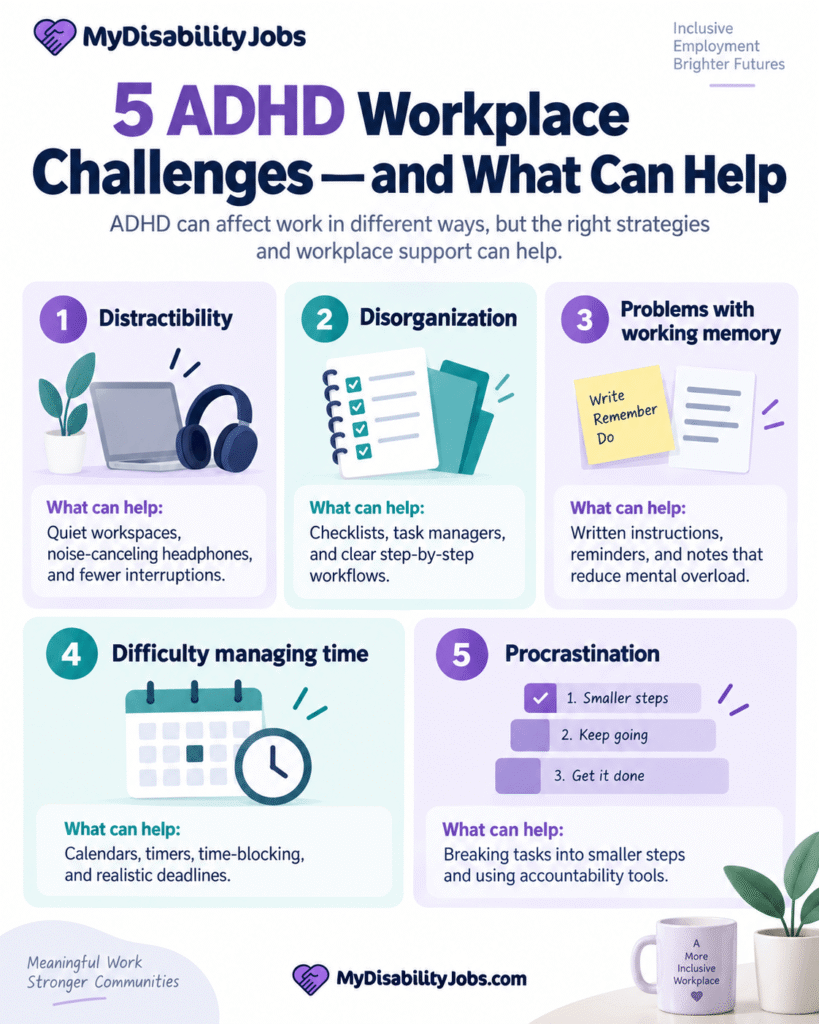
ADHD can affect attention, organization, impulse control, working memory, and the ability to manage time. But the way these characteristics appear at work can vary considerably from one person to another.
For example, one employee may find it difficult to remain focused during long periods of repetitive work but become highly engaged when solving an interesting problem. Another may enjoy repetitive tasks but struggle when priorities change without warning. Someone else may work effectively independently but find frequent interruptions particularly difficult.
That is why broad statements such as “people with ADHD need fast-paced jobs” or “people with ADHD are more creative” are not useful career rules. A person’s interests, experience, ADHD presentation, working style, and individual strengths all matter.
Some workplace challenges that people with ADHD may experience include:
- difficulty filtering distractions or interruptions
- organization and task prioritization challenges
- difficulty keeping information in working memory
- time-management problems or losing track of time
- procrastination or difficulty beginning tasks
- difficulty switching between tasks or stopping an engaging task
- managing deadlines and competing priorities
None of these automatically prevent someone from succeeding at work. The goal is to identify which environments make those challenges easier to manage and which tools, strategies, or ADHD accommodations at work may help.
What Makes a Job ADHD-Friendly?
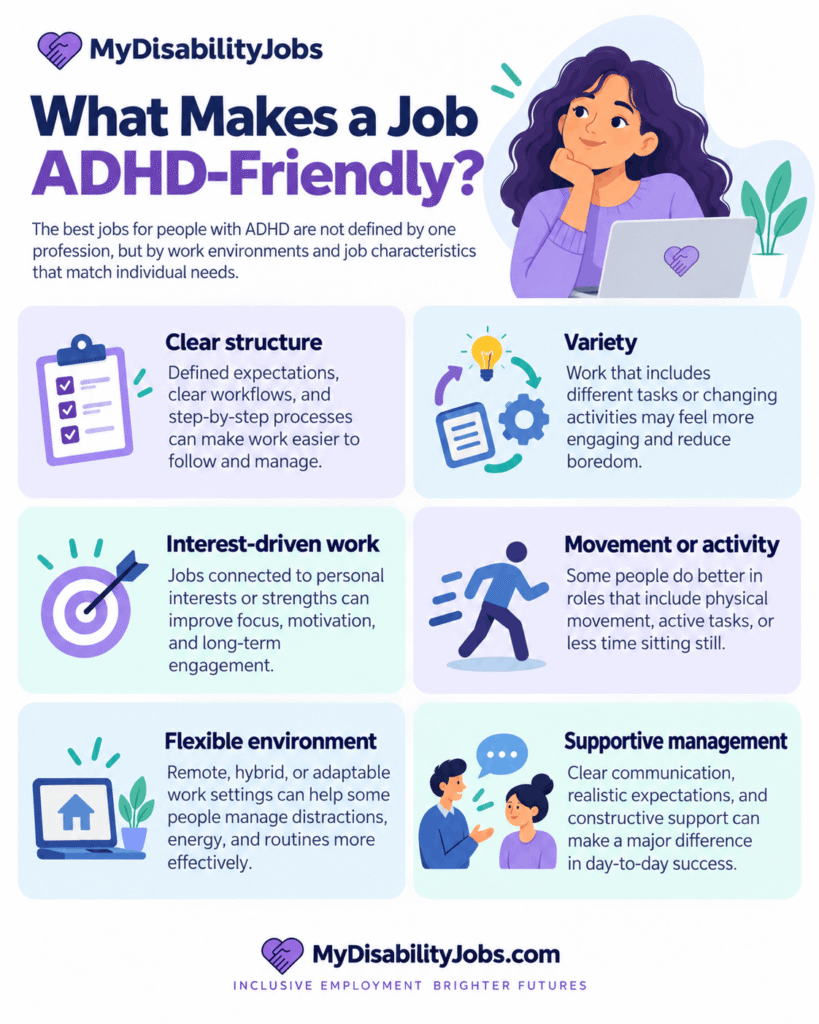
There is no universal definition of an ADHD-friendly job. The same occupation can be a strong fit for one person and a poor fit for another.
Rather than judging a career only by its title, compare the actual working conditions.
Clear structure
Defined responsibilities, visible priorities, clear deadlines, and established workflows can make it easier to know what needs to be done and what should come first.
That does not necessarily mean rigid supervision. Many people benefit from having clear goals while retaining some freedom in how they complete the work.
Variety
A role that includes different projects, people, locations, or types of tasks may help someone who finds highly repetitive work difficult to sustain.
However, variety should not be confused with constant chaos. Too many competing priorities or unpredictable interruptions can create their own challenges.
Interest-driven work
Interest can strongly influence engagement. A career connected to topics, activities, or problems someone genuinely enjoys may make it easier to maintain motivation.
This is one reason there is no single list of careers that works for everyone with ADHD.
Movement or activity
Some people prefer occupations that involve moving between tasks, locations, or physical activities rather than remaining at a desk throughout the day.
Others may prefer concentrated computer-based work, particularly when they have control over their environment.
A flexible environment
Remote, hybrid, flexible, or results-focused arrangements can give some workers greater control over distractions, commuting, breaks, and their workspace.
But remote work is not automatically easier. It can also require strong self-management and may involve fixed hours, meetings, communication expectations, and deadlines. For more context, see our guide to work from home with a disability.
Supportive management
The manager and workplace culture can matter as much as the career itself.
Clear communication, realistic priorities, constructive feedback, written instructions when useful, and a willingness to discuss workplace needs can substantially change the experience of a role.
How to Choose a Career When You Have ADHD
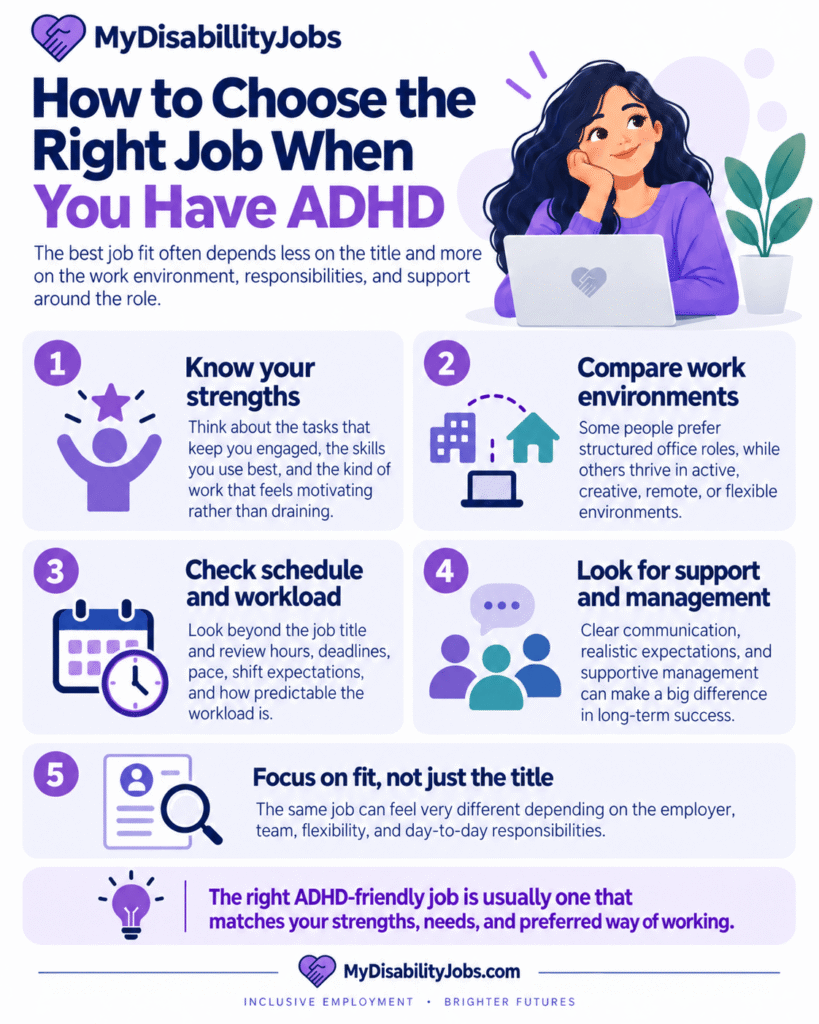
A list of recommended careers is useful for generating ideas, but it should not make the decision for you.
Before applying, compare each position with the way you actually prefer to work.
1. Identify the work that keeps you engaged
Think about previous jobs, school projects, hobbies, volunteering, or personal projects.
Which activities made it easy to stay engaged? Which ones felt exhausting or unusually difficult to begin?
Look for patterns rather than trying to identify a stereotypical “ADHD strength.”
2. Compare work environments
Ask yourself whether you prefer:
- working independently or with other people
- a desk-based or physically active role
- predictable routines or changing projects
- onsite, hybrid, or remote work
- frequent feedback or greater autonomy
These preferences can sometimes tell you more about career fit than the job title itself.
3. Look closely at schedules and workload
Two positions with the same title can have very different working conditions.
Before accepting a role, try to understand:
- normal working hours
- overtime expectations
- whether shifts rotate
- how frequently priorities change
- typical deadlines
- how many projects are handled simultaneously
- how much of the day involves meetings or interruptions
4. Consider management and workplace support
A strong manager can provide clear priorities and feedback without micromanaging. A poor management environment can make even an otherwise suitable occupation difficult.
When researching an employer, look beyond salary and job responsibilities to understand how teams communicate and how work is organized.
5. Focus on fit, not labels
You do not need to choose a career because somebody described it as “perfect for ADHD.”
A highly structured accounting role may suit one person. Another might prefer journalism or design. Someone else may enjoy an active healthcare or public-service occupation.
The goal is to find a sustainable combination of interest, responsibilities, environment, schedule, and support.
Best Careers for People With ADHD
The careers below offer different combinations of structure, variety, creativity, physical activity, human interaction, and independent work.
They should be treated as career options to investigate rather than jobs that are automatically suitable for everyone with ADHD.
If you are also researching work environments that may present different challenges, see our separate guide to the worst jobs for ADHD and careers to avoid.
1. Graphic Designer
Graphic designers create visual concepts for websites, advertising, branding, publications, social media, packaging, and other digital or print materials. The work combines creative problem-solving with clearly defined briefs, deadlines, and client or team feedback.
For some people with ADHD, this combination of structure and changing creative projects may be appealing. Graphic design can also be performed in many different environments, including agencies, in-house design teams, freelance businesses, and remote positions.
Why it may be a good fit for people with ADHD
Graphic design often provides variety without requiring an entirely unstructured workday. Designers may move between different clients, campaigns, visual formats, and creative problems while still working toward defined deliverables.
Someone who enjoys visual problem-solving and becomes deeply engaged in design projects may appreciate that balance. However, the job also involves revisions, detailed briefs, file organization, deadlines, and sometimes several projects at once. A good project-management system can therefore be just as important as creativity.
Main tasks include:
- Creating visual concepts for websites, advertisements, branding, social media, or print materials
- Developing layouts, typography, color systems, and other visual elements
- Using design software such as Adobe Photoshop, Illustrator, InDesign, Figma, or similar tools
- Meeting with clients or internal teams to understand project requirements
- Revising designs in response to feedback
- Preparing and organizing final files for digital or print delivery
Skills needed:
- Visual design and creative problem-solving
- Attention to detail and visual consistency
- Proficiency with relevant design software
- Ability to interpret project briefs and feedback
- Time management and deadline awareness
- Communication and collaboration skills
How to get started:
A degree in graphic design or a related field can be useful, but a strong portfolio is one of the most important assets when applying for design work. Beginners can learn core principles such as typography, layout, color, branding, and digital design through formal education or online training, then build a portfolio with personal projects, volunteer work, internships, or freelance assignments.
- Coursera – Graphic Design Specialization
- Udemy – Photoshop Essentials
- Alison – Diploma in Graphic Design
- Domestika – Creative Design Courses
- Skillshare – Graphic Design Classes
Expected salary:
According to the U.S. Bureau of Labor Statistics, graphic designers earned a median annual wage of $62,960 in May 2025. Earnings vary by industry, experience, location, and whether the designer works as an employee or freelancer. The BLS also notes that schedules can vary depending on workload and deadlines.
Source: U.S. Bureau of Labor Statistics
Where to find jobs:
- FlexJobs – Remote & Flexible Design Jobs
- Upwork – Freelance Graphic Design Projects
- Dribbble – Design & Creative Roles
- Behance – Graphic Design Job Listings
- MyDisabilityJobs – Browse Jobs
2. Journalist

Journalists research, verify, write, and report stories for newspapers, magazines, television, radio, digital publications, and other media organizations. The work can involve everything from interviewing sources and researching documents to attending events and producing stories under deadline.
For some adults with ADHD, the variety of topics, people, assignments, and work settings may help keep the role engaging. Journalism can include both independent research and highly collaborative work, depending on the position.
Why it may be a good fit for people with ADHD
Journalism can provide frequent changes in subject matter and clear short-term objectives: investigate a question, interview sources, verify the information, and complete the story by a deadline. Someone who enjoys learning about new subjects and moving between research, writing, and conversations may appreciate that variety.
The same characteristics can also make journalism demanding. Deadlines may be tight, priorities can change quickly, and accurate fact-checking remains essential even under pressure. News schedules may also include evenings, weekends, or irregular hours, depending on the role.
Main tasks include:
- Researching news stories, issues, people, or events
- Interviewing sources and subject-matter experts
- Writing articles, scripts, reports, or digital content
- Verifying facts and evaluating sources before publication
- Attending events, press conferences, meetings, or briefings
- Working with editors, photographers, producers, and other newsroom staff
Skills needed:
- Strong writing and storytelling skills
- Research and fact-checking ability
- Curiosity and critical thinking
- Interviewing and communication skills
- Ability to organize information under deadlines
- Attention to accuracy, ethics, and source reliability
How to get started:
News analysts, reporters, and journalists typically need a bachelor’s degree, according to the BLS, although entry routes vary. Experience on a college publication, radio station, television station, local publication, internship, or freelance assignment can help build practical skills. A portfolio of published work is especially useful when applying for journalism positions.
- Coursera – Journalism Specialization
- Alison – Diploma in Journalism
- edX – Journalism Courses
- Udemy – How to Be a Journalist
- NBCU Academy – Fundamentals of Journalism
Expected salary:
The U.S. Bureau of Labor Statistics reports that news analysts, reporters, and journalists earned a median annual wage of $62,200 in May 2025. Pay can vary considerably by employer, market, experience, and type of media organization. The BLS also notes that schedules vary and that many people in the occupation work full time.
Source: U.S. Bureau of Labor Statistics
Where to find jobs:
- FlexJobs – Remote & Flexible Journalism Jobs
- Indeed – Journalist Job Listings
- Mediabistro – Media & Journalism Jobs
- MyDisabilityJobs – Browse Jobs
3. Personal Trainer
Personal trainers help clients improve fitness, strength, mobility, and overall physical conditioning through individualized exercise programs and coaching. The work is typically hands-on and involves regular interaction with clients, demonstrations, progress tracking, and changes to exercise plans.
For some people with ADHD, a role that includes physical movement, scheduled client sessions, and different people throughout the day may be appealing. Trainers can work in gyms, recreation centers, wellness facilities, clients’ homes, or independently.
Why it may be a good fit for people with ADHD
Personal training combines structured appointments with an active working environment. Each client has different goals and abilities, which can create variety while still giving the trainer a clear purpose for each session.
The career can offer autonomy as well, particularly for self-employed trainers. However, independent trainers must manage scheduling, client follow-up, marketing, payments, and other administrative work. Some positions also involve early mornings, evenings, weekends, or variable hours.
Main tasks include:
- Assessing clients’ current fitness levels, needs, and goals
- Creating individualized exercise programs
- Demonstrating exercises and appropriate technique
- Monitoring progress and adjusting programs when needed
- Motivating and educating clients about exercise and healthy habits
- Maintaining safe training practices and organized client records
Skills needed:
- Knowledge of exercise technique and basic fitness principles
- Clear communication and coaching skills
- Ability to adapt exercises to different clients and abilities
- Organization and appointment management
- Observation and attention to safe technique
- Relevant personal-training certification when required or preferred by employers
How to get started:
Education requirements vary by employer and specialty. The BLS notes that employers commonly prefer trainers who have certification, and some roles require additional credentials such as CPR or first-aid training. A recognized certification can provide structured training in exercise programming, client assessment, safety, and coaching.
- NASM – Certified Personal Trainer Program
- ACE – Personal Trainer Certification
- ISSA – Certified Personal Trainer
- Coursera – Getting Started as a Personal Fitness Trainer
Trainers who later offer virtual coaching may also be interested in options to work from home with a Disability, although running an online training business requires additional self-management and client administration.
Expected salary:
The U.S. Bureau of Labor Statistics reports that fitness trainers and instructors earned a median annual wage of $47,160 in May 2025. Earnings vary according to experience, location, employer, hours worked, and whether someone is employed or self-employed. The BLS notes that many trainers work variable or part-time schedules that may include nights, weekends, or holidays.
Source: U.S. Bureau of Labor Statistics
Where to find jobs:
- Indeed – Personal Trainer Listings
- FlexJobs – Remote & Flexible Fitness Jobs
- LinkedIn Jobs – Fitness & Wellness Roles
- MyDisabilityJobs – Browse Jobs
4. Social Worker

Social workers help individuals, families, and communities address challenges involving healthcare, housing, education, mental health, family services, disability support, and access to public or community resources. Depending on the specialty, they may work in hospitals, schools, government agencies, nonprofit organizations, clinics, or community programs.
For some adults with ADHD, social work can provide meaningful interpersonal work, changing cases, and clearly defined professional responsibilities rather than a highly repetitive daily routine.
Why it may be a good fit for people with ADHD
Social work often combines human interaction, problem-solving, advocacy, and practical coordination. Someone who enjoys working directly with people and solving different real-world problems may find the variety engaging.
Many roles also operate within established procedures, teams, and service plans, providing structure around the work. At the same time, social workers may handle multiple cases, detailed documentation, deadlines, and emotionally demanding situations, so organization systems and workload management are important.
Main tasks include:
- Assessing clients’ needs, circumstances, and available support
- Developing or coordinating service and care plans
- Connecting clients with healthcare, housing, benefits, education, or community resources
- Advocating for clients and helping them navigate services
- Responding to crises or changing client needs
- Maintaining accurate case notes, records, and required documentation
Skills needed:
- Empathy and active listening
- Clear verbal and written communication
- Organization and case-management skills
- Problem-solving and resource coordination
- Ability to maintain professional boundaries
- Knowledge of social services, community resources, and relevant professional requirements
How to get started:
Education and licensing requirements depend on the type of social work. Many positions require a Bachelor of Social Work (BSW) or a related degree, while clinical social workers generally need a Master of Social Work (MSW), supervised experience, and state licensure. Volunteering or working with community organizations can also help prospective social workers learn more about the field before committing to a degree path.
Expected salary:
According to the U.S. Bureau of Labor Statistics, social workers earned a median annual wage of $61,780 in May 2025. Pay varies significantly by specialty: healthcare social workers, mental health and substance abuse social workers, child and family social workers, and other social-work occupations have different median wages.
Source: U.S. Bureau of Labor Statistics
Where to find jobs:
- FlexJobs – Remote & Flexible Social Work Jobs
- Indeed – Social Worker Job Listings
- LinkedIn Jobs – Social Worker Roles
- MyDisabilityJobs – Browse Jobs
5. Artist

Artists create original work using visual, physical, digital, or mixed media. Depending on the career path, this may include painting, illustration, sculpture, photography, digital art, commercial artwork, or other creative disciplines. Some artists work for organizations, while many work independently or combine commissioned work with their own projects.
For some people with ADHD, the opportunity to work on personally meaningful projects, experiment with different ideas, and vary the creative process may make artistic work appealing.
Why it may be a good fit for people with ADHD
Artistic work can offer a high degree of variety and, in some settings, autonomy over how projects are completed. Someone who finds it easier to stay engaged with visually creative or interest-driven tasks may enjoy developing concepts and turning them into finished work.
However, professional art also involves responsibilities beyond creating. Independent artists may need to manage deadlines, pricing, finances, client communication, marketing, inventory, and self-promotion. Building external structure around those tasks can be important for maintaining a sustainable career.
Main tasks include:
- Developing concepts and creating original artwork
- Selecting materials, techniques, software, or other creative tools
- Revising work in response to client, gallery, or project requirements
- Preparing artwork for presentation, sale, publication, or exhibition
- Building and maintaining a professional portfolio
- Promoting work and communicating with potential clients or buyers
Skills needed:
- Technical ability in the chosen artistic medium
- Visual communication and creative problem-solving
- Ability to accept and apply constructive feedback
- Project and deadline management
- Portfolio development and presentation
- Basic marketing, client communication, or business skills for independent work
How to get started:
There is no single route into an art career. Some artists complete fine-arts or design programs, while others develop their skills through workshops, online courses, apprenticeships, or sustained independent practice. A strong portfolio is essential for demonstrating your work to potential employers, clients, galleries, or buyers.
- Coursera – Music and Art Courses
- Skillshare – Illustration & Creative Arts
- Udemy – Art Courses
- Alison – Diploma in Graphic Design
- Domestika – Creative Arts Courses
You can also explore our broader guide to jobs for the mentally disabled for additional career ideas across creative and non-creative fields.
Expected salary:
Income in artistic careers varies widely, particularly because many artists are self-employed. The U.S. Bureau of Labor Statistics reports that craft and fine artists earned a median annual wage of $55,290 in May 2025. The BLS notes that earnings for self-employed artists vary considerably and that some artists hold another job while developing their artistic careers.
Source: U.S. Bureau of Labor Statistics
Where to find jobs:
- FlexJobs – Remote Art & Creative Jobs
- Behance – Creative Job Listings
- Dribbble – Design & Creative Roles
- MyDisabilityJobs – Browse Jobs
6. Lawyer

Lawyers advise and represent individuals, businesses, government agencies, and other organizations on legal matters. Their work may involve researching laws and precedents, preparing legal documents, negotiating agreements, advising clients, or representing them in court.
For some adults with ADHD, legal work can be appealing because it combines intellectually challenging problems with clearly defined rules, procedures, and deadlines. The day-to-day experience varies considerably by specialty, employer, and type of practice.
Why it may be a good fit for people with ADHD
Legal work can provide a useful combination of structure and variety. Lawyers often work within formal procedures and deadlines while moving between research, writing, client meetings, negotiations, and case strategy.
Someone who enjoys analyzing complex problems or becoming deeply engaged in a subject may find certain areas of law particularly interesting. However, the profession also requires sustained reading, careful documentation, detailed time management, and the ability to handle multiple deadlines. Some lawyers also work more than 40 hours per week, particularly when preparing for trials or major transactions.
Main tasks include:
- Advising clients about legal rights, responsibilities, and possible courses of action
- Researching laws, regulations, and previous court decisions
- Preparing contracts, briefs, pleadings, wills, and other legal documents
- Negotiating settlements, agreements, or other resolutions
- Representing clients in court, hearings, or arbitration when required
- Managing case files, evidence, deadlines, and client communications
Skills needed:
- Analytical and critical-thinking skills
- Strong written and verbal communication
- Careful legal research and attention to detail
- Organization and deadline management
- Negotiation and advocacy skills
- Juris Doctor degree and bar admission for practicing attorneys
How to get started:
Becoming a lawyer generally requires completing a bachelor’s degree, earning a Juris Doctor (JD) from an accredited law school, and meeting the licensing requirements of the state where you plan to practice. Exploring different legal specialties before or during law school can help you understand whether you prefer litigation, transactional work, public-interest law, corporate practice, or another area.
- Coursera – Introduction to American Law
- edX – Law Courses
- Udemy – Law Courses
- LSAC – Law School Admission Council
- National Paralegal College
Expected salary:
According to the U.S. Bureau of Labor Statistics, lawyers earned a median annual wage of $159,670 in May 2025. Pay varies substantially by employer, location, legal specialty, and experience. The BLS notes that some lawyers work more than 40 hours per week.
Source: U.S. Bureau of Labor Statistics
Where to find jobs:
- FlexJobs – Remote & Flexible Legal Jobs
- Indeed – Lawyer Job Listings
- Glassdoor – Legal Positions
- LinkedIn Jobs – Legal Opportunities
- MyDisabilityJobs – Browse Disability-Friendly Jobs
7. Entrepreneur
Entrepreneurs create and operate businesses, which may range from freelance services and small online companies to local businesses and larger startups. The work can involve product development, sales, marketing, finance, customer service, hiring, and day-to-day operations.
For some adults with ADHD, entrepreneurship can be appealing because it offers autonomy, variety, and the ability to build a business around a subject or service they find genuinely interesting. At the same time, running a business requires substantial self-management and should not be treated as an automatically ADHD-friendly career.
Why it may be a good fit for people with ADHD
Entrepreneurship can give someone more control over what they work on, how they organize their day, and the environment in which they work. It may also involve a wide variety of tasks rather than a single repetitive routine.
However, that freedom comes with responsibility. Business owners often need to manage priorities, deadlines, invoices, taxes, customer follow-up, marketing, documentation, and long-term planning without the external structure provided by a traditional employer. Systems for scheduling, bookkeeping, delegation, and accountability can therefore be especially valuable.
Main tasks include:
- Identifying customer needs and business opportunities
- Developing and improving products or services
- Marketing and selling to potential customers or clients
- Managing budgets, expenses, payments, and business operations
- Communicating with customers, suppliers, contractors, or employees
- Reviewing results and adapting the business strategy when needed
Skills needed:
- Problem-solving and decision-making
- Organization and prioritization
- Communication and customer-service skills
- Basic financial and budgeting knowledge
- Sales, marketing, or business-development skills
- Ability to adapt while maintaining focus on longer-term goals
How to get started:
Entrepreneurship does not require one specific degree or career path. Many people begin with freelance work, consulting, a small online business, or a side project before committing to a larger company. Testing an idea on a small scale can help determine whether there is genuine customer demand before investing significant time or money.
Training in business planning, marketing, bookkeeping, and financial management can also make the administrative side of entrepreneurship easier to manage.
- Coursera – Entrepreneurship Specialization
- Udemy – Entrepreneurship Course
- Alison – Diploma in Entrepreneurship
- edX – Entrepreneurship Courses
- SCORE – Free Mentorship & Business Advice for Entrepreneurs
Expected salary:
Entrepreneur income varies too widely for a single salary figure to accurately represent the career. Business owners may initially earn little or reinvest profits into the company, while established businesses may generate substantially higher income. Earnings depend on the business model, profitability, industry, location, ownership structure, and how much revenue is retained in the company.
Where to find opportunities:
- Upwork – Freelance Projects to Start a Business
- Freelancer – Global Freelance Marketplace
- Shopify – Build Your Online Store
- Fiverr – Launch Freelance Services
8. Doctor
Doctors diagnose illnesses, provide treatment, monitor patients, and help people manage or prevent health conditions. Medical careers vary enormously, from primary care and psychiatry to radiology, surgery, emergency medicine, pathology, and many other specialties.
For some adults with ADHD, medicine can provide meaningful work, intellectually challenging problems, structured professional standards, and considerable variety. Whether a particular medical career is a good fit depends heavily on the specialty, workplace, schedule, and individual working style.
Why it may be a good fit for people with ADHD
Medicine can combine structured procedures with changing clinical problems. Physicians may move between patient consultations, diagnostic decisions, treatment planning, procedures, and collaboration with other healthcare professionals.
Someone who enjoys complex problem-solving and is strongly interested in medicine may find this work engaging. However, physicians also need sustained attention to patient safety, documentation, medication decisions, follow-up, and professional standards. Some specialties involve long or irregular hours, overnight work, or on-call responsibilities, making it important to evaluate the actual working conditions rather than the profession only by its title.
Main tasks include:
- Examining patients and evaluating symptoms
- Diagnosing illnesses, injuries, or other medical conditions
- Ordering and interpreting diagnostic tests
- Developing and monitoring treatment plans
- Prescribing medication or performing procedures when appropriate
- Maintaining accurate medical records and coordinating care with other professionals
Skills needed:
- Medical knowledge and clinical reasoning
- Careful attention to patient safety and documentation
- Clear communication with patients and healthcare teams
- Ability to organize and prioritize clinical responsibilities
- Emotional resilience and professional judgment
- Medical degree, residency training, licensure, and specialty-specific credentials
How to get started:
Physicians typically complete a bachelor’s degree followed by medical school. The U.S. Bureau of Labor Statistics notes that medical school generally takes an additional four years, followed by approximately three to nine years of internship and residency training depending on the specialty. Additional fellowship training may be required for subspecialties.
Students considering medicine should research not only the subject matter but also the day-to-day working conditions of different specialties, because schedules, patient contact, procedures, documentation demands, and workplace environments vary considerably.
- Coursera – Medicine Courses
- Alison – Health and Medicine Courses
- edX – Medicine Courses
- Udemy – Medical Terminology 101
- UCSF – Course and Study List Registration Information
- AMA – Physician Career Planning Resources
Expected salary:
The U.S. Bureau of Labor Statistics reports that physicians and surgeons earned a median annual wage of $275,930 in May 2025. Earnings vary substantially by medical specialty, employer, location, and experience. For example, BLS wage data show large differences among specialties such as pediatrics, emergency medicine, radiology, cardiology, surgery, and anesthesiology.
Source: U.S. Bureau of Labor Statistics
Where to find jobs:
- Indeed – Doctor & Medical Job Listings
- DocCafe – Doctor and Advanced Practice Opportunities
- LinkedIn Jobs – Medical Positions
- MyDisabilityJobs – Browse Disability-Friendly Healthcare Jobs
9. Police Officer
Police officers protect the public, respond to emergencies, investigate incidents, enforce laws, prepare reports, and work with community members. The occupation combines fieldwork with significant procedural, administrative, and documentation responsibilities.
For some adults with ADHD, the combination of structured procedures, teamwork, changing situations, and work outside a traditional desk environment may be appealing. However, police work is safety-sensitive and requires consistent judgment, attention, accurate reporting, and adherence to department procedures.
Why it may be a good fit for people with ADHD
Police work can provide clear responsibilities, formal training, established procedures, and a team-based environment. Depending on the assignment, officers may also move between patrol, public interaction, investigations, documentation, and other duties.
Those characteristics may suit someone who prefers varied and active work. At the same time, the profession requires sustained attention during safety-critical situations, accurate written records, emotional regulation, and careful compliance with policies and laws. Shift work is also common, including nights, weekends, and holidays.
ADHD itself should not be treated as evidence that someone will perform better in high-pressure situations. Suitability depends on the individual and on meeting the requirements of the specific agency and position.
Main tasks include:
- Patrolling assigned areas and responding to calls for service
- Enforcing laws and investigating possible offenses
- Interviewing witnesses, victims, or suspects
- Collecting information and evidence
- Preparing detailed reports and maintaining case records
- Working with community members and other public-safety professionals
Skills needed:
- Sound judgment and decision-making
- Clear written and verbal communication
- Observation and accurate documentation
- Ability to follow procedures and legal requirements
- Teamwork and conflict-management skills
- Physical fitness and the ability to meet agency-specific qualifications
How to get started:
Requirements vary by agency and jurisdiction. The U.S. Bureau of Labor Statistics notes that entry requirements range from a high school diploma to a college degree. Most police officers must graduate from their agency’s training academy and complete a period of on-the-job training.
Candidates should review the specific educational, physical, background, licensing, and other requirements of the department where they intend to apply.
- U.S. Supreme Court Police – Qualifications and Requirements
- Rasmussen University – How to Become a Police Officer
Expected salary:
The U.S. Bureau of Labor Statistics reports that police and detectives earned a median annual wage of $77,310 in May 2025. Within that category, police and sheriff’s patrol officers had a median annual wage of $76,210. Pay varies by occupation, agency, jurisdiction, experience, and location.
Source: U.S. Bureau of Labor Statistics
Where to find jobs:
- Indeed – Police Officer Listings
- USAJobs – Federal Law Enforcement Positions
- U.S. Supreme Court Police – Career Information
10. Firefighter
Firefighters respond to fires, accidents, medical emergencies, hazardous situations, and other incidents that threaten people or property. Their work also includes training, maintaining equipment, inspecting facilities, completing reports, and educating communities about fire prevention and safety.
For some adults with ADHD, the combination of teamwork, physical activity, formal procedures, and varied responsibilities may be appealing. Firefighting is also a safety-critical occupation, so the ability to consistently follow procedures and maintain attention during both emergencies and routine duties is essential.
Why it may be a good fit for people with ADHD
Fire departments provide substantial external structure through training, procedures, team roles, equipment checks, drills, and established chains of command. The job also includes a mix of emergency response, physical tasks, maintenance, training, and community-safety work.
That variety may appeal to someone who prefers active work over a conventional desk-based role. However, firefighting also requires careful adherence to safety protocols, sustained attention, accurate communication, physical fitness, and the ability to work long or irregular hours. The BLS notes that firefighters often work long periods and that overtime is common.
ADHD should therefore not be framed as an advantage in emergency decision-making. The relevant question is whether the individual can meet the professional and safety requirements of the role.
Main tasks include:
- Responding to fires, accidents, medical emergencies, and other incidents
- Controlling and extinguishing fires
- Rescuing people from hazardous situations
- Providing emergency medical assistance when trained and required
- Inspecting and maintaining firefighting equipment and vehicles
- Participating in training, drills, prevention programs, and safety education
Skills needed:
- Knowledge of emergency and fire-safety procedures
- Ability to follow instructions and team protocols
- Physical fitness and stamina
- Clear communication during routine and emergency situations
- Situational awareness and careful attention to safety
- Required firefighting, emergency-medical, and local credentials
How to get started:
Firefighters typically need at least a high school diploma and training in emergency medical services. Most receive formal training at a fire academy. Certification requirements vary by state and locality, and many departments require or prefer Emergency Medical Technician credentials.
Prospective firefighters should check the hiring standards of the departments where they plan to apply, including physical testing, medical requirements, background checks, academy training, and any required emergency-medical certification.
- U.S. Fire Administration – Online Fire Service Training
- Alison – Fire Safety Training
- NFPA – Fire and Safety Training
- Udemy – Basic Fire Fighting
Expected salary:
According to the U.S. Bureau of Labor Statistics, firefighters earned a median annual wage of $59,280 in May 2025. Earnings vary by location, department, experience, and overtime. The BLS notes that firefighters typically work long periods, that work schedules vary, and that overtime is common.
Source: U.S. Bureau of Labor Statistics
Where to find jobs:
Resources for Individuals with ADHD Seeking Employment
People with ADHD may be able to access career guidance, workplace-accommodation support, training resources, and disability employment services. The following organizations can be useful starting points:
- Job Accommodation Network (JAN): Free guidance on workplace accommodations, disability disclosure, and employment rights.
- Attention Deficit Disorder Association (ADDA): Resources, education, and community support specifically for adults with ADHD.
- National Alliance on Mental Illness (NAMI): Mental-health education, support resources, and information that may be useful when navigating work and accommodations.
- Vocational Rehabilitation Services: State vocational rehabilitation agencies can help eligible people with disabilities prepare for, obtain, and maintain employment. Because programs are administered at the state level, services and eligibility requirements vary by location.
- CareerOneStop: U.S. Department of Labor-sponsored tools for career exploration, training, résumés, and job searching.
These services will not all be relevant to every job seeker, but they can provide useful support when exploring careers, requesting accommodations, building skills, or returning to work.
For guidance on whether to disclose a disability during a job application, see our separate guide.
Final Thoughts
There is no single career that is best for every person with ADHD. A job that works well for one person may be frustrating for another, even when they have the same diagnosis.
When comparing careers, look beyond the job title. Consider the tasks you enjoy, the amount of structure you prefer, how much variety or movement you want, the schedule, workload, management style, and whether the work environment supports the way you function best.
The careers in this guide are starting points rather than rules. Explore the options that match your interests and skills, then evaluate individual employers and job descriptions carefully.
With the right combination of responsibilities, environment, support, and personal interest, people with ADHD can build successful and sustainable careers across many different fields.
FAQ
Yes. People with ADHD work successfully across many different industries and professions. Career fit depends less on the diagnosis itself and more on factors such as interests, skills, responsibilities, work environment, schedule, and the level of structure or support available.
There is no single job that is best for everyone with ADHD. Some people may prefer careers with variety, movement, creative problem-solving, or frequent interaction, while others may perform better in highly structured roles with predictable routines. Graphic design, journalism, personal training, social work, law, medicine, and other careers can all be worth exploring depending on the individual.
An ADHD-friendly job is usually one that matches the individual’s preferred way of working. Helpful characteristics may include clear expectations, manageable workloads, engaging tasks, some variety, opportunities for movement, flexibility, and supportive management. The same occupation can feel very different depending on the employer and workplace.
Not necessarily. Some people may enjoy fast-paced or changing environments, while others may find constant interruptions, unpredictable schedules, or high-pressure decisions difficult to manage. ADHD should not be treated as an automatic advantage in emergency or safety-sensitive work. The demands of the specific role and the individual’s working style matter more.
Yes. Remote work can help some people control distractions, commuting, breaks, and their physical workspace. However, working from home can also require more self-management, planning, and organization. A remote job is therefore not automatically better for someone with ADHD; it depends on the person and the structure of the role.
Useful accommodations depend on the employee and the job. Examples may include written instructions, quieter workspaces, reduced interruptions, task-management tools, flexible scheduling, regular check-ins, modified break schedules, or clearer prioritization of assignments. Employees who need accommodation guidance can also consult the Job Accommodation Network (JAN).