
20 Best Jobs for People With MS in 2026: Careers, Accommodations & Resources
Living with multiple sclerosis does not automatically determine whether you can work or what kind of career you can pursue. MS affects people differently, and symptoms and support needs can also change over time. For that reason, there is no single job that is right for everyone with MS.
A better approach is to look at the actual demands of a job: how much standing or walking it requires, whether the schedule is predictable, whether remote or hybrid work is available, how much control you have over your environment, and whether reasonable accommodations could help you perform the essential duties.
This guide covers 20 jobs for people with MS across remote-friendly, analytical, financial, healthcare-information, administrative, and communication careers. For each job, we will look at what the work involves, why some people with MS may find its working conditions useful, potential drawbacks, skills and training requirements, current salary data, and where to find relevant job opportunities.
The guide also covers low-stress work, remote jobs, workplace accommodations, disclosure, career changes, and employment resources so you can evaluate more than just a job title.
If you want to compare these careers with a broader range of options, you can also explore our guide to easy jobs for disabled adults and current jobs for people with disabilities.
Table of Contents
- Can You Work With Multiple Sclerosis?
- What Makes a Job MS-Friendly?
- What Does “Low Stress” Mean When You Have MS?
- Remote and Work-From-Home Jobs for People With MS
- 20 Jobs for People With MS
- Workplace Accommodations for People With MS
- Should You Tell Your Employer You Have MS?
- Changing Careers, Reducing Hours, or Retraining With MS
- How to Find Disability-Friendly Employers
- How to Avoid Job Scams When Searching for Remote Work
- Employment and Career Resources for People With MS
- Final Thoughts
- Frequently Asked Questions
Can You Work With Multiple Sclerosis?
Yes. Many people with multiple sclerosis continue working after diagnosis, although the type of work, number of hours, work environment, and accommodations that are appropriate vary from person to person.
The more useful question is often not simply “Can I work with MS?” but “What working conditions allow me to do my job effectively?” Someone may continue in the same career without changes, while another person may benefit from an adjusted schedule, modified workstation, remote or hybrid work, additional breaks, changes to nonessential duties, or a transition to a different role.
The Job Accommodation Network explains that people with MS can experience very different functional limitations and that not everyone with MS needs workplace accommodations. When accommodations are needed, they should be considered individually based on the employee’s limitations and job duties.
Under the Americans with Disabilities Act, qualified applicants and employees with disabilities may be entitled to reasonable accommodations when needed to apply for a job or perform its essential functions, unless providing the accommodation would create an undue hardship for the employer.
Useful resources:
- Job Accommodation Network — Multiple Sclerosis
- U.S. Equal Employment Opportunity Commission — The ADA: Your Employment Rights as an Individual With a Disability
If your current position is becoming difficult, leaving the workforce is not necessarily the only option. Depending on your situation and employer, possibilities may include adjusting duties, modifying your schedule, working remotely where feasible, reducing hours, retraining, or moving into a different role.
What Makes a Job MS-Friendly?
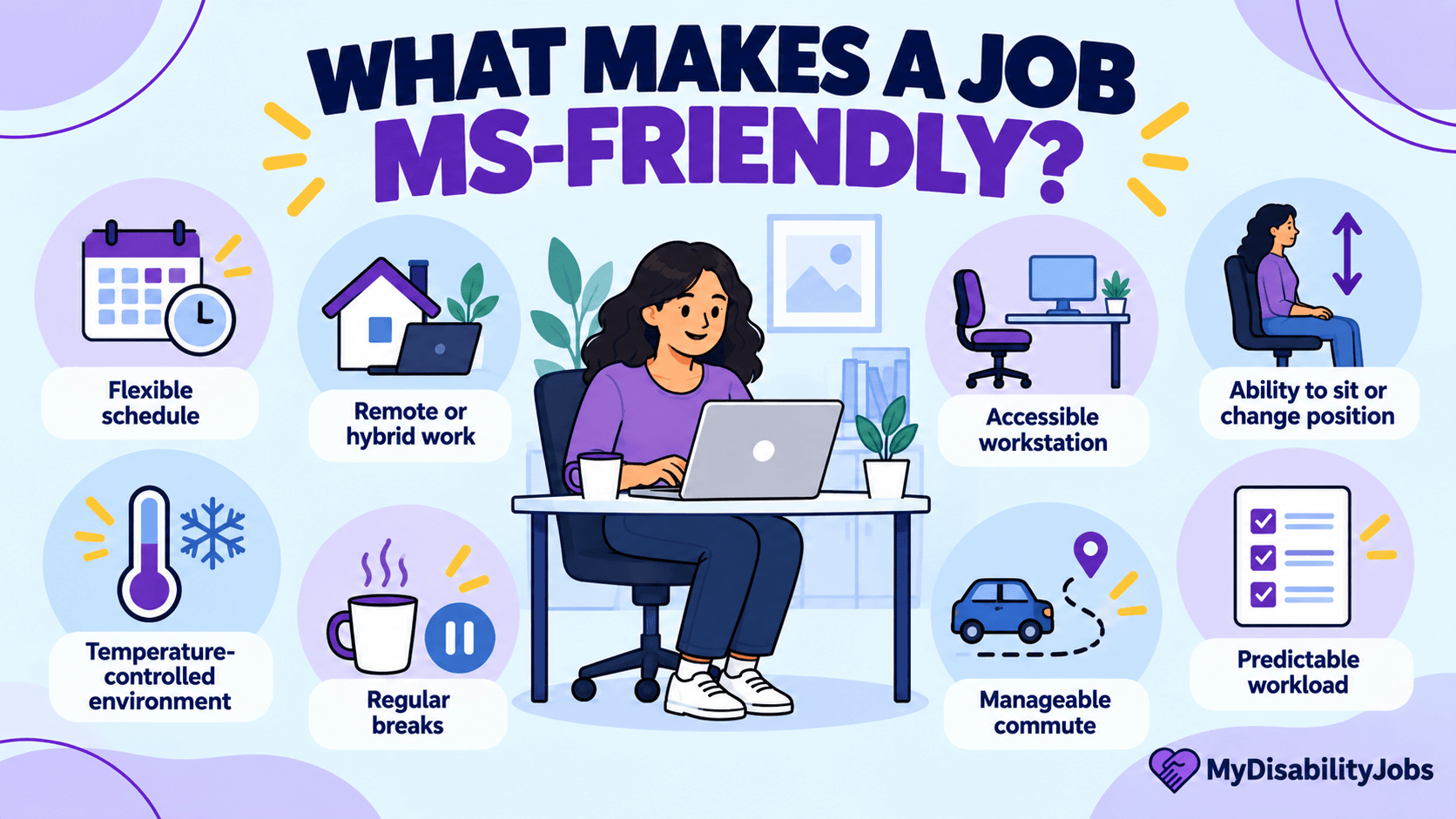
There is no official category of “MS-friendly jobs,” and a role that works well for one person with multiple sclerosis may be unsuitable for another. Instead of judging a career only by its title, it is more useful to examine the conditions under which the work is performed.
Depending on your individual needs, factors worth considering can include:
- How much standing, walking, lifting, or other physical activity the job requires
- Whether you can alternate between sitting and standing
- Whether the workplace is physically accessible
- How much control you have over temperature and the work environment
- Whether remote or hybrid work is realistically available
- Whether the schedule is fixed, flexible, part time, or shift based
- How long and demanding the commute is
- Whether breaks can be taken when needed
- How predictable the workload is
- How frequently the job involves urgent deadlines or interruptions
- The amount of concentration, multitasking, reading, or screen time required
- Whether the role involves frequent travel
- How much customer, client, or public interaction is involved
- Whether assistive technology or other workplace accommodations could be used effectively
Some people with MS may prioritize a seated role or accessible workstation. Others may care more about flexible scheduling, reduced commuting, temperature control, or the ability to work from home. Cognitive demands are also important to consider: a physically undemanding job may still require prolonged concentration, rapid task switching, complex decision-making, or frequent deadlines.
This is why the careers in this guide are not presented as universally suitable for everyone with MS. Each occupation will include a balanced discussion of potentially useful work characteristics as well as realistic demands and limitations.
People specifically looking for occupations with limited standing or walking may also want to review our guide to sit-down jobs for disabled people.
What Does “Low Stress” Mean When You Have MS?
Searches for low-stress jobs for people with MS are common, but “low stress” is highly individual. A quiet job with little physical activity may still involve difficult deadlines. A remote position may remove commuting but involve a heavy workload. A predictable office job may suit one person while another values greater control over working hours.
Instead of looking for a supposedly stress-free occupation, consider which sources of work pressure matter most to you.
These may include:
- Tight or frequently changing deadlines
- High production targets
- Constant interruptions
- Customer complaints or conflict
- Unpredictable shifts
- Mandatory overtime
- Long commutes
- Frequent travel
- Limited opportunities to take breaks
- High physical demands
- Long periods of concentration without interruption
- Heavy multitasking
- Lack of control over the work environment
A job with a predictable schedule and manageable workload may feel relatively low stress to one person, while another may prefer freelance or remote work that provides greater autonomy. The employer, team, workload, manager, and available accommodations can make the same occupation feel very different from one workplace to another.
When reviewing the 20 careers below, look at the drawbacks as carefully as the advantages. A role should not be considered a good fit simply because it can be done while sitting down or using a computer.
Remote and Work-From-Home Jobs for People With MS
Remote work can be useful for some people with MS, but it should not automatically be treated as easier or less stressful than working on site.
Depending on the position, working from home may eliminate a commute, provide greater control over temperature and the physical workspace, make it easier to use an accessible or ergonomic workstation, and provide access to opportunities that are not available locally.
Remote jobs can still involve fixed schedules, video meetings, productivity targets, long periods at a computer, frequent communication, and strict deadlines. Some employers also require workers to live within a particular state or region even when a position is fully remote.
When comparing remote opportunities, check:
- Whether the position is fully remote, hybrid, or temporarily remote
- Whether working hours are fixed or flexible
- Whether there are required core hours
- How many meetings are normally expected
- Whether the job is primarily independent or collaborative
- Whether performance is measured through quotas or productivity targets
- Whether occasional travel or office attendance is required
- Whether the employer provides equipment or expects you to supply your own
- Whether the job is an employee position or independent contract work
Several careers in this guide — including technical writing, content writing, editing, software development, web development, accounting, translation, and some analytical and administrative roles — may be available in remote or hybrid arrangements depending on the employer and position.
For more options, see our guide to work-from-home jobs for people with disabilities.
20 Jobs for People With MS
The jobs below are grouped by work style rather than ranked from “best” to “worst.” That is intentional. The right fit depends on your skills, experience, individual needs, preferred schedule, work environment, and the accommodations available.
Some of these roles are commonly available remotely, while others are better suited to structured office environments. Several require a bachelor’s degree or specialized training, while others offer more accessible entry routes.
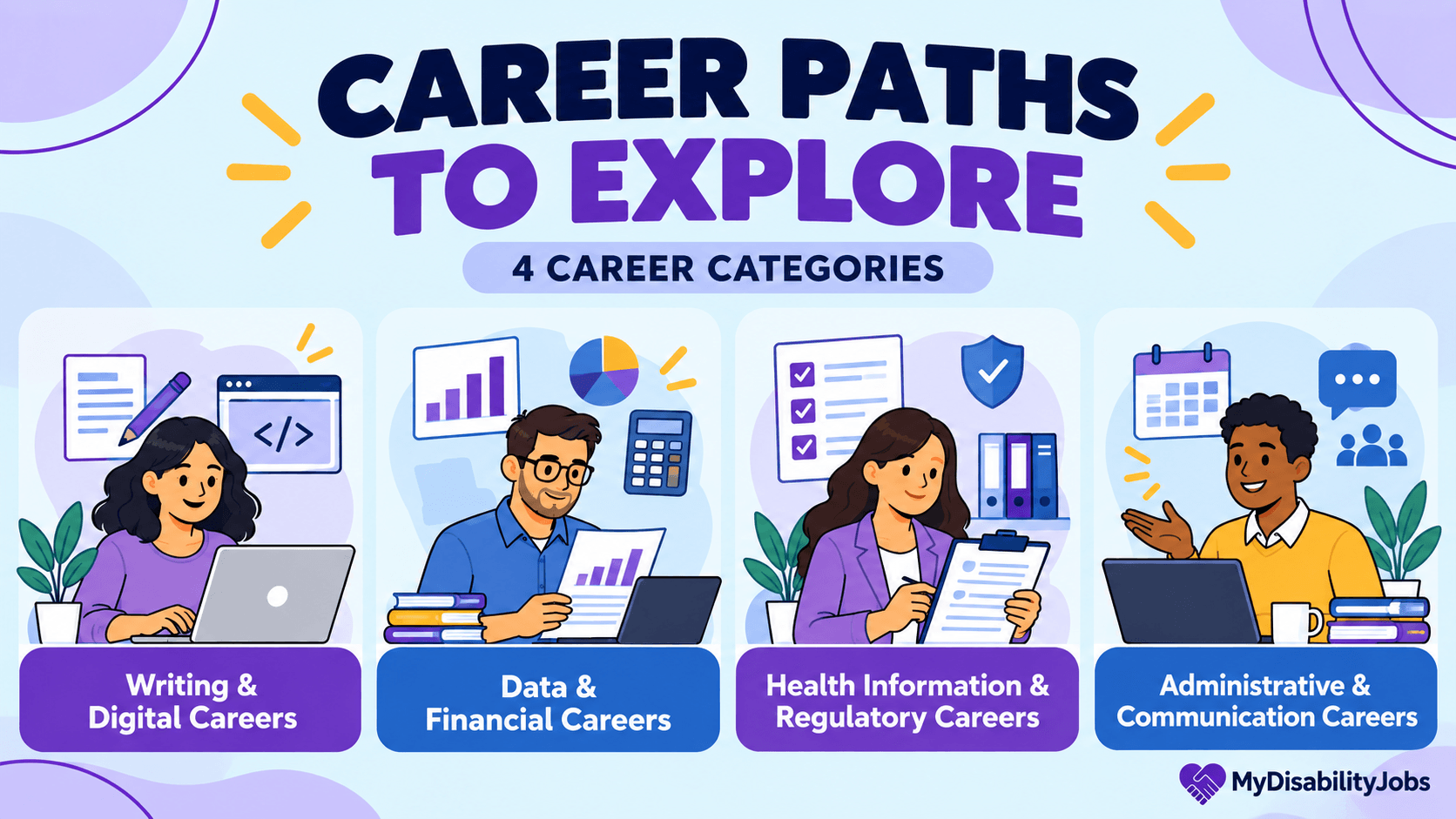
In the next phase, the 20 careers will be divided into four practical groups:
- Remote-Friendly, Writing & Digital Careers
- Analytical, Data & Financial Careers
- Health Information, Regulatory & Structured Office Careers
- Flexible, Administrative & Communication Careers
Remote-Friendly, Writing & Digital Careers
These careers are primarily computer-based and are commonly found in office, hybrid, remote, freelance, or self-employed arrangements depending on the occupation and employer. For some people with MS, reducing commuting or having greater control over the physical work environment may be useful.
Remote or computer-based work is not automatically low stress. Writing and technology careers can involve deadlines, long periods of screen time, sustained concentration, meetings, collaboration, and periods of high workload. Review the actual duties and working conditions of each position rather than assuming that remote work alone makes a job suitable.
1. Technical Writer
Technical writers turn complex information into clear documentation such as user guides, product manuals, help-center articles, operating procedures, API documentation, knowledge-base content, and technical instructions. They often work closely with engineers, developers, product teams, researchers, or other subject-matter experts.
Common employers include software and technology companies, engineering firms, manufacturers, government contractors, professional-services companies, and organizations that maintain complex products or internal systems. Some technical writers work as employees, while others work on contracts or freelance projects.
Why it may be a good fit for people with MS
Technical writing is primarily knowledge- and computer-based rather than physically demanding. Many positions are performed in office, hybrid, or remote environments, which may be useful for someone who benefits from an accessible workstation, reduced commuting, or greater control over the work environment.
The job still requires sustained concentration, careful reading, research, collaboration, and the ability to understand complex material. Deadlines can also be demanding. The U.S. Bureau of Labor Statistics notes that technical writers may sometimes work evenings or weekends to meet deadlines, so schedule and workload should be reviewed carefully when considering a particular position.
Main tasks include:
- Researching technical products, systems, or processes
- Interviewing engineers and other subject-matter experts
- Writing user guides, manuals, procedures, help content, or technical documentation
- Organizing complex information so it is easier to understand
- Editing and updating existing documentation
- Working with developers, engineers, designers, product teams, or reviewers
Skills needed:
- Clear written communication
- Ability to explain complex information simply
- Research and interviewing skills
- Editing and proofreading
- Attention to detail and consistency
- Ability to learn technical concepts and documentation tools
How to get started:
The U.S. Bureau of Labor Statistics lists a bachelor’s degree as the typical entry-level education for technical writers. Employers often value degrees or experience in English, communications, journalism, science, engineering, computer science, or another field related to the material being documented.
A strong portfolio is important. Useful samples might include a software tutorial, product guide, process document, knowledge-base article, API tutorial, or a rewritten piece of confusing documentation. Familiarity with Markdown, version control, documentation platforms, screenshots, basic HTML, and structured writing can also help in technology-focused roles.
Useful resources include:
- Google for Developers — Technical Writing Courses
- Write the Docs — Software Documentation Guide
- Microsoft Writing Style Guide
Expected salary:
The U.S. Bureau of Labor Statistics reports a median annual wage of $90,390 in May 2025 for technical writers.
Pay varies by industry, location, technical specialization, experience, employer, and whether the work is salaried, contract, or freelance.
Source: U.S. Bureau of Labor Statistics — Technical Writers
Where to find jobs:
- Search Technical Writer Jobs on MyDisabilityJobs
- LinkedIn — Technical Writer Jobs
- Indeed — Technical Writer Jobs
- Dice — Technical Writer Jobs
2. Content Writer

Content writers create written material for websites, blogs, email campaigns, product pages, social media, newsletters, guides, and other digital publications. Some work as salaried employees, while others work remotely or freelance for several clients.
The role combines writing with research, editing, and an understanding of the audience the content is intended to reach. Writers may specialize in areas such as technology, healthcare, finance, education, ecommerce, SEO content, copywriting, or business-to-business marketing.
Why it may be a good fit for people with MS
Content writing is primarily computer-based and can often be performed from an accessible home or office workspace. Remote and freelance arrangements may reduce commuting and, in some situations, provide greater control over the physical work environment or working schedule.
However, content writing should not automatically be described as working “at your own pace.” Freelance writers still have client deadlines, while employed writers may have fixed hours, meetings, editorial calendars, revisions, performance targets, and production schedules. The amount of research and screen time can also be substantial.
Main tasks include:
- Researching topics using reliable sources
- Writing blog posts, web pages, guides, emails, or product content
- Following a company or client’s tone and editorial guidelines
- Editing and proofreading drafts before publication
- Incorporating keywords and basic SEO requirements when relevant
- Working with editors, marketers, designers, or subject-matter experts
Skills needed:
- Strong written communication
- Grammar, spelling, and editing skills
- Research and fact-checking
- Ability to explain information clearly
- Time management and ability to meet deadlines
- Basic understanding of digital publishing and SEO
How to get started:
A writing portfolio is often one of the most useful ways to demonstrate your ability. Create several strong samples in subjects you understand or want to specialize in. These can include personal projects, blog posts, sample landing pages, guides, email copy, or articles published on your own website or another publication.
The Bureau of Labor Statistics lists a bachelor’s degree as the typical entry-level education for the broader writers and authors occupation, but requirements vary considerably in digital content and freelance work. Practical writing ability, subject expertise, research skills, and a strong portfolio may carry substantial weight with some employers and clients.
Useful resources include:
- HubSpot Academy — Content Marketing Certification
- Google Search Central — SEO Starter Guide
- Purdue OWL — Writing Process
Expected salary:
The U.S. Bureau of Labor Statistics reports a median annual wage of $76,910 in May 2025 for the broader writers and authors occupation.
This is not a content-writer-only salary figure. The BLS category includes a wider range of writers and authors, and content-writing income can vary considerably based on specialization, experience, location, employment arrangement, clients, and how freelance work is priced.
Source: U.S. Bureau of Labor Statistics — Writers and Authors
Where to find jobs:
- Search Content Writer Jobs on MyDisabilityJobs
- LinkedIn — Content Writer Jobs
- Indeed — Content Writer Jobs
- Upwork — Freelance Content Writing Jobs
- ProBlogger — Writing Jobs
3. Editor
Editors review, revise, and prepare written content for publication. Depending on the role, they may improve clarity and structure, correct grammar and style, check facts, develop story ideas, assign work to writers, or manage content through an editorial workflow.
Editors work for publishers, news organizations, websites, marketing departments, nonprofits, professional associations, educational organizations, and companies that publish substantial amounts of digital content. Freelance and remote editing opportunities also exist.
Why it may be a good fit for people with MS
Editing is generally computer-based and involves limited routine physical activity. Some positions can be performed remotely, which may be useful for people who prefer to reduce commuting or work from an accessible home environment.
The main limitation is deadline pressure. The Bureau of Labor Statistics notes that editors work under pressure to meet production deadlines. The role also requires prolonged reading, concentration, attention to detail, frequent screen use, and sometimes managing several pieces of content at once. Someone considering editing should pay particular attention to workload and production schedules.
Main tasks include:
- Reviewing drafts for clarity, organization, grammar, and style
- Revising content while preserving the writer’s intended meaning
- Checking facts, sources, names, and other details when required
- Applying publication or organizational style guidelines
- Coordinating revisions with writers and subject-matter experts
- Managing content through editorial and publication deadlines
Skills needed:
- Excellent grammar and language skills
- Close attention to detail
- Strong reading comprehension
- Clear written communication
- Fact-checking and research ability
- Time management and deadline awareness
How to get started:
BLS lists a bachelor’s degree as the typical entry-level education for editors. Common fields of study include English, communications, journalism, and related subjects, although subject-matter expertise can also be valuable in specialized editing.
Practical experience matters. Aspiring editors can build a portfolio by editing student publications, nonprofit content, newsletters, websites, independent publications, or freelance projects. Learning a major style guide, tracked changes, editorial markup, fact-checking practices, and modern content-management systems can also strengthen a portfolio.
Useful resources include:
- ACES — Poynter ACES Certificate Programs in Editing
- Editorial Freelancers Association — Education Program
- Purdue OWL — Writing Process
Expected salary:
The U.S. Bureau of Labor Statistics reports a median annual wage of $77,920 in May 2025 for editors.
Pay varies significantly according to industry, location, experience, editorial specialty, level of responsibility, and whether the editor is employed or works independently.
Source: U.S. Bureau of Labor Statistics — Editors
Where to find jobs:
- Search Editor Jobs on MyDisabilityJobs
- LinkedIn — Editor Jobs
- Indeed — Editor Jobs
- Mediabistro — Editor Jobs
4. Software Developer

Software developers design and build applications, systems, and software components. Their work can include understanding user needs, planning software architecture, writing or reviewing code, testing functionality, correcting problems, and maintaining products after release.
They work in industries ranging from technology and finance to healthcare, manufacturing, government, education, and ecommerce. Most work as part of a development or product team, and positions may be office-based, hybrid, or remote depending on the employer.
Why it may be a good fit for people with MS
Software development is primarily computer-based and usually requires little routine physical labor. Remote and hybrid opportunities are available in the profession, and computer-based work can make it possible to use an accessible workstation and a wide range of assistive or ergonomic technology where needed.
The role can nevertheless be demanding. Developers may spend long periods concentrating on complex problems and working at a screen. Team meetings, deadlines, software releases, debugging, changing requirements, and occasional urgent technical problems can create periods of pressure. Some employers also have on-call responsibilities, so individual job descriptions should be checked carefully.
Main tasks include:
- Analyzing user, product, or business requirements
- Designing software components and application features
- Writing, reviewing, and maintaining code
- Testing software and diagnosing defects
- Collaborating with developers, designers, product managers, and other teams
- Documenting and improving existing software systems
Skills needed:
- Programming and software-development fundamentals
- Logical problem-solving
- Debugging and testing
- Ability to learn programming languages and development tools
- Collaboration and technical communication
- Attention to reliability, security, and maintainability
How to get started:
The Bureau of Labor Statistics lists a bachelor’s degree in computer and information technology or a related field as the typical entry route for software developers, although employer requirements vary.
Practical ability is also important. Build projects that demonstrate your skills, place code in a portfolio or public repository when appropriate, and learn tools such as version control, testing frameworks, databases, and at least one widely used programming language. Internships, open-source contributions, apprenticeships, and personal projects can provide useful experience.
Useful resources include:
Expected salary:
The U.S. Bureau of Labor Statistics reports a median annual wage of $135,980 in May 2025 for software developers.
Pay varies substantially by specialization, industry, location, experience, technical stack, employer, and level of responsibility.
Source: U.S. Bureau of Labor Statistics — Software Developers, Quality Assurance Analysts, and Testers
Where to find jobs:
- Search Software Developer Jobs on MyDisabilityJobs
- LinkedIn — Software Developer Jobs
- Indeed — Software Developer Jobs
- Dice — Software Developer Jobs
5. Web Developer
Web developers build and maintain websites and web applications. Depending on the position, they may work on front-end interfaces, back-end systems, content-management platforms, ecommerce websites, integrations, performance, accessibility, or a combination of these areas.
They work for technology companies, agencies, retailers, educational organizations, publishers, professional-services firms, nonprofits, and many other employers. Some web developers are self-employed or freelance, while others work as part of in-house development teams.
Why it may be a good fit for people with MS
Web development is primarily computer-based, and the occupation can be found in office, hybrid, remote, freelance, and self-employed arrangements. That range of work settings may be useful for someone who values an accessible workstation or greater control over where work is performed.
However, web development still requires long periods of screen use and sustained concentration. Developers may need to troubleshoot unexpected problems, respond to changing requirements, coordinate with designers and clients, and meet launch or project deadlines. Freelance work can also produce uneven workloads and requires managing clients and business administration.
Main tasks include:
- Building website pages, interfaces, and web functionality
- Writing and maintaining HTML, CSS, JavaScript, or other relevant code
- Integrating websites with databases, APIs, or content-management systems
- Testing websites across browsers and devices
- Improving performance, accessibility, usability, and reliability
- Troubleshooting, maintaining, and updating existing sites
Skills needed:
- HTML, CSS, and web-development fundamentals
- JavaScript or other relevant programming skills
- Problem-solving and debugging
- Responsive and accessible web-development practices
- Version control and development tools
- Communication with designers, clients, and other developers
How to get started:
BLS reports that educational requirements for web developers vary considerably, ranging from a high school diploma to a bachelor’s degree depending on the employer and role.
A portfolio is especially useful in this field. Build several functioning websites or web applications that demonstrate responsive design, accessibility, clean code, and practical problem-solving. Learning HTML, CSS, JavaScript, Git, browser developer tools, accessibility principles, and a modern development framework can make the portfolio more relevant to current jobs.
Useful resources include:
- MDN Web Docs — Learn Web Development
- freeCodeCamp — Web Development Curriculum
- GitHub Skills
- Google Search Central — SEO Guide for Web Developers
Expected salary:
The U.S. Bureau of Labor Statistics reports a median annual wage of $92,650 in May 2025 for web developers.
BLS separately reports pay for web and digital interface designers, so this figure should not be presented as a combined salary for web development and web design. Pay for web developers varies by industry, experience, location, technical specialization, and employment arrangement.
Source: U.S. Bureau of Labor Statistics — Web Developers and Digital Designers
Where to find jobs:
- Search Web Developer Jobs on MyDisabilityJobs
- LinkedIn — Web Developer Jobs
- Indeed — Web Developer Jobs
- Dice — Web Developer Jobs
Analytical, Data & Financial Careers
These careers focus on research, numbers, financial information, quantitative models, or structured analysis. Most involve substantial computer and desk-based work, which can reduce routine physical demands and may make it easier to use an accessible or ergonomic workstation.
The tradeoff is that low physical demand does not mean low cognitive demand. Accuracy, concentration, deadlines, complex problem-solving, and periods of heavier workload are common across many analytical and financial roles. Some positions also involve client meetings, travel, busy seasons, or professional examinations, so the specific work environment should be reviewed carefully.
6. Market Research Analyst

Market research analysts study consumers, competitors, markets, products, and business trends to help organizations understand what people want and how demand may change. Their work can include designing research, analyzing survey or sales data, monitoring competitors, and presenting findings to decision-makers.
They work across many industries, including consulting, technology, healthcare, finance, retail, advertising, consumer products, and professional services. Most roles are office- or computer-based, and some employers offer hybrid or remote arrangements.
Why it may be a good fit for people with MS
Market research analysis generally involves limited routine physical labor and a large amount of computer-based research, data analysis, report writing, and presentation preparation. For someone who benefits from a seated workstation, an accessible office, or reduced physical demands, those characteristics may be useful.
The work can still be mentally demanding. Analysts may manage several studies at once, work toward client or campaign deadlines, interpret large datasets, and present recommendations to colleagues or clients. Some roles involve frequent meetings or periods of intense concentration, so workload, meeting frequency, and deadline expectations should be considered carefully.
Main tasks include:
- Researching markets, customers, products, and competitors
- Designing or supporting surveys and other research projects
- Collecting and organizing research or business data
- Analyzing trends, responses, and market information
- Preparing reports, charts, and presentations
- Explaining findings to marketing, product, strategy, or leadership teams
Skills needed:
- Research methodology
- Data analysis and interpretation
- Written and verbal communication
- Spreadsheet and data-visualization skills
- Attention to detail
- Ability to translate findings into practical recommendations
How to get started:
The U.S. Bureau of Labor Statistics lists a bachelor’s degree as the typical entry-level education for market research analysts. Relevant fields may include market research, business, communications, statistics, social science, economics, or another quantitative or research-oriented discipline.
Employers often value practical experience with surveys, spreadsheets, statistical analysis, dashboards, research reports, and presentation tools. Building a portfolio of research projects can help demonstrate your ability to define a question, collect or analyze data, and explain what the findings mean.
Useful resources include:
- Insights Association — Career Advancement
- Qualtrics Learn
- Coursera / University of California, Davis — Market Research Specialization
Expected salary:
The U.S. Bureau of Labor Statistics reports a median annual wage of $78,760 in May 2025 for market research analysts.
Pay varies by industry, location, experience, research specialty, employer, and level of responsibility.
Source: U.S. Bureau of Labor Statistics — Market Research Analysts
Where to find jobs:
- Search Market Research Analyst Jobs on MyDisabilityJobs
- LinkedIn — Market Research Analyst Jobs
- Indeed — Market Research Analyst Jobs
- Insights Association — Career Center
7. Operations Research Analyst

Operations research analysts use mathematics, statistics, data, and analytical models to help organizations make better decisions. They may work on problems involving scheduling, logistics, pricing, inventory, staffing, transportation, resource allocation, supply chains, or other systems where several constraints need to be considered at once.
Common employers include consulting firms, technology companies, manufacturers, logistics businesses, financial organizations, government agencies, healthcare organizations, and defense contractors. Most work is analytical and computer-based, although some positions involve meetings with clients or travel.
Why it may be a good fit for people with MS
Operations research is primarily a desk- and computer-based profession with little routine physical labor. The ability to perform much of the work using mathematical and analytical software can make an accessible workstation or adapted computer setup practical where needed.
However, the role requires substantial concentration and complex problem-solving. Analysts may spend long periods working with models, code, large datasets, or difficult business problems. Deadlines, presentations, client requirements, and occasional travel can also be part of the job. Some employers prefer advanced degrees, so this is not a quick-entry career for everyone.
Main tasks include:
- Defining complex operational or business problems
- Collecting and analyzing relevant data
- Building mathematical, statistical, or simulation models
- Testing different scenarios and possible solutions
- Using optimization or analytics software
- Presenting recommendations to managers, clients, or decision-makers
Skills needed:
- Mathematics and statistics
- Analytical and logical reasoning
- Optimization or modeling techniques
- Programming or analytical software skills
- Data interpretation
- Clear communication of complex findings
How to get started:
The Bureau of Labor Statistics lists a bachelor’s degree as the typical entry-level education for operations research analysts. Relevant fields include operations research, applied mathematics, statistics, engineering, computer science, analytics, and related quantitative disciplines.
Some employers require or prefer a master’s degree. Strong candidates should be able to show practical quantitative work such as optimization models, simulations, forecasting projects, scheduling models, or decision-analysis projects. Familiarity with Python, R, SQL, spreadsheets, optimization software, or statistical tools can also be useful depending on the role.
Useful resources include:
- INFORMS — Consider a Career in Operations Research and Analytics
- INFORMS — Professional Development
- INFORMS — Certified Analytics Professional
Expected salary:
The U.S. Bureau of Labor Statistics reports a median annual wage of $88,940 in May 2025 for operations research analysts.
Pay varies by industry, education, location, experience, technical specialization, employer, and level of responsibility.
Source: U.S. Bureau of Labor Statistics — Operations Research Analysts
Where to find jobs:
- Search Operations Research Analyst Jobs on MyDisabilityJobs
- LinkedIn — Operations Research Analyst Jobs
- Indeed — Operations Research Analyst Jobs
- INFORMS — Career Center
8. Accountant or Auditor

Accountants prepare and analyze financial records, while auditors examine records and processes to determine whether financial information is accurate and whether organizations are following relevant rules and controls. Depending on the role, the work may involve financial reporting, tax, internal controls, compliance, budgeting, or assurance.
Accountants and auditors work for accounting firms, corporations, nonprofits, government agencies, financial institutions, healthcare organizations, and many other employers. Most work is office- and computer-based, although auditors may sometimes travel to client locations.
Why it may be a good fit for people with MS
Accounting is generally a low-physical-demand profession centered on financial records, spreadsheets, accounting systems, documentation, and analysis. Some employers also offer hybrid or remote arrangements, which may be useful for someone who benefits from reduced commuting or greater control over the work environment.
The main challenge is workload rather than physical exertion. Tax deadlines, audits, month-end or year-end reporting, and other financial deadlines can create periods of overtime or increased pressure. Auditing may also require travel or client-site work. Someone seeking a more predictable schedule should compare different accounting specialties and employers carefully.
Main tasks include:
- Preparing and reviewing financial records
- Reconciling accounts and investigating discrepancies
- Preparing financial statements or reports
- Reviewing internal controls and accounting processes
- Supporting tax, audit, or regulatory requirements
- Explaining financial information to managers, clients, or other stakeholders
Skills needed:
- Accounting principles
- Accuracy and attention to detail
- Spreadsheet and accounting-software skills
- Analytical reasoning
- Organization and deadline management
- Professional communication and confidentiality
How to get started:
BLS lists a bachelor’s degree in accounting or a related field as the typical entry-level education for accountants and auditors.
Becoming a Certified Public Accountant is not required for every accounting job, but CPA licensure is important or required for certain responsibilities and may improve career prospects. CPA education, examination, experience, and other requirements are established by state accountancy boards, so candidates should check the rules for the jurisdiction where they plan to become licensed.
Internships, entry-level accounting roles, tax preparation experience, and familiarity with spreadsheets and accounting software can help build practical experience.
Useful resources include:
- AICPA & CIMA — Everything You Need to Know About the CPA Exam
- NASBA — CPA Exam
- Coursera / University of Pennsylvania — Introduction to Financial Accounting
Expected salary:
The U.S. Bureau of Labor Statistics reports a median annual wage of $83,680 in May 2025 for accountants and auditors.
Pay varies by industry, location, experience, specialty, professional credentials, employer, and level of responsibility.
Source: U.S. Bureau of Labor Statistics — Accountants and Auditors
Where to find jobs:
- Search Accountant Jobs on MyDisabilityJobs
- LinkedIn — Accountant Jobs
- Indeed — Accountant Jobs
- AICPA & CIMA — Career Hub
9. Bookkeeping, Accounting, or Auditing Clerk
Bookkeeping, accounting, and auditing clerks help organizations maintain complete and accurate financial records. Their duties may include entering transactions, reconciling accounts, recording payments, preparing invoices, checking figures, maintaining ledgers, and producing routine financial reports.
They work in professional services, construction, retail, wholesale businesses, healthcare organizations, nonprofits, and many other industries. BLS describes the occupation as usually office-based, and most positions are full time.
Why it may be a good fit for people with MS
This occupation is typically computer- and desk-based and generally involves less routine physical activity than many service, retail, or manual jobs. It may appeal to someone who prefers structured financial tasks, a seated work environment, and clearly defined procedures.
Accuracy and repetitive concentration are important, however, and deadlines can become more demanding during month-end or year-end closing, tax periods, or audits. Some roles involve frequent communication with clients or coworkers. BLS also projects employment in the occupation to decline as more routine work becomes automated, although replacement openings are still expected.
For readers who specifically prioritize seated occupations, our guide to sit down jobs includes additional career ideas.
Main tasks include:
- Recording financial transactions in accounting software
- Maintaining ledgers and account records
- Processing invoices, receipts, payments, or vouchers
- Reconciling accounts and checking figures for accuracy
- Preparing routine financial reports
- Identifying and reporting discrepancies in financial records
Skills needed:
- Accuracy and attention to detail
- Basic accounting and arithmetic
- Spreadsheet and bookkeeping-software skills
- Organization and record keeping
- Confidentiality and integrity
- Ability to identify discrepancies and follow procedures
How to get started:
BLS lists some college with no degree as the typical entry-level education for this occupation, but entry requirements vary. Some employers prefer candidates who have completed accounting courses or a degree, while others may hire applicants with a high school diploma and provide on-the-job training.
Practical familiarity with spreadsheets and bookkeeping software can improve employability. Optional bookkeeping or software certifications can also help demonstrate skills, although they are not generally required for the occupation.
Useful resources include:
- Intuit Academy Bookkeeping Professional Certificate
- Intuit QuickBooks — ProAdvisor Certification Information
- Coursera / Intuit — Bookkeeping Basics
Expected salary:
The U.S. Bureau of Labor Statistics reports a median annual wage of $50,670 in May 2025 for bookkeeping, accounting, and auditing clerks.
Pay varies by industry, location, experience, responsibilities, employer, and level of accounting knowledge.
Source: U.S. Bureau of Labor Statistics — Bookkeeping, Accounting, and Auditing Clerks
Where to find jobs:
- Search Bookkeeping Jobs on MyDisabilityJobs
- LinkedIn — Bookkeeper Jobs
- Indeed — Bookkeeper Jobs
- Upwork — Freelance Bookkeeping Jobs
10. Actuary
Actuaries use mathematics, statistics, financial theory, and risk models to estimate the financial effects of uncertainty. They are especially common in insurance, but they also work in consulting, employee benefits, finance, government, risk management, and other fields that require long-term financial modeling.
Most actuaries work in office environments and spend substantial time using statistical models, spreadsheets, databases, and specialized actuarial software. Consulting actuaries may travel to meet clients.
Why it may be a good fit for people with MS
Actuarial work is highly analytical and generally involves little routine physical labor. Much of the job is performed at a computer, which can make an accessible or adapted workstation practical. Some employers also offer hybrid arrangements.
The career has significant demands that should not be understated. Actuarial work requires sustained concentration and advanced mathematics, and professional qualification involves a series of rigorous examinations completed over several years. BLS also notes that some actuaries work more than 40 hours per week, while consulting positions may involve travel. It is therefore a strong option for someone who enjoys quantitative work, but it should not be characterized as an easy or low-stress career.
Main tasks include:
- Analyzing financial and statistical data
- Estimating the probability and financial impact of future events
- Building and testing risk models
- Helping design insurance, pension, or financial products
- Evaluating pricing, reserves, or long-term financial obligations
- Presenting findings to managers, clients, regulators, or other professionals
Skills needed:
- Advanced mathematics and statistics
- Analytical and quantitative reasoning
- Spreadsheet, programming, or actuarial-modeling skills
- Accuracy and attention to detail
- Business and financial understanding
- Ability to communicate quantitative findings clearly
How to get started:
BLS lists a bachelor’s degree as the typical entry-level education for actuaries. Common fields include actuarial science, mathematics, statistics, economics, finance, and related quantitative disciplines.
Professional qualification is a major part of the career. In the United States, candidates typically progress through examinations and other requirements administered by organizations such as the Society of Actuaries or Casualty Actuarial Society. Entry-level actuarial jobs may be available to candidates who have already passed one or more preliminary exams.
Useful resources include:
- Society of Actuaries — How to Become an Actuary
- Society of Actuaries — ASA Pathway Requirements
- Casualty Actuarial Society — Exams and Admissions
Expected salary:
The U.S. Bureau of Labor Statistics reports a median annual wage of $130,000 in May 2025 for actuaries.
Pay varies by industry, location, experience, professional credentials, examination progress, employer, and level of responsibility.
Source: U.S. Bureau of Labor Statistics — Actuaries
Where to find jobs:
- Search Actuary Jobs on MyDisabilityJobs
- LinkedIn — Actuary Jobs
- Indeed — Actuary Jobs
- Society of Actuaries — Job Center
Health Information, Regulatory & Structured Office Careers
These careers center on records, data quality, regulation, insurance decisions, compensation, or other structured business processes. Many are primarily office- and computer-based, with limited routine physical labor and clearly defined procedures.
That can make them worth considering for someone who values a seated or accessible work environment, but they are not automatically low stress. Accuracy, confidentiality, regulatory deadlines, detailed documentation, and sustained concentration are important in these roles. Some healthcare positions may involve nonstandard schedules, while compliance and insurance work can include investigations, site visits, or periods of heavier workload.
11. Medical Records Specialist
Medical records specialists organize, code, maintain, and protect patient health information. Their work may involve reviewing records for completeness, assigning medical codes, entering information into electronic health record systems, processing documentation, and ensuring that health information is stored accurately and securely.
They work in hospitals, physician offices, clinics, insurance-related organizations, administrative service companies, and other healthcare settings. Unlike many healthcare occupations, the role generally does not involve providing direct hands-on patient care.
Why it may be a good fit for people with MS
Medical records work is primarily computer- and information-based and usually involves limited routine physical activity. The Bureau of Labor Statistics describes medical records specialists as spending many hours at a computer, which may suit someone who benefits from a seated or adapted workstation.
The role still requires prolonged concentration, accuracy, familiarity with medical terminology, and careful handling of confidential information. Hospital-based positions may require evening, overnight, or weekend shifts because some healthcare facilities operate around the clock. Schedule requirements should therefore be checked carefully.
Main tasks include:
- Reviewing patient records for completeness and accuracy
- Entering and updating information in electronic health record systems
- Assigning medical classification or billing codes where required
- Organizing and maintaining health records
- Protecting confidential patient information
- Communicating with healthcare staff when documentation is incomplete or unclear
Skills needed:
- Attention to detail
- Medical terminology
- Computer and electronic health record skills
- Data-entry accuracy
- Understanding of privacy and confidentiality requirements
- Organization and record-management skills
How to get started:
The U.S. Bureau of Labor Statistics lists a postsecondary nondegree award as the typical entry-level education for medical records specialists, although some positions may require an associate’s or bachelor’s degree.
Relevant training often includes medical terminology, anatomy, health data standards, coding systems, healthcare reimbursement, and electronic health records. Employers may prefer or require professional certification depending on the position.
Useful resources include:
- AHIMA — Registered Health Information Technician (RHIT)
- AHIMA — Health Information 101
- AHIMA — Certification
Expected salary:
The U.S. Bureau of Labor Statistics reports a median annual wage of $51,140 in May 2025 for medical records specialists.
Pay varies by employer, healthcare setting, location, experience, certification, and job responsibilities.
Source: U.S. Bureau of Labor Statistics — Medical Records Specialists
Where to find jobs:
- Search Medical Records Specialist Jobs on MyDisabilityJobs
- LinkedIn — Medical Records Specialist Jobs
- Indeed — Medical Records Specialist Jobs
- AHIMA Career Assist — Health Information Jobs
12. Health Information Technologist or Medical Registrar
Health information technologists and medical registrars work with healthcare data, information systems, clinical registries, and electronic records. Depending on the role, they may help design or evaluate health information systems, analyze clinical data, support data quality, manage registries, or produce reports for healthcare organizations.
They work in hospitals, physician groups, health systems, insurance organizations, consulting firms, government agencies, software companies, and other organizations that manage healthcare data. Most of the work is performed in office or computer-based environments.
Why it may be a good fit for people with MS
This occupation generally involves limited routine physical labor and substantial computer-based work. BLS notes that health information technologists and medical registrars usually work in offices and may spend many hours at a computer, which can make an accessible workstation practical.
The work can still require significant concentration, accuracy, data analysis, and knowledge of healthcare systems and privacy requirements. Some roles involve coordinating with clinicians, administrators, or information-technology teams. Jobs based in hospitals or other continuous-care environments may also have schedule requirements that differ from standard office hours.
Main tasks include:
- Maintaining or evaluating electronic health information systems
- Analyzing clinical and administrative healthcare data
- Supporting disease or procedure registries
- Checking health data for quality and completeness
- Producing reports for clinical, operational, or regulatory use
- Working with healthcare, IT, administrative, and data teams
Skills needed:
- Health information management
- Data analysis
- Electronic health record systems
- Understanding of healthcare terminology
- Accuracy and data-quality awareness
- Communication across clinical, administrative, and technology teams
How to get started:
The Bureau of Labor Statistics lists an associate’s degree as the typical entry-level education for health information technologists and medical registrars, although educational requirements vary by employer and specialization.
Health information management, health informatics, healthcare data, and related programs can provide relevant preparation. Professional credentials may also be useful or required for certain roles.
Useful resources include:
- AHIMA — Registered Health Information Administrator (RHIA)
- AHIMA — Career Advancement
- AHIMA — Health Information 101
Expected salary:
The U.S. Bureau of Labor Statistics reports a median annual wage of $68,020 in May 2025 for health information technologists and medical registrars.
Pay varies by healthcare setting, employer, specialization, education, certification, experience, and location.
Source: U.S. Bureau of Labor Statistics — Health Information Technologists and Medical Registrars
Where to find jobs:
- Search Health Information Jobs on MyDisabilityJobs
- LinkedIn — Health Information Technologist Jobs
- Indeed — Health Information Management Jobs
- AHIMA Career Assist — Health Information Jobs
13. Compliance Officer
Compliance officers help organizations follow laws, regulations, industry standards, and internal policies. Their responsibilities vary by industry and may include reviewing procedures, monitoring regulatory requirements, investigating potential violations, conducting audits, documenting findings, and helping employees understand compliance obligations.
They work in industries such as finance, healthcare, manufacturing, government, insurance, technology, and professional services. BLS describes the occupation as generally office-based, although some compliance officers travel to inspect facilities, investigate issues, or meet with staff.
Why it may be a good fit for people with MS
Much of compliance work is desk- and computer-based and involves reviewing documents, regulations, policies, reports, and business processes. BLS reports that compliance officers usually work in offices and generally have standard full-time schedules.
The work can become demanding when regulations change, investigations arise, audits are underway, or reports have strict deadlines. Some positions require site inspections or travel. The role also requires careful judgment, confidentiality, and the ability to communicate potentially sensitive findings, so it should not be presented as universally low stress.
Main tasks include:
- Monitoring laws, regulations, and internal requirements
- Reviewing policies and business procedures
- Conducting or supporting compliance audits and reviews
- Investigating possible violations or complaints
- Preparing compliance reports and documentation
- Advising employees or managers on compliance requirements
Skills needed:
- Attention to detail
- Research and regulatory interpretation
- Documentation and report writing
- Ethical judgment and confidentiality
- Analytical thinking
- Professional communication
How to get started:
BLS lists a bachelor’s degree as the typical entry-level education for compliance officers. Relevant fields vary by industry and may include business, finance, accounting, healthcare administration, law, criminal justice, environmental science, or another subject related to the organization being regulated.
Industry experience can be especially valuable because compliance rules differ substantially between sectors. Some professional certifications require prior compliance experience rather than functioning as entry-level qualifications.
Useful resources include:
- Society of Corporate Compliance and Ethics — Certified Compliance & Ethics Professional (CCEP)
- Society of Corporate Compliance and Ethics — Compliance Certification
- Society of Corporate Compliance and Ethics — Compliance & Ethics Academies
Expected salary:
The U.S. Bureau of Labor Statistics reports a median annual wage of $80,730 in May 2025 for compliance officers.
Pay varies by industry, location, regulatory specialization, experience, employer, and level of responsibility.
Source: U.S. Bureau of Labor Statistics — Compliance Officers
Where to find jobs:
- Search Compliance Officer Jobs on MyDisabilityJobs
- LinkedIn — Compliance Officer Jobs
- Indeed — Compliance Officer Jobs
- Society of Corporate Compliance and Ethics
14. Insurance Underwriter

Insurance underwriters evaluate applications for insurance and decide whether coverage should be offered and under what terms. They review information about applicants, assess risk, use underwriting software and guidelines, determine appropriate coverage, and may help establish premiums or policy conditions.
Underwriters work primarily for insurance carriers, agencies, brokerages, and related financial organizations. The Bureau of Labor Statistics describes the occupation as generally office-based during regular business hours.
Why it may be a good fit for people with MS
Insurance underwriting is primarily analytical and computer-based, with limited routine physical labor. Standard office hours and structured decision-making processes may appeal to someone who prefers a predictable professional environment.
The role still involves productivity expectations, detailed risk decisions, accuracy, and sometimes high volumes of applications. Some property and casualty underwriters travel to assess properties or meet with clients. BLS also projects declining employment in the occupation as automated underwriting software handles more routine applications, although openings are still expected from worker replacement.
Main tasks include:
- Reviewing insurance applications
- Evaluating applicant and risk information
- Using underwriting software and company guidelines
- Deciding whether to approve, modify, or decline coverage
- Determining policy terms or appropriate pricing
- Communicating with agents, brokers, or other insurance professionals
Skills needed:
- Analytical reasoning
- Attention to detail
- Risk assessment
- Financial and numerical literacy
- Decision-making
- Professional communication
How to get started:
The Bureau of Labor Statistics lists a bachelor’s degree as the typical entry-level education for insurance underwriters, although some employers may hire candidates with relevant insurance experience.
New underwriters commonly receive on-the-job training. Professional insurance designations can help develop specialized knowledge and may be particularly useful for advancement.
Useful resources include:
- The Institutes — Associate in Commercial Underwriting (AU)
- The Institutes — Underwriting
- The Institutes — Chartered Property Casualty Underwriter (CPCU)
Expected salary:
The U.S. Bureau of Labor Statistics reports a median annual wage of $81,370 in May 2025 for insurance underwriters.
Pay varies by type of insurance, location, experience, professional credentials, employer, and level of underwriting authority.
Source: U.S. Bureau of Labor Statistics — Insurance Underwriters
Where to find jobs:
- Search Insurance Underwriter Jobs on MyDisabilityJobs
- LinkedIn — Insurance Underwriter Jobs
- Indeed — Insurance Underwriter Jobs
- The Institutes — Underwriting Resources
15. Compensation, Benefits, and Job Analysis Specialist
Compensation, benefits, and job analysis specialists help organizations design and administer employee pay and benefit programs. They may research salary data, evaluate job descriptions, classify positions, analyze benefit plans, compare compensation practices, and prepare recommendations for human resources or management teams.
They work across many industries, including insurance, professional services, healthcare, government, and large corporations. BLS describes the occupation as typically office-based, and most specialists work full time.
Why it may be a good fit for people with MS
The occupation is primarily office- and computer-based and combines structured data analysis with human-resources work. Much of the job involves reviewing salary information, benefits data, job descriptions, spreadsheets, surveys, and policies rather than routine physical activity.
The role still requires concentration, accuracy, deadlines, and communication with managers or employees. Annual compensation planning, benefits enrollment, job-evaluation projects, or organizational changes can create periods of heavier workload. It is also not usually an entry-level HR occupation: BLS says related work experience is typically needed.
Main tasks include:
- Researching compensation and benefits practices
- Analyzing salary, benefits, and labor-market data
- Evaluating job descriptions and position classifications
- Comparing organizational pay with external market data
- Preparing compensation or benefits reports
- Presenting recommendations to HR leaders or management
Skills needed:
- Data analysis
- Spreadsheet skills
- Attention to detail
- Understanding of compensation or benefits practices
- Research and benchmarking
- Clear written and verbal communication
How to get started:
The Bureau of Labor Statistics lists a bachelor’s degree and related work experience as the typical entry path for compensation, benefits, and job analysis specialists.
Relevant degrees may include human resources, business, finance, economics, accounting, or related subjects. Many people enter the specialty after gaining broader HR, payroll, benefits, recruiting, or compensation-analysis experience.
Professional credentials can help develop deeper expertise but are not necessarily entry-level requirements.
Useful resources include:
- WorldatWork — Certified Compensation Professional (CCP)
- WorldatWork — Employee Compensation Resources
- WorldatWork — Career Center
Expected salary:
The U.S. Bureau of Labor Statistics reports a median annual wage of $78,210 in May 2025 for compensation, benefits, and job analysis specialists.
Pay varies by industry, employer, location, experience, specialization, and level of responsibility.
Source: U.S. Bureau of Labor Statistics — Compensation, Benefits, and Job Analysis Specialists
Where to find jobs:
- Search Compensation and Benefits Jobs on MyDisabilityJobs
- LinkedIn — Compensation and Benefits Jobs
- Indeed — Compensation and Benefits Specialist Jobs
- WorldatWork — Career Center
Flexible, Administrative & Communication Careers
These careers involve communication, organization, records, payroll, employee support, language, or teaching rather than substantial routine physical labor. Depending on the employer and occupation, some positions may be available in office, hybrid, remote, part-time, freelance, or flexible arrangements.
The working conditions vary considerably, however. Human resources and administrative roles can involve frequent interruptions and meetings, translators may face tight deadlines, tutors often work evenings or variable schedules, and payroll staff have recurring processing deadlines. Someone with MS should therefore compare the actual schedule, workload, communication demands, and flexibility of a particular position rather than relying on the job title alone.
16. Human Resources Specialist

Human resources specialists support organizations with recruiting, hiring, employee records, benefits, onboarding, workplace policies, and other personnel-related activities. Some specialize in recruiting, employee relations, benefits, training coordination, or HR operations, while others work across several areas.
They work in nearly every industry, including healthcare, government, education, manufacturing, professional services, technology, nonprofits, and financial organizations. Most positions are office- and computer-based, and some employers offer hybrid or remote arrangements.
Why it may be a good fit for people with MS
Human resources work generally involves limited routine physical labor and can often be performed from an accessible workstation. Regular business hours are common, and some HR functions can be carried out in hybrid or remote environments.
The occupation is highly people-focused, however. HR specialists may spend significant time in meetings, interviews, telephone calls, documentation, employee questions, and time-sensitive hiring or workplace matters. BLS notes that some HR specialists work more than 40 hours per week, so workload and schedule expectations should be considered carefully.
Main tasks include:
- Recruiting and screening job applicants
- Coordinating interviews and hiring processes
- Maintaining employee records
- Supporting onboarding and benefits administration
- Explaining workplace policies and procedures
- Responding to employee or manager questions
Skills needed:
- Professional communication
- Organization and record keeping
- Confidentiality
- Attention to detail
- Knowledge of HR practices
- Ability to manage multiple requests and deadlines
How to get started:
The U.S. Bureau of Labor Statistics lists a bachelor’s degree as the typical entry-level education for human resources specialists. Common fields include human resources, business, communications, psychology, or related subjects.
Internships, recruiting coordination, administrative work, payroll support, customer-facing business experience, or other office roles can help build relevant experience.
Professional certification is optional for many entry-level roles but can demonstrate HR knowledge. The SHRM-CP is designed for people performing HR duties or pursuing an HR career, and SHRM states that a degree or prior HR experience is not required to apply.
Useful resources include:
- SHRM — Certification
- SHRM — SHRM-CP and SHRM-SCP Eligibility Criteria
- SHRM — Choosing the Right HR Certification
Expected salary:
The U.S. Bureau of Labor Statistics reports a median annual wage of $75,940 in May 2025 for human resources specialists.
Pay varies by industry, location, specialization, experience, employer, and level of responsibility.
Source: U.S. Bureau of Labor Statistics — Human Resources Specialists
Where to find jobs:
- Search Human Resources Specialist Jobs on MyDisabilityJobs
- LinkedIn — Human Resources Specialist Jobs
- Indeed — Human Resources Specialist Jobs
- SHRM Career Center
17. Administrative Assistant
Administrative assistants help offices and teams operate efficiently by organizing schedules, preparing documents, managing correspondence, maintaining files, coordinating meetings, entering information, and supporting everyday business processes.
They work in businesses, schools, healthcare organizations, nonprofits, professional-services firms, government agencies, and many other settings. The exact duties can vary substantially depending on the employer and whether the role supports one person, a department, or an entire office.
Why it may be a good fit for people with MS
Administrative work is primarily office- and computer-based and often involves limited physical exertion. Many tasks can be completed from a seated workstation, and some employers offer hybrid or remote administrative roles.
The job can nevertheless involve frequent interruptions, phone calls, calendar changes, competing priorities, and requests from several people at once. Some roles also require front-desk coverage, moving around an office, or handling supplies. Reviewing the actual job description is important because administrative positions vary greatly in pace and physical requirements.
Main tasks include:
- Managing calendars and scheduling meetings
- Preparing documents, reports, and correspondence
- Organizing electronic and paper records
- Handling email and telephone communication
- Entering and updating information
- Coordinating routine office or departmental activities
Skills needed:
- Organization
- Written and verbal communication
- Calendar and email management
- Word-processing and spreadsheet skills
- Accuracy and attention to detail
- Ability to prioritize competing tasks
How to get started:
Educational requirements vary by employer. BLS notes that high school graduates who are comfortable with word processing and spreadsheet programs typically qualify for many entry-level secretary and administrative assistant positions.
Practical experience with Microsoft 365, Google Workspace, calendars, spreadsheets, document formatting, videoconferencing, file management, and professional email can be especially useful.
Professional certification is optional. The International Association of Administrative Professionals offers the Certified Administrative Professional credential for administrative professionals.
Useful resources include:
- International Association of Administrative Professionals — CAP Certification
- Google Workspace — Learning Center
- Microsoft Support — Microsoft 365 Training
Expected salary:
The U.S. Bureau of Labor Statistics reports a median annual wage of $47,540 in May 2025 for secretaries and administrative assistants, except legal, medical, and executive.
This is the closest BLS category to a general administrative assistant role. Pay varies according to industry, employer, location, responsibilities, experience, and whether the position supports senior executives or specialized departments.
Source: U.S. Bureau of Labor Statistics — Secretaries and Administrative Assistants
Where to find jobs:
- Search Administrative Assistant Jobs on MyDisabilityJobs
- LinkedIn — Administrative Assistant Jobs
- Indeed — Administrative Assistant Jobs
- IAAP Career Center
18. Translator
Translators convert written material from one language into another while preserving meaning, tone, terminology, and context. They may specialize in legal, technical, medical, financial, literary, marketing, software, or other types of content.
Translators work for language-service companies, government agencies, publishers, international organizations, healthcare organizations, businesses, and private clients. Many translators are self-employed, and remote work is common in parts of the profession.
Why it may be a good fit for people with MS
Translation is generally computer-based and involves little routine physical labor. Freelance and remote arrangements may allow some translators greater control over their workspace, commuting, or schedule.
The work can still be demanding. Translators may face tight deadlines, substantial screen time, long periods of concentration, detailed terminology research, and variable workloads. Freelancers must also manage clients, contracts, invoicing, and periods of uneven demand. Translation should therefore not be described as automatically low stress or fully flexible.
Main tasks include:
- Translating written material between languages
- Researching terminology and subject-specific vocabulary
- Editing and proofreading translations
- Maintaining consistent terminology and style
- Using translation-memory or terminology-management tools
- Communicating with clients, project managers, or reviewers
Skills needed:
- High proficiency in at least two languages
- Excellent writing ability in the target language
- Research skills
- Attention to nuance and context
- Editing and proofreading
- Familiarity with translation technology where relevant
How to get started:
BLS states that interpreters and translators typically need at least a bachelor’s degree and must be proficient in English and at least one other language. Subject-matter knowledge is especially valuable in specialized areas such as medicine, law, finance, or technology.
Aspiring translators can build a portfolio using carefully selected sample translations and may benefit from learning computer-assisted translation tools and terminology-management practices.
The American Translators Association offers professional education and certification in certain language combinations. ATA notes that its certification exam is designed for experienced translators rather than complete beginners.
Useful resources include:
- American Translators Association — Certification
- American Translators Association — Exam Schedule and Registration
- American Translators Association — Resources for New Translators
Expected salary:
The U.S. Bureau of Labor Statistics reports a median annual wage of $60,170 in May 2025 for interpreters and translators.
This BLS category combines interpreters and translators rather than reporting translators separately. Translation income can vary considerably by language combination, specialization, experience, employment arrangement, client base, and whether the translator is salaried or self-employed.
Source: U.S. Bureau of Labor Statistics — Interpreters and Translators
Where to find jobs:
- Search Translator Jobs on MyDisabilityJobs
- LinkedIn — Translator Jobs
- Indeed — Translator Jobs
- ProZ — Translation Jobs
19. Tutor
Tutors provide individual or small-group instruction to help learners improve knowledge or skills in a particular subject. They may teach school subjects, test preparation, languages, college coursework, professional skills, or other areas in which they have strong subject knowledge.
Tutors work for schools, colleges, tutoring centers, educational-support organizations, online tutoring companies, and private clients. Many positions are part time, and some tutoring can be performed remotely.
Why it may be a good fit for people with MS
Tutoring can offer more schedule variety than many conventional full-time jobs. BLS reports that most tutors work part time, and online tutoring may reduce commuting and allow the work to be performed from an accessible home environment.
The schedule is not necessarily predictable, however. Tutors may work evenings and weekends when students are available, and hours can increase during the school year or before examinations. Tutoring also requires sustained interpersonal interaction, preparation, concentration, and the ability to explain concepts repeatedly in different ways.
Main tasks include:
- Assessing what a learner needs help with
- Explaining concepts and solving example problems
- Preparing lessons, exercises, or study activities
- Reviewing assignments and practice work
- Tracking learner progress
- Adapting explanations to different learning styles
Skills needed:
- Strong subject knowledge
- Clear verbal communication
- Patience and active listening
- Ability to explain ideas in multiple ways
- Organization and preparation
- Basic technology skills for online tutoring
How to get started:
BLS reports that educational requirements vary. Some employers do not require formal credentials, while others prefer tutors who have a bachelor’s degree.
Subject expertise is the most important foundation. Experience may come from teaching, peer tutoring, academic support centers, mentoring, professional work, or strong academic performance in the subject being taught.
Tutor training is also available. The National Tutoring Association offers individual tutor certification, while the College Reading and Learning Association certifies tutor-training programs at colleges and universities.
Useful resources include:
- National Tutoring Association — Tutor Certification
- College Reading and Learning Association — International Tutor Training Program Certification
- Khan Academy
Expected salary:
The U.S. Bureau of Labor Statistics reports a median annual wage of $43,350 in May 2025 for tutors.
BLS notes that most tutors work part time, so annual earnings for an individual tutor may differ substantially depending on hours worked, employer, subject, experience, location, and whether the tutor works independently.
Source: U.S. Bureau of Labor Statistics — Tutors
Where to find jobs:
- Search Tutor Jobs on MyDisabilityJobs
- LinkedIn — Tutor Jobs
- Indeed — Tutor Jobs
- HigherEdJobs — Tutoring and Learning Support Jobs
20. Payroll and Timekeeping Clerk
Payroll and timekeeping clerks compile and maintain employee time and payroll information. Their work may include reviewing time records, calculating pay, entering payroll data, processing deductions, correcting discrepancies, preparing payroll reports, and responding to employee questions about pay.
They work in businesses, payroll-service companies, government agencies, healthcare organizations, schools, professional-services firms, and many other industries. The work is primarily office- and computer-based.
Why it may be a good fit for people with MS
Payroll work generally involves limited routine physical labor and is centered on computer systems, spreadsheets, time records, and financial information. A seated or adapted workstation can therefore be practical for many positions.
The main demands involve accuracy, concentration, confidentiality, and recurring deadlines. Payroll must be processed on schedule, so certain days of the week or month may involve heavier workloads. Problems with time records, deductions, or system data may also require urgent resolution before payroll closes.
Main tasks include:
- Reviewing employee time and attendance records
- Entering payroll information
- Calculating wages, deductions, and adjustments
- Checking payroll data for accuracy
- Correcting discrepancies
- Preparing payroll reports and responding to pay-related questions
Skills needed:
- Numerical accuracy
- Attention to detail
- Spreadsheet and payroll-software skills
- Organization
- Confidentiality
- Understanding of payroll procedures and deadlines
How to get started:
BLS includes payroll and timekeeping clerks within the broader financial clerks occupation. Entry requirements vary by employer, and many financial clerk roles require a high school diploma with on-the-job training.
Courses in bookkeeping, payroll, spreadsheets, accounting fundamentals, and payroll software can strengthen an application.
PayrollOrg offers the Fundamental Payroll Certification, which is intended for entry-level payroll professionals and does not require prior payroll experience. The Certified Payroll Professional credential is designed for professionals with greater payroll knowledge and experience.
Useful resources include:
- PayrollOrg — Fundamental Payroll Certification
- PayrollOrg — Certification Overview
- PayrollOrg — Payroll Administration Learning Path
Expected salary:
The U.S. Bureau of Labor Statistics reports a median annual wage of $58,260 in May 2025 for payroll and timekeeping clerks.
BLS reports this figure within its Financial Clerks occupational profile. Pay varies by industry, location, payroll complexity, experience, employer, and responsibilities.
Source: U.S. Bureau of Labor Statistics — Financial Clerks
Where to find jobs:
- Search Payroll Jobs on MyDisabilityJobs
- LinkedIn — Payroll Specialist Jobs
- Indeed — Payroll Clerk Jobs
- PayrollOrg — Career Center
Workplace Accommodations for People With MS
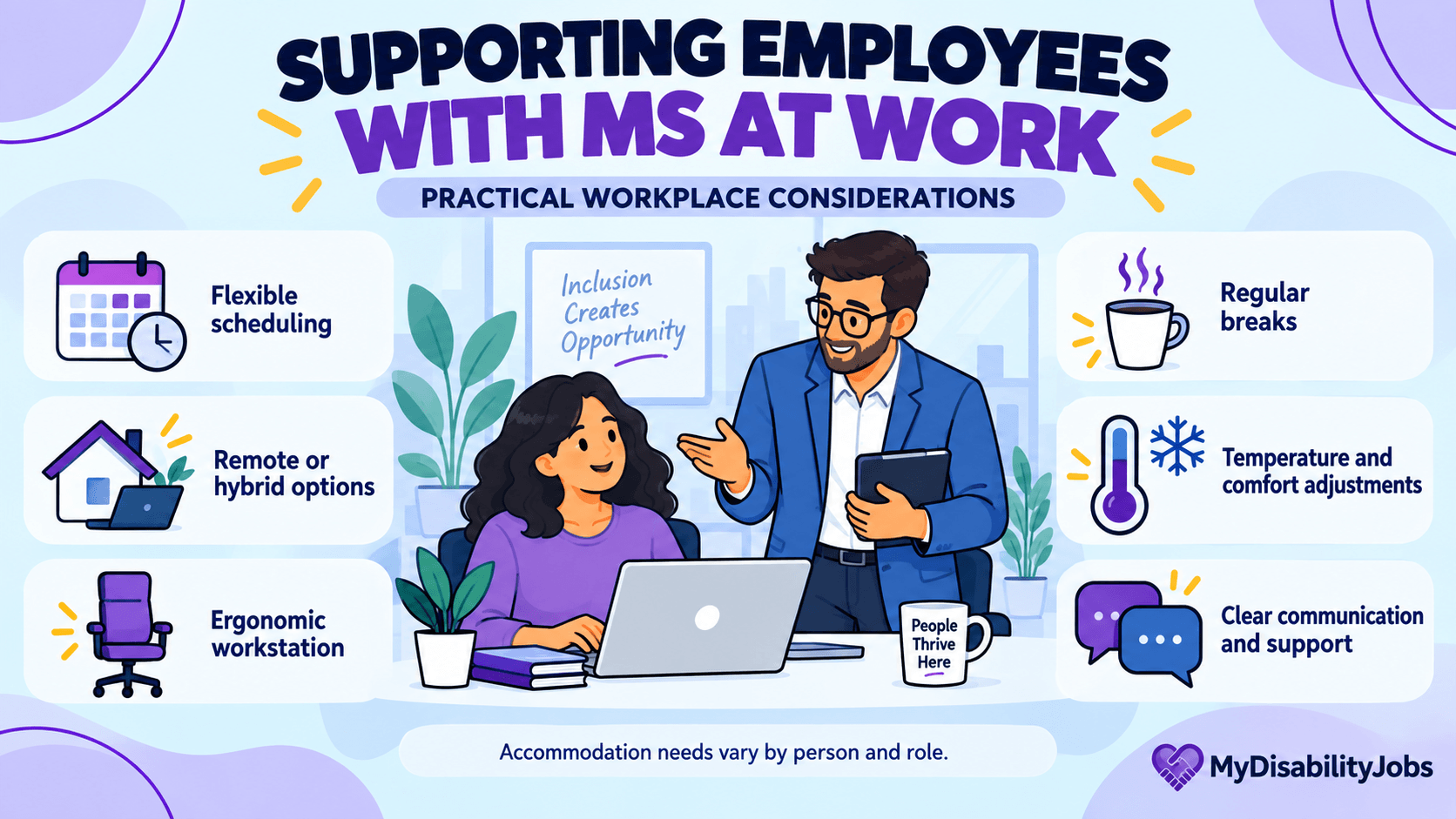
There is no single list of workplace accommodations that fits every person with multiple sclerosis. MS symptoms, job duties, schedules, environments, and support needs can vary a great deal. A helpful accommodation for one employee may be unnecessary or unworkable for another.
That is why the most useful approach is practical and individualized. Instead of asking whether a job is “MS-friendly” in the abstract, it is often better to ask what changes, tools, or adjustments would help you perform the essential parts of the job effectively and safely.
Examples of workplace accommodations
Some accommodations that may be useful for certain people with MS include:
- flexible start and end times
- additional or more frequent rest breaks
- remote or hybrid work arrangements when the job allows it
- a seated workstation or the ability to change position during the day
- ergonomic equipment such as an adjusted chair, keyboard, mouse, or monitor setup
- temperature-related adjustments such as fans, cooling strategies, or climate-controlled workspace changes
- modified parking arrangements or reduced walking requirements
- written instructions, task lists, or workflow supports if cognitive symptoms affect memory or concentration
- schedule adjustments for medical appointments or treatment
- temporary reassignment of marginal tasks that are especially difficult during a flare or symptom change
How to request accommodations
If you think you need an accommodation, focus on the work-related barrier and the adjustment that may help. In many cases, you do not need to explain every detail of your medical history. What matters most is that the employer understands the limitation affecting work and the practical change that may allow you to do the job.
It can also help to approach the request as a problem-solving conversation. The Job Accommodation Network explains that accommodation is usually an interactive process. An employer may ask for reasonable documentation where appropriate, and the final accommodation may differ from the first idea you raise as long as it effectively addresses the work-related need.
Know your rights and get expert help
In the United States, workplace accommodation questions are often discussed in relation to the Americans with Disabilities Act and guidance from the U.S. Equal Employment Opportunity Commission. The Job Accommodation Network is also one of the most useful practical resources because it provides accommodation ideas, examples, and confidential guidance.
Useful resources include:
- Job Accommodation Network — Workplace Accommodation Toolkit
- U.S. Equal Employment Opportunity Commission — Disability Discrimination
- National MS Society — Accommodations at Work
Should You Tell Your Employer You Have MS?
Disclosure is a personal decision, and there is no single right answer for everyone with MS. Some people disclose early because they want support or accommodations. Others prefer to keep their diagnosis private unless a specific work-related need arises.
In many cases, disclosure becomes most relevant when you need an accommodation, medical leave, schedule flexibility, or an explanation for work limitations that an employer may otherwise misunderstand. If you do not need any workplace change, you may decide that disclosure is not necessary right now.
Why some people choose to disclose
Some employees choose to disclose because:
- they need a workplace accommodation
- they need intermittent leave, time off for treatment, or schedule changes
- symptoms affect stamina, mobility, concentration, heat sensitivity, or other work-related functions
- they want to reduce confusion if a visible or fluctuating symptom affects work
- they prefer proactive communication with HR or a supervisor
Why some people choose to wait
Other employees decide to wait because:
- they do not currently need accommodations
- symptoms are stable and not affecting job performance
- they prefer to keep medical information private
- they want more time to understand the culture of the workplace
- they are concerned about stigma or misunderstanding
Practical disclosure tips
If you decide to disclose, it is often best to keep the conversation focused on work. Explain what is affecting your job, what support or accommodation may help, and which person should be involved, such as a direct manager, HR representative, or both. Written follow-up can be useful, especially if you are requesting a formal accommodation.
Useful resources include:
- National MS Society — Disclosure
- Job Accommodation Network — Disability Disclosure
- U.S. Department of Labor — Family and Medical Leave Act Employee Guide
Changing Careers, Reducing Hours, or Retraining With MS
For some people, the best next step is not leaving work entirely but changing how they work. That could mean moving from a physically demanding job into a more desk-based role, reducing hours temporarily, seeking remote work, changing employers, or pursuing training that opens up a more sustainable career path.
A career change related to health is not a failure. Sometimes it is a practical way to preserve income, independence, and long-term work ability. It is often worth reviewing accommodations and internal job options first, but retraining or redesigning your career path can also be a constructive step.
Signs it may be time to reconsider your current role
Some people begin exploring a change when:
- the physical demands of the current job are becoming harder to manage
- fatigue, mobility issues, or cognitive symptoms are affecting core duties
- the work environment is no longer a good fit even with reasonable adjustments
- the schedule is too rigid for treatment, recovery, or symptom management
- another role in the same organization or a different field may offer a better long-term fit
Ways to make a transition more gradually
Possible transition strategies include:
- requesting accommodations before deciding to leave
- discussing transfer opportunities within the same employer
- moving from full-time to part-time work if financially possible
- shifting into a more remote, hybrid, or desk-based role
- building new skills through short courses, certificates, or targeted training
- using a portfolio, project work, or volunteer experience to move into a different field
Useful support resources
Several organizations may help with retraining, career planning, or employment transitions:
- National MS Society — MS Navigator
- CareerOneStop — Career Planning and Self-Assessments
- Social Security Ticket to Work
- Rehabilitation Services Administration — State Vocational Rehabilitation Agencies
How to Find Disability-Friendly Employers
The job itself is only part of the decision. Two employers can advertise the same role but offer very different schedules, management styles, accessibility, flexibility, benefits, and attitudes toward workplace accommodations.
Rather than trying to identify a perfect list of “MS-friendly companies,” look for concrete signs that an employer has thought seriously about accessibility and employee support.
What to look for in a job posting
Useful signals may include:
- clear information about remote, hybrid, or flexible work arrangements
- specific statements about workplace accommodations
- accessible application and interview processes
- clearly defined duties rather than vague expectations
- realistic scheduling and travel requirements
- transparent information about benefits and leave
- an equal employment opportunity or disability-inclusion statement backed by practical policies
Do not assume that a diversity statement alone proves that the day-to-day workplace will be supportive.
Questions worth asking during the hiring process
You do not need to disclose MS simply to learn about working conditions.
Depending on the role, useful questions may include:
- What does a typical workday look like?
- Is the schedule fixed or flexible?
- How often is overtime expected?
- Is remote or hybrid work available for this position?
- How much travel is required?
- How is performance measured?
- What does the team’s meeting schedule look like?
- Is there flexibility in how or where core duties are completed?
The answers can help you evaluate whether the actual working environment fits your needs before deciding whether disability disclosure is relevant.
Where to search
Use a combination of specialist and mainstream job-search resources rather than relying on a single site.
- Search jobs for people with disabilities on MyDisabilityJobs
- Disability in the workplace and developing accessibility
- CareerOneStop
- Social Security Ticket to Work — Find Help
- Job Accommodation Network
How to Avoid Job Scams When Searching for Remote Work
Remote job searches can attract fake recruiters, check scams, bogus equipment purchases, task scams, and other fraudulent offers. A professional-looking website, recruiter profile, or job-board listing does not automatically prove that an opportunity is legitimate.
Be cautious if an employer asks you to pay money, sends a check and tells you to purchase equipment, promises unusually high pay for simple work, pressures you to act immediately, or conducts the entire hiring process through private messaging apps.
Before sharing sensitive information, verify the company independently, check the employer’s official careers page, and confirm that the recruiter’s contact details match the real organization.
For a more detailed checklist, warning signs, and official reporting resources, see our guide to work-from-home jobs for people with disabilities.
Employment and Career Resources for People With MS
Career decisions involving MS can raise several different questions at once: finding suitable work, requesting accommodations, retraining, understanding disability benefits, evaluating disclosure, or deciding whether a current role can be modified.
The following resources serve different purposes. You may only need one or two of them depending on your situation.
MS-specific employment support
Use as a resource for information about employment with MS, disclosure, accommodations, and navigating changes in work.
Workplace accommodations
Use for practical accommodation ideas and guidance about the accommodation process.
Career exploration and job-search tools
Use for occupation research, career exploration, training information, job-search tools, resumes, and local employment resources.
Vocational rehabilitation
State Vocational Rehabilitation agencies may provide eligible people with disabilities with services related to employment, training, rehabilitation, job placement, or workplace support.
Rehabilitation Services Administration — State Vocational Rehabilitation Agencies
Support for Social Security disability beneficiaries who want to work
Social Security Ticket to Work is a free and voluntary employment-support program for eligible people ages 18 through 64 who receive SSDI or SSI based on disability and want to work.
Employment Networks and state Vocational Rehabilitation agencies participating in the program may provide services such as career planning, job placement, training, ongoing support, and benefits counseling.
MyDisabilityJobs resources
- Job application disability question: declaring it or not
- Work from home jobs
- Part-time jobs for disabled people
- Sit-down jobs for disabled people
- Search jobs on MyDisabilityJobs
Final Thoughts
There is no single career that is automatically the best job for everyone with MS. Symptoms, priorities, qualifications, finances, and working conditions differ too much for a universal answer.
A more useful approach is to compare each role against the factors that matter to you: physical demands, commuting, temperature, schedule, concentration, deadlines, flexibility, workplace accessibility, and whether reasonable accommodations could address a particular barrier.
For some people, the right answer may be remaining in a current career with adjustments. For others, it may mean moving to a different employer, reducing hours, retraining, or choosing a more remote or desk-based occupation.
The 20 careers in this guide are starting points rather than prescriptions. Use the salary, training, workplace, and job-search information to narrow your options, then evaluate individual vacancies based on the actual duties and conditions.
If you are ready to look for opportunities, search current openings on MyDisabilityJobs.
Frequently Asked Questions
Yes. Many people with multiple sclerosis continue working, although the type of work and support that is practical can change over time. MS affects people differently, so the important questions are whether you can perform the essential duties of a particular role and whether changes to the schedule, workspace, commute, or working conditions would help.
Some employees may benefit from reasonable workplace accommodations. Examples can include schedule adjustments, additional breaks, an accessible workstation, remote or hybrid work where appropriate, or changes that address a specific work-related limitation.
There is no single job that is best for everyone with MS. A suitable role depends on your symptoms, qualifications, interests, stamina, mobility, concentration, preferred schedule, and the conditions offered by the employer.
Jobs with lower routine physical demands, an accessible workstation, manageable commuting, predictable duties, and some flexibility may work well for some people. The 20 careers in this guide include writing and digital work, analytical and financial careers, health-information and regulatory roles, and administrative and communication jobs.
“Low stress” depends on the person and the workplace rather than the job title alone. A desk-based position can still involve demanding deadlines, high workloads, frequent interruptions, customer complaints, or rigid performance targets.
When comparing jobs, look at factors such as schedule predictability, workload, overtime, travel, commuting, interruptions, physical demands, deadlines, meeting frequency, and whether you can take breaks or adjust how the work is performed.
Remote opportunities exist in fields such as writing, editing, software development, web development, bookkeeping, translation, tutoring, human resources, and some analytical or administrative occupations.
Remote work can reduce commuting and provide greater control over the physical work environment, but it is not automatically easier or less stressful. Check the actual schedule, meeting requirements, workload, screen time, productivity expectations, and flexibility of each remote position.
Some people with MS work full time, while others find that part-time work, flexible scheduling, reduced hours, or a different type of role is more sustainable. There is no single work schedule that is appropriate for everyone with MS.
If full-time work becomes difficult, possible options may include workplace accommodations, changes to duties or scheduling, an internal transfer, remote or hybrid work, or moving gradually into a different role. Individual medical and financial decisions should be discussed with the appropriate qualified professionals.
Accommodation needs vary by person and job. Depending on the work-related limitation, examples may include flexible scheduling, additional breaks, remote or hybrid work where feasible, an ergonomic or accessible workstation, temperature-related adjustments, modified parking, reduced walking requirements, written task supports, or schedule changes for medical appointments.
In the United States, the Job Accommodation Network and the U.S. Equal Employment Opportunity Commission provide guidance about workplace accommodations and the accommodation process.
Disclosure is a personal decision, and an employee does not necessarily need to disclose MS simply because they have the condition. Disclosure may become relevant when an employee needs a workplace accommodation, medical leave, schedule adjustment, or another change connected to a work-related limitation.
If you decide to disclose, it is usually useful to focus the conversation on the work-related issue and the support or adjustment that may help rather than providing unnecessary medical detail. Employees with questions about their own legal circumstances should use authoritative guidance or obtain appropriate professional advice.