

Workplace Accommodations for Depression and Anxiety: Examples & ADA Guidance
Workplace accommodations for depression and anxiety can include adjusted hours, breaks, a quieter workspace, written priorities, remote or hybrid work, and time for treatment. The right arrangement depends on your workplace barrier and the duties you need to perform. You may need one change, a combination, or no accommodation at all.
Start with the situation that is making work difficult. Are unexpected task changes leaving you unsure what to finish first? Is a recurring appointment incompatible with your shift? Does a busy workspace interrupt a task you can otherwise complete? Naming the problem makes it easier to compare possible solutions and prepare a specific request.
This guide explains practical options, examples, request wording, documentation, and relevant U.S. Americans with Disabilities Act (ADA) context. It offers general workplace information; an individual legal outcome depends on the circumstances. Accommodations support access to work and are separate from medical treatment.
On this page
- What Are Workplace Accommodations for Depression and Anxiety?
- Workplace Barriers Related to Depression and Anxiety
- Workplace Accommodations for Depression and Anxiety
- Workplace Accommodation Examples by Challenge
- How to Request an Accommodation for Depression or Anxiety
- Are Depression and Anxiety Disabilities Under the ADA?
- What Employers Should Know About Depression and Anxiety Accommodations
- What If an Accommodation Is Not Working?
- Workplace Accommodation Checklist
- Frequently Asked Questions
- Final Takeaway
What Are Workplace Accommodations for Depression and Anxiety?
A workplace accommodation changes the setting or the way work is organized so a qualified person with a disability can apply for a job, perform essential duties, or access employment benefits. Essential duties are the fundamental tasks of the role. A change might address where you work, when you work, or how instructions reach you.
For example, a staff member who can process invoices accurately might need uninterrupted time for that task. Another employee might need a schedule change to attend treatment. Neither situation means that everyone with depression or anxiety needs the same arrangement.
The EEOC’s mental-health workplace rights guidance describes possible changes such as modified schedules, quiet work areas, and different supervisory methods. These are options to assess, rather than a checklist of guaranteed approvals.
Distinguish an accommodation request from a personal strategy or general benefit. Keeping your own reminder list is a personal strategy. Asking your manager to put changing priorities in one agreed list requires a workplace change. An employee assistance program may offer useful support, but access to counseling does not resolve a request for an adjustment to your duties or schedule.
For wider context, our mental health employment statistics explore employment and mental health. Population findings cannot tell you which accommodation fits your job or establish your individual eligibility.
Workplace Barriers Related to Depression and Anxiety
Depending on the individual, a possible barrier may involve concentration, stamina, organizing assignments, responding to changing deadlines, communication, stress tolerance, attendance, or treatment schedules. Identify what you experience rather than selecting a limitation because it appears on a diagnosis-based list.
Describe the task and setting together. “I lose track of verbal changes to assignments during busy shifts” is more useful than “I cannot handle pressure.” You might work well with demanding tasks when priorities are clear, or find one particular environment difficult while another works well.
Our depression and disability statistics provide background on the relationship between these topics. That background is separate from assessing your needs. A diagnosis does not establish your abilities, work preferences, or need for every adjustment below.
Workplace Accommodations for Depression and Anxiety
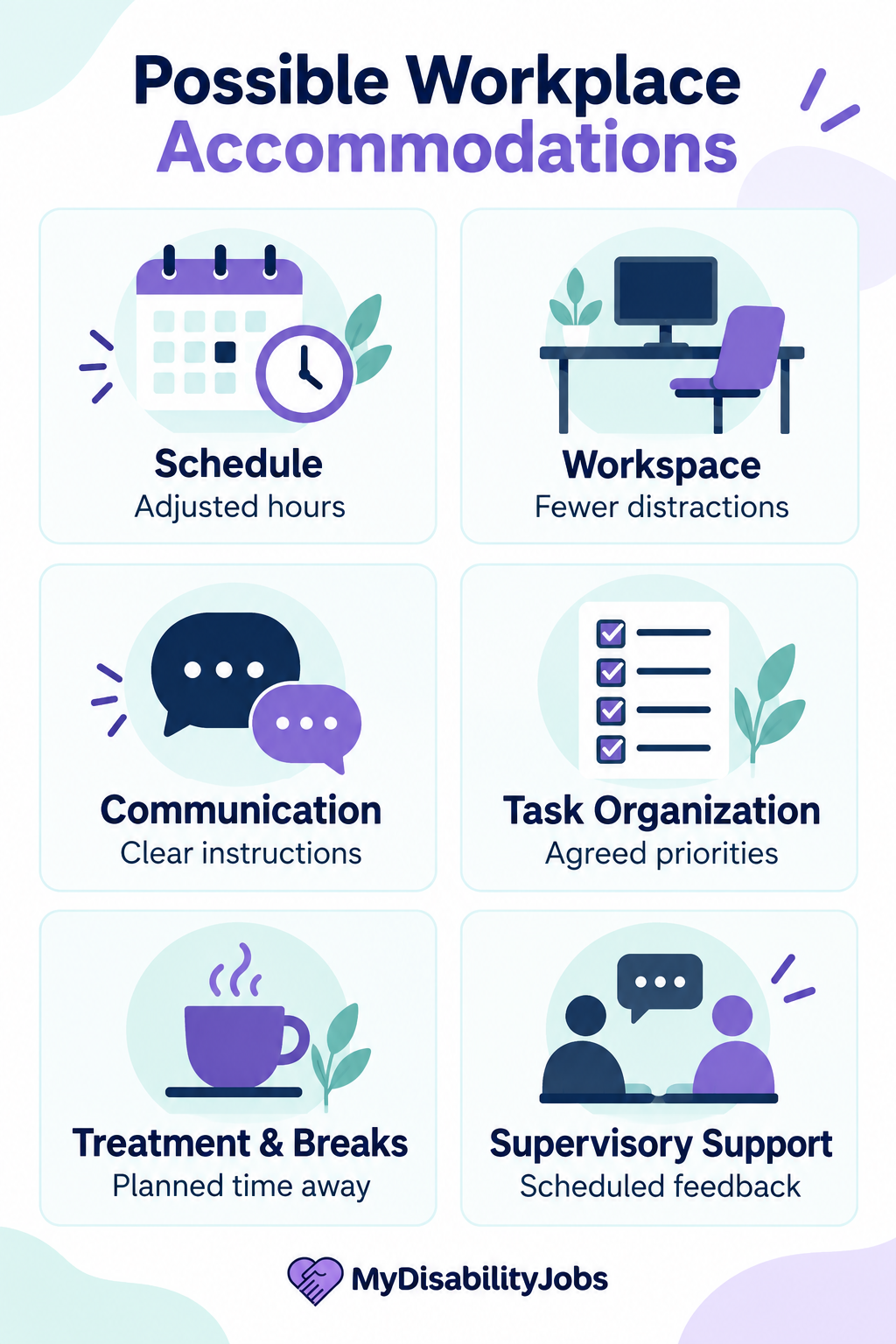
Use the following categories to explore possibilities. The Job Accommodation Network’s depression resource emphasizes individual differences and lists options by limitation and work function. Select a change that addresses the barrier, then work out how it would operate in your role.
Flexible schedules and breaks
A possible adjustment could involve a consistent shift, a different start time, or changes to when breaks occur. Work accommodations for depression may include a later start when a disability-related morning limitation affects attendance; another person may benefit more from predictable hours. Explain your own need rather than assuming flexible hours are always helpful.
Make the request concrete. A library employee could ask to start at 10 a.m. on specified days while covering the later service period. The discussion would need to account for opening duties and staffing. If a later start would leave an essential duty uncovered, explore another effective arrangement.
For breaks, identify when you need to step away, for approximately how long, and how urgent work will be handled. A short break between sustained tasks is different from an unrestricted ability to leave a customer-facing station. Agree a way to notify the relevant person and arrange coverage where needed.
Avoid relying on an informal promise of “flexibility.” Confirm the hours or break arrangement, how changes will be communicated, and whether there is a review date. A consistent agreement is easier to use than having to negotiate permission during each difficult workday.
Quiet workspaces and reduced distractions
If noise, movement, or interruptions interfere with a particular duty, options could include a workstation away from shared equipment, access to a quiet room, partitions, or agreed periods without routine interruptions. A quieter setting does not necessarily mean a permanent private office.
For example, a records coordinator might prepare detailed reconciliations in a quiet room while remaining available for urgent questions through one designated channel. Specify the task and duration so the arrangement can be considered alongside required availability.
Noise-reducing headphones may be another possibility, but they must fit the job. If you need to hear alarms, vehicles, customers, or coworkers, discuss whether headphones would be safe or whether a different location would address the same problem. Less notification noise on a computer may also be useful, subject to essential communications.
Check the practical details before choosing equipment: access to the quieter area, permission to use it, required systems, and what happens when the room is occupied. An option that exists on paper but cannot be used during the relevant task will need further discussion.
Written instructions and clear priorities
When instructions change verbally or different people assign competing tasks, a written reference can reduce uncertainty. The request should identify the information you need: the required outcome, sequence, priority, deadline, or person to contact for clarification.
JAN’s written-instructions guidance describes written directions as a possible accommodation. In practice, a short task brief or checklist may be more usable than a long manual. Agree where the current instructions will be kept and who will update them.
For instance, an operations assistant could ask the supervisor to confirm the three current priorities in the shared task system after the morning briefing. If an urgent assignment arrives, the supervisor would identify which existing task moves back. This addresses conflicting instructions while preserving responsibility for the work.
You can also ask what a completed task should look like, or confirm your understanding after a conversation. These approaches give you a reliable reference and a route for questions; they do not require every workplace interaction to become a formal document.
Remote or hybrid work
Remote work may address a specific onsite barrier when the relevant duties can be done elsewhere. Hybrid work could combine focused tasks at home with required onsite activities. Consider your own experience: working at home may introduce isolation, interruptions, or less structure, so it is not automatically the best option.
A useful proposal describes the duties, location, hours, access to equipment, and communication arrangements. For example, an employee could prepare reports remotely on agreed days and attend essential onsite appointments. Discuss whether a quieter onsite setting or different hours would also work.
If a return-to-office policy affects an existing arrangement, raise the disability-related barrier and ask for an individual assessment. The EEOC’s telework guidance explains that remote work can be an accommodation, including where an employer does not normally offer it, but another effective option may be provided. A previous period of remote work is useful information, not an automatic guarantee of future approval.
For readers exploring a different role, our work from home guide covers remote job options. A job advertised as remote still has its own deadlines, meetings, and availability requirements.
Time for medical appointments and treatment
Possible accommodations include adjusting hours around a recurring appointment, permitting occasional time away, or considering leave for treatment or recovery. Explain the timing and work change you need without giving your manager a detailed account of therapy sessions.
The Department of Labor’s accommodation guidance includes scheduling, breaks, leave, and changes to work organization. These examples still require consideration of your circumstances and job.
An employee with a regular afternoon appointment could propose an earlier shift on that day, where coverage permits, or a defined period of leave. Clarify whether you are asking to change hours, use available paid leave, or explore another arrangement. An ADA accommodation does not automatically create paid time off.
If treatment needs change, explain the updated scheduling need and ask how to revise the arrangement. You can ask HR about applicable leave policies and any separate legal rights rather than treating all time away as one interchangeable benefit.
Task Organization, Prioritization, and Workload Structure
If an assignment is difficult to begin or track, options could include smaller milestones, one agreed task queue, a visible sequence, or a defined first deliverable. Workload structure concerns how required work is organized; it does not necessarily mean fewer essential duties.
For example, a communications assistant preparing a newsletter might agree separate dates for an outline, draft, and final approval. This creates opportunities to clarify direction before the final deadline. For competing assignments, identify who decides which task takes priority.
When considering work accommodations for anxiety, distinguish an adjustable internal deadline from a fixed service requirement. A revised project timeline might be possible, while a safety check or customer appointment may have to happen at its scheduled time. Discuss a different workflow, tools, or allocation of marginal duties where appropriate.
Avoid adding an elaborate tracking system that creates more work than it solves. Ask what information you need to act on, where it will appear, and how outdated tasks will be removed. A manageable process can be more useful than another application with constant reminders.
Communication and supervisory support
Possible changes include scheduled feedback, advance agendas, written action items, or a private setting for performance discussions. Be specific about what would improve access to information. A predictable check-in may be useful for one employee and an unnecessary interruption for another.
JAN’s supervisory-methods resource discusses modifying how supervision is delivered. You could ask to receive feedback with concrete examples and agreed next steps, or to have a short meeting at a consistent time rather than repeated unscheduled questions.
For presentations or meetings, consider advance notice, a clear agenda, rehearsal, or an alternative way to contribute where compatible with the role. If live speaking is an essential duty, removing it entirely may not be workable. A change to preparation, setting, or format may address the barrier while retaining the duty.
Agree how urgent issues will be handled outside the routine check-in. Scheduled communication should make expectations clearer without leaving you unable to ask a time-sensitive question.
Other Individualized Accommodations
The JAN anxiety resource includes possibilities such as access to a private rest area and changes to break schedules. If you experience an episode that requires stepping away, discuss a practical arrangement: where to go, how to notify someone, and how required coverage will continue.
Other possibilities could involve a different training format, additional instruction on a new process, or an agreed transition after leave. Describe the particular work need and intended result. Your request does not have to match the wording on a published list.
An accommodation also cannot solve every workplace problem. Bullying, unsafe conditions, or conflicting management decisions may need separate reporting or organizational action. You can raise those concerns while also requesting a change for a disability-related barrier.
Workplace Accommodation Examples by Challenge
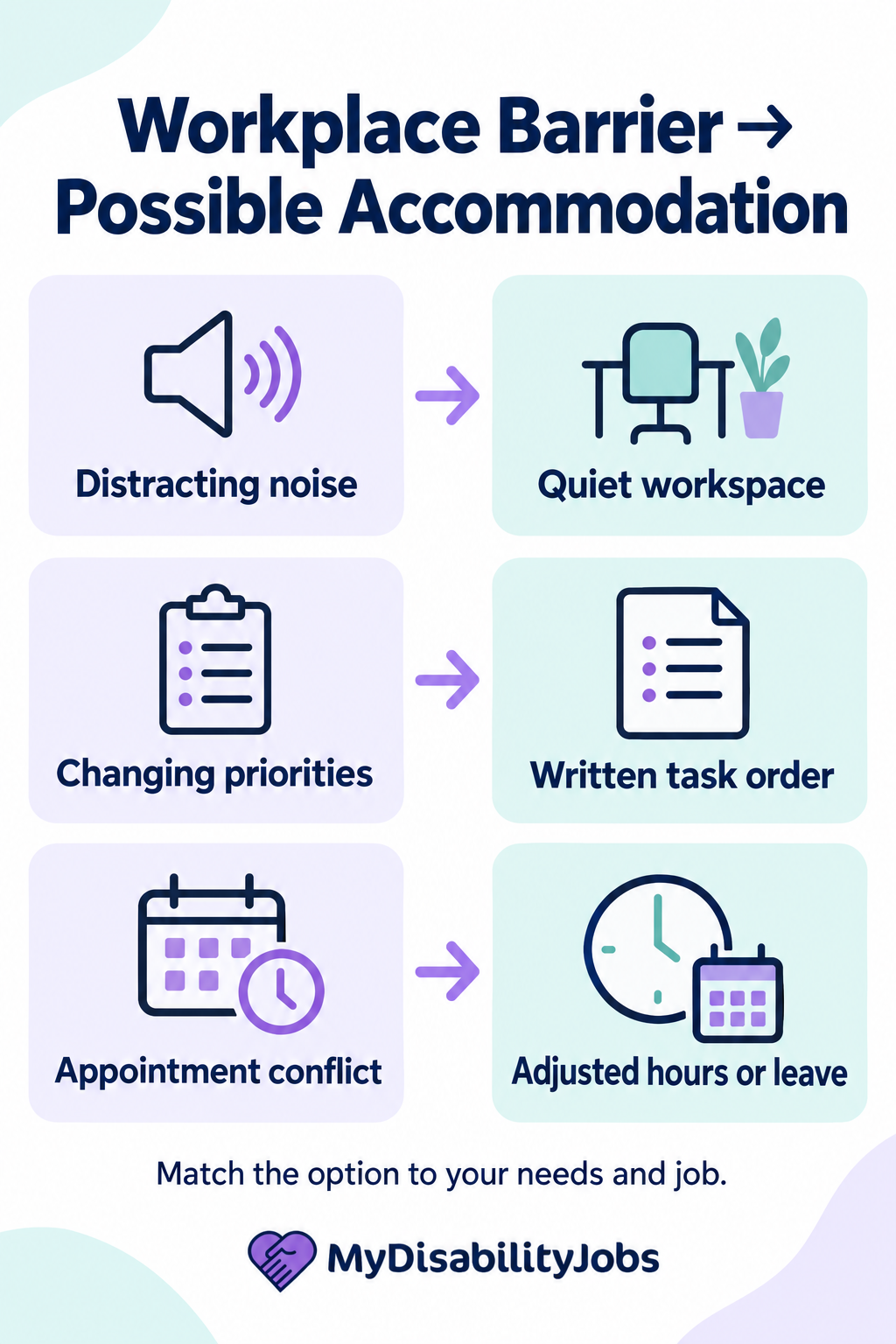
These are examples of reasonable accommodations for anxiety or depression to discuss, rather than promises of approval. Use the table to connect a barrier to an arrangement you could describe to your employer.
| Workplace barrier | Possible accommodation | Example implementation |
|---|---|---|
| Conversations disrupt detailed work | Quiet work area | Use an available room during invoice checks; urgent queries use one agreed channel. |
| Variable shifts interfere with a disability-related routine | Predictable schedule | Agree consistent starting hours while maintaining required coverage. |
| Verbal changes make priorities difficult to track | Written priority list | Supervisor updates task order in the shared system when assignments change. |
| Sustained tasks require additional pauses | Modified breaks | Agree short breaks and a coverage contact during staffed service hours. |
| A recurring appointment overlaps work | Adjusted hours or leave | Confirm the appointment window, handover, and applicable leave arrangement. |
| A large assignment is difficult to organize | Intermediate milestones | Agree an outline, draft, and review date before the final deadline. |
| An onsite setting creates a specific work barrier | Remote or hybrid arrangement | Identify duties suitable for home, onsite responsibilities, and communication expectations. |
| Unplanned feedback makes instructions harder to use | Scheduled private feedback | Review examples and next steps at an agreed weekly meeting. |
| Meeting information is difficult to retain | Written action summary | Confirm responsibilities and deadlines after the meeting. |
When comparing options, ask what changes in the actual working day. A quieter room that lacks required equipment or a task list nobody updates may leave the barrier in place. Include implementation details in the conversation rather than relying on the label alone.
How to Request an Accommodation for Depression or Anxiety
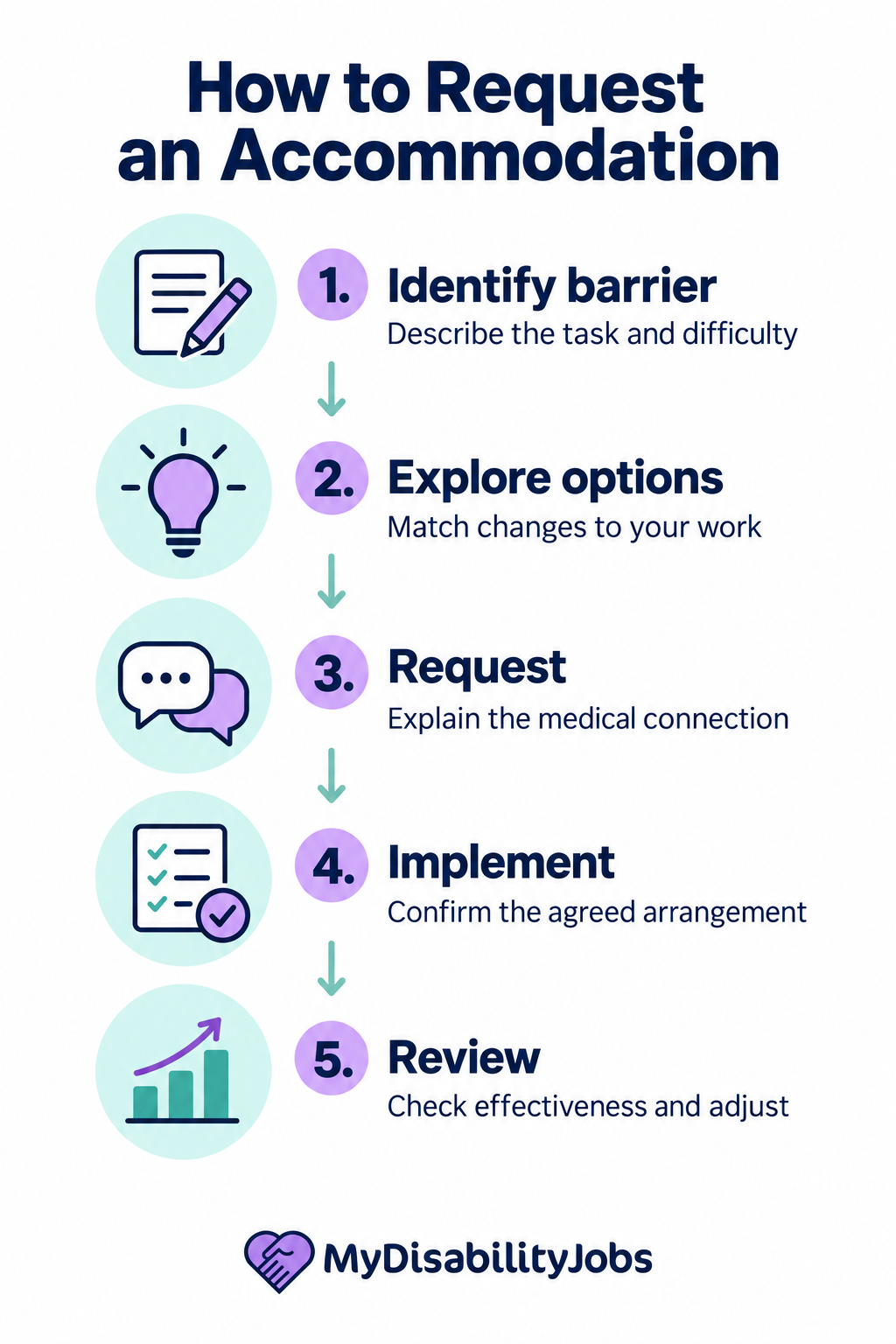
You do not need a perfect solution before asking for a discussion. Prepare a description of the barrier and one or more changes that might help. JAN’s accommodation-request guidance offers a useful starting point; a formal letter is not required to make an initial ADA request.
Preparation can make the options clearer, but it does not guarantee approval. A randomized study of an online accommodation-education course found improved knowledge and self-efficacy compared with a wait-list group. Too few participants requested accommodations to assess whether the course increased requests or receipt of accommodations. It tested education, not the effectiveness of a particular workplace change.
Identify the workplace barrier
Write down the task, what happens, and its effect on your work. For example: “When urgent assignments arrive during concentrated work, I lose track of the order and miss a handover.” Include when the problem occurs and which duties you need to maintain.
Use examples that explain the situation without taking confidential client information or sensitive workplace records into a personal document. You are describing a functional need, not collecting every mistake you have made.
Connect the request to a medical condition or functional limitation
Explain that you need a work change because of a medical condition. Saying only that you dislike the office or prefer different hours may not communicate an accommodation request. You can describe how a disability-related limitation affects the relevant task without recounting your full medical history.
For example: “Because of a medical condition, I have difficulty sustaining concentration in the shared workspace. I would like to discuss a quieter location for detailed processing tasks.” If the connection is unclear, the appropriate contact may ask for clarification or relevant documentation.
Choose one or more workable options
Compare the preferred option with an alternative where practical. For concentration difficulties, that might mean a quiet onsite room, protected task time, or remote work for specified duties. Explain why the option addresses your barrier and how required outcomes would be maintained.
For remote, hybrid, or RTO requests, prepare the work details. Identify duties that can be performed remotely, duties requiring onsite attendance, equipment and secure access, communication arrangements, and the requested schedule. Prior successful remote work can help explain feasibility, but describe what happened during that period rather than relying only on “I did it before.”
If a policy change is approaching, ask how your individual request or existing accommodation will be considered. Discuss an interim arrangement where necessary, without assuming that the request itself authorizes you to disregard attendance instructions. If an onsite alternative would not address the limitation, explain what barrier would remain.
Agree how effectiveness could be assessed, such as completing the relevant task, maintaining coverage, or meeting existing standards. A trial can help compare options; it should have a defined arrangement and review point.
Talk to HR or your manager
Check the workplace accommodation policy for the appropriate contact. This might be HR, an accommodations team, or your supervisor. Ask for a private discussion and say that you are requesting a change for a medical reason. You can use plain language; special legal terms are not necessary.
Ask who will respond, how to provide any documentation securely, and when to follow up. An employer may have a form, but the initial request can start with a conversation or email. Job seekers can also request an adjustment to an interview or assessment by explaining the barrier in that process.
Our disability disclosure guide discusses the wider disclosure decision. Sharing enough information with the appropriate accommodation contact is separate from choosing whether to tell coworkers about your diagnosis.
What documentation can an employer request?
When the disability or accommodation need is not obvious, an employer may request reasonable documentation establishing the covered disability and why a change is needed. Relevant information could explain the functional limitation, the affected duties, and how the proposed adjustment would help. A diagnosis alone may not answer those questions.
The EEOC’s guidance for mental-health providers explains what supporting information can be useful. Give your provider an accurate description of the job and proposed arrangement. An appropriate healthcare or rehabilitation professional can explain the connection between the condition and the work need.
If you prefer not to disclose the specific diagnosis, a general description may be sufficient when it otherwise establishes the disability and need. This depends on the information provided; it is not a guarantee that naming a limitation alone will always be enough.
Ask what information is required before sending records. Complete medical files generally contain unrelated information and ordinarily should not be requested for this purpose. If documentation is insufficient, ask which point needs clarification. Medical information is subject to ADA confidentiality rules, including separate medical files and limited exceptions for sharing.
Follow up in writing
After a conversation, send a brief summary of the requested change, its connection to the work barrier, and the agreed next step. Ask the recipient to correct any misunderstanding. Keep a copy of the request and responses without copying protected workplace information into personal accounts.
Once a change is agreed, confirm the start date, responsibilities, practical arrangements, and review point. A clear written record helps when schedules, managers, or duties change. If you have not received a response, follow up through the stated process and ask whether anything is outstanding.
Example accommodation request
Adapt this example to your circumstances. The stated options are illustrative, and the wording can describe a medical condition without naming the diagnosis in the initial request.
I am requesting a workplace accommodation because of a medical condition. Frequent conversations and interruptions in the shared workspace make it difficult for me to sustain concentration during detailed account checks.
I would like to discuss using an available quiet room during those tasks, with urgent questions reaching me through one agreed channel. I believe this would help me complete the required checks accurately while remaining available for essential work. I am open to discussing another effective option.
Please let me know the next steps and whether relevant supporting documentation is needed. Once an arrangement is agreed, I would like to confirm how it will operate and set a time to review its effectiveness.
Are Depression and Anxiety Disabilities Under the ADA?
Both can qualify, depending on how the condition affects the individual. ADA accommodations for anxiety and depression concern disability-related access to work, rather than a diagnosis automatically entitling someone to a particular arrangement. This section covers U.S. employment; other countries use different rules.
Title I generally covers employers with at least 15 employees. Other laws may protect workers in smaller workplaces. The ADA statute defines disability broadly, including a mental impairment that substantially limits a major life activity. Activities include concentrating, thinking, communicating, and sleeping.
Is Depression a Disability Under the ADA?
Depression can meet the definition, and EEOC guidance says major depressive disorder should easily qualify. The assessment considers individual limitations; symptoms do not have to be constant. An episodic condition or one in remission can qualify if it would substantially limit a major life activity when active.
The beneficial effects of medication and most other mitigating measures generally are not counted when assessing disability. You do not need to stop treatment to establish eligibility.
Is Anxiety a Disability Under the ADA?
An anxiety disorder can qualify when it substantially limits a major life activity. Ordinary nervousness or workplace stress alone does not automatically establish an ADA disability. Explain the relevant limitation and work need rather than relying only on the word “anxiety.”
Eligibility for protection and the appropriate accommodation are related but separate questions. Even when anxiety qualifies, the proposed change must be considered in the context of the job.
What Does the ADA Require?
A qualified employee must be able to perform the essential functions with or without accommodation. Covered employers generally must provide an effective reasonable accommodation for a known disability-related need unless it would cause undue hardship: significant difficulty or expense in the employer’s circumstances.
The EEOC’s reasonable-accommodation guidance explains the assessment and options. Employers may choose another effective accommodation after considering the employee’s preference. They do not have to remove essential duties or lower uniformly applied production standards. Protection based solely on being regarded as disabled does not itself create an accommodation entitlement.
What Employers Should Know About Depression and Anxiety Accommodations
Start with the employee’s stated barrier and required work outcome. Ask what would help, compare effective options, and discuss practical implementation. Do not assume a diagnosis means poor performance, a safety risk, or a need for the same package of adjustments as another employee.
Make the arrangement usable. Identify who will arrange workspace access, update priorities, approve scheduling changes, or handle coverage. Tell relevant managers what they need to implement the adjustment and agree a review point with the employee.
Protect confidentiality. Keep medical information separate from ordinary personnel records and restrict sharing to permitted purposes. The EEOC’s psychiatric-disability guidance explains confidentiality and limited exceptions. Do not explain a colleague’s changed hours by disclosing their diagnosis or accommodation status.
General inclusive workplace practices can make instructions and request routes easier to use. They complement individualized accommodations; an employee assistance program or general wellness initiative does not settle a specific accommodation request.
What If an Accommodation Is Not Working?
Ask for a review and describe what remains difficult. First check implementation: can you actually access the room, are priorities updated, and are agreed breaks available? Then consider whether the arrangement addresses the right barrier or whether duties or needs have changed.
Use concrete observations. “The room is only available after the processing deadline” points to an access problem. “The written list helps, but conflicting deadlines still arrive from three managers” points to a coordination problem. An ineffective adjustment does not necessarily mean that accommodation is unnecessary.
If a trial is agreed, confirm its duration, how effectiveness will be assessed, and the next discussion. A review date should guide follow-up, rather than leave an unresolved need without a decision. Explore another effective option where necessary.
Workplace Accommodation Checklist
Use this checklist to prepare and track the request. It is a planning aid, not a legal eligibility test.
- Task: Which duty or application step is affected?
- Barrier: What happens, in which setting, and with what work impact?
- Connection: Can you explain that the change is needed for a medical reason?
- Options: What is your preferred adjustment, and could another approach work?
- Requirements: How will essential duties, safety, coverage, and communication continue?
- Contact: Who handles requests, and how will you submit information privately?
- Documentation: If requested, what relevant information is missing?
- Agreement: What changes, who implements it, and when does it begin?
- Review: How will you assess effectiveness and raise difficulties?
You can request a conversation before you have every answer. Bring the information you have and ask for help clarifying the next step.
Frequently Asked Questions
You generally need to explain that a change is needed because of a medical condition. If the disability or need is not obvious, relevant documentation may be requested. A general description can sometimes be sufficient, but it must establish the disability and need. You do not have to disclose the diagnosis to coworkers.
Sometimes. Explain the disability-related onsite barrier, duties that can be done remotely, and communication and equipment arrangements. The employer can assess essential functions, effectiveness, and undue hardship, and may offer another effective option. A diagnosis alone does not guarantee remote work.
A general policy change should not substitute for considering an individual’s disability-related need. Ask how the existing arrangement will be assessed and explain the barrier that returning would create. Continued remote work is not automatic, and another effective accommodation may be considered.
They can be possible options where they address a disability-related need. Describe the specific hours or break arrangement and how required duties and coverage would continue. Approval depends on the circumstances; “flexibility” does not automatically mean unrestricted hours or time away.
Not necessarily. An initial request can be made in plain language. An employer may then seek reasonable documentation if the disability or accommodation need is not obvious. Ask what information is required; complete medical records ordinarily include unrelated information.
ADA medical information must be kept confidential, with limited exceptions. Managers may need to know necessary restrictions and accommodations, and safety personnel may need relevant emergency information. Coworkers are not entitled to your medical details simply because they notice an adjustment.
Ask for the reason, whether information is missing, and what alternative could address the barrier. An employer may choose an effective alternative. If you believe your rights were violated, seek prompt advice about your situation; complaint deadlines can apply.
Requesting an accommodation is a protected activity, as the EEOC’s retaliation guidance explains. This does not prevent legitimate, unrelated performance management. If you suspect retaliation, keep relevant records through appropriate channels and seek timely guidance; an internal review may not extend filing deadlines.
Final Takeaway
Useful workplace accommodations begin with your experience of the job: a task, a barrier, and a change that could help. Compare practical options, communicate the medical connection, confirm the arrangement, and review whether it works.
If you are also considering a different role, our guide to workplace fit for anxiety can help you examine work environments and demands. Assess those demands against your own experience; a diagnosis does not determine which career you can pursue.
Comments are closed