
Best Sit-Down Jobs in 2026 – Top 20 Jobs Where You Can Sit Down
If you are looking for sit down jobs, there are many careers where most core duties can be performed from a desk or workstation. That does not automatically mean every position will be accessible or comfortable for every disabled person.
The best sit-down jobs depend on the individual, the actual duties involved, the workstation, the amount of movement required, the schedule, and any accommodations or assistive technology that may be needed.
Some seated roles can be performed remotely or in a hybrid setting, while others require employees to work in an office, clinic, call center, or other workplace. Even jobs that are mostly performed at a desk may still involve occasional walking, standing, lifting, travel, meetings, or prolonged computer use.
This guide covers 20 practical sit down jobs for disabled people across administration, technology, customer service, finance, healthcare support, design, legal work, and other fields. It also covers entry-level roles, higher-paying careers, and factors to consider when comparing jobs where most of the work can be done while seated.
If working from home would make a role easier to manage, you can also explore our guide to work-from-home jobs for people with disabilities.
Looking for a part-time job as a disabled person? We invite you to have a look at our list of jobs for people with disabilities to find and apply to disabled friendly part-time jobs that might interest you.
Table of Contents
- What Counts as a Sit-Down Job?
- How to Tell if a Sit-Down Job Will Work for You
- Jobs for People Who Can’t Stand for Long Periods
- Sit-Down Jobs for Disabled People With No Experience
- High-Paying Sit-Down Jobs
- Best Sit-Down Jobs for Disabled People
- Quick Checklist: Is This Sit-Down Job a Good Fit for You?
- Conclusion
- Frequently Asked Questions
What Counts as a Sit-Down Job?
“Sit-down job” is not a formal occupational category. It is a practical term for work where most core tasks can usually be performed while seated.
If you’re comparing sitting down jobs, focus on how much of the normal workday can realistically be completed while seated rather than relying on the job title alone.
That can include traditional office jobs, computer-based work, customer support, administrative roles, technical positions, creative work, and some remote jobs.
However, two positions with the same job title can have very different physical requirements. One administrative assistant may spend nearly the entire day at a workstation, while another may regularly move between offices, manage supplies, greet visitors, or carry documents and equipment.
Before assuming that a job is primarily seated, check the actual responsibilities in the job description and ask about any physical requirements that are unclear.
Typical factors to check include:
- how much standing and walking is required;
- whether lifting, carrying, reaching, or bending is part of the job;
- whether the employee can remain seated while completing the main duties;
- whether an adjustable or accessible workstation is available;
- whether the role requires travel between locations;
- whether remote or hybrid work is possible;
- whether employees can change position or take appropriate breaks when needed.
A seated role may still be a poor fit if the workstation, commute, schedule, equipment, or other job demands are not workable for the individual.
Many seated jobs still involve occasional movement. If you need work where you can sit for most of the day, check whether meetings, filing, equipment access, customer interaction, travel, or other duties regularly take you away from the workstation.
How to Tell if a Sit-Down Job Will Work for You
A job title alone is not enough to determine whether a seated position will be a good fit. Even jobs where you can sit down for most core duties can involve very different physical demands depending on the employer, workplace, schedule, and specific responsibilities.
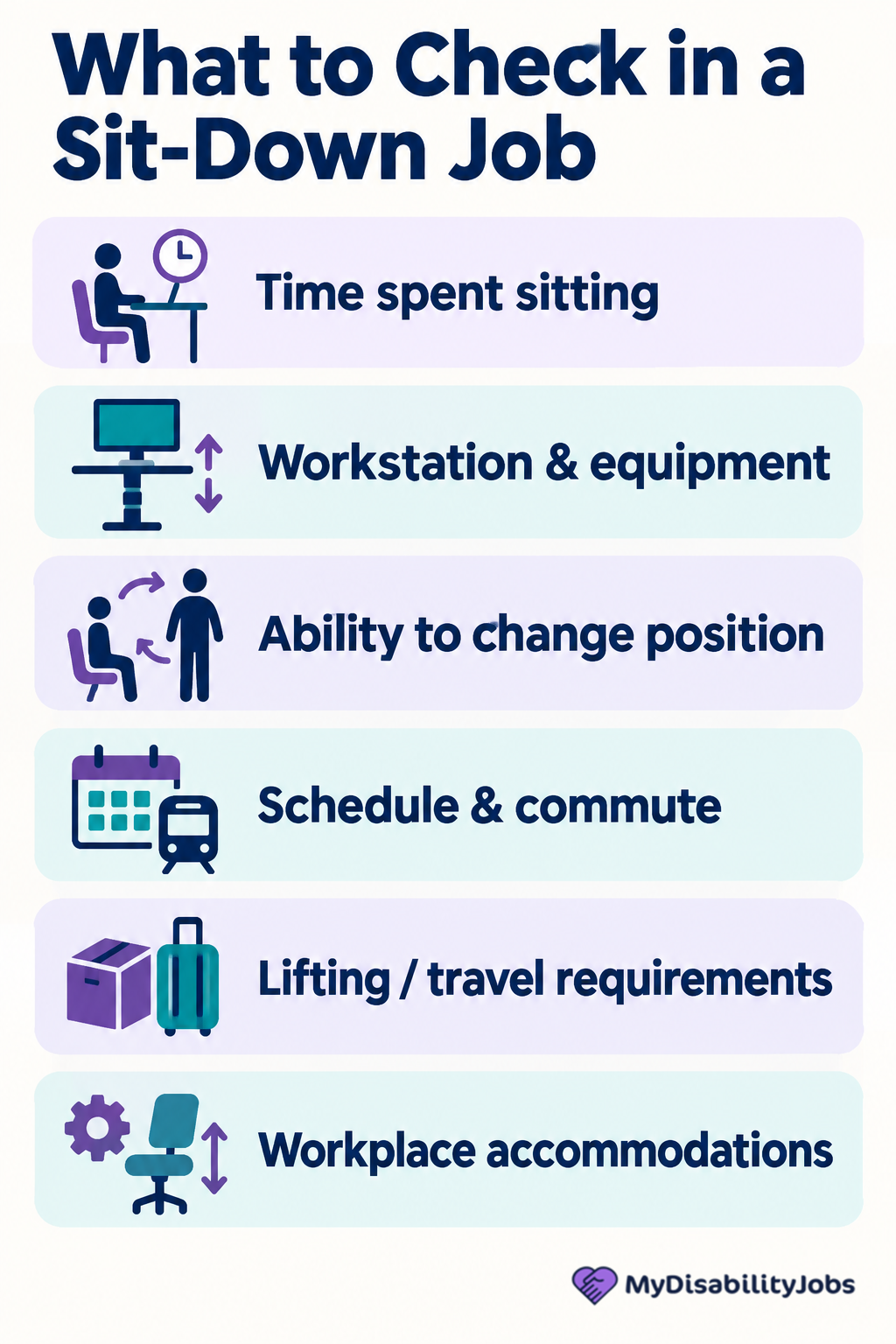
1. Check how much of the day is actually spent sitting
Look at the normal workday rather than assuming that an office or computer-based job involves no standing or walking. Ask whether the role includes meetings in different locations, filing, stocking supplies, visiting clients, moving equipment, or other duties away from the workstation.
2. Look at the workstation and equipment
A suitable workstation can make a major difference. Depending on individual needs, useful features may include an adjustable desk, supportive seating, sufficient space for mobility equipment, alternative keyboards or pointing devices, accessible software, or other assistive technology.
3. Consider whether you need to change position during the day
Some people need to avoid prolonged standing, while others may find remaining seated for long periods difficult. A role that allows position changes, movement breaks, or flexible workstation arrangements may be more practical than one that requires staying in the same position for an entire shift.
4. Check the schedule, commute, and remote-work options
The physical demands of getting to work can matter as much as the tasks performed after arriving. Consider transportation, parking, building access, shift length, start times, and whether remote or hybrid work is available.
5. Review any lifting, travel, or mobility requirements
Even primarily seated jobs may occasionally require lifting supplies, moving between departments, attending events, visiting clients, or traveling. Check whether these tasks are essential functions of the position or occasional duties that may be handled differently.
6. Consider workplace accommodations
Reasonable workplace accommodations may change how some tasks are performed. Depending on the person and the position, this could involve workstation adjustments, assistive technology, modified equipment, schedule changes, or other solutions.
If you are deciding whether to discuss a disability during the hiring process, see our guide to disclosing a disability during a job application.
Jobs for People Who Can’t Stand for Long Periods
If standing for long periods is difficult, roles where most essential duties can be completed from a workstation may be worth prioritizing.
Examples in this guide include administrative assistant, customer service representative, medical records specialist, data entry clerk, payroll clerk, software QA analyst, technical writer, web developer, financial analyst, and other computer-based roles.
A job that requires little standing can still involve other demands, including prolonged sitting, repetitive typing, phone work, meetings, commuting, lifting, or occasional movement around the workplace. Check the actual job description rather than assuming every desk-based role has the same physical requirements.
If mobility is one of your main considerations, you can also explore our guide to jobs for people in wheelchairs.
Sit-Down Jobs for Disabled People With No Experience
If you are looking for sit down jobs for disabled people with no experience, some seated occupations have entry-level openings where employers provide training and do not require several years of previous work experience. These roles can be useful starting points, although employers may still expect computer skills, typing ability, customer-service skills, accurate recordkeeping, relevant education, or familiarity with particular software.
Examples of roles worth exploring include:
| Career | Possible Entry Path | Typical Work Setting |
|---|---|---|
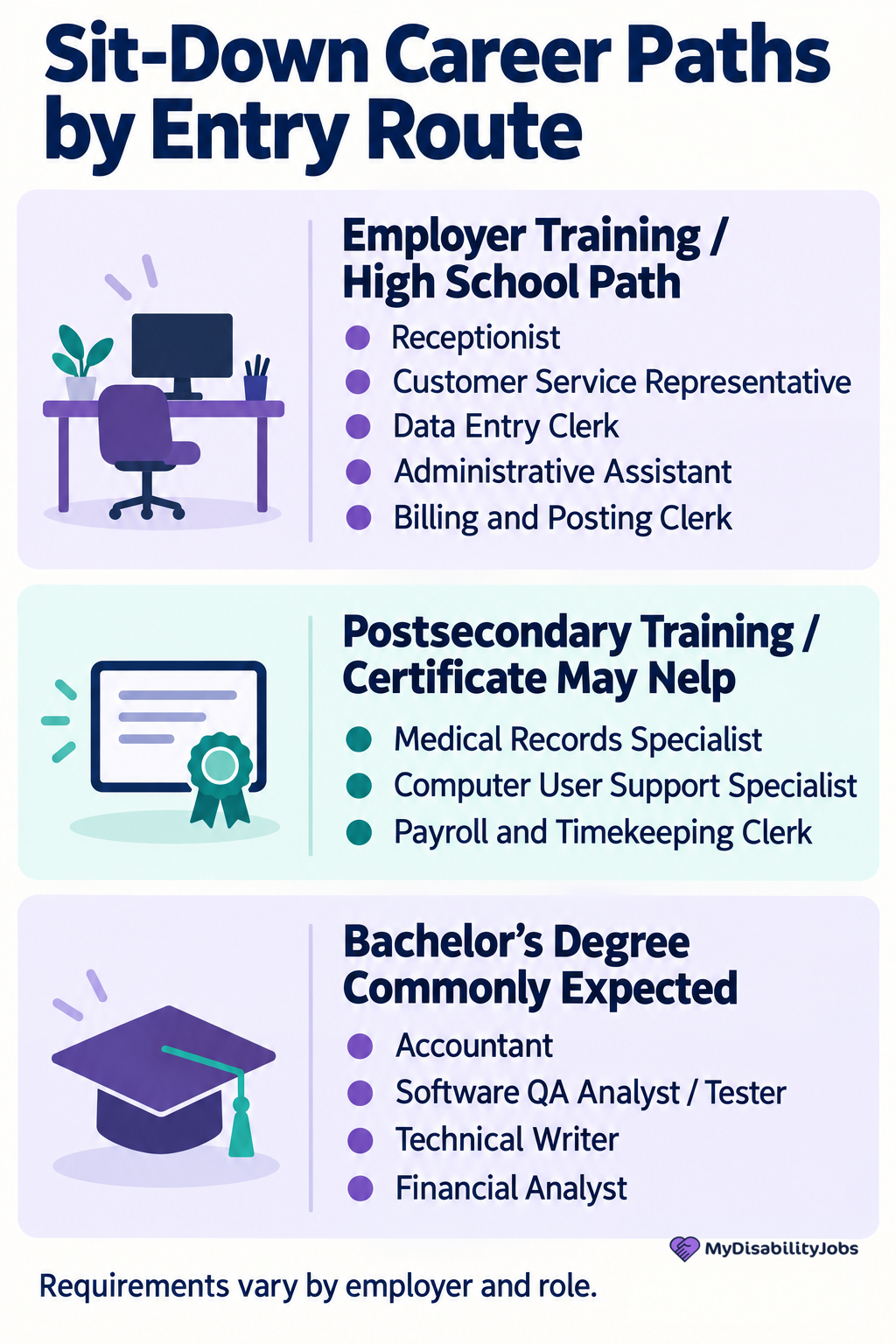
| Customer Service Representative | High school diploma or equivalent; employer training is common | Office, call center, remote, or hybrid |
| Administrative Assistant | High school diploma or equivalent for some entry-level roles; basic office-software skills | Office, remote, or hybrid |
| Data Entry Clerk | Basic computer and typing skills; requirements vary by employer | Office or remote |
| Appointment Scheduler | Customer-service and computer skills; employer training may be available | Office, healthcare setting, call center, or remote |
| Receptionist | High school diploma or equivalent for many entry-level positions | Office, clinic, hotel, or other front-desk setting |
| Insurance Support / Claims Processing | Entry requirements vary; some employers provide role-specific training | Office, call center, remote, or hybrid |
Some entry-level sit down jobs do not require previous experience, but that does not mean they require no skills. Employers may still expect computer skills, communication, accurate recordkeeping, typing, customer service, or familiarity with specific software.
Some of the easier sit down jobs to enter are roles where employers commonly provide training or where the formal education requirements are relatively limited. Reception, customer service, data entry, administrative support, billing, and some insurance-support roles can fall into this category, depending on the employer.
Many entry-level sit down jobs also do not require a four-year college degree. That does not mean they require no qualifications: employers may still expect a high school diploma, computer skills, relevant training, certifications, customer-service experience, or familiarity with specific systems.
Part-time sit down jobs are also available in areas such as customer service, reception, administration, scheduling, billing, and data entry. Availability varies by employer, and part-time positions may have different schedules, training expectations, or benefit eligibility.
For more options, see our guide to part-time jobs for disabled people.
If you want a broader list of lower-barrier career ideas, see our guide to easy jobs for disabled adults.
High-Paying Sit-Down Jobs
Some sit down jobs can offer relatively high pay, although higher salaries often come with additional education, technical skills, certifications, experience, or responsibility.
Among the occupations already covered in this guide, several have relatively high national median wages according to the U.S. Bureau of Labor Statistics.
| Career | BLS Median Pay | Important Context |
|---|---|---|
| Cybersecurity Specialist | $129,180 per year | BLS figure is for information security analysts, a closely related occupation |
| Software Quality Assurance Analyst / Tester | $104,300 per year | Specific BLS figure for software quality assurance analysts and testers |
| Financial Analyst | $102,740 per year | Specific BLS figure for financial and investment analysts |
| Web Developer | $92,650 per year | Specific BLS median for web developers |
| Technical Writer | $90,390 per year | Occupation-wide median for technical writers |
| Accountant | $83,680 per year | Specific BLS figure for accountants and auditors |
| Marketing Specialist | $78,760 per year | BLS category is market research analysts and marketing specialists |
| Insurance Claims Specialist | $78,000 per year | BLS category includes claims adjusters, examiners, and investigators and is broader than the office-based roles emphasized here |
| Human Resources Specialist | $75,940 per year | Occupation-wide median for human resources specialists |
| Graphic Designer | $62,960 per year | Occupation-wide median for graphic designers |
| Paralegal / Legal Assistant | $62,890 per year | Occupation-wide median for paralegals and legal assistants |
| Computer User Support Specialist | $61,860 per year | Specific BLS figure for computer user support specialists |
These are U.S. occupation-wide median wages reported for May 2025. They are not starting salaries, and actual earnings vary by experience, location, employer, industry, and the specific position.
Sources: U.S. Bureau of Labor Statistics occupational profiles cited in the individual career sections below.
Best Sit-Down Jobs for Disabled People
The 20 sit down jobs below cover administrative, technical, customer-facing, creative, financial, healthcare-support, and legal work.
These careers include jobs where you can sit down for most core duties, but the amount of standing, walking, travel, or other movement still varies by employer and position. Inclusion here does not mean a role is automatically accessible to every disabled person.
Actual physical requirements vary by employer and position, so compare the day-to-day duties, workstation, schedule, accessibility, and accommodation options before deciding whether a job is right for you.
1. Accountant / Bookkeeper
Accountants and bookkeepers work with financial records, transactions, budgets, invoices, taxes, and reports. The two roles overlap, but accountants typically handle broader analysis, reporting, and compliance work, while bookkeepers focus more heavily on recording and maintaining day-to-day financial information.
Why it may be a good fit for some disabled people:
Much of accounting and bookkeeping work is performed at a computer or desk, which may make these roles worth exploring for people who prefer primarily seated work. Some positions are also available remotely or in hybrid settings. Actual accessibility depends on the employer, workstation, schedule, software, and job duties. Accountants may attend meetings, visit clients, work longer hours during tax or reporting periods, or handle deadlines that make some positions more demanding than others.
Main tasks include:
- Record financial transactions and maintain accurate accounts.
- Prepare or review invoices, payments, and account reconciliations.
- Produce financial statements or reports.
- Assist with budgets, taxes, payroll, or compliance work depending on the role.
- Check records for errors or discrepancies.
- Use accounting software and spreadsheets to organize financial information.
Skills needed:
- Numerical accuracy and attention to detail.
- Spreadsheet and accounting-software skills.
- Organization and recordkeeping.
- Understanding of basic accounting principles.
- Confidentiality when handling financial information.
- Written and verbal communication with clients, coworkers, or management.
How to get started:
Entry requirements depend on the role. Bookkeeping positions may accept candidates with a high school diploma, postsecondary coursework, or relevant training, while accountants typically need a bachelor’s degree in accounting or a related field. Some accountants pursue the Certified Public Accountant (CPA) credential, although not every accounting job requires CPA licensure. Compare the requirements of the positions you want before choosing a training path.
Expected salary:
Pay depends on which path you pursue. The U.S. median annual wage was $83,680 in May 2025 for accountants and auditors and $50,670 in May 2025 for bookkeeping, accounting, and auditing clerks. These are separate BLS occupational categories and should not be treated as one blended salary or as starting pay.
Sources: U.S. Bureau of Labor Statistics — Accountants and Auditors; U.S. Bureau of Labor Statistics — Bookkeeping, Accounting, and Auditing Clerks
Where to find jobs:
- Search accounting and bookkeeping jobs on MyDisabilityJobs
- Search accountant jobs on Indeed
- Search bookkeeping jobs on Indeed
- Search accounting jobs on LinkedIn
2. Administrative Assistant
Administrative assistants support the day-to-day operation of an office, department, or organization. Their work may include calendars, correspondence, documents, meetings, records, phone calls, and general administrative coordination.
Why it may be a good fit for some disabled people:
Administrative assistant roles are among the more common sit down jobs, with many duties performed at a desk or computer. Some employers offer remote or hybrid arrangements. However, the physical requirements vary considerably. Some roles include greeting visitors, moving files or supplies, setting up meeting rooms, handling mail, or regularly walking between departments. Check the actual duties, workstation, and schedule rather than assuming every administrative job is fully seated.
Main tasks include:
- Manage calendars, appointments, and meetings.
- Answer phone calls and respond to emails.
- Prepare, format, or proofread documents.
- Maintain digital or paper records.
- Enter information into office systems or spreadsheets.
- Support coworkers with routine administrative tasks.
- Coordinate supplies, mail, visitors, or meeting logistics when required.
Skills needed:
- Organization and time management.
- Written and verbal communication.
- Basic office-software skills.
- Accurate data entry and document formatting.
- Attention to detail.
- Professional handling of confidential or sensitive information.
How to get started:
BLS says high school graduates who are comfortable using word-processing and spreadsheet programs typically qualify for entry-level secretary and administrative-assistant positions. Some specialized roles, such as legal or medical administrative work, may require additional terminology or industry training. Build practical skills in common office software and compare job descriptions before paying for a certificate or course.
Expected salary:
The U.S. median annual wage for the broader BLS category secretaries and administrative assistants was $48,310 in May 2025. Pay varies by specialty: BLS reports different medians for executive, legal, medical, and other administrative-assistant categories. This occupation-wide figure is not guaranteed entry-level pay.
Source: U.S. Bureau of Labor Statistics — Secretaries and Administrative Assistants
Where to find jobs:
- Search administrative jobs on MyDisabilityJobs
- Search administrative assistant jobs on Indeed
- Search administrative assistant jobs on LinkedIn
- Explore federal administrative jobs on USAJOBS
3. Cybersecurity Specialist
Cybersecurity professionals help protect computer systems, networks, accounts, and data from unauthorized access and other security threats. Depending on the role, they may monitor alerts, investigate incidents, assess vulnerabilities, manage security controls, or help organizations improve their security practices.
Why it may be a good fit for some disabled people:
A large share of cybersecurity work can be performed at a computer workstation, which may make some roles suitable for people looking for primarily seated technical work. Remote and hybrid positions also exist. However, cybersecurity jobs can involve long periods of screen use, detailed documentation, urgent incident response, on-call schedules, or occasional access to physical systems. The actual fit depends on the employer, role, schedule, and workstation.
Main tasks include:
- Monitor security alerts and investigate suspicious activity.
- Review account access, permissions, and security settings.
- Identify vulnerabilities and recommend corrective actions.
- Help respond to security incidents.
- Document findings, incidents, and response procedures.
- Explain security requirements to technical and nontechnical coworkers.
Skills needed:
- Networking, operating-system, and cybersecurity fundamentals.
- Analytical and troubleshooting skills.
- Careful documentation.
- Familiarity with security tools and monitoring systems.
- Communication with technical and nontechnical teams.
- Ability to follow security procedures under time pressure.
How to get started:
Cybersecurity has several entry routes, but many specialist-level positions expect prior IT experience, relevant education, or both. Start by learning networking, operating systems, and security fundamentals, then build practical experience through lawful labs, help-desk or IT-support work, internships, or entry-level technical roles. Certifications can demonstrate knowledge, but they do not replace every employer’s experience or degree requirements.
Career resources: CISA NICCS Career Pathways Roadmap; ISC2 Certified in Cybersecurity.
Expected salary:
The BLS does not publish a separate national wage category called “cybersecurity specialist.” For the closely related occupation information security analysts, the U.S. median annual wage was $129,180 in May 2025. This is an occupation-wide median and should not be presented as typical entry-level cybersecurity pay.
Source: U.S. Bureau of Labor Statistics — Information Security Analysts
Where to find jobs:
- Search cybersecurity jobs on MyDisabilityJobs
- Search cybersecurity jobs on Indeed
- Search cybersecurity jobs on Dice
- Explore federal cybersecurity openings on USAJOBS
4. Customer Service Representative
Customer service representatives help customers with questions, orders, account issues, complaints, or product and service information. They commonly work by phone, email, live chat, messaging systems, or a combination of these channels.
Why it may be a good fit for some disabled people:
Customer service is a common sit down job for disabled people because many roles are performed primarily at a computer and involve long periods of seated work. Remote positions are also available in some industries. The role is not automatically easy or accessible: some jobs involve continuous phone work, strict performance metrics, fixed break schedules, high call volumes, background noise, or prolonged screen use. Compare the communication channel, schedule, workstation, and performance expectations before deciding whether a particular role fits.
Main tasks include:
- Respond to customer questions by phone, email, chat, or messaging.
- Explain products, services, policies, or account information.
- Resolve routine problems or complaints.
- Record customer interactions accurately.
- Update account or customer information.
- Escalate complex issues when necessary.
- Follow company procedures and service standards.
Skills needed:
- Clear verbal and written communication.
- Active listening and customer service.
- Computer and typing skills.
- Accurate recordkeeping.
- Problem-solving and patience.
- Ability to learn company systems, products, and procedures.
How to get started:
BLS says customer service representatives typically need a high school diploma or equivalent and receive short-term on-the-job training. Employers may also look for basic computer skills, clear communication, and experience dealing with customers. Requirements vary by industry, especially in areas such as finance, insurance, healthcare, or technical support.
Expected salary:
The U.S. median hourly wage for customer service representatives was $21.53 in May 2025. Pay varies by industry, employer, schedule, location, and experience. This is an occupation-wide median rather than a guaranteed entry-level rate.
Source: U.S. Bureau of Labor Statistics — Customer Service Representatives
Where to find jobs:
- Search customer service jobs on MyDisabilityJobs
- Search customer service representative jobs on Indeed
- Search customer service jobs on LinkedIn
- Explore remote jobs in our work-from-home jobs guide
5. Human Resources Specialist
Human resources specialists support functions such as recruiting, hiring, onboarding, employee records, benefits, policies, and workplace programs. Duties vary significantly by employer and HR specialty.
Why it may be a good fit for some disabled people:
Many HR specialist duties are computer- and desk-based, and hybrid work is available at some organizations. However, the job may also involve interviews, orientation sessions, meetings, training events, employee conversations, or movement around the workplace. Some roles involve sensitive or time-critical situations, so accessibility and work demands depend on the employer, specialty, schedule, and workstation.
Main tasks include:
- Recruit or screen job candidates.
- Coordinate interviews and onboarding.
- Maintain employee records and HR systems.
- Explain policies, benefits, or workplace procedures.
- Assist with employee relations or workplace programs.
- Prepare reports and documentation.
- Support compliance with employment policies and procedures.
Skills needed:
- Written and verbal communication.
- Organization and accurate recordkeeping.
- Discretion with confidential information.
- Familiarity with HR systems and spreadsheets.
- Interpersonal skills.
- Understanding of workplace policies and employment practices.
How to get started:
BLS says human resources specialists typically need a bachelor’s degree in human resources, business, communications, or a related field, although requirements vary by position. Relevant internships, administrative work, recruiting coordination, or HR-assistant experience can help build practical knowledge. Review actual job postings before choosing a degree or certification because entry requirements differ by employer and specialty.
Expected salary:
The U.S. median annual wage for human resources specialists was $75,940 in May 2025. This figure covers the BLS occupation as a whole and is not a guaranteed entry-level salary. Pay varies by experience, specialty, industry, employer, and location.
Source: U.S. Bureau of Labor Statistics — Human Resources Specialists
Where to find jobs:
- Search human resources jobs on MyDisabilityJobs
- Search HR specialist jobs on Indeed
- Search human resources jobs on LinkedIn
- Explore federal human resources jobs on USAJOBS
6. Insurance Claims Specialist
Insurance claims specialists review information related to insurance claims, communicate with policyholders or other parties, maintain records, and help determine whether claims are complete and ready for further review or payment. Duties vary by insurer and job title.
Why it may be a good fit for some disabled people:
Many claims-processing and examination duties are performed at a computer or desk, which may make some insurance roles worth considering for people seeking primarily seated work. However, not every claims job is office-based. Some adjusters inspect damaged property or vehicles, travel to claim sites, or work irregular schedules. When searching, focus on positions centered on document review, claims processing, policy support, or office-based examination if minimizing travel or standing is important.
Main tasks include:
- Review claim forms, policy information, and supporting documents.
- Check claims for completeness or inconsistencies.
- Communicate with policyholders, providers, agents, or other parties.
- Enter and update information in claims systems.
- Request missing documentation when necessary.
- Escalate complex claims for further investigation or review.
- Maintain accurate records and follow insurance procedures.
Skills needed:
- Attention to detail and accurate recordkeeping.
- Reading and interpreting policy or claim information.
- Computer and data-entry skills.
- Customer communication.
- Analytical thinking.
- Confidential handling of personal and financial information.
How to get started:
Entry requirements vary by employer and the type of claims work. BLS says a high school diploma or equivalent is typically sufficient for some entry-level claims adjuster, examiner, or investigator positions, although other jobs may require a bachelor’s degree or insurance-related experience. State licensing requirements may also apply to some adjuster roles. Review the exact position before choosing training or licensing.
Expected salary:
The U.S. median annual wage for claims adjusters, examiners, and investigators was $78,000 in May 2025. This BLS category is broader than the office-based claims-specialist roles emphasized here and includes positions that may involve field inspections or travel. It is not a guaranteed entry-level salary.
Source: U.S. Bureau of Labor Statistics — Claims Adjusters, Appraisers, Examiners, and Investigators
Where to find jobs:
- Search insurance and claims jobs on MyDisabilityJobs
- Search insurance claims jobs on Indeed
- Search claims specialist jobs on LinkedIn
- Explore insurance and claims roles on USAJOBS
7. Marketing Specialist
Marketing specialists help organizations understand customers, plan campaigns, create or coordinate marketing content, and measure results. Depending on the role, they may work with websites, email, social media, advertising, research, analytics, or other digital channels.
Why it may be a good fit for some disabled people:
Many marketing tasks can be completed at a computer, including research, writing, campaign planning, analytics, and digital content work. Some employers also offer remote or hybrid arrangements. Physical and scheduling demands still vary: certain roles involve events, travel, presentations, client meetings, fast deadlines, or prolonged screen use. Review the actual specialty and employer rather than treating all marketing jobs as equally accessible.
Main tasks include:
- Research customers, audiences, competitors, or market trends.
- Plan or coordinate marketing campaigns.
- Create or edit website, email, advertising, or social content.
- Track campaign performance and audience data.
- Prepare reports and recommendations.
- Coordinate with designers, sales teams, clients, or other departments.
Skills needed:
- Clear writing and communication.
- Research and analytical thinking.
- Familiarity with digital marketing tools.
- Spreadsheet and reporting skills.
- Project and deadline management.
- Ability to interpret audience or campaign data.
How to get started:
BLS says market research analysts typically need a bachelor’s degree in market research or a related business, communications, or social-science field. Entry requirements for broader marketing roles vary more widely. Internships, portfolio projects, analytics experience, content work, and familiarity with common digital tools can help demonstrate practical skills. Compare the requirements of the specific marketing jobs you want rather than assuming one credential applies to the entire field.
Expected salary:
The U.S. median annual wage for the BLS category market research analysts and marketing specialists was $78,760 in May 2025. This category does not represent every marketing occupation and should not be treated as a starting salary.
Source: U.S. Bureau of Labor Statistics — Market Research Analysts
Where to find jobs:
- Search marketing jobs on MyDisabilityJobs
- Search marketing specialist jobs on Indeed
- Search marketing jobs on LinkedIn
- Explore federal marketing and communications jobs on USAJOBS
8. Medical Records Specialist
Medical records specialists organize, review, and maintain patient health information. Depending on the position, they may update electronic records, verify documentation, assign medical codes, or help ensure records meet healthcare and privacy requirements.
Why it may be a good fit for some disabled people:
Much of this work is computer-based and can often be performed while seated. Some employers also offer remote medical-records or coding positions. The role can still involve prolonged screen use, repetitive data entry, strict accuracy requirements, productivity targets, deadlines, and detailed privacy rules. Workstation accessibility and the pace of the specific employer are important factors to evaluate.
Main tasks include:
- Review patient records for completeness and accuracy.
- Enter or update information in electronic health record systems.
- Apply medical coding rules where the position includes coding.
- Identify missing or inconsistent documentation.
- Maintain confidential health information.
- Follow applicable documentation and privacy procedures.
Skills needed:
- Attention to detail and accuracy.
- Computer and data-entry skills.
- Understanding of medical terminology.
- Familiarity with electronic health record systems.
- Knowledge of confidentiality and privacy requirements.
- Coding-system knowledge where required.
How to get started:
BLS says medical records specialists typically need a postsecondary certificate, although some positions may accept a high school diploma and relevant healthcare experience. Employers may prefer or require a professional certification for certain coding roles. Compare actual job listings before selecting a medical-records or coding program.
Industry resources: AHIMA and AAPC.
Expected salary:
The U.S. median annual wage for medical records specialists was $51,140 in May 2025. This is an occupation-wide median and not a guaranteed starting salary.
Source: U.S. Bureau of Labor Statistics — Medical Records Specialists
Where to find jobs:
- Search medical records jobs on MyDisabilityJobs
- Search medical records specialist jobs on Indeed
- Search medical records jobs on LinkedIn
9. Graphic Designer
Graphic designers create visual materials for digital and print projects. Their work may include layouts, branding assets, advertising, reports, social media graphics, packaging, or other designs that combine images, typography, color, and text.
Why it may be a good fit for some disabled people:
Graphic design is usually computer-based and much of the work can be performed while seated. Some designers also work remotely or freelance. Fit still depends on the person and job: prolonged screen use, deadlines, client feedback, detailed text checking, meetings, and the accessibility of design software and input devices can all affect whether a particular role works well.
Main tasks include:
- Discuss project goals and requirements.
- Develop visual concepts and layouts.
- Select and arrange typography, images, and color.
- Edit graphics and prepare digital or print files.
- Respond to feedback and revise designs.
- Check final files for errors and technical requirements.
Skills needed:
- Visual communication and layout.
- Design-software proficiency.
- Typography and image-editing skills.
- File organization.
- Attention to detail.
- Communication and deadline management.
How to get started:
BLS says graphic designers usually need a bachelor’s degree in graphic design or a related field and a portfolio that demonstrates their work. Requirements vary by employer, and practical software skills and a strong portfolio remain important. Build examples that show different types of design work, revisions, and final deliverables.
For practical software learning, see Adobe Learn.
Expected salary:
The U.S. median annual wage for graphic designers was $62,960 in May 2025. This is an occupation-wide median and does not represent guaranteed entry-level or freelance earnings.
Source: U.S. Bureau of Labor Statistics — Graphic Designers
Where to find jobs:
- Search graphic design jobs on MyDisabilityJobs
- Explore AIGA Design Careers
- Search graphic designer jobs on Indeed
- Search graphic design jobs on LinkedIn
10. Paralegal / Legal Assistant
Paralegals and legal assistants support lawyers by organizing files, researching legal issues, preparing or formatting documents, tracking deadlines, and helping manage case information. Duties vary by law firm, legal department, government agency, and practice area.
Why it may be a good fit for some disabled people:
Much of paralegal and legal-assistant work can be performed at a desk or computer. Some employers also offer hybrid arrangements. However, the work often involves substantial reading, document handling, strict deadlines, prolonged screen use, client communication, and detailed recordkeeping. Certain positions may require courthouse visits, filing, meetings, or other movement away from the workstation.
Main tasks include:
- Organize case files, evidence, and legal records.
- Research laws, regulations, and case information.
- Draft, format, or proofread legal documents.
- Track court dates, filing deadlines, and case schedules.
- Communicate with clients, attorneys, and court personnel as assigned.
- Maintain confidential information and case-management systems.
Skills needed:
- Careful reading and writing.
- Legal research.
- Document organization.
- Attention to deadlines.
- Confidentiality.
- Familiarity with office and legal case-management software.
How to get started:
BLS says paralegals and legal assistants typically need an associate degree or certificate in paralegal studies, although requirements vary by employer. Some employers hire candidates with a bachelor’s degree and provide on-the-job legal training. Compare local job postings and reputable paralegal programs before choosing a credential.
Professional resources: American Bar Association paralegal resources and NALA.
Expected salary:
The U.S. median annual wage for paralegals and legal assistants was $62,890 in May 2025. This is an occupation-wide median and not a guaranteed entry-level salary.
Source: U.S. Bureau of Labor Statistics — Paralegals and Legal Assistants
Where to find jobs:
- Search legal and paralegal jobs on MyDisabilityJobs
- Search paralegal jobs on Indeed
- Explore federal paralegal jobs on USAJOBS
- Search paralegal jobs on LinkedIn
11. Data Entry Clerk
Data entry clerks enter, update, verify, and organize information in computer systems or databases. The work may involve customer records, financial information, inventory data, forms, survey responses, or other business records depending on the employer.
Why it may be a good fit for some disabled people:
Data entry is usually computer-based and much of the work can be performed while seated. Some employers also offer remote positions. However, the role may involve long periods of typing and screen use, repetitive tasks, productivity targets, and strict accuracy requirements. The workstation, input devices, software, break policies, and pace of the job can make a major difference in whether a particular position is workable.
Main tasks include:
- Enter information into databases, spreadsheets, or business systems.
- Update existing records.
- Compare entered data with source documents.
- Identify and correct obvious errors or inconsistencies.
- Organize digital records and files.
- Follow privacy, security, and recordkeeping procedures.
- Communicate with coworkers when information is missing or unclear.
Skills needed:
- Accurate keyboarding and data entry.
- Attention to detail.
- Basic spreadsheet and database skills.
- File and record organization.
- Ability to work accurately with repetitive information.
- Confidential handling of sensitive records where required.
How to get started:
BLS classifies data entry keyers as an occupation that typically requires a high school diploma or equivalent, no prior related work experience, and short-term on-the-job training. Employers may still require specific typing speeds, spreadsheet skills, database experience, or familiarity with industry-specific systems. Practice accurate keyboarding and basic spreadsheet work, and compare the actual software and productivity expectations in job listings before applying.
Expected salary:
The BLS Occupational Employment and Wage Statistics data report a median hourly wage of $19.88 in May 2025 for data entry keyers. This is a national occupation-wide median, not a guaranteed starting wage or a rate for every remote data-entry position.
Source: U.S. Bureau of Labor Statistics — May 2025 National Occupational Employment and Wage Data
Where to find jobs:
- Browse jobs for people with disabilities on MyDisabilityJobs
- Search data entry jobs on Indeed
- Search data entry jobs on LinkedIn
- Explore federal data-entry and records jobs on USAJOBS
12. Computer User Support Specialist
Computer user support specialists help people resolve problems with computers, software, accounts, devices, and workplace technology. Support may be provided by phone, chat, email, ticketing systems, remote-access tools, or in person.
Why it may be a good fit for some disabled people:
A substantial part of user-support work can be performed from a computer workstation, and remote support positions exist in some organizations. However, the job can involve prolonged screen and phone use, working through a queue of support requests, evening or weekend shifts, or occasional physical setup of computers and other equipment. Review whether a position is primarily remote help-desk work or includes significant on-site hardware responsibilities.
Main tasks include:
- Respond to user questions and technical-support requests.
- Diagnose common software, account, device, or connectivity problems.
- Guide users through troubleshooting steps.
- Reset accounts or update approved settings and permissions.
- Document problems and resolutions in a ticketing system.
- Escalate more complex technical problems.
- Help users understand workplace technology and procedures.
Skills needed:
- Computer hardware, software, and operating-system fundamentals.
- Troubleshooting and logical problem-solving.
- Clear verbal and written communication.
- Customer-service skills.
- Accurate ticket documentation.
- Ability to explain technical information clearly.
How to get started:
BLS says entry requirements vary for computer support specialists. Computer user support positions may require some college coursework, but candidates may also qualify with a high school diploma plus relevant IT knowledge or certifications. Help-desk experience, practical troubleshooting, familiarity with common operating systems, and basic networking knowledge can help prepare candidates for entry-level roles.
Expected salary:
The U.S. median annual wage for computer user support specialists was $61,860 in May 2025. This is the user-support figure rather than the higher wage reported for computer network support specialists, and it is not guaranteed entry-level pay.
Source: U.S. Bureau of Labor Statistics — Computer Support Specialists
Where to find jobs:
- Browse jobs for people with disabilities on MyDisabilityJobs
- Search computer support jobs on Indeed
- Search IT support jobs on LinkedIn
- Search technical-support jobs on Dice
13. Payroll and Timekeeping Clerk
Payroll and timekeeping clerks collect and review employee time and pay information, calculate or verify payroll-related data, update records, and help ensure employees are paid accurately and on time.
Why it may be a good fit for some disabled people:
Payroll work is generally office- and computer-based and can often be performed while seated. Some employers also offer hybrid arrangements. The role requires sustained attention to detail, accurate handling of confidential information, regular computer use, and strict deadlines around payroll cycles. Workload may increase near payroll-processing dates or year-end reporting periods.
Main tasks include:
- Review employee time and attendance records.
- Enter or verify hours, pay rates, deductions, and adjustments.
- Help process payroll according to scheduled deadlines.
- Update payroll and employee records.
- Investigate discrepancies or missing information.
- Respond to routine employee payroll questions.
- Maintain confidential payroll documentation.
Skills needed:
- Numerical accuracy.
- Spreadsheet and payroll-software skills.
- Attention to detail.
- Confidential recordkeeping.
- Organization and deadline management.
- Clear communication when resolving payroll questions.
How to get started:
BLS includes payroll and timekeeping clerks within the broader financial-clerk occupational group. Most financial-clerk positions typically require a high school diploma or equivalent and are learned through on-the-job training. Employers may prefer candidates with payroll, bookkeeping, spreadsheet, or HR-system experience. Requirements vary depending on the complexity of the organization and payroll system.
Expected salary:
The U.S. median annual wage for payroll and timekeeping clerks was $58,260 in May 2025. This is the BLS figure for that specific financial-clerk specialty and is not a guaranteed starting salary.
Source: U.S. Bureau of Labor Statistics — Financial Clerks
Where to find jobs:
- Browse jobs for people with disabilities on MyDisabilityJobs
- Search payroll clerk jobs on Indeed
- Search payroll specialist jobs on LinkedIn
- Explore federal payroll jobs on USAJOBS
14. Software Quality Assurance Analyst / Tester
Software quality assurance analysts and testers evaluate software to identify defects, usability problems, or other issues before and after release. They create test plans, run tests, document problems, and work with developers and product teams to improve software quality.
Why it may be a good fit for some disabled people:
Software testing is primarily computer-based and is commonly performed in office, hybrid, or remote technology environments. That may make some roles worth exploring for people looking for seated technical work. The position can still involve prolonged screen use, detailed documentation, repeated testing, meetings, tight release deadlines, and the need to learn complex software tools.
Main tasks include:
- Review software requirements and expected behavior.
- Develop test cases or testing plans.
- Run manual or automated software tests.
- Identify and reproduce defects.
- Document bugs clearly for development teams.
- Verify fixes and perform regression testing.
- Collaborate with developers, designers, and product teams.
Skills needed:
- Logical and analytical thinking.
- Careful attention to detail.
- Software-testing concepts and tools.
- Clear technical documentation.
- Basic understanding of software-development processes.
- Communication with technical teams.
- Programming or automation skills for some QA roles.
How to get started:
BLS says software quality assurance analysts and testers typically need a bachelor’s degree in computer and information technology or a related field. Requirements vary by employer and type of testing. Practical experience with software testing, bug-tracking systems, test cases, basic programming, or automation tools can help candidates demonstrate relevant skills.
Expected salary:
The U.S. median annual wage for software quality assurance analysts and testers was $104,300 in May 2025. This is the QA-and-testing figure published within the broader BLS profile for software developers, quality assurance analysts, and testers. It is not an entry-level salary guarantee.
Source: U.S. Bureau of Labor Statistics — Software Developers, Quality Assurance Analysts, and Testers
Where to find jobs:
- Browse jobs for people with disabilities on MyDisabilityJobs
- Search software QA jobs on Indeed
- Search QA tester jobs on LinkedIn
- Search software-testing jobs on Dice
15. Technical Writer
Technical writers create documentation that explains complex products, systems, processes, or technical information. Their work may include user guides, online help content, manuals, procedures, product documentation, and other instructional materials.
Why it may be a good fit for some disabled people:
Technical writing is predominantly computer- and document-based, so much of the work can usually be performed while seated. Remote and hybrid roles also exist. The job can involve prolonged screen use, extensive reading and writing, detailed editing, meetings with subject-matter experts, and deadline pressure. The accessibility of the writing tools and the amount of required travel or product access vary by employer.
Main tasks include:
- Research technical products, systems, or processes.
- Interview engineers, developers, or other subject-matter experts.
- Write and update manuals, guides, procedures, or online documentation.
- Organize complex information into a clear structure.
- Edit documentation for accuracy and consistency.
- Manage document versions and revisions.
- Maintain documentation as products or procedures change.
Skills needed:
- Clear technical writing and editing.
- Research and interviewing.
- Information organization.
- Attention to terminology and detail.
- Document-management and publishing tools.
- Ability to understand technical subjects.
- Collaboration with technical teams.
How to get started:
BLS says technical writers typically need a bachelor’s degree, and knowledge of a technical subject such as science, engineering, computing, or another specialized field is beneficial. A portfolio of technical documentation can help demonstrate writing and information-design skills. Entry requirements vary by industry and the complexity of the subject matter.
Expected salary:
The U.S. median annual wage for technical writers was $90,390 in May 2025. This is an occupation-wide median and is not guaranteed entry-level pay.
Source: U.S. Bureau of Labor Statistics — Technical Writers
Where to find jobs:
- Browse jobs for people with disabilities on MyDisabilityJobs
- Search technical writer jobs on Indeed
- Search technical writing jobs on LinkedIn
- Explore federal technical-writing jobs on USAJOBS
16. Receptionist
Receptionists welcome visitors, answer phone calls, provide information, schedule appointments, and help organizations manage front-desk communication. They work in settings such as offices, medical facilities, professional services firms, schools, and other organizations.
Why it may be a good fit for some disabled people:
Many receptionist duties can be performed from a seated front-desk workstation, and the occupation commonly has entry-level opportunities. However, not every reception position is continuously seated. Some roles require greeting visitors away from the desk, handling deliveries, filing documents, preparing meeting spaces, or moving around the workplace. The workstation layout, public-facing environment, schedule, and amount of phone work should all be considered.
Main tasks include:
- Answer and route phone calls.
- Welcome visitors and provide basic information.
- Schedule appointments or meetings.
- Receive messages, mail, or deliveries.
- Enter or update information in office systems.
- Maintain calendars, visitor logs, or other records.
- Perform routine administrative tasks.
Skills needed:
- Clear verbal communication.
- Basic computer and office-software skills.
- Organization and scheduling.
- Professional customer service.
- Accurate recordkeeping.
- Ability to manage calls, visitors, and routine tasks.
How to get started:
BLS says receptionists typically need a high school diploma or equivalent and good communication skills. Most learn their duties through short-term on-the-job training. Familiarity with email, calendars, office software, and phone systems can help when applying for entry-level positions.
Expected salary:
The U.S. median hourly wage for receptionists was $18.27 in May 2025. This is a national occupation-wide median and not a guaranteed starting wage.
Source: U.S. Bureau of Labor Statistics — Receptionists
Where to find jobs:
- Browse jobs for people with disabilities on MyDisabilityJobs
- Search receptionist jobs on Indeed
- Search receptionist jobs on LinkedIn
- Explore federal receptionist jobs on USAJOBS
17. Billing and Posting Clerk
Billing and posting clerks calculate charges, prepare bills and invoices, update account information, and maintain financial records. They work in healthcare, professional services, utilities, finance, and many other industries.
Why it may be a good fit for some disabled people:
Billing work is usually performed in an office environment using computers, spreadsheets, billing software, and electronic records. Much of the work can therefore be completed while seated. The role may still involve repetitive data entry, prolonged screen use, deadlines, customer communication, and strict accuracy requirements. Remote or hybrid availability depends on the employer.
Main tasks include:
- Calculate charges for products or services.
- Prepare invoices or billing statements.
- Review purchase orders, service records, or other billing documents.
- Enter and update account information.
- Investigate billing discrepancies.
- Contact customers or coworkers about missing information.
- Maintain accurate financial records.
Skills needed:
- Numerical accuracy.
- Basic spreadsheet and billing-software skills.
- Attention to detail.
- Data entry and recordkeeping.
- Organization.
- Clear customer or coworker communication.
How to get started:
BLS includes billing and posting clerks within the broader financial-clerk occupational group. Most financial-clerk jobs typically require a high school diploma or equivalent and are learned through on-the-job training. Employers may prefer previous office, billing, bookkeeping, healthcare, or customer-service experience depending on the industry.
Expected salary:
The U.S. median annual wage for billing and posting clerks was $48,500 in May 2025. This is the BLS median for that specific financial-clerk specialty and is not guaranteed entry-level pay.
Source: U.S. Bureau of Labor Statistics — Financial Clerks
Where to find jobs:
- Browse jobs for people with disabilities on MyDisabilityJobs
- Search billing clerk jobs on Indeed
- Search billing jobs on LinkedIn
- Explore federal billing and financial-clerk jobs on USAJOBS
18. Public Safety Telecommunicator
Public safety telecommunicators receive emergency and nonemergency calls and coordinate responses with police, fire, emergency medical services, and other public-safety personnel. They are sometimes referred to as emergency dispatchers or 911 dispatchers.
Why it may be a good fit for some disabled people:
Public safety telecommunicators usually work at computer and communications consoles and spend much of their shifts seated. However, this is not a low-demand job. The work can involve continuous headset use, multiple computer screens, urgent decision-making, emotionally difficult calls, strict procedures, and evening, weekend, overnight, or extended shifts. People considering this career should evaluate the sensory, cognitive, scheduling, and workstation demands carefully.
Main tasks include:
- Answer emergency and nonemergency calls.
- Gather accurate information from callers.
- Determine the type and location of an incident.
- Dispatch appropriate police, fire, or emergency medical personnel.
- Monitor communication with responding units.
- Enter information into dispatch systems.
- Maintain records and follow emergency communication procedures.
Skills needed:
- Clear verbal communication.
- Active listening.
- Accurate and rapid information entry.
- Ability to follow procedures under pressure.
- Multitasking across communication and computer systems.
- Emotional composure.
- Attention to detail.
How to get started:
BLS says public safety telecommunicators typically need a high school diploma and receive training on the job. Many states and localities require certification or other training. Hiring may also involve typing tests, background checks, or other screening depending on the agency.
Expected salary:
The U.S. median annual wage for public safety telecommunicators was $53,040 in May 2025. Pay varies by employer, location, shift schedule, and level of experience.
Source: U.S. Bureau of Labor Statistics — Public Safety Telecommunicators
Where to find jobs:
- Browse jobs for people with disabilities on MyDisabilityJobs
- Search dispatcher jobs on Indeed
- Search emergency dispatcher jobs on LinkedIn
- Explore dispatcher jobs on USAJOBS
19. Web Developer
Web developers build and maintain websites and web applications. Their work may involve front-end interfaces, back-end systems, databases, performance, testing, debugging, and collaboration with designers or other technical teams.
Why it may be a good fit for some disabled people:
Web development is primarily computer-based and is widely performed in office, hybrid, remote, and self-employed settings. That can make it worth exploring for people seeking seated technical work. The role can still involve prolonged screen use, detailed problem-solving, meetings, deadlines, and sustained keyboard or pointing-device use. Accessible development tools and workstation equipment may therefore be important.
Main tasks include:
- Write and maintain website or web-application code.
- Build page layouts and interactive functionality.
- Work with databases, APIs, or server-side systems where required.
- Test websites for errors and performance issues.
- Debug and correct technical problems.
- Maintain or update existing websites.
- Collaborate with designers, content teams, and other developers.
Skills needed:
- HTML, CSS, JavaScript, or other relevant web technologies.
- Programming and debugging.
- Understanding of web standards.
- Problem-solving and logical thinking.
- Version-control and development tools.
- Communication with technical and nontechnical teams.
How to get started:
BLS says education requirements for web developers vary from a high school diploma to a bachelor’s degree. Some employers may accept candidates who demonstrate their abilities through previous work or projects. Building a portfolio of functional websites or applications can help show practical skills, but hiring requirements differ by employer and specialization.
Expected salary:
The U.S. median annual wage for web developers was $92,650 in May 2025. BLS separately reports higher pay for web and digital interface designers, so this figure should be presented specifically as the web-developer median.
Source: U.S. Bureau of Labor Statistics — Web Developers and Digital Designers
Where to find jobs:
- Browse jobs for people with disabilities on MyDisabilityJobs
- Search web developer jobs on Indeed
- Search web developer jobs on LinkedIn
- Search web-development jobs on Dice
20. Financial Analyst
Financial analysts evaluate financial data and help organizations or clients make decisions about investments, budgets, business performance, or financial risk. Specific responsibilities vary considerably across industries and analyst specialties.
Why it may be a good fit for some disabled people:
Financial-analysis work is primarily performed at computers and in meetings, so much of the occupation is seated. Some employers also offer hybrid work. The role may involve long periods of screen use, spreadsheets and financial software, detailed reading, presentations, strict deadlines, and workweeks longer than 40 hours in some positions.
Main tasks include:
- Analyze financial statements and other business data.
- Build or review financial models.
- Research companies, industries, markets, or investments.
- Compare financial performance and trends.
- Prepare reports, forecasts, or recommendations.
- Present findings to managers, clients, or other stakeholders.
- Monitor developments that may affect financial decisions.
Skills needed:
- Financial and quantitative analysis.
- Spreadsheet and financial-modeling skills.
- Research.
- Attention to detail.
- Written and verbal communication.
- Ability to interpret complex financial information.
How to get started:
BLS says financial analysts typically need a bachelor’s degree. Relevant areas of study may include business, finance, accounting, economics, mathematics, or related fields. Some positions, particularly in investment or regulated financial activities, may require additional licenses or professional credentials depending on the job.
Expected salary:
The U.S. median annual wage for financial and investment analysts was $102,740 in May 2025. BLS also reports a separate wage for financial risk specialists. The figure used here specifically represents financial and investment analysts and is not guaranteed entry-level pay.
Source: U.S. Bureau of Labor Statistics — Financial Analysts
Where to find jobs:
- Browse jobs for people with disabilities on MyDisabilityJobs
- Search financial analyst jobs on Indeed
- Search financial analyst jobs on LinkedIn
- Explore federal financial analyst jobs on USAJOBS
Quick Checklist: Is This Sit-Down Job a Good Fit for You?
Before applying for a position, look beyond the job title and check how the work is actually performed. Even jobs where you can sit for most of the day can involve physical, scheduling, sensory, or accessibility requirements that matter to you.
Ask yourself:
- How much of the workday is actually spent sitting?
- Will I need to stand, walk, lift, carry, reach, or move between locations?
- Can the workstation be adjusted to meet my needs?
- Can I use assistive technology or alternative input devices if needed?
- Am I comfortable with the amount of typing, screen use, or phone work?
- Can I change position or take appropriate breaks during the workday?
- Is the commute and workplace entrance accessible for me?
- Would remote or hybrid work make the role more practical?
- Does the schedule work with my energy levels, medical needs, or transportation?
- Are the actual responsibilities a good match for my skills and interests?
- Would I be comfortable requesting reasonable accommodations if necessary?
A role that works well for one disabled person may not work for another. The goal is not simply to find a job that allows sitting, but to find a combination of duties, workplace conditions, schedule, tools, and support that is sustainable for you.
If mobility is one of your main considerations, you can also explore our guide to jobs for people in wheelchairs for additional career ideas and job-fit factors.
Conclusion
There is no single type of sit-down job that works for every disabled person. Some people may prefer entry-level administrative or customer-service work, while others may be better suited to technical, financial, creative, legal, or professional careers.
The 20 jobs in this guide include options with different education requirements, salary levels, schedules, and workplace environments. Some can be entered with a high school diploma and employer training, while others require college education, technical skills, certification, or professional experience.
When comparing careers, focus on the real day-to-day duties rather than assuming that a desk job will automatically be accessible. Consider the workstation, amount of movement, schedule, commute, technology, communication demands, and accommodations that may affect your ability to work comfortably and effectively.
When you are ready to look for openings, browse current jobs for people with disabilities on MyDisabilityJobs.
Frequently Asked Questions
Many sitting down jobs are found in office, computer-based, administrative, financial, technical, customer-service, and professional fields. Examples include administrative assistant, customer service representative, medical records specialist, graphic designer, paralegal, computer support specialist, software QA tester, technical writer, web developer, and financial analyst. The actual amount of sitting varies by employer and position.
A good sit-down job depends on the individual and the actual work environment. Primarily seated options can include customer service, accounting, administration, medical records, payroll, IT support, graphic design, legal support, web development, and other computer-based roles. Before applying, check the workstation, physical requirements, schedule, commute, technology, and accommodation options.
Some entry-level seated roles may accept applicants without several years of previous experience and provide employer training. Examples can include customer service representative, receptionist, administrative assistant, data entry clerk, appointment scheduler, and some insurance-support or billing roles. Requirements still vary by employer, and basic computer, typing, communication, or recordkeeping skills may be needed.
Some primarily seated careers have relatively high national median wages. Examples in this guide include information-security-related cybersecurity work, software quality assurance, financial analysis, web development, technical writing, accounting, marketing, and insurance claims work. Higher-paying roles often require additional education, technical skills, certifications, or experience.
Jobs where most core duties can be completed at a workstation may be worth exploring for someone who cannot stand for long periods. Examples include administrative work, customer support, payroll, medical records, graphic design, IT support, technical writing, and some finance or legal roles. However, even desk jobs may involve occasional standing, walking, meetings, lifting, or travel, so the actual job description matters.
Yes. Some seated jobs are available remotely or in hybrid arrangements, particularly in customer support, technology, accounting, marketing, writing, design, and administrative work. Remote availability varies by employer and occupation, and some positions still require on-site meetings, equipment access, or other in-person duties.
No. Being able to perform most duties while seated does not automatically make a job accessible for every disabled person. Factors such as workstation design, screen or phone use, repetitive movement, building access, commute, shift length, sensory conditions, software accessibility, and the availability of reasonable accommodations can all affect whether a specific role is workable.
To find sit down jobs near me, search for the occupation you want and then review each listing for standing, walking, lifting, travel, and on-site requirements. Administrative, customer-service, records, billing, technology, and other desk-based roles may be worth exploring locally. Remote or hybrid positions can also expand the number of options available beyond your immediate area.