


Workplace Accommodations for Autism: Examples and Best Practices for Employers
An employee says the open office makes it hard to concentrate. Another asks for written priorities after meetings. Both may be requesting workplace accommodations for autism, but neither request has a one-size-fits-all answer. The useful question for an employer is: which part of the job is difficult under the current conditions, and what change would let this person do it effectively?
This guide gives HR teams and managers practical examples, a way to match adjustments to workplace barriers, and a process for responding to requests. It also explains the U.S. Americans with Disabilities Act (ADA) rules that employers should keep separate from optional, broadly inclusive practices. An employee’s own account of what helps should guide the discussion; a diagnosis alone cannot identify the right solution.
On this page
- What Are Workplace Accommodations for Autism?
- Why Workplace Accommodations Matter for Autistic Employees
- Common Workplace Accommodations for Autism
- Autism Accommodation Examples by Workplace Barrier
- How Employers Should Identify Appropriate Accommodations
- How to Handle an Autism Accommodation Request
- Autism Workplace Accommodations and the ADA
- Can Employers Refuse an Autism Accommodation Request?
- How Managers Can Support Autistic Employees Beyond Formal Accommodations
- Workplace Accommodation Checklist for HR and Managers
- For Autistic Employees: How to Request Workplace Accommodations
- Frequently Asked Questions
- Final Takeaway
What Are Workplace Accommodations for Autism?
A workplace accommodation is a change to the work environment or the usual way work is done that enables a qualified person with a disability to apply for a job, perform essential duties, or access employment benefits and opportunities. Under the ADA, examples can include modified schedules, equipment, changes in supervisory methods, job restructuring of marginal tasks, or adjustments to policies. The EEOC’s reasonable accommodation guidance explains both the employer’s obligation and its limits.
For an autistic employee, a useful change might be a quieter workstation, instructions in writing, advance notice of a changed schedule, or a different way to participate in a meeting. These are possibilities, not an autism checklist. As the Job Accommodation Network (JAN) emphasizes, autistic workers vary in their needs, and some need no accommodation at all. Start with the specific job task and barrier, then consider options with the employee.
Some practices—such as clear agendas and written task priorities—can be offered to a whole team as part of inclusive workplace practices. They can improve access without requiring an employee to disclose a disability. An individualized ADA request, however, still needs to be recognized and handled through the appropriate process; a general policy does not automatically resolve that request.
Why Workplace Accommodations Matter for Autistic Employees
The same workday can present different obstacles to different people. Background conversations may interrupt one employee’s concentration; another may be most affected by vague instructions, an unpredictable shift change, or a meeting where decisions are made only verbally. Those barriers can obscure a person’s ability to perform the actual work. An accommodation changes the conditions around the task while preserving the essential job standard.
The evidence supports taking this seriously without promising a universal outcome. A systematic review of workplace accommodations and employment outcomes among autistic employees grouped studied supports into technology, organizational and sensory adjustments, supervisory and relational support, and skills-related support. It also noted small samples and frequent reliance on self-report. Employers should therefore assess whether an adjustment works in their setting rather than assuming any one measure guarantees retention or performance.
This matters to HR for both access and execution. A clear accommodation process helps managers respond consistently, protects employee privacy, and creates a point at which to review whether a solution is effective. It also makes it easier to distinguish a barrier in the environment from a job requirement. For broader employment context, see our autism employment statistics. For employers building a broader approach to workplace accessibility, these habits are useful beyond any single request.
The next sections move from common accommodation options to barrier-based examples. Treat each as a starting point for a conversation, subject to the role’s essential functions and the employee’s preferences.
Common Workplace Accommodations for Autism
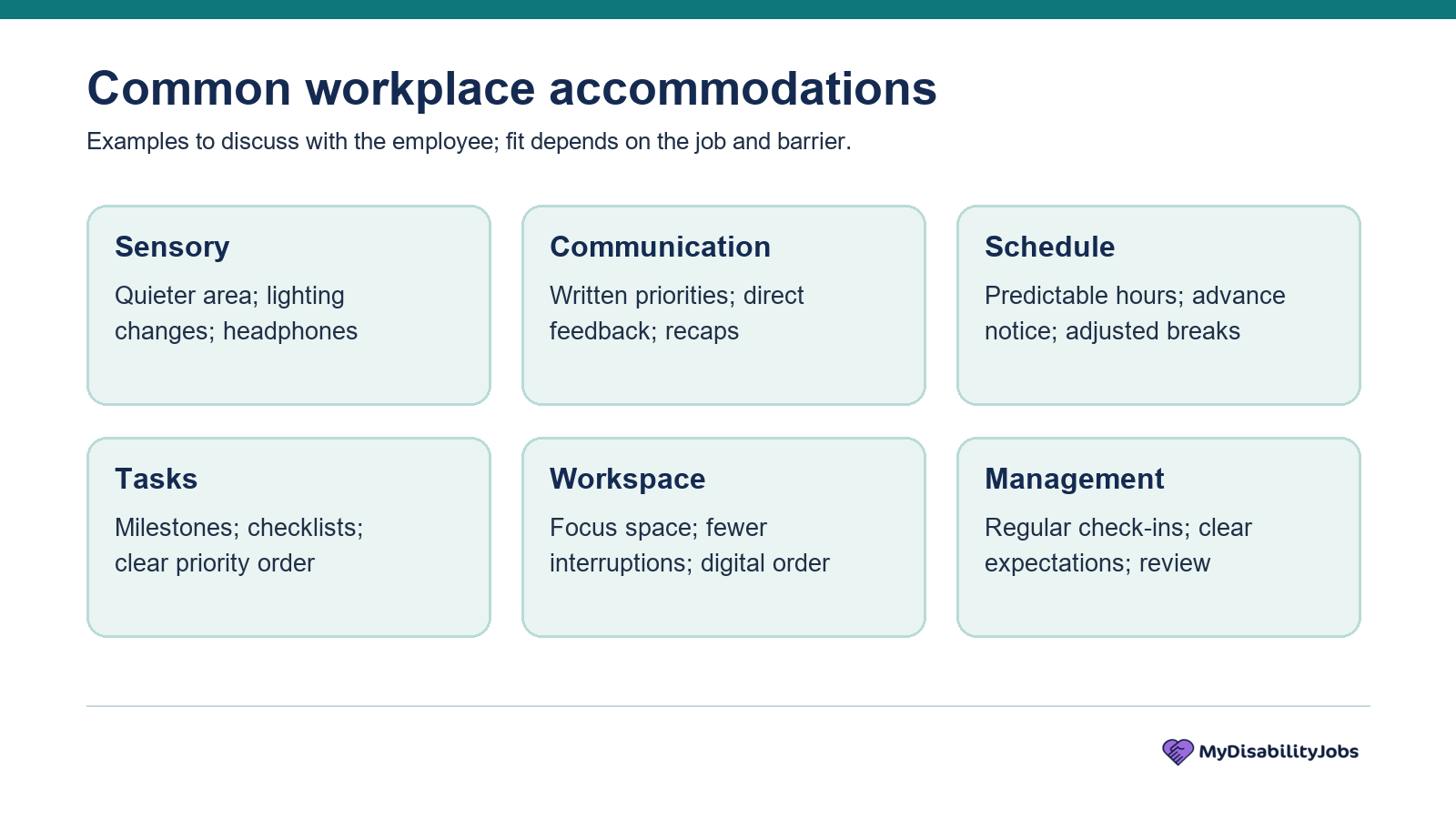
Common autism accommodations at work span the environment, communication, scheduling, tasks, and supervision. Their usefulness depends on the person and the job. Ask what is getting in the way before selecting a tool, policy change, or schedule. For example, headphones may reduce distracting sound for desk work but may be unsuitable for a role that requires continuous audio alerts; a quieter location or adjusted alert method might address the same barrier.
Sensory accommodations
Noise, light, smells, temperature, and visual activity can make a workspace difficult to use. Possible adjustments include noise-reducing headphones when safe, a seat away from heavy traffic, a quiet room for focused tasks, task lighting rather than harsh overhead light, or a low-fragrance workspace policy. A person may prefer one of these, several, or none. Ask which conditions interfere with a specific task and check any safety or team requirements before changing equipment or location. The options are a menu, not a prescription.
Communication accommodations
Clear communication can mean sending instructions, priorities, and deadlines in writing; stating the expected outcome of a task; or following a verbal conversation with a short summary. A manager can give direct, specific feedback instead of relying on hints such as “be more proactive.” If a person processes information better asynchronously, allow questions by email or chat where the role permits. Confirm understanding without requiring an employee to disclose personal details to coworkers. Written communication should clarify work, not become an extra reporting burden.
Scheduling and flexibility
A predictable shift, advance notice of changes, protected focus time, a modified break pattern, or flexible start time may reduce a barrier. Remote or hybrid work can be considered when the essential functions can be performed that way, but it is neither automatically required nor automatically excluded. Look at which hours, tasks, and interactions actually require presence. If a change is temporary or experimental, agree on a review date and the work outcomes that will show whether it helps.
Task and executive-function support
When the obstacle is organizing competing demands, an employer might provide a prioritized task list, written milestones, a shared project board, checklists for recurring work, or a brief scheduled check-in. Break a large assignment into deliverables with owners and dates. Clarify what to do when priorities conflict. These adjustments support planning and execution without lowering the essential quality or timing standard. Avoid assuming that strong technical performance means an employee needs no support with changing priorities.
Workspace accommodations
Consider the physical and digital workspace together. A quieter desk or reduced visual clutter may help in person; fewer notifications, accessible written documentation, and a predictable channel for urgent messages may help in remote work. Ask before moving someone’s desk or changing software settings. If a private room is unavailable, consider a reservable focus area or periods of uninterrupted work. The goal is a workable environment, not a separate space imposed on an employee.
Meetings and social interaction
Send an agenda in advance, identify decisions and action items afterward, and explain whether participation is expected verbally or can be written. In some roles, optional camera use or a written contribution before a meeting may be workable; in others, live interaction is an essential part of the task. Distinguish required collaboration from unwritten expectations about eye contact, small talk, or a particular conversational style. A manager can make meeting rules explicit for everyone without singling out one employee.
Supervisory and managerial support
The supervisor’s methods can be part of the accommodation. Agree on a consistent check-in rhythm, a clear channel for questions, timely notice of changed priorities, and feedback that identifies the work product to change. Offer a written recap of decisions where useful. JAN lists changes in supervisory methods among accommodation possibilities. Supervisors still set and assess essential standards; the adjustment concerns how expectations and support are communicated.
Autism Accommodation Examples by Workplace Barrier
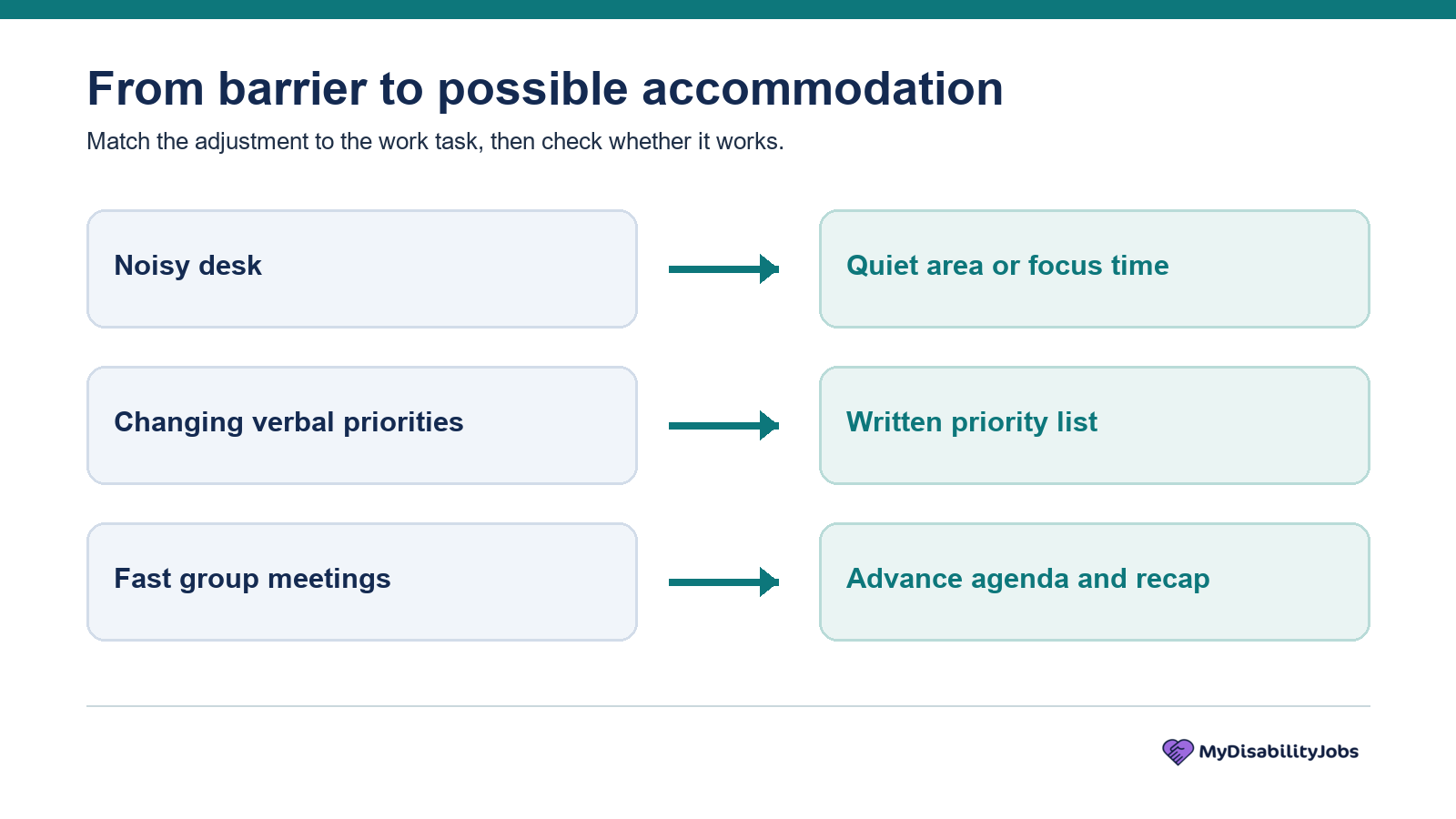
The table translates a reported barrier into options an employer can discuss. These are examples of workplace accommodations for autism, not automatic entitlements or substitutes for an individualized assessment.
| Workplace barrier | Possible accommodation to explore | What to confirm |
|---|---|---|
| Background conversations interrupt concentration during analysis work | Quiet desk, headphones where safe, or reserved focus blocks | Required calls, audible alerts, and how output will be measured |
| Verbal instructions are hard to retain when tasks change quickly | Written priorities and a short recap after meetings | Who updates the list and which channel is authoritative |
| Unannounced schedule changes disrupt preparation or travel | Advance notice where possible and a predictable core schedule | Which changes are unavoidable and how much notice is feasible |
| Several deadlines arrive without a clear order | Shared priority board and agreed escalation rule | Who decides priority when requests conflict |
| Bright overhead lighting makes desk work difficult | Alternative desk, task lighting, or permitted light adjustment | Workspace and safety constraints |
| Group meetings move too quickly for considered input | Advance agenda, written comments, and post-meeting decisions | Which discussions require live participation |
| Feedback is indirect or arrives only at annual review | Specific examples, regular brief check-ins, written action items | Consistent performance standards and a workable review cadence |
The useful test is whether the proposed change addresses the barrier while allowing the employee to perform the role’s essential functions. If the first option does not work, revisit the barrier and try another effective approach. The next sections explain how to do that as an employer and how U.S. accommodation rules shape the decision.
How Employers Should Identify Appropriate Accommodations
Start with the job and the barrier. Identify the role’s essential functions, the task or setting in which a barrier occurs, and the outcome the employee is expected to deliver. Do not start with an assumption about autism.
Ask for the employee’s input. Find out what part of the situation is difficult and what has helped before. Someone may know the exact adjustment they need; someone else may describe the problem but need help exploring options. Either response is a useful starting point.
Compare effective options where practical. A worker who cannot focus amid frequent conversations might prefer a quieter desk, a room for concentrated work, or defined periods without interruption. Test each possibility against actual duties, safety needs, available space, and the employee’s input. Consider how a tool or policy will be used: headphones are less useful if urgent instructions still arrive only as audible announcements. JAN recommends identifying limitations, connecting them to job tasks, exploring solutions, implementing, and following up.
Document and review the change. Write down the agreed adjustment, who will arrange it, the start date, and a review point. Assess whether the employee can perform the relevant task under the adjusted conditions. A short trial can be useful when effectiveness is uncertain, but it should not become an excuse for indefinite delay. Keep any medical information separate from ordinary performance documentation. If the first approach fails, ask why and consider another effective option.
For example, a customer-support analyst might meet quality and response-time standards but struggle when multiple supervisors change the order of incoming tasks. The barrier may be the absence of one clear priority source, rather than the work itself. HR could ask the analyst and supervisors to test a shared queue with a named person who resolves conflicts.
At the review, compare the same quality and response-time measures used for the role, and ask whether the queue reduced confusion. If it did not, adjust the process rather than assuming the employee’s first idea was the only possible answer.
How to Handle an Autism Accommodation Request
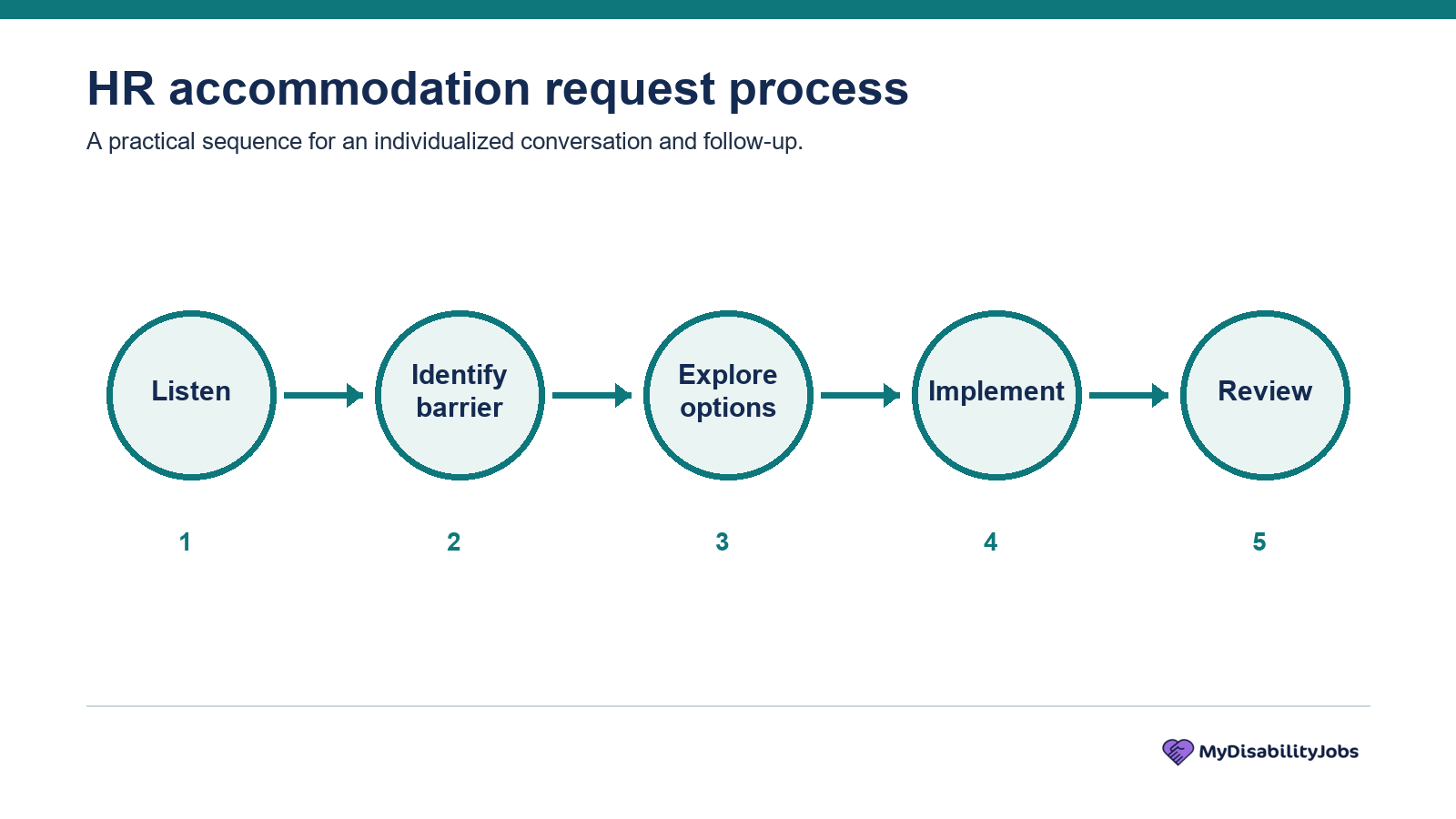
A manager may hear “I need instructions in writing because of a medical condition” rather than a formal reference to the ADA. Train managers to recognize that as a possible accommodation request and route it promptly to the person who handles requests. The EEOC’s manager guidance stresses recognition, prompt response, and confidentiality.
- Listen and acknowledge. Thank the employee for raising the issue, confirm the work barrier in their own terms, and explain who will follow up. Do not debate whether they “seem autistic” or ask them to justify the request to teammates.
- Identify the task and barrier. Review the relevant essential duties and ask what happens under current conditions. If the disability or need is not obvious, HR should determine whether limited supporting information is appropriate under EEOC rules; avoid collecting unrelated medical history.
- Explore effective options together. Discuss the employee’s preferred solution and reasonable alternatives. The employer may select another effective accommodation, but should give the employee’s preference primary consideration and explain the practical choice.
- Implement promptly. Tell the employee what will change, who will arrange it, and when. Give the manager only the information needed to carry out the adjustment. Keep medical records confidential and separate from personnel records.
- Review and adjust. Ask whether the change removes the barrier, whether work outcomes are being met, and whether another change is needed. Revisit it when duties, location, schedule, or technology changes.
The process should be documented enough for continuity, especially when managers change. It should also remain a conversation rather than a one-time form. The EEOC’s reasonable accommodation guidance says employers should respond and act promptly; unnecessary delay can violate the ADA.
Autism Workplace Accommodations and the ADA
The legal discussion here concerns U.S. federal employment law. Title I of the ADA generally applies to employers with 15 or more employees. State or local law may provide additional coverage or protections. Covered employers must provide reasonable accommodation to a qualified applicant or employee with a disability when needed, unless doing so would impose undue hardship. The person must be able to perform the position’s essential functions with or without reasonable accommodation. The ADA statute supplies those definitions and the basic duty.
Is Autism Protected Under the ADA?
Yes. The EEOC’s explanation of the ADA Amendments Act specifically identifies autism among impairments that should readily meet the disability definition. The legal definition also recognizes a record of a substantially limiting impairment or being regarded as having an impairment. Accommodation duties concern an actual disability or record of one; being regarded as disabled alone does not create an accommodation entitlement. Whether and which adjustment is needed still depends on the person and the job. A manager should avoid assuming that every autistic employee needs an adjustment or rejecting a request because the employee appears to be doing well.
An employee does not need to say “ADA” or use a special form to start a request. They need to communicate that a work change is needed for a reason related to a medical condition. The employer may ask for reasonable documentation when the disability or need is not obvious, but the request should be limited to information needed to establish disability and the accommodation need. The EEOC explains these points in its guidance linked above.
Reasonable accommodation can apply to hiring, essential job duties, and benefits or privileges of employment. It need not eliminate an essential function or lower a consistently applied production standard. It may change how the employee meets that standard. Medical information obtained through the process must be kept confidential in separate medical files, with only the limited disclosures the law permits. These are legal requirements; teamwide agendas, predictable communication, and optional quiet work areas can also be good practices even when no individual legal request has been made.
Can Employers Refuse an Autism Accommodation Request?
An employer does not have to grant the exact adjustment requested if another reasonable accommodation effectively removes the barrier. It also need not remove an essential job function or lower a uniformly applied production standard. A particular accommodation may be denied if it would cause undue hardship—significant difficulty or expense assessed in light of the employer’s resources and circumstances. Cost alone is not a universal reason to deny a request, and coworker resentment or stereotypes are not an undue-hardship analysis. The EEOC guidance linked in the request process addresses effective alternatives and undue hardship in detail.
When a preferred option cannot be provided, explain the job-related reason and continue exploring effective alternatives. For example, if continuous headset use would prevent an employee from hearing a required safety alarm, consider a quieter station, adjusted alert method, or another workable measure. Document the decision and the alternatives considered. A blanket “we do not do that here” response can miss an option that would work in the particular role.
How Managers Can Support Autistic Employees Beyond Formal Accommodations
Managers can make ordinary work more understandable without asking anyone to disclose a diagnosis. Share agendas, name decision owners, write down changed priorities, and give direct feedback tied to a deliverable. Explain how to ask for clarification and when a response is urgent. These practices can help a whole team and may prevent avoidable barriers; they do not replace an individualized accommodation process when one is needed.
Avoid treating eye contact, informal socializing, or a preferred communication style as a proxy for performance unless a specific behavior is truly required by the job. Judge the work against stated criteria. Ask an employee how they prefer to receive feedback and how much advance notice helps with changes. Respect the answer without making them a spokesperson for all autistic people. Follow up after an adjustment starts, and bring HR in if duties change or an option stops working.
For a wider employer plan, connect manager training with hiring people with disabilities and accessible onboarding. Accommodations are part of the employment cycle, not a favor granted only after a problem becomes severe.
Workplace Accommodation Checklist for HR and Managers
- Give employees a clear way to raise a work-related accommodation need, including with a manager.
- Train managers to recognize a request stated in ordinary language and refer it promptly.
- Identify the affected essential task and the workplace barrier before selecting an adjustment.
- Ask the employee for preferred options; assess alternatives for effectiveness and feasibility.
- Request only appropriate supporting information when disability or need is not obvious.
- Keep medical information confidential and in a separate medical file.
- Record the agreed change, owner, start date, and review date.
- Check whether the adjustment works and revise it if the role or environment changes.
- Keep teamwide accessibility practices available without treating them as a substitute for individual requests.
This checklist is a practical management aid, not a replacement for the employer’s legal review of a specific case.
For Autistic Employees: How to Request Workplace Accommodations
If a work condition is creating a barrier, you can tell a manager or HR contact what task is affected, how the current setup causes difficulty, and what change might help. Under EEOC guidance, you do not have to cite the ADA or use the phrase “reasonable accommodation.” You can ask in plain language, for example: “Because of a medical condition, I need written priorities after our weekly planning meeting so I can track changes accurately.” You can propose an option without having to know the only solution.
You may want to note when the barrier occurs and which adjustment has worked elsewhere. Ask who will handle the request and when you can expect a response. If the proposed solution is ineffective, explain what remains difficult and ask to revisit options. The legal process may require enough information for an employer to understand the disability-related need, but you do not have to share your medical information with coworkers. If you are exploring a new role, jobs for autistic people can be a starting point for considering job fit and workplace questions; a job title alone cannot tell you whether a particular workplace will be accessible.
Frequently Asked Questions
Options include a quieter work area, written instructions, advance agendas, a predictable schedule, structured priorities, or a different feedback method. The right option depends on the employee’s barrier and essential job duties.
They can be when they address a sound-related barrier and allow the employee to perform essential duties safely. If the role requires audible alerts, discuss a quieter location or another effective option.
Anyone can ask for a clearer process or work change. For a formal ADA accommodation, the employer may need limited information establishing a covered disability and the accommodation need when these are not obvious. The employee need not announce a diagnosis to coworkers.
The employee needs to tell the employer that a work change is needed for a reason related to a medical condition, but need not use the word “autism” or disclose a diagnosis to coworkers. If the disability or need is not obvious, the employer may request limited supporting information.
Yes, if the alternative is effective. The EEOC says the employee’s preference should receive primary consideration when more than one option works.
No automatic rule applies. Employers should assess the essential functions, the barrier, and whether remote or hybrid work would be effective and reasonable in the particular role.
Yes. An adjusted start time, predictable schedule, or modified breaks can be reasonable if they address the employee’s disability-related barrier and fit the role’s essential duties, unless they would cause undue hardship.
A covered employer generally bears the cost of an accommodation it is legally required to provide, unless it establishes undue hardship. Employers should assess the specific option and available alternatives instead of assuming an adjustment is expensive.
Reopen the discussion. Changes in tasks, environment, or technology can make a previous solution less effective; both sides can review the barrier and consider another option.
Final Takeaway
Effective workplace accommodations for autism begin with an individual employee’s work barrier, not a list of traits. For employers, the practical sequence is to listen, identify the affected task, explore effective options, implement promptly, and review the result. Keep legal duties, discretionary inclusive practices, and employee privacy clear throughout. Employers seeking to connect that work with recruitment can use MyDisabilityJobs to share jobs for people with disabilities.
Comments are closed