


ADHD Accommodations at Work: Examples, ADA Rights & How to Ask in 2026
ADHD accommodations at work can include a quieter workspace, written priorities, task reminders, changes to a schedule or break pattern, and a different way to receive instructions. The useful choice depends on what is getting in your way and what your job requires. You do not need every option on a list, and a diagnosis alone does not tell an employer which change would help.
If you keep losing the thread after interruptions or leave meetings uncertain about your next task, start with that specific situation. Describe the barrier, consider possible changes, and ask the appropriate person at work to discuss them with you. A practical request connects the change to the work you need to do.
This guide explains common options, realistic workplace examples, how to choose and request support, and the relevant U.S. Americans with Disabilities Act (ADA) rules. It is general workplace information; the legal outcome of an individual request depends on the circumstances. The aim is to help you prepare an informed next step.
On this page
- What Are ADHD Accommodations at Work?
- Common ADHD Accommodations at Work
- ADHD Workplace Accommodation Examples by Challenge
- How to Choose the Right ADHD Accommodation
- How to Ask for ADHD Accommodations at Work
- ADHD Accommodations and the ADA
- What Employers Should Know About ADHD Accommodations
- ADHD Workplace Accommodation Checklist
- Frequently Asked Questions
- Final Takeaway
What Are ADHD Accommodations at Work?
A workplace accommodation changes how work is arranged so a qualified person with a disability can apply for a job, perform its essential functions, or access employment benefits. Essential functions are the fundamental duties of the role. An adjustment might change the setting, tools, instructions, or schedule while keeping the required work outcome. The EEOC’s guide to employment rights explains these basics.
For example, if you can prepare accurate reports but nearby conversations repeatedly disrupt that task, a quiet work area could address the barrier. If assignments arrive through several conversations and you lose track of their order, a shared written priority list might be more useful. Neither example means that all employees with ADHD need a private office or a particular app.
It helps to distinguish three kinds of support:
- Personal strategies: tools or routines you manage yourself, such as a checklist or calendar reminders.
- General workplace practices: options available to a team, such as meeting agendas or flexible hours under an existing policy.
- Individual reasonable accommodations: disability-related changes considered through an employer’s accommodation process, subject to the applicable legal rules.
The same tool can fall into different categories. You may already use a task planner, but need permission to keep it open during a meeting or help placing assignments in one agreed system. Be clear about the change you need from the employer. For wider employment context, see our ADHD employment statistics; population figures cannot determine what will work for you.
Common ADHD Accommodations at Work
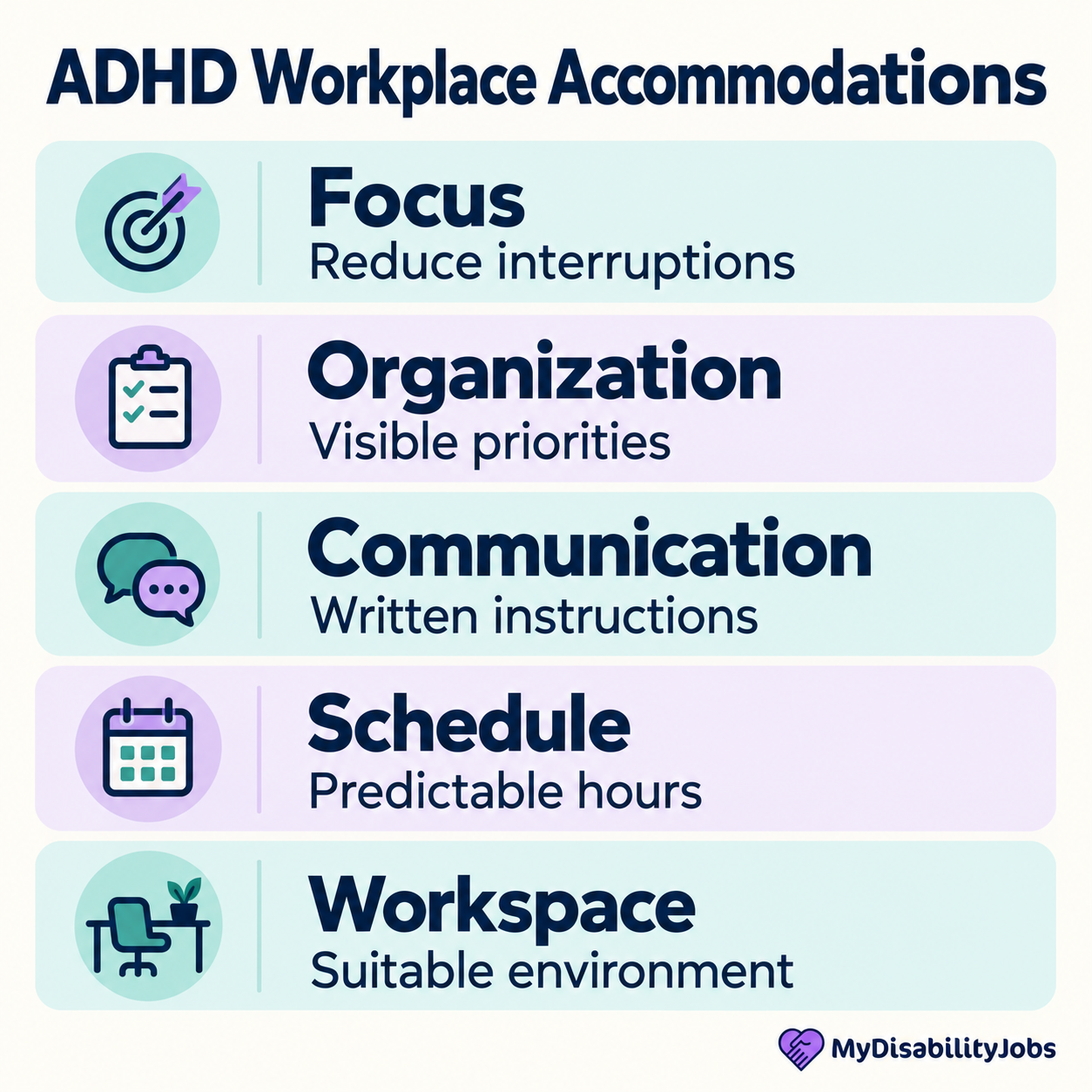
Use these ADHD workplace accommodations as a menu of possibilities. Choose the ones that match your actual tasks and barriers. The Job Accommodation Network (JAN) ADHD resource includes options related to concentration, time management, supervision, and other work functions. The examples below show how you might turn an option into a specific workplace arrangement.
Focus and distraction accommodations
If conversations, foot traffic, notifications, or repeated interruptions make a task difficult, identify which distraction matters most. A desk facing away from a busy walkway addresses a different problem from a quieter room or a period without incoming chat messages.
Possible adjustments include:
- access to a quiet area for particular tasks;
- a workstation farther from shared equipment or frequent conversations;
- permission to use noise-reducing headphones where safe;
- an agreed period for concentrated work, with a separate way to flag urgent matters.
Make the arrangement usable. Instead of asking only for “fewer interruptions,” you could propose doing report writing in a quiet room from 9 to 10 a.m., while urgent customer issues still reach you through one designated channel. That gives you and your manager something concrete to discuss.
Headphones will not fit every role. If you need to hear alarms, customers, or coworkers for safety, discuss another way to reduce distraction without losing necessary information. Also consider whether blocking sound helps you or whether a different location would work better. The goal is to address your barrier, rather than buy a tool that leaves the difficult situation unchanged.
Organization and time-management accommodations
When assignments are scattered across email, chat, and verbal requests, adding another planner may create more places to check. First work out whether the problem is capturing tasks, deciding their order, estimating time, or noticing when you need to switch activities.
Options to discuss include one shared task list, visible due dates, reminders at useful points, intermediate milestones for a large project, or a brief meeting to confirm priorities. Ask how urgent changes will be added and who can resolve a conflict between two assignments.
For example, a coordinator preparing an event might use milestones for booking, supplier confirmation, and final checks. Each milestone could have a named owner and a due date. This changes how progress is organized; it does not assume the event date can move.
Keep the system manageable. A reminder needs to tell you what action to take, and a task list needs to show what is current. If everything is marked urgent, ask which item takes priority and what can wait. Before choosing software, check whether an existing workplace tool can support the arrangement and whether you can access it during the tasks where it is needed.
Written instructions and task clarity
If spoken directions are difficult to retain or several people give conflicting instructions, a written reference may help. The useful request is usually more specific than “put everything in writing.” Describe which information you need to refer back to: steps in a new process, changes to an assignment, a deadline, or the standard for a finished task.
You could ask for a short task brief containing the outcome, priority, deadline, and person to contact with questions. For recurring work, a checklist or an approved example of the completed task may be more useful than a long manual. JAN’s written-instructions guidance describes this as an accommodation option.
For instance, after a supervisor explains a new procedure, you might take notes and ask them to check that the sequence is correct. Alternatively, the supervisor could provide the steps in the team’s shared system. Agree who will update those steps when the process changes.
Written instructions should give you a reliable reference, not bury the assignment in more text. You can ask follow-up questions such as, “Which step must happen first?” or “What would a complete result look like?” These questions make the requested support easier to define.
Flexible schedules and breaks
A schedule adjustment might mean a different start time, a consistent shift, or changes to when breaks occur. Short, agreed breaks may be worth discussing if you need movement between sustained tasks. You can also ask about scheduling work around disability-related appointments.
Define the arrangement rather than leaving “flexibility” open-ended. Which hours would change? How would you cover required duties? Would the change affect a handover or a service that must be available at a fixed time? A request for a later start in a role with flexible coverage is different from one that would leave essential opening duties unstaffed.
The EEOC’s small-employer accommodation guidance recognizes modified schedules and periodic breaks as possible accommodations, absent undue hardship. That does not make every requested schedule automatically available. Discuss a disability-related need and workable options, including a predictable schedule if that addresses your difficulty better than variable hours.
Remote and hybrid work
Working from home can reduce a particular office distraction, but it may introduce different barriers, such as less structure or difficulty separating work from household activity. Consider your actual experience rather than assuming remote work will be easier because you have ADHD.
If you request remote or hybrid work, explain which duties you can perform away from the workplace, how you will communicate, and what barrier the arrangement would address. A designated remote day for focused analysis might be one option; a quieter onsite location could be another. The EEOC’s telework guidance calls for assessing essential duties and whether an effective accommodation can be provided.
If you are exploring a different role, our work from home guide can help you investigate remote job options. A job advertised as remote still has its own schedule, communication expectations, and performance requirements.
Meetings and communication
If you find it hard to listen, take notes, and work out your next action simultaneously, identify the information you need to leave the meeting with. Possible options include an agenda in advance, written action items, permission to take notes in your preferred format, or pauses to clarify an instruction.
For example, a project meeting could end with a short recap of each person’s task, deadline, and unresolved question. You could then confirm your own assignment before leaving. This supports a clear handover without requiring a transcript of every conversation.
Recordings, captions, or transcription may be options, but agree the method with your employer. Client confidentiality, workplace policies, access controls, and consent requirements can affect how these tools are used. Do not assume permission to record or send work conversations to an outside app. Sometimes a brief written summary addresses the same need with less complexity.
Executive-function and management support
You may need support with starting a task, switching between activities, or tracking several stages of a project. A useful arrangement could involve a scheduled priority check, a defined first step, a visual workflow, or feedback before a project reaches its final deadline.
Ask for support that fits your working style. If frequent unscheduled check-ins interrupt you, a predictable meeting may be better. If a task feels unclear, agree a first deliverable and a time to review it. JAN’s supervisory-methods resource explains that changing how supervision is provided can be an accommodation option.
A job coach or additional task training may also be worth exploring when it addresses a specific work need. Be clear about the skill, task, duration, and intended result. Coaching is not an automatic entitlement, and a supervisor should not assume that you need constant oversight simply because you have ADHD. You should have a voice in what support looks like.
ADHD Workplace Accommodation Examples by Challenge
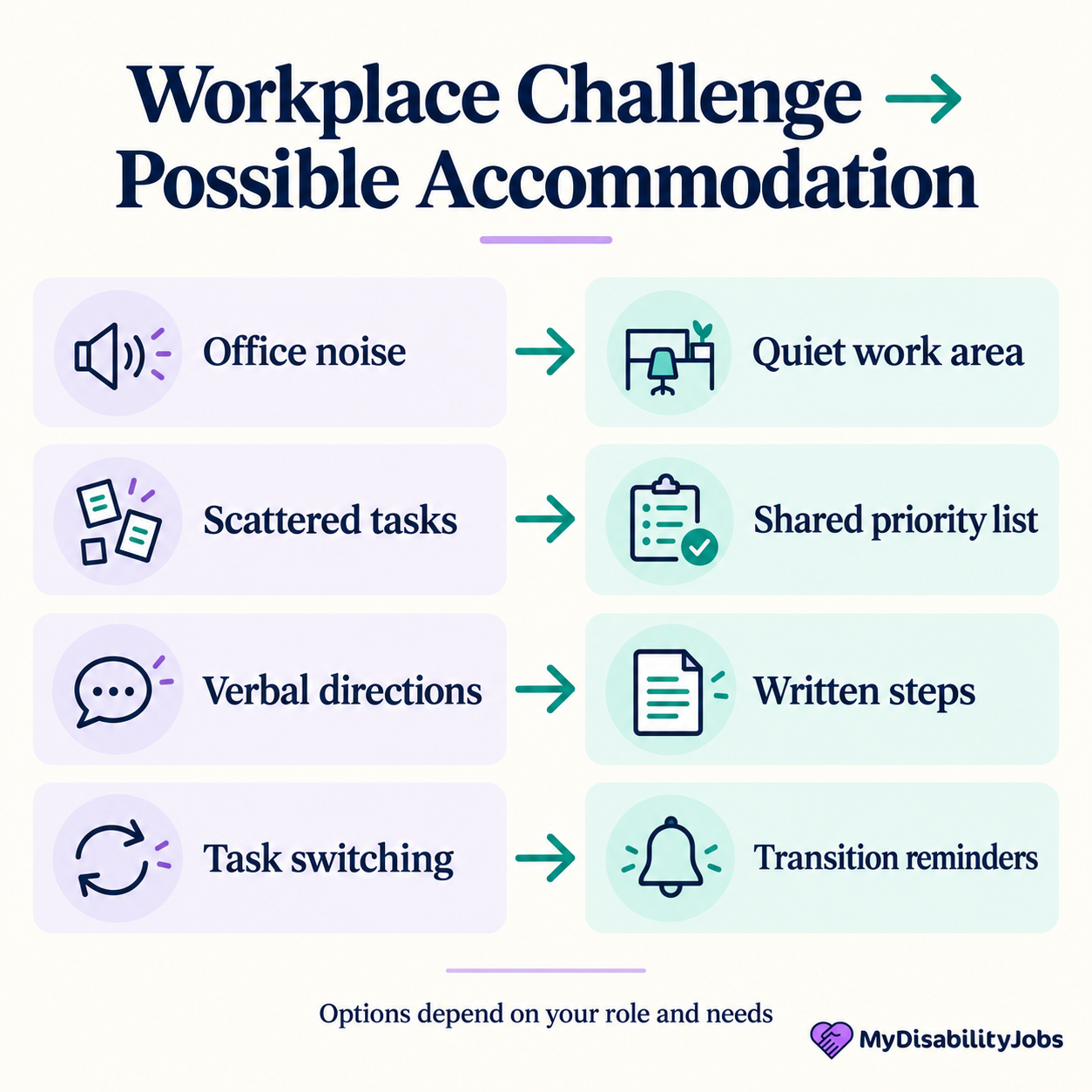
These examples of ADHD work accommodations are starting points for discussion, not a list of guaranteed approvals. Match the option to your role and assess whether it would actually address the difficulty.
| Workplace challenge | Possible accommodation to discuss |
|---|---|
| Nearby conversations repeatedly interrupt detailed work | A quiet work area for that task or safe use of noise-reducing headphones |
| Assignments arrive through several channels | One agreed task queue showing owner, priority, and due date |
| Spoken steps in a new procedure are difficult to retain | A written sequence, checked notes, or an approved demonstration to revisit |
| A large project is difficult to start and track | Defined milestones and a scheduled review of the first deliverable |
| Switching tasks causes you to lose your place | Transition reminders and a checklist showing where to resume |
| Long seated tasks are difficult to sustain | Agreed movement breaks or a suitable adjustable workstation |
| Meeting decisions are hard to capture while listening | Written action items or an agreed note-taking method |
| Changing shifts make an established routine difficult | A predictable schedule, where compatible with essential coverage |
Example in an onsite role: A service technician knows how to complete repairs but loses track when several work orders change priority during a shift. They could ask for updated priorities in one dispatch system and a clear contact for conflicts. This preserves the repair duties while changing how assignments arrive.
Example in a remote role: An analyst misses a task switch because messages arrive while they are concentrating on another assignment. They could discuss a defined escalation channel and transition reminders. Moving the role home has not, by itself, solved the communication barrier.
How to Choose the Right ADHD Accommodation
When choosing work accommodations for ADHD, start with a task you need to perform and the barrier that gets in the way. “I need help with ADHD” gives your employer less to work with than “When assignments change verbally during a shift, I cannot reliably track which task is now urgent.” The second description points toward a change you can discuss and evaluate.
Choose for your actual job. Consider when the difficulty occurs, how often it affects your work, and which duties or outcomes you must maintain. A quiet workspace may help with detailed analysis but do little for missed handovers. A shared priority list may address changing assignments better than a new calendar app.
Compare workable options. Pick a preferred approach and, where practical, an alternative that could address the same barrier. You do not need to arrive with a perfect solution. Your employer can help explore options, and the accommodation process should consider your input. Safety, essential job functions, available resources, and effectiveness all matter.
Agree what success looks like. For a written-priority arrangement, that might mean knowing which assignment comes first and meeting agreed deadlines. For a workspace change, it might mean completing a particular task with fewer interruptions. Set a review point appropriate to the work. A trial can help assess an option; it should have a clear arrangement and follow-up rather than leaving your request unresolved.
If the change does not work, describe what remains difficult and revisit the options. An ineffective tool does not necessarily mean that your underlying need has disappeared.
How to Ask for ADHD Accommodations at Work
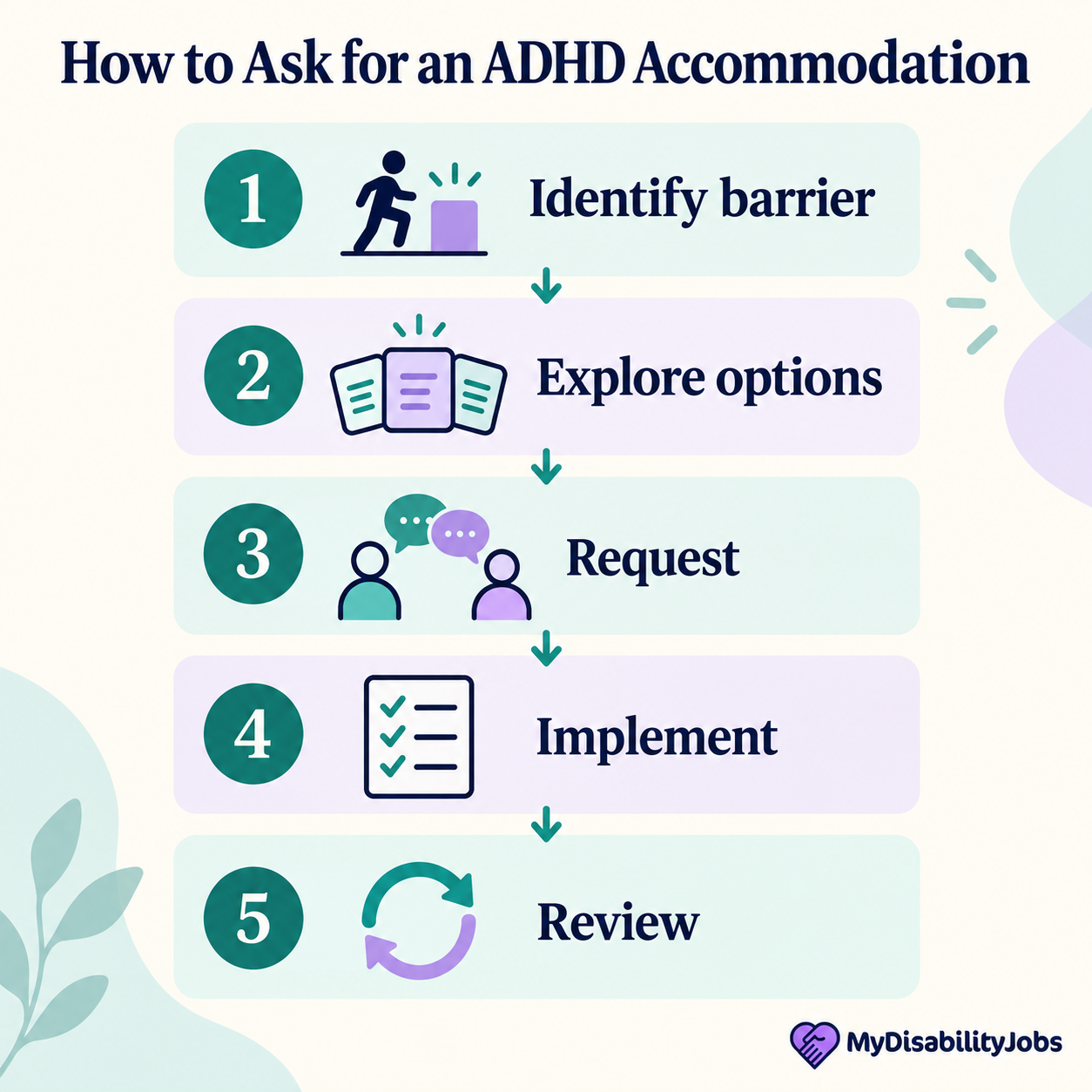
A useful request explains the work barrier, its connection to a medical condition, and the change you want to discuss. You can ask before a difficulty becomes a performance problem. The following steps can help you prepare without turning the conversation into a detailed account of your entire medical history.
Identify the workplace barrier
Write down one or two specific situations: the task, what happens, and the effect on your work. For example, an instruction may be clear when given but difficult to recall when you begin the task later. Describe that difficulty and the task it affects, rather than assuming that an ADHD diagnosis explains everything by itself.
Use appropriate examples from your work without taking confidential client information or sensitive workplace records into a personal document. You are preparing to explain a functional need, not to build a file of every mistake.
Choose possible accommodations
Use the examples above to identify a change that addresses your barrier. Describe how it would operate: written steps for which procedures, a priority check at what point in the week, or a quieter space for which tasks.
You can offer a preferred option and ask to explore alternatives. If you are unsure what would help, say so and ask for a discussion. JAN’s accommodation-request guidance offers a useful starting point for organizing the information.
Talk to HR or your manager
Check your workplace’s accommodation policy for the appropriate contact. Depending on the organization, that may be HR, an accommodations team, or your manager. Explain that you need a change at work for a medical reason. Under the EEOC’s reasonable-accommodation guidance, a request can be made in plain language; you do not need to use the term “ADA” or start with a formal written letter.
A conversation can start the process, although a short written follow-up can clarify what you requested and who will respond. Ask about next steps, any relevant documentation, and a time to follow up. An employer may ask you to complete its form, but an initial request should not be ignored simply because it was not on that form.
You do not have to share your diagnosis with coworkers. Whether to disclose disability information more broadly is a separate choice; our guide to disability disclosure on job applications discusses that decision. For an accommodation request, give the appropriate contact enough information to understand the disability-related need.
Job seekers can also request an adjustment to the application or interview process. Identify the barrier in that process and the adjustment you need, such as written instructions for an assessment. A request for an interview accommodation does not require you to predict every adjustment you might need in the eventual job.
What documentation can an employer request?
When your disability or need for accommodation is not obvious, an employer may request reasonable documentation establishing that you have a covered disability and explaining why the accommodation is needed. The request should be limited to relevant information. It generally should not require your complete medical records, which may contain unrelated information.
An appropriate healthcare or rehabilitation professional may be able to explain the functional limitations and how a proposed change would help. Give them an accurate description of the relevant work tasks. The EEOC’s guidance for mental-health providers explains the role of this documentation and notes that a specific diagnosis is not always necessary if the information otherwise establishes the disability and need.
Ask what information is missing if a letter is insufficient. Medical information is subject to ADA confidentiality requirements, including separate medical files and limited exceptions for sharing. A manager may need to know the adjustment to implement without receiving your full medical history.
Example ADHD accommodation request
Adapt this example to your situation. Naming ADHD is optional in the initial wording, provided you communicate that the change is needed for a medical condition.
I am requesting a workplace accommodation related to ADHD. When task priorities change only through verbal instructions, I have difficulty tracking the current order and deadlines. This affects my ability to manage several assignments reliably.
I would like to discuss keeping updated priorities and deadlines in one shared task list, with a short scheduled check-in to resolve conflicts. I believe this would help me complete the required work. I am also open to discussing another effective option.
Please let me know the next steps and whether you need relevant documentation. Once we agree an arrangement, I would like to confirm how it will work and set a time to review its effectiveness.
After the discussion, confirm the agreed change, who will implement it, and how you will raise problems. Keep a copy of your request and follow-up. If the arrangement is not effective or your duties change, ask to revisit it.
ADHD Accommodations and the ADA
This section concerns U.S. workplace rights and reasonable accommodations for ADHD. Title I of the Americans with Disabilities Act generally covers employers with at least 15 employees. Other laws may provide protections in smaller workplaces, and rules outside the United States differ.
Is ADHD a Disability Under the ADA?
ADHD can qualify as a disability under the ADA, but a diagnosis alone does not settle an individual accommodation request. The assessment considers whether the condition substantially limits a major life activity, such as concentrating, thinking, or learning, or a major bodily function. The definition is intended to be interpreted broadly. For this assessment, the beneficial effects of medication and most other mitigating measures generally are not counted.
A person must also be qualified for the job: able to perform its essential functions with or without reasonable accommodation. An employer generally must provide an effective reasonable accommodation for a known disability-related need unless doing so would cause undue hardship. That means significant difficulty or expense in the employer’s circumstances; it is not simply a preference against changing a routine.
An employer may choose another effective accommodation after considering your preference. It does not have to remove essential duties, lower uniformly applied performance standards, or approve every requested arrangement. Being protected solely because an employer regards you as disabled does not itself create an entitlement to accommodation.
The EEOC’s disability and employment guidance explains these protections, including protection against retaliation for requesting accommodation. If a request is refused, ask for the reason and whether another effective option is available. If you believe your rights were violated, seek prompt guidance about your circumstances; the EEOC’s charge-filing information explains the process and applicable time limits. Federal employees use a different complaint process.
What Employers Should Know About ADHD Accommodations
Respond to the person and the work barrier they describe. ADHD does not tell you which tasks someone finds difficult, what their strengths are, or whether they need an accommodation. Do not substitute a standard package of headphones, software, or extra supervision for a conversation about their needs.
Clarify the required outcome. Identify the essential job function and the obstacle to performing it. Ask what has helped before and discuss effective options. For example, if changing instructions create a barrier, consider how priorities reach the employee rather than assuming the solution is closer monitoring.
Separate an individual request from general practice. Clear instructions, accessible procedures, and predictable communication can support many employees. These inclusive workplace practices can coexist with a tailored accommodation. Offering the general practice does not settle an individual request if the person’s disability-related need remains unmet.
Assess the real requirements. Check safety, essential duties, feasibility, and whether the option addresses the barrier. Consider alternatives where appropriate. Avoid relying on assumptions about ADHD, speculative disruption, or a blanket rule against exceptions. When accommodation is legally required, an undue-hardship assessment depends on the specific circumstances.
Make implementation clear. Confirm the agreed change, responsibilities, and a review point. Ensure the person implementing it understands the arrangement. Keep medical information confidential and avoid explaining a coworker’s accommodation by disclosing their diagnosis. If an option fails, revisit the barrier and possible alternatives with the employee.
Performance expectations can remain in place, but explain them clearly and distinguish essential outcomes from a preferred way of working. A request does not automatically erase past performance issues. Respond to an accommodation request prospectively and consult appropriate HR or legal support if disability, discipline, and a pending request overlap. Broader workplace accessibility planning can help make the request process easier to find and use.
ADHD Workplace Accommodation Checklist
Use this ADHD accommodations checklist to prepare for a conversation and track what happens afterward. It is a planning aid, not a legal eligibility test.
- Task: Which duty or part of the application process is affected?
- Barrier: What happens, when does it occur, and how does it affect the task?
- Connection: Can you explain that the change is needed for a medical condition?
- Options: What is your preferred change? Could another approach meet the same need?
- Practical details: How would the change work alongside essential duties, coverage, communication, and safety?
- Contact: Who handles accommodation requests at your workplace?
- Documentation: If requested, what relevant information is needed and who can provide it?
- Agreement: What will change, who will implement it, and when will it start?
- Review: How will you assess effectiveness and raise a problem?
You do not need every answer before making an initial request. Keep useful notes and ask for clarification where the process or decision is unclear.
Frequently Asked Questions
Possible options include written instructions, a shared priority list, a quieter workspace, agreed breaks, modified schedules, meeting summaries, and adjusted supervisory methods. The appropriate option depends on your barrier and job. A list of examples does not guarantee approval of a particular request.
They may be, if they address a disability-related distraction barrier and can be used safely while performing required duties. A role involving alarms, vehicles, or direct communication may need a different approach. Discuss when headphones would be used and alternatives such as a quieter work area.
A modified schedule or agreed breaks may be reasonable when connected to a disability-related need. Describe the specific adjustment and how required work would be covered. Employers can assess effectiveness, essential duties, and undue hardship rather than treating all flexible arrangements as automatically available.
You generally need to communicate that a work change is needed because of a medical condition. You do not have to tell every coworker or use a particular legal phrase. If the disability or need is not obvious, your employer may request relevant documentation; a specific diagnosis is not always required if the information establishes the disability and need.
Not necessarily. You can make an initial request in plain language. An employer may then ask for reasonable documentation when the disability or accommodation need is not obvious. Ask what information is required rather than assuming you must submit your complete medical records.
A change to task timing may be worth discussing, but extra time is not automatically required. Identify what causes the difficulty and whether milestones, clearer priorities, or another adjustment would help. An employer does not have to remove essential duties or lower uniformly applied performance standards.
Sometimes telework can be a reasonable accommodation, but it is not guaranteed by an ADHD diagnosis. The assessment includes essential job duties, whether the work can be performed remotely, other effective options, and undue hardship. Explain the specific barrier remote work would address.
Tell the appropriate contact what remains difficult and ask to review the arrangement. You may need to adjust how it is implemented or explore another effective option. Keep the discussion focused on the barrier, required work, and what you learned from trying the change.
Final Takeaway
Useful ADHD accommodations at work begin with your actual experience: a task, a barrier, and a change that could help you perform the work. Prepare a specific request, discuss effective options, confirm the arrangement, and review whether it works.
An accommodation is one part of workplace fit. If you are also exploring a new role, our guide to jobs for people with ADHD can help you consider work environments and responsibilities alongside your interests and skills. Your diagnosis does not prescribe a career or a single accommodation plan.
Comments are closed