


35 Best Interview Questions to Ask Candidates (With Evaluation Tips)
Choosing interview questions to ask candidates starts with the work you need them to do. Ask for specific examples, explore the candidate’s own contribution, and decide in advance what evidence would meet the role’s requirements.
In NACE’s Job Outlook 2026 survey, 70% of 183 employer respondents reported using skills-based hiring, up from 65% in the previous survey; the research focuses on hiring new college graduates, rather than representing all US employers.
The 35 questions below cover eight skill categories. Each includes what it assesses, what to listen for, and an optional follow-up. Choose a focused set for your vacancy rather than trying to ask all 35 in one interview.
In this article
- 35 Best Interview Questions to Ask Candidates
- Self-Motivation and Career Goals
- Experience and Job-Specific Skills
- Teamwork and Collaboration
- Communication and Feedback
- Problem-Solving and Decision-Making
- Adaptability and Resilience
- Accountability and Initiative
- Conflict Resolution
- How to Choose the Right Interview Questions
- How to Evaluate Candidate Answers
- Interview Questions Employers Should Avoid
35 Best Interview Questions to Ask Candidates
Use these questions as a starting bank. Replace broad references to a task, project, or customer with the work involved in your role, then use the same core prompts for candidates interviewing for that position. Examples can come from paid work, education, volunteering, or independent projects.
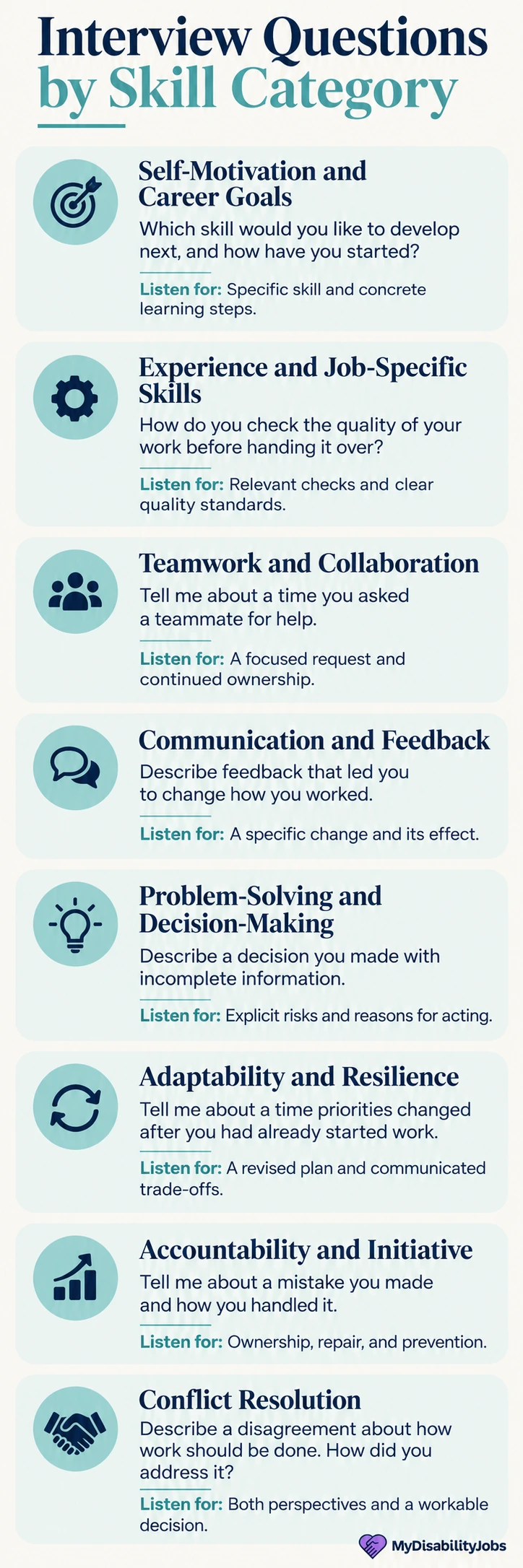
Self-Motivation and Career Goals
1. What interests you about the day-to-day work in this role?
Assesses: Motivation grounded in the actual job.
Look for: Specific responsibilities the candidate wants to take on and a realistic understanding of the work. Interest in pay or stability does not invalidate their answer; explore their reasons for choosing this particular role.
Optional follow-up: Which responsibility would you most like to learn more about?
2. Tell me about a goal you pursued without someone regularly checking your progress.
Assesses: Self-direction and sustained effort.
Look for: A clear goal, a way to track progress, and adjustments when momentum slipped. Distinguish independent execution from refusing useful guidance.
Optional follow-up: What did you do when progress slowed?
3. Which skill would you like to develop next, and how have you started?
Assesses: Learning motivation and realistic development goals.
Look for: A specific skill, an explanation of its value, and concrete learning steps. Formal courses are only one route; practice, feedback, and self-directed projects also count.
Optional follow-up: How will you know you are improving?
4. How do you keep necessary but repetitive work accurate and on track?
Assesses: Maintaining accuracy and pace across repetitive work.
Look for: A repeatable routine using checklists, planned review points, or workload organization to limit errors across repeated tasks. Ask about consistent execution rather than expecting enthusiasm for every task.
Optional follow-up: Can you give an example of a mistake your approach helped prevent?
Experience and Job-Specific Skills
5. Which experience best prepares you for the main responsibility of this job?
Assesses: Relevant experience and transfer of skills.
Look for: A direct connection between an example and the vacancy’s requirements, including the candidate’s own actions. A familiar job title alone does not establish the required capability.
Optional follow-up: What would be different about applying that experience here?
6. Walk me through how you completed a task similar to one you would handle here.
Assesses: Practical command of the work.
Look for: A coherent sequence, appropriate tools, quality checks, and an explanation of decisions. Invite a representative example without requesting confidential client or employer information.
Optional follow-up: Which step required the most judgment, and why?
7. Describe a result you helped achieve. How did you establish whether your work made a difference?
Assesses: Outcome awareness and evidence of contribution.
Look for: A credible baseline or comparison and an honest account of team contributions. Results can include fewer errors, a completed handoff, or positive user feedback; not every role produces revenue metrics.
Optional follow-up: What other factors influenced the outcome?
8. What would you need to learn first to perform this role effectively?
Assesses: Assessing onboarding needs and readiness for the role.
Look for: A realistic distinction between transferable skills and gaps in knowledge of the role’s systems, products, or procedures, with a sensible order for addressing those gaps. An acknowledgment of a learning need is more useful than an unsupported claim to know everything.
Optional follow-up: How would you approach that learning during your first few weeks?
9. How do you check the quality of your work before handing it over?
Assesses: Job-specific quality control.
Look for: A final review against specific requirements and acceptance criteria before handoff, with recognition of when another reviewer is needed. Probe beyond a general claim to be detail-oriented.
Optional follow-up: Tell me about a time your check caught an issue.
Teamwork and Collaboration
10. Tell me about a shared project where the team depended on your contribution.
Assesses: Reliability within a team.
Look for: Clear responsibilities, awareness of dependencies, and communication about progress. Separate the candidate’s contribution from the overall team’s success without discounting collaborative work.
Optional follow-up: How did you make sure others could rely on your part?
11. Describe a time you worked with someone whose approach differed from yours.
Assesses: Collaboration across working styles.
Look for: An effort to understand the difference and agree on a workable process. The relevant signal is how they coordinated the work, not whether they became friends.
Optional follow-up: What did each of you change?
12. How have you handled a handoff that involved several people or teams?
Assesses: Coordination and shared understanding.
Look for: Named owners, documented requirements, deadlines, and confirmation that the next person had what they needed. Notice whether the candidate considered downstream consequences.
Optional follow-up: Where was the handoff most likely to break down?
13. Tell me about a time you asked a teammate for help.
Assesses: Judgment about seeking support.
Look for: Recognition of a limit, a focused request, and continued ownership of the task. Asking for help early enough to protect quality can be a strength.
Optional follow-up: What had you tried before asking?
14. Describe a time a teammate’s input improved your work.
Assesses: Openness to collaboration and shared credit.
Look for: A specific contribution from another person and a clear explanation of how it improved the result. Listen for appreciation of expertise beyond the candidate’s own.
Optional follow-up: How did you incorporate the suggestion?
Communication and Feedback
15. Tell me about a time you explained something complex to someone unfamiliar with it.
Assesses: Audience-aware communication.
Look for: An explanation adapted to the person’s needs, appropriate examples, and a check for understanding. Technical vocabulary matters only when it serves the audience.
Optional follow-up: How did you know your explanation worked?
16. Describe feedback that led you to change how you worked.
Assesses: Ability to understand and use feedback.
Look for: A specific behavior, a considered response, and a change the candidate can describe. They may reasonably question feedback; explore how they tested or clarified it.
Optional follow-up: What happened after you made the change?
17. How would you tell a stakeholder that a deadline is at risk?
Assesses: Communicating a deadline risk early enough for others to act.
Look for: Early notice, an explanation of the impact, realistic options, and a clear request for a decision or support. Promising an impossible deadline is not a strong answer.
Optional follow-up: What would you include in your first update?
18. Tell me about a time you discovered that you and someone else understood a request differently.
Assesses: Listening and clarification.
Look for: How the mismatch was identified, questions used to clarify expectations, and agreement on next steps. Focus on repairing the misunderstanding rather than assigning blame.
Optional follow-up: What would you confirm earlier next time?
Problem-Solving and Decision-Making
19. Tell me about a problem whose cause was not obvious. How did you investigate it?
Assesses: Diagnosis before action.
Look for: A clear problem definition, information gathered from relevant sources, and a way to test possible causes. Distinguish finding a root cause from treating the first visible symptom.
Optional follow-up: What evidence changed your initial view?
20. Describe a decision you made with incomplete information.
Assesses: Judgment under uncertainty.
Look for: The information available, the cost of waiting, and an explicit account of risks. A sound decision process can still produce an unfavorable result.
Optional follow-up: What would have made you pause or escalate the decision?
21. How would you prioritize two urgent requests when you cannot complete both on time?
Assesses: Prioritization and trade-off management.
Look for: Clarification of impact, dependencies, deadlines, and who can resolve competing priorities. A strong answer includes communicating what will be delayed rather than quietly dropping a task.
Optional follow-up: What would you do if both requesters insisted their work came first?
22. Tell me about a time you compared several possible solutions.
Assesses: Evaluation of alternatives.
Look for: Relevant decision criteria, meaningful alternatives, and consideration of costs or unintended effects. Ask why the chosen option fit the situation instead of assuming complexity means quality.
Optional follow-up: What did you give up by choosing that option?
23. Describe a solution you tried that did not work. What did you do next?
Assesses: Testing and revision of an approach.
Look for: Recognition that the solution was failing, a reasoned change, and learning applied to the next attempt. Avoid rewarding a tidy success story over a candid account of an unresolved problem.
Optional follow-up: How did you decide whether to adjust the solution or replace it?
Adaptability and Resilience
24. Tell me about a time priorities changed after you had already started work.
Assesses: Reprioritizing existing work when a different task becomes more important.
Look for: Confirmation of the new priority, a revised plan, and communication about affected commitments. Adaptability includes clarifying trade-offs rather than accepting every new request without question.
Optional follow-up: What did you stop or postpone?
25. How have you learned an unfamiliar tool or process for a task?
Assesses: Learning and validating an unfamiliar tool or process.
Look for: A learning plan, suitable resources, practice, and checks that the new approach worked. Evaluate the method, not access to expensive training or a particular brand of software.
Optional follow-up: How did you check that you were using it correctly?
26. Describe a setback that required you to revise your plan.
Assesses: Recovery and realistic planning.
Look for: Reassessment of what remained possible, use of support or resources, and a credible next step. Keep the example work-related; candidates do not need to disclose personal hardship.
Optional follow-up: What helped you decide on the next achievable step?
27. Tell me about a time you had to deliver work while requirements were still evolving.
Assesses: Clarifying evolving requirements while work continues.
Look for: Clarified assumptions about scope or acceptance criteria, short review cycles, and identification of decisions that could wait. Look for how the candidate checked what a usable result would require as details emerged.
Optional follow-up: Which assumptions did you document or check with others?
Accountability and Initiative
28. Tell me about a mistake you made and how you handled it.
Assesses: Ownership and corrective action.
Look for: A clear account of responsibility, timely communication, repair where possible, and a change to prevent recurrence. Evaluate the response in context rather than treating any admitted mistake as disqualifying.
Optional follow-up: Who needed to know, and when did you tell them?
29. Describe an improvement you suggested before anyone asked you to.
Assesses: Initiative connected to a useful need.
Look for: Evidence of the problem, consultation with affected people, and proportionate action. A suggestion need not have been adopted to reveal sound judgment.
Optional follow-up: How did you check whether the improvement was worth pursuing?
30. What do you do when you realize you cannot meet a commitment?
Assesses: Renegotiating a commitment and following through on the recovery plan.
Look for: Early acknowledgment, an assessment of consequences, and a revised commitment agreed with the people affected. Listen for how the candidate tracked the recovery plan and repaired the impact after the initial warning.
Optional follow-up: Can you give an example of how you repaired the impact?
31. Tell me about an issue you took ownership of even though responsibility was unclear.
Assesses: Initiative with appropriate boundaries.
Look for: A useful first step, clarification of authority, and coordination with the eventual owner. Taking initiative does not mean bypassing controls or making decisions outside one’s remit.
Optional follow-up: What did you handle yourself, and what did you escalate?
Conflict Resolution
32. Describe a disagreement about how work should be done. How did you address it?
Assesses: Constructive handling of a task-related disagreement.
Look for: An accurate account of both positions, discussion of evidence, and a workable decision. Agreement with the candidate’s preference is not the measure of success.
Optional follow-up: What did you learn about the other person’s reasoning?
33. Tell me about a time you needed to raise a concern with a colleague.
Assesses: Direct, respectful handling of a difficult conversation.
Look for: Specific observations, explanation of the work impact, and space for the colleague’s perspective. Distinguish a clear request for change from a personal criticism.
Optional follow-up: How did you agree on what would happen next?
34. How would you respond if a customer or stakeholder challenged your recommendation?
Assesses: De-escalation and professional judgment.
Look for: Listening, clarification of the objection, and an explanation of options or limits. Maintaining boundaries can be appropriate; agreeing to everything is not the goal.
Optional follow-up: When would you involve a manager or another specialist?
35. Describe a conflict that remained unresolved. How did you keep the work moving?
Assesses: Managing ongoing disagreement responsibly.
Look for: Agreed responsibilities, documented decisions, appropriate escalation, and continued professional conduct. Not every conflict ends in consensus or a repaired relationship.
Optional follow-up: What would you do differently if the situation arose again?
How to Choose the Right Interview Questions
Good interview questions reveal evidence you can use in a hiring decision. Start with the role’s essential tasks, then choose prompts that help distinguish the level of skill you need.
- Identify the priority competencies. Use the job description and input from someone who understands the work. Separate skills needed on day one from skills you can teach.
- Choose a manageable core set. For a 45-minute interview, six to eight substantive questions can be a useful starting point, leaving time for introductions, follow-ups, and the candidate’s questions. Adjust to the complexity of the role.
- Connect each prompt to a requirement. For a coordination-heavy role, questions 12, 17, and 21 explore handoffs, updates, and competing priorities. For work involving unfamiliar problems, questions 19, 20, and 25 explore diagnosis, judgment, and learning.
- Define useful evidence before interviewing. Write down what a satisfactory answer would demonstrate. Avoid deciding afterward that an answer was strong simply because you liked the candidate.
- Prepare consistent follow-ups. Use neutral probes to clarify the situation, individual actions, and result. Do not coach one candidate toward an answer while leaving another without equivalent clarification.
Strategic interview questions to ask candidates do not need to be surprising. A straightforward prompt tied to a real responsibility usually gives you more usable information than an elaborate hypothetical with no clear assessment purpose.
When interviewing a candidate with limited paid experience, keep the competency the same and allow examples from study, volunteering, or personal projects. Assess the complexity of the example against the level of the job, rather than requiring a particular employment history.
How to Evaluate Candidate Answers
Use the same standards you set before the interview, and record evidence while it is fresh. In SHRM’s 2026 skills-first report, based on a 2025 survey of 1,184 US HR professionals, organizations reported as knowing how to assess job-relevant candidate skills were more likely to meet or exceed financial objectives (63% versus 51% for those without that knowledge). This self-reported association does not show that skills assessment caused the difference.
What to Look for in Candidate Responses
Listen for the situation, what the candidate personally did, the reasoning behind their actions, and what happened afterward. These details are useful whether the candidate tells a polished story or needs a neutral follow-up to organize their answer.
- Specificity: Can they explain an actual example rather than describe what people should generally do?
- Individual contribution: What did they own, and where did others contribute?
- Judgment: Did their actions fit the constraints, risks, and authority they had?
- Outcome and reflection: What evidence shows the result, and what would they repeat or change?
Treat missing detail as something to clarify, not immediate proof of dishonesty or inability. Likewise, a confident delivery does not prove competence. Avoid using eye contact, an accent, shared interests, or personal similarity as substitutes for job-related evidence.
How to Use a Consistent Interview Scorecard
Create one scorecard for the role, with a row for each priority competency, space for evidence, and a defined rating scale. The US Office of Personnel Management’s structured interview guidance supports using predetermined questions and common rating standards; the illustrative scale below should be adapted to your job.
| Rating | Evidence standard |
|---|---|
| 1 — Below requirement | After clarification, the example shows substantial gaps against the defined job requirement. |
| 2 — Partly meets | Some relevant actions are present, but an important part of the requirement remains unmet. |
| 3 — Meets requirement | Specific actions demonstrate the level of skill and judgment needed for the role. |
| 4 — Exceeds requirement | Evidence meets the requirement and shows relevant additional complexity, foresight, or improvement. |
| Not assessed | There was insufficient opportunity or information to evaluate this competency. |
Illustrative evaluation — Question 21: “How would you prioritize two urgent requests when you cannot complete both on time?” The competency is prioritization and trade-off management. For a role that requires coordinating requests, the examples below show how ratings 1 and 3 might apply; adapt the evidence standards to the actual job before interviewing.
1 — Below requirement: “I would start with whichever request arrived first and try to finish both.” If a neutral follow-up still reveals no consideration of impact, dependencies, or communication with the requesters, record those missing steps. They show substantial gaps against this role’s prioritization requirement, which justifies a rating of 1.
3 — Meets requirement: “I would confirm both deadlines, the impact of a delay, and any dependencies; agree on priority with the appropriate decision-maker; then tell each requester what I can deliver and when.” The proposed actions address impact, competing priorities, and communication of the revised plan. Record that evidence to support a rating of 3 rather than relying on how confidently the answer was delivered.
Use “not assessed” when the interview did not produce enough evidence; do not silently convert a missing assessment into a failing score. Arrange an equivalent follow-up if the competency is important to the decision.
How to Compare Candidates Using Job-Related Criteria
Have interviewers record their ratings independently before discussing candidates. Then compare the evidence for each competency, resolve differences in interpretation, and identify unanswered questions. Agree on any weighting and minimum requirements before interviews begin.
For example, one candidate may describe rescuing a delayed project while another explains preventing a similar delay through careful planning. Compare how each demonstrated the required coordination skills; the more dramatic story is not automatically stronger.
Use a relevant work sample or another appropriate assessment when an interview cannot establish a critical skill. Keep the decision tied to the requirements rather than allowing an overall impression or an unexplained “culture fit” label to override the evidence.
Interview Questions Employers Should Avoid
Remove prompts that cannot be connected to a job requirement or evaluated against a clear standard. The aim is to gather useful evidence, not to make the candidate uncomfortable or reward a preferred personality.
Questions That Provide Little Useful Information
- Unrelated brainteasers: An arbitrary puzzle says little about the role unless the task and scoring method have a defensible connection to the work. Use a realistic problem instead.
- Leading questions: Asking candidates to confirm that they are reliable invites agreement. Ask for an example that shows how they managed a responsibility.
- Generic self-ratings: Claims such as being a perfectionist or a “people person” need supporting examples before they become useful evidence.
- Hostile challenges: An intentionally confrontational interview can obscure the skill you meant to assess. If handling difficult interactions matters, describe a realistic scenario and evaluate the response against defined criteria.
A simple opening question can help establish context. Just avoid assigning it more weight than the evidence supports.
Questions Unrelated to Job Requirements
Keep questions focused on the work rather than a candidate’s private life. The EEOC recommends avoiding inquiries about protected personal characteristics, including religion, national origin, age, and pregnancy or family plans; these can also become evidence of discriminatory intent.
Describe the actual schedule, travel, or other relevant requirements and ask candidates consistently whether they can meet them. Do not use questions about childcare, family arrangements, or personal background as indirect tests of availability or commitment. Have HR review sensitive screening language for applicable requirements.
Choose a manageable set of interview questions to ask candidates based on the role’s actual requirements; you do not need to ask all 35. Define evaluation criteria beforehand, apply the same standards, and compare candidates using specific, job-related evidence from their answers.
Comments are closed