
Remote Jobs for People with Disabilities: Top 15 Work From Home Jobs in 2026

Work-from-home jobs can remove barriers that make traditional workplaces difficult for some people with disabilities, including commuting, inaccessible buildings, rigid work environments, and limited control over a workstation. Remote work can also make it easier to use assistive technology or an adapted setup that is already available at home.
But working from home is not automatically easier, more flexible, or more accessible. Remote jobs can still involve fixed schedules, productivity targets, meetings, long periods at a computer, inaccessible software, and demanding deadlines. The right fit depends on the job itself, the employer, your skills, and the working conditions you need.
This guide covers 15 work-from-home and remote jobs for disabled people, including freelance, administrative, customer-support, writing, education, healthcare, creative, and technology roles. Each job includes practical information about the work, skills, training, pay, and places to search for openings.
It also goes beyond the job list. You will find guidance on evaluating whether a remote position is genuinely disability-friendly, finding jobs when you have limited experience, checking whether an opportunity is legitimate, avoiding remote-work scams, and understanding employment support if you receive disability benefits.
If you are ready to search current openings, you can also find jobs for people with disabilities on MyDisabilityJobs.
Table of Contents
- Why Work From Home Can Help People With Disabilities
- What Makes a Remote Job Disability-Friendly?
- Remote Jobs for Disabled People With No Experience or Without a Degree
- 15 Work From Home Jobs for Disabled People
- How to Find Legitimate Work-From-Home Jobs
- How to Avoid Remote Job Scams
- Working From Home While on Disability Benefits: Support and Resources
- How Can a Disabled Person Make Money From Home?
- Frequently Asked Questions
Why Work From Home Can Help People With Disabilities
Working from home can remove some barriers that have little to do with a person’s ability to perform the actual job. For someone with limited mobility, chronic pain, fatigue, sensory sensitivities, a fluctuating health condition, or another disability, eliminating a daily commute or working from a familiar environment may make employment more practical.
Potential advantages can include:
- avoiding or reducing a difficult commute;
- using an accessible or ergonomic workstation already set up at home;
- having greater control over lighting, noise, temperature, seating, or other environmental factors;
- using assistive technology or specialized equipment in a familiar setup;
- reducing physical barriers associated with an office building;
- accessing employers outside the local area;
- making some disability-related routines easier to manage around the workday.
These are possible advantages rather than guarantees. A remote employee still has to perform the essential duties of the position and meet the employer’s legitimate performance, communication, scheduling, and attendance requirements.
Remote work can be an accommodation in some situations
In the United States, the Equal Employment Opportunity Commission explains that telework may sometimes be a reasonable accommodation under the Americans with Disabilities Act when the employee can perform the essential functions of the job from home and the arrangement would not create an undue hardship for the employer.
That does not mean every employee with a disability has an automatic right to work remotely, or that every job can be performed from home. The appropriate arrangement depends on the individual situation, the essential duties of the job, and whether another effective accommodation is available.
U.S. Equal Employment Opportunity Commission — Work at Home/Telework as a Reasonable Accommodation
The EEOC confirms that telework can be a reasonable accommodation in some circumstances, while also noting that not every disability or job requires or supports working from home.
What Makes a Remote Job Disability-Friendly?
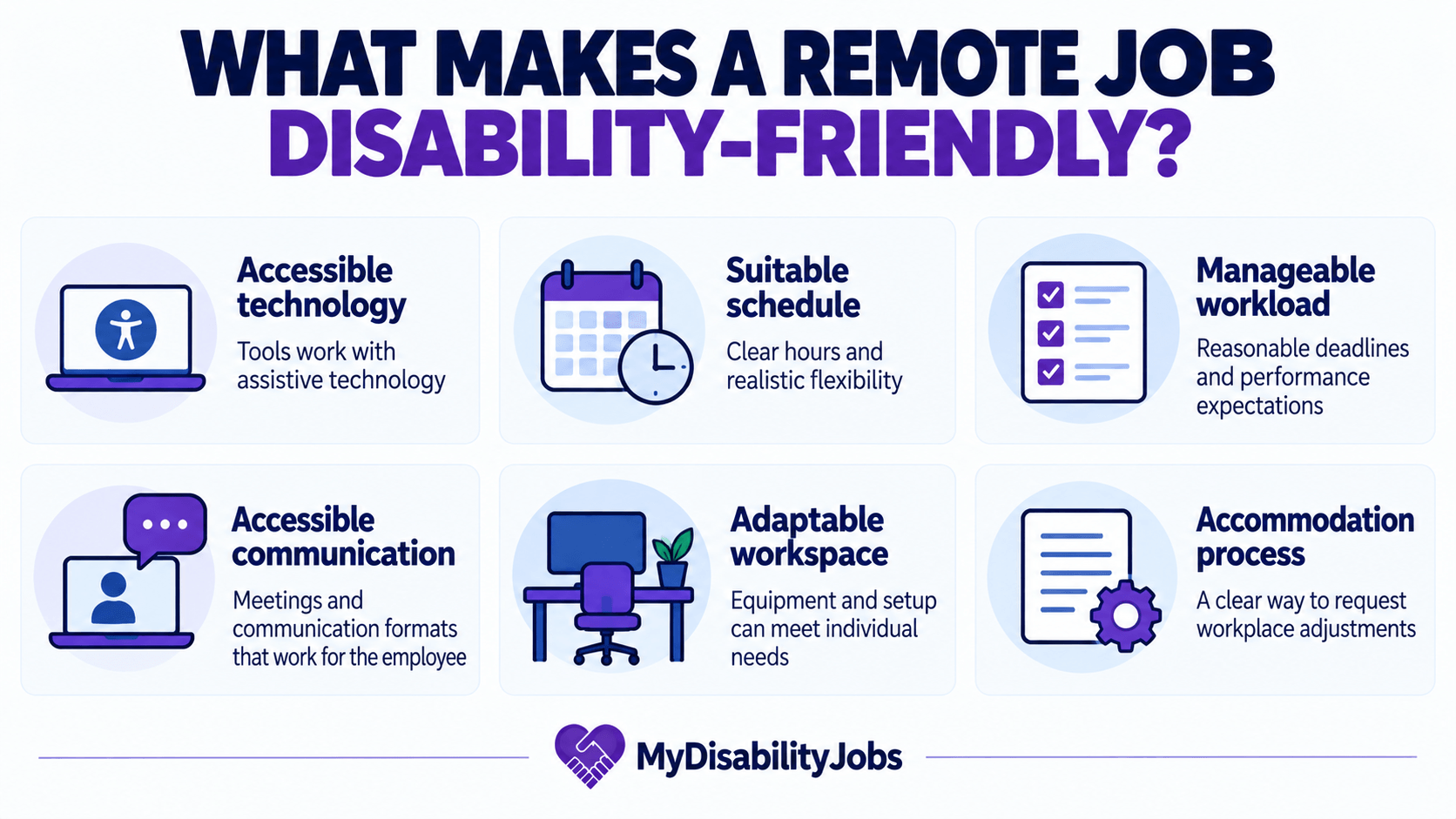
A job is not automatically disability-friendly simply because the advertisement says “remote.” The actual working conditions matter more than the location alone.
Two employers can advertise the same remote job while offering very different schedules, technology, workloads, accessibility, and accommodation processes.
When evaluating a remote position, look at the following factors.
Schedule and flexibility
Check whether the job has fixed working hours, flexible scheduling, required core hours, rotating shifts, evening or weekend work, or an expectation that employees remain continuously available.
Remote work can remove commuting without changing the schedule at all. If flexibility is important to you, confirm what the employer actually allows rather than assuming that working from home means choosing your own hours.
Accessible technology
A remote employee may depend heavily on video-conferencing tools, messaging platforms, virtual desktops, customer-management systems, shared documents, internal websites, and other digital tools.
If you use a screen reader, speech recognition, magnification, alternative input device, captions, or other assistive technology, the accessibility of these systems can be as important as the physical accessibility of an office.
Workload and performance expectations
Ask how performance is measured.
Some remote jobs are evaluated through normal project goals, while others use call volumes, response times, sales targets, productivity quotas, monitoring software, or strict turnaround requirements.
A position that can technically be performed at home may still be a poor fit if its workload or performance model does not match your needs.
Communication requirements
Find out how often the team uses video meetings, phone calls, live chat, collaborative work sessions, or client meetings.
Some people prefer asynchronous written communication, while others work better with scheduled conversations. The most suitable arrangement depends on the person and role.
Equipment and workspace
Check what equipment the employer provides and what you are expected to supply yourself.
Depending on the job and individual needs, the setup might involve an ergonomic chair, adapted keyboard or mouse, larger monitor, headset, assistive software, captions, screen-reading technology, or another workplace adjustment.
Accommodation process
Remote employees can still need reasonable accommodations.
The U.S. Equal Employment Opportunity Commission explains that reasonable accommodations may include equipment or device modifications, changes to schedules or policies, accessible training materials, and in some circumstances telework itself.
A useful sign is an employer that clearly explains how applicants and employees can request accommodations and responds to those requests through an individualized process.
The EEOC lists modified equipment, changes to schedules and policies, accessible training materials, and other adjustments among possible reasonable accommodations.
Read more about developing accessibility in the workplace.
Remote Jobs for Disabled People With No Experience or Without a Degree
Some remote jobs have entry routes that do not require a four-year degree, but “no experience required” should be treated carefully. Employers may still expect basic computer skills, communication ability, subject knowledge, a portfolio, certifications, or some evidence that you can do the work.
Among the careers in this guide, roles with more accessible entry routes can include:
- Customer Support Representative — many employers provide on-the-job training and focus on communication and computer skills;
- Virtual Assistant — some clients prioritize organization, reliability, and familiarity with everyday office tools over formal qualifications;
- Transcriber — typing accuracy, listening skills, and meeting turnaround requirements may matter more than a degree;
- Proofreader — strong grammar, attention to detail, and sample work can be more important than formal credentials for some freelance opportunities;
- Bookkeeper — some employers accept relevant coursework, software skills, or practical bookkeeping knowledge without requiring a bachelor’s degree;
- Freelancing — requirements depend on the service you offer, and a strong portfolio or client history may matter more than formal education.
Remote work does not remove the need to meet the employer’s requirements. A job advertised as entry level may still require specific software, scheduled availability, communication skills, background checks, or previous experience in a related area.
How to improve your chances with limited experience
If you are new to remote work, focus on showing evidence of skills.
Useful ways to do that include:
- completing a short course or recognized certification where relevant;
- building sample projects or a simple portfolio;
- practicing with the tools used in the job;
- doing volunteer, freelance, internship, or project-based work;
- updating your résumé to emphasize transferable skills;
- preparing examples that show reliability, communication, problem-solving, or technical ability.
Do not pay a company simply for the right to apply for a job.
If you are also exploring broader entry-level options, see our guide to easy jobs for disabled adults.
15 Work From Home Jobs for Disabled People
The 15 jobs below are not ranked from best to worst. They represent different skill levels, work styles, industries, and entry requirements.
Some are primarily employee roles, while others are commonly freelance or contract-based. Some may be available with limited formal education, while others require specialized training or a degree.
For each option, review the actual employer or client requirements, schedule, technology, workload, and accessibility rather than assuming that every remote version of the job will offer the same working conditions.
1. Freelancing
Freelancing offers one of the most flexible ways to earn a living from home. Whether you’re skilled in writing, design, marketing, tech, or admin work, there is demand for freelancers across many industries. You may be able to choose clients, set rates, and arrange your working hours, although deadlines, client needs, and platform rules can limit that flexibility. It can be a useful option for people with disabilities who want to work independently in a familiar environment.
Why it’s a great fit for disabled people:
Freelancing can give you more control over your workspace and schedule. Depending on the contract, you may be able to choose projects that suit your energy levels and arrange work around your needs, while still meeting client deadlines. It can work well for people who require flexible hours or remote accommodations. In fact, it’s one of the best part-time jobs for disabled person, and also one of the top jobs for people in wheelchairs because many freelance tasks can be completed from a laptop in an accessible workspace.
Main tasks include:
- Creating a freelance profile and portfolio
- Offering services like writing, design, admin support, or coding
- Communicating with clients and managing deadlines
- Invoicing and receiving payments
- Building long-term relationships with clients or agencies
Skills needed:
- A marketable skill (writing, design, marketing, etc.)
- Self-discipline and time management
- Clear communication
- Ability to meet deadlines
- Basic knowledge of freelancing platforms
How to get started:
First, identify the skill or service you want to offer. Then create a portfolio or a few examples of your work. Sign up on one or more freelance platforms, take time to fill out your profile professionally, and start applying for jobs that match your strengths.
- Skillshare – Freelancing Classes
- LinkedIn Learning – Freelancing Courses
- Coursera – Plan a Successful Freelancing Business
Expected salary:
Indeed reports an average base salary of $29.25 per hour for freelancers in the United States. Actual rates vary substantially by service, experience, contract, and platform.
Source: Indeed
Where to find jobs:
- Search Freelance Jobs on MyDisabilityJobs
- Upwork – Global Freelance Platform
- Fiverr – Sell Freelance Services
- Freelancer – Freelance Projects Worldwide
- PeoplePerHour – Freelance Opportunities
2. Virtual Assistant

If you’re organized, communicative, and comfortable with digital tools, working as a virtual assistant could be a useful option. It’s even listed as an easy job for disabled adults because many tasks are computer-based and some roles offer flexibility. You’ll help entrepreneurs or small businesses stay on top of their schedule and tasks from home.
Why it’s a great fit for disabled people:
Most VA tasks are computer-based and can be done while seated. Some clients offer adjustable hours, while others require availability during set business hours. This may suit people with mobility limitations, chronic fatigue, or pain conditions when the schedule and duties match their needs.
Main tasks include:
- Managing calendars and booking appointments
- Answering emails and messages
- Organizing documents and spreadsheets
- Assisting with blog or social media updates
- Basic research or customer service
Skills needed:
- Good written communication
- Organizational skills
- Attention to detail
- Familiarity with tools like Gmail, Google Calendar, Word/Excel, Zoom
How to get started:
You don’t need a degree to become a virtual assistant. Many people start with no formal training and learn along the way. Here are some useful resources to build your skills and confidence:
- Udemy – Virtual Assistant Courses – Practical and affordable
- Alison – Free Virtual Assistant Course – 100% free course with certification
- Coursera – How to Become a Virtual Assistant – Beginner guide + course recommendations
- YouTube – Search for “virtual assistant tutorials” to find free walkthroughs and real-world examples
Expected salary:
Indeed reports an average salary of $22.19 per hour for virtual assistants in the United States. Pay varies by duties, experience, location, and whether the work is freelance or employed.
Sources: Indeed, Zippia, SalaryExpert
Where to find jobs:
- Search Remote Virtual Assistant Jobs on MyDisabilityJobs
- Upwork – Freelance platform for all levels
- Fiverr – Offer services as a VA
- Remote.co – Curated remote jobs
- Indeed – Browse verified virtual assistant jobs
3. Social Media Manager
If you love spending time on platforms like Instagram, TikTok, LinkedIn, or Facebook — and you understand how they work — a job as a social media manager could be a strong option. It’s a creative role that may be available remotely, part-time, or on a freelance basis, although schedules and campaign deadlines depend on the employer or client.
Why it’s a great fit for disabled people:
Many social media management tasks are completed online and can be handled from an accessible home workspace. Some roles still require scheduled meetings, calls, live-event coverage, or rapid responses to customers, so the exact arrangement depends on the employer or client. It may suit people who enjoy creativity and independent computer-based work.
Main tasks include:
- Writing captions and creating content calendars
- Scheduling posts using tools like Buffer or Hootsuite
- Engaging with followers (comments, messages)
- Managing brand voice and visual consistency
- Analyzing post performance (likes, shares, reach)
- Assisting with ad campaigns or influencer partnerships
Skills needed:
- Creativity and attention to detail
- Basic copywriting
- Good time management
- Knowledge of one or more platforms (Instagram, Facebook, TikTok, LinkedIn)
- Familiarity with Canva, scheduling tools, and basic analytics
How to get started:
A degree is not always required to start working in social media. Most employers or clients just want to see that you understand the platform, can create engaging content, and are reliable. Here are free or affordable ways to build skills:
- Udemy – Social Media Management Courses – Practical and affordable training for all levels
- Coursera – Social Media Marketing Courses – Courses from top institutions with certification options
- Alison – Social Media Manager Career Path – 100% free course with certificate option
- Meta Blueprint – Facebook & Instagram Official Training – Learn directly from the source
- YouTube – Search for “social media manager tutorial” to find walkthroughs and real-world examples
Expected salary:
Indeed reports an average salary of $65,452 per year for social media managers in the United States. Pay varies by location, industry, experience, and whether the position is freelance or salaried.
Sources:
Where to find jobs:
- Search Remote Social Media Jobs on MyDisabilityJobs
- Upwork – Social Media Manager Jobs
- Indeed – Remote Social Media Jobs
- Fiverr – Offer social media services
4. Digital Marketing Specialist

If you’re analytical, creative, and enjoy working online, digital marketing offers one of the most versatile and in-demand remote jobs for disabled people. From content creation and SEO to running ads or analyzing traffic, there’s a wide range of specializations you can explore — all from the comfort of your home.
Why it’s a great fit for disabled people:
Digital marketing specialist roles are mostly computer-based, and some are remote or include asynchronous tasks. Employers and clients may still require fixed hours, meetings, campaign deadlines, or live reporting. For people with mobility limitations, chronic fatigue, or sensory sensitivities, a remote arrangement may allow more control over the work environment when the role matches their needs.
Main tasks include:
- Creating and managing online ads (Google, Facebook, etc.)
- Search Engine Optimization (SEO)
- Writing content or managing blogs
- Email marketing and automation
- Analyzing performance data (Google Analytics, Meta Ads Manager, etc.)
Skills needed:
- Basic understanding of online marketing strategies
- Written communication and content creation
- Analytical mindset
- Familiarity with tools like Google Ads, Meta Business Suite, Mailchimp, or Canva
How to get started:
A degree is not always required to enter digital marketing, but having a solid understanding of core concepts is essential. Here are top resources to learn and gain confidence:
- Coursera – Digital Marketing Specializations (University-backed courses with certificate options)
- HubSpot Academy – Free Marketing Courses (Inbound marketing, SEO, email, etc.)
- Udemy – Digital Marketing Courses (Practical training at all levels)
- Google Digital Garage – Digital Marketing Training (Training available through Google Skillshop)
Expected salary:
Indeed reports an average salary of $66,058 per year for digital marketers in the United States. Pay varies by specialty, location, experience, and employment arrangement.
Sources: Indeed, ZipRecruiter, Coursera
Where to find jobs:
- Upwork – Digital Marketing Jobs
- Fiverr – Offer digital marketing services
- Search Digital Marketing Jobs on MyDisabilityJobs
5. Customer Support Representative

If you’re a good communicator, enjoy helping people, and want a remote job that may provide stability, working as a Customer Support Representative could be a suitable option. Depending on the employer, you may assist customers by email, chat, or phone while working from home.
Why it’s a great fit for disabled people:
This job is mostly computer-based and usually requires limited physical movement. Some companies offer remote setups or flexible shifts, while others require fixed schedules, phone work, response-time targets, or performance quotas. It may suit individuals with limited mobility, chronic conditions, or energy-related disabilities when the schedule and communication format are appropriate.
Main tasks include:
- Answering customer inquiries via chat, email, or phone
- Troubleshooting issues and providing accurate information
- Escalating complex problems to relevant departments
- Maintaining records of customer interactions
- Providing product or service guidance and technical support
Skills needed:
- Excellent written and verbal communication
- Patience and empathy when dealing with frustrated customers
- Basic computer literacy
- Ability to follow scripts and procedures
- Familiarity with tools like Zendesk, Intercom, or Freshdesk (optional but helpful)
How to get started:
Many customer support roles do not require a degree, and employers may provide on-the-job training. However, getting familiar with basic tools and concepts will help you stand out. Here are free or affordable resources to build your confidence:
- Udemy – Customer Service Training (Practical training for beginners)
- Alison – Customer Service Skills (Free course with certificate)
- Coursera – Customer Service Fundamentals (With certificate option)
- YouTube – Search “customer support training” (Free tutorials and walkthroughs)
Expected salary:
Indeed reports an average salary of $19.13 per hour for customer service representatives in the United States. Pay varies by industry, location, schedule, and the level of technical support required.
Sources: Indeed, Zippia, Salary.com
Where to find jobs:
- Search Remote Customer Support Jobs on MyDisabilityJobs
- We Work Remotely – Customer Support Category
- RemoteOK – Remote Customer Support Listings
- Indeed – Remote Customer Service Jobs
6. Proofreader

Proofreaders review written content for spelling, grammar, punctuation, formatting, and consistency. Many proofreading assignments can be completed remotely using digital documents, making it a practical work-from-home option for people who enjoy focused, detail-oriented work.
Why it’s a great fit for disabled people:
Proofreading is a quiet, focused activity that is usually computer-based. Freelancers may be able to choose projects based on their availability, but client and publishing deadlines still apply. It may suit people with mobility issues or chronic fatigue when the workload and deadlines are manageable.
Main tasks include:
- Reviewing texts for spelling, grammar, and punctuation errors
- Checking for consistency in tone, formatting, and terminology
- Making suggestions for clearer expression or flow
- Ensuring content adheres to client or brand style guides
Skills needed:
- Excellent command of grammar and spelling
- Attention to detail
- Patience and focus for long-form documents
- Familiarity with Microsoft Word, Google Docs, or PDF editors
How to get started:
You don’t need a formal degree to become a proofreader, but excellent grammar and attention to detail are essential. Here are some useful training resources:
- Udemy – Proofreading Courses – Affordable, practical online courses for beginners
- Alison – Free Proofreading Courses – 100% free with certificate options
- Coursera – Proofreading & Writing Courses – Academic-level courses with certification
- YouTube – Proofreading Tutorials – Free video guides and real-world examples
Expected salary:
Indeed reports an average salary of $27.41 per hour for proofreaders in the United States. Freelance rates may also be set by project, page, or word.
Sources:
Indeed, Zippia, Ziprecruiter
Where to find jobs:
- Search Remote Proofreader Jobs on MyDisabilityJobs
- Upwork – Freelance proofreading gigs
- Fiverr – Offer proofreading services
- Indeed – Remote proofreading jobs
- FlexJobs – Curated remote proofreading opportunities
7. Translator

If you’re fluent in more than one language, working as a translator can be a rewarding remote career. Translators help bridge language gaps in areas like business, law, healthcare, and media. Many document-translation roles can be performed from home, although schedules, deadlines, and work locations vary by employer and assignment. Whether you’re translating documents, subtitles, or website content, this job can turn language skills into income from a familiar and accessible environment.
Why it’s a great fit for disabled people:
Written translation is often computer-based and may be available remotely, on a freelance basis, or part-time. Some positions still require scheduled meetings, office attendance, or fixed deadlines, and interpreting is a separate role that may involve live speech. For wheelchair users or individuals with chronic pain or fatigue, a remote written-translation role may reduce commuting and physical strain when its schedule is suitable.
Main tasks include:
- Translating documents, articles, or subtitles from one language to another
- Ensuring accuracy and cultural appropriateness of translations
- Editing and proofreading translated texts
- Using CAT (Computer-Assisted Translation) tools
- Managing translation deadlines and communicating with clients
- Specializing in legal, medical, technical, or business content
Skills needed:
- Fluency in at least two languages
- Excellent written communication skills
- Attention to detail
- Cultural sensitivity and awareness
- Familiarity with translation tools (e.g., SDL Trados, Smartcat, DeepL)
How to get started:
To begin, choose the language pair(s) you want to specialize in and consider getting certified or taking an online course. Many platforms also offer free or low-cost tools to build your portfolio. Specializing in a niche (e.g., legal or medical translation) can also increase your earning potential.
- Coursera – Translation in Practice
- Udemy – Professional Translation Masterclass
- Smartcat Academy – Free translator training
Expected salary:
The U.S. Bureau of Labor Statistics reports a median annual wage of $60,170 in May 2025 for interpreters and translators. The wage data exclude self-employed workers, and pay varies by language, specialty, experience, education, and certification.
Source: U.S. Bureau of Labor Statistics
Where to find jobs:
- Search Translator Jobs on MyDisabilityJobs
- ProZ – Translation Job Board
- Upwork – Translation Freelance Jobs
- Freelancer – Translation Projects
8. Content Writer
If you enjoy writing and have a way with words, working as a content writer can be a rewarding remote career. From blogs and newsletters to product descriptions and website copy, there’s a wide range of content that businesses need help creating. Freelance and remote roles may offer schedule flexibility, while salaried positions usually follow employer hours and deadlines. This can make content writing a useful option for many people with disabilities.
Why it’s a great fit for disabled people:
Many content-writing jobs can be performed remotely with a computer and internet connection. Freelancers may choose projects that suit their availability, but both freelance and salaried writers must meet editorial deadlines and client or employer requirements. A suitable remote arrangement may help people dealing with chronic pain, fatigue, or mobility limitations avoid commuting.
Main tasks include:
- Writing blog posts, articles, product descriptions, or web content
- Researching topics and organizing information clearly
- Following client guidelines and brand voice
- Editing and proofreading your own work
- Collaborating with editors or content managers
- Using SEO tools to optimize content for search engines
Skills needed:
- Strong grammar and writing skills
- Creativity and adaptability in tone
- Ability to meet deadlines
- Basic research skills
- Familiarity with SEO (Search Engine Optimization) principles
How to get started:
Start by building a simple writing portfolio — even unpaid blog posts or sample articles can help. Then, consider taking a beginner course in SEO writing or digital content. As you gain experience, you can niche down into an industry you enjoy, like travel, tech, health, or finance.
- Udemy – Content Writing Masterclass
- Coursera – Content Marketing Courses
- HubSpot Academy – Free Content Marketing Course
- Skillshare – Content Writing Classes
- Moz – Learn SEO Content Basics
Expected salary:
The U.S. Bureau of Labor Statistics reports a median annual wage of $76,910 in May 2025 for the broader writers and authors occupation, which includes content writers. Freelance income may vary substantially by assignment, specialty, and experience.
Source: U.S. Bureau of Labor Statistics
Where to find jobs:
- Search Content Writer Jobs on MyDisabilityJobs
- Freelancer – Article & Content Writing Projects
- Upwork – Content Writing Freelance Jobs
- ProBlogger – Blogging & Writing Jobs
- PeoplePerHour – Writing & Translation Jobs
- Fiverr – Writing & Translation Gigs
9. Online Teacher
If you enjoy connecting with others and have a passion for teaching, working as an online teacher can be a fulfilling remote job. Online teachers deliver academic subjects, languages, or professional skills through virtual classrooms. Depending on the employer or platform, they may teach one-on-one or in groups and may have either fixed class times or some choice over availability.

Why it’s a great fit for disabled people:
Online teaching requires a stable internet connection, suitable audio or video equipment, subject knowledge, and the qualifications required by the employer. Some course platforms accept demonstrated expertise, while online K–12 schools may require a bachelor’s degree, teaching license, or classroom experience. Working from home can remove a commute, but lessons, meetings, and student support are commonly scheduled.
Main tasks include:
- Conducting live lessons via video calls
- Preparing lesson plans and materials
- Giving feedback and answering student questions
- Monitoring student progress and adapting lessons accordingly
- Creating quizzes, assignments, or interactive activities
- Managing a digital teaching profile and schedule
Skills needed:
- Strong communication and interpersonal skills
- Good knowledge of the subject you want to teach
- Patience and adaptability to different learning styles
- Basic tech skills (Zoom, Google Meet, or teaching platforms)
- Ability to stay organized and punctual
How to get started:
Choose the subject or language you would like to teach and identify the type of employer or platform you want to use. Review its education, licensing, background-check, technology, and schedule requirements before applying. Build a teaching profile with your qualifications, sample lesson materials, and availability, and consider an online-teaching course if you need experience with virtual instruction.
- Coursera – Online Teaching Courses
- Udemy – Teacher Training Courses
- Udemy – Teach on Udemy (free resources for new instructors)
- FutureLearn – Online Teaching Courses
Expected salary:
Salary.com reports an average salary of $53,724 per year for online teachers in the United States as of September 2026. Pay varies by subject, qualifications, employer, schedule, and whether the position is salaried or contract-based.
Source: Salary.com
Where to find jobs:
- Search Online Teaching Jobs on MyDisabilityJobs
- Outschool – Apply to Teach Online Classes
- Stride – Online Teaching Careers
- Indeed – Remote Online Teacher Jobs
- LinkedIn – Remote Online Teacher Jobs
10. Transcriber
If you have good listening and typing skills, working as a transcriber is one of the most accessible online jobs for disabled people you can do from home. Transcription involves listening to audio or video content — such as podcasts, interviews, or meetings — and typing the spoken words into a text format. It’s a great job for people who enjoy focused, independent work and prefer minimal client interaction.
Why it’s a great fit for disabled people:
Many transcription jobs can be done from home with a computer, headphones, reliable internet, and transcription software. Some assignments allow flexible timing, while others have strict turnaround deadlines or client communication requirements. This may suit people with mobility challenges or fatigue when the workload is manageable. Blind and visually impaired people may also be able to do transcription when the software, text fields, and timestamp controls work with their screen reader or other assistive technology; accessibility varies by platform. Our guide to finding a suitable job for blind people covers additional options.
Main tasks include:
- Listening to audio or video recordings carefully
- Typing spoken content with high accuracy
- Formatting transcripts according to client guidelines
- Identifying speakers and adding timestamps
- Reviewing and proofreading transcripts for errors
- Submitting files on time and maintaining confidentiality
Skills needed:
- Excellent listening and concentration
- Fast and accurate typing
- Strong grammar and punctuation
- Ability to follow formatting rules
- Familiarity with transcription tools (like Otter, Descript, or Express Scribe)
How to get started:
To begin, practice typing from audio sources and consider taking a beginner-friendly transcription course. You’ll also want to familiarize yourself with transcription software and build a small portfolio to show potential clients.
- Udemy – General Transcription Course for Beginners
- Transcribe Anywhere – Full Transcription Training
- Skillshare – Learn Transcription Basics
- TypingTest – Improve Your Typing Speed
- YouTube – Beginner Transcription Tutorial
Expected salary:
PayScale reports an average hourly rate of $22.33 in 2026 for transcribers with transcription skills. Actual pay varies by subject matter, audio quality, turnaround time, and employment arrangement.
Source: PayScale
Where to find jobs:
- Search Transcription Jobs on MyDisabilityJobs
- GoTranscript – Apply to Be a Transcriber
- Rev – Freelance Transcription Jobs
- TranscribeMe – Join as a Transcriptionist
- Upwork – Freelance Transcription Listings
11. Bookkeeper
Bookkeepers organize financial records, record transactions, reconcile accounts, and help businesses keep their books accurate. Many duties are completed with accounting software, making remote bookkeeping a practical work-from-home option with businesses, accounting firms, or freelance clients. Remote availability varies, and some employers require set hours or occasional access to an office.
Why it’s a great fit for disabled people:
Bookkeeping is detail-focused, computer-based work that may be performed from an accessible home workstation. A remote arrangement can reduce commuting and allow the use of preferred keyboards, monitors, seating, or assistive software. Month-end deadlines and periods of concentrated work still need to match the individual’s energy, focus, and accommodation needs.
Main tasks include:
- Recording income, expenses, payments, and other transactions
- Reconciling bank and credit-card accounts
- Preparing invoices and monitoring accounts payable or receivable
- Maintaining ledgers and organized financial records
- Producing routine reports for clients, accountants, or managers
- Protecting confidential financial information
Skills needed:
- Accuracy and attention to detail
- Basic accounting and bookkeeping knowledge
- Spreadsheet and accounting-software skills
- Organization and deadline management
- Discretion with financial information
- Clear communication with clients or coworkers
How to get started:
Some bookkeeping jobs accept a high school diploma plus relevant coursework or experience, while others prefer college-level accounting study. Learn double-entry bookkeeping, practice with spreadsheets and accounting software, and create sample ledgers or reconciliations. Certification is optional for many jobs but may help demonstrate skills.
- Coursera – Intuit Academy Bookkeeping Professional Certificate
- AccountingCoach – Free Bookkeeping and Accounting Lessons
- QuickBooks – Training and Certification
- NACPB – Bookkeeping Training and Certification Information
Expected salary:
The U.S. Bureau of Labor Statistics reports a median annual wage of $50,670 in May 2025 for bookkeeping, accounting, and auditing clerks. This is a broader occupational category that includes bookkeepers, and pay varies by location, industry, and experience.
Source: U.S. Bureau of Labor Statistics
Where to find jobs:
- Indeed – Remote Bookkeeper Jobs
- LinkedIn – Remote Bookkeeping Jobs
- FlexJobs – Remote Bookkeeping Jobs
- Upwork – Freelance Bookkeeping Projects
12. Medical Coder
Medical coders review clinical documentation and assign standardized diagnosis and procedure codes used for billing, records, and healthcare reporting. Some hospitals, clinics, insurers, and coding companies offer work-from-home positions, although remote roles may require completed training, certification, or previous coding experience.
Why it’s a great fit for disabled people:
Medical coding is computer-based and can sometimes be performed from a private, accessible home workspace. This may reduce commuting and make it easier to use personalized ergonomic or assistive equipment. Coders must still meet accuracy, productivity, confidentiality, and deadline requirements, and not every employer offers remote work.
Main tasks include:
- Reviewing medical records and clinical documentation
- Assigning ICD-10-CM, CPT, or HCPCS codes as appropriate
- Checking records for completeness and coding accuracy
- Following payer, privacy, and documentation rules
- Querying authorized staff when documentation needs clarification
- Maintaining confidential electronic health information
Skills needed:
- Knowledge of medical terminology, anatomy, and coding systems
- Accuracy and close attention to documentation
- Comfort with electronic health-record and coding software
- Understanding of privacy and confidentiality requirements
- Research and problem-solving skills
- Ability to meet productivity and quality standards
How to get started:
Many medical coders complete a postsecondary certificate or associate-level program covering medical terminology, anatomy, and coding systems. Employers may prefer credentials such as the AAPC Certified Professional Coder or AHIMA Certified Coding Associate, but certification requirements vary. Check each employer’s requirements before paying for an exam or course.
- AAPC – Certified Professional Coder Pathway
- AHIMA – Certified Coding Associate
- CMS – ICD-10 Coding Resources
Expected salary:
The U.S. Bureau of Labor Statistics reports a median annual wage of $51,140 in May 2025 for medical records specialists. Medical coders are included within this broader occupational category, so the figure is not specific to coding-only positions.
Source: U.S. Bureau of Labor Statistics
Where to find jobs:
- Indeed – Remote Medical Coder Jobs
- LinkedIn – Remote Medical Coding Jobs
- AAPC – Medical Coding Job Board
- AHIMA Career Assist – Health Information Jobs
13. Graphic Designer
Graphic designers create visual materials for websites, social media, advertising, publications, packaging, and brand campaigns. Freelance and remote graphic-design jobs can be performed from a home studio, while many salaried positions involve team collaboration, meetings, and employer-set hours. A strong portfolio is usually central to getting hired.
Why it’s a great fit for disabled people:
Remote or freelance design work may allow a disabled professional to arrange an accessible workstation and use preferred input devices, displays, shortcuts, or other assistive tools. Design software is highly visual and may require precise pointer or keyboard work, so accessibility depends on the person, the software, and the project. Deadlines and client feedback also affect the amount of schedule flexibility.
Main tasks include:
- Developing layouts, illustrations, graphics, or brand assets
- Interpreting creative briefs and audience needs
- Selecting typography, color, imagery, and visual hierarchy
- Preparing designs for web, social media, print, or presentations
- Revising work after client or team feedback
- Maintaining an organized portfolio and project files
Skills needed:
- Visual communication and layout skills
- Typography, color, and composition knowledge
- Experience with relevant design software
- Creativity and attention to detail
- Ability to accept and apply feedback
- Time management across multiple deadlines
How to get started:
Learn design fundamentals and one or two widely used tools, then create a focused portfolio showing several kinds of projects. BLS lists a bachelor’s degree as the typical entry-level education for graphic designers, but freelance clients and some employers may place greater weight on portfolio quality and practical experience.
- Coursera – Graphic Design Specialization
- Adobe – Creative Cloud Tutorials
- Canva Design School
- Behance – Build and Share a Design Portfolio
Expected salary:
The U.S. Bureau of Labor Statistics reports a median annual wage of $62,960 in May 2025 for graphic designers. Freelance income may vary based on project scope, specialty, experience, and client demand.
Source: U.S. Bureau of Labor Statistics
Where to find jobs:
- LinkedIn – Remote Graphic Designer Jobs
- Indeed – Remote Graphic Designer Jobs
- Dribbble – Design Jobs
- Upwork – Freelance Graphic Design Projects
14. Software Developer
Software developers design, build, test, and maintain applications and systems. The role can support a long-term work-from-home career in technology, and remote software-development jobs are available across many industries. Remote availability still depends on the employer, and some teams use hybrid schedules, fixed collaboration hours, or on-call rotations.
Why it’s a great fit for disabled people:
Development work is primarily computer-based, so a remote role may allow an accessible workstation, customized input devices, screen readers, voice-control software, or other accommodations. The fit depends on the individual and employer because the job may also involve long periods of concentration, scheduled meetings, deadlines, and occasional support duties.
Main tasks include:
- Designing and writing application or system code
- Testing software and fixing defects
- Using version-control and issue-tracking tools
- Reviewing code and documenting technical decisions
- Collaborating with designers, product teams, and other developers
- Maintaining and improving existing software
Skills needed:
- Programming in languages relevant to the role
- Logical reasoning and problem solving
- Testing and debugging
- Version control, such as Git
- Written communication and technical documentation
- Ability to learn new tools and systems
How to get started:
BLS lists a bachelor’s degree as the typical entry-level education for software developers. Requirements vary, however, and some employers consider candidates with relevant training, a strong project portfolio, internships, certifications, or professional experience. Start with one programming path, build several working projects, and publish code or project documentation that employers can review.
- freeCodeCamp – Free Coding Curriculum
- The Odin Project – Web Development Curriculum
- Harvard CS50x – Introduction to Computer Science
- GitHub Skills – Git and GitHub Courses
Expected salary:
The U.S. Bureau of Labor Statistics reports a median annual wage of $135,980 in May 2025 for software developers. Pay varies by specialty, industry, experience, and location.
Source: U.S. Bureau of Labor Statistics
Where to find jobs:
- LinkedIn – Remote Software Developer Jobs
- Indeed – Remote Software Developer Jobs
- We Work Remotely – Programming Jobs
- Wellfound – Startup Technology Jobs
15. Recruiter / Talent Acquisition Specialist
Recruiters and talent acquisition specialists help employers find, evaluate, and hire candidates. Much of the work takes place through applicant-tracking systems, email, phone calls, and video interviews, so some employers offer remote recruiting jobs. Other positions are office-based or hybrid, and remote recruiters normally work employer-set hours to coordinate with candidates and hiring teams.
Why it’s a great fit for disabled people:
A remote recruiting role may remove commuting and allow the use of an accessible home workstation. It can suit people who enjoy structured communication, research, and relationship building. The job usually includes scheduled phone or video conversations, multiple deadlines, and frequent coordination, so applicants should compare those demands with their communication and accommodation needs.
Main tasks include:
- Writing or refining job descriptions
- Searching for candidates through databases and professional networks
- Reviewing applications and conducting screening calls
- Scheduling interviews with candidates and hiring teams
- Tracking candidates in an applicant-tracking system
- Communicating hiring updates and supporting offer or onboarding steps
Skills needed:
- Clear written, phone, and video communication
- Interviewing and active-listening skills
- Organization and calendar management
- Candidate research and sourcing
- Familiarity with applicant-tracking systems
- Professional judgment and confidentiality
How to get started:
BLS lists a bachelor’s degree as the typical entry-level education for human resources specialists, the broader category that includes many recruiters. Some employers also consider recruiting coordination, sales, customer service, staffing, or industry experience. Learn the hiring process, practice structured screening, and become familiar with applicant-tracking and scheduling tools.
- Coursera – Recruiting, Hiring, and Onboarding Employees
- LinkedIn Learning – Recruiting Courses
- SHRM – Talent Acquisition Specialty Credential
Expected salary:
The U.S. Bureau of Labor Statistics reports a median annual wage of $75,940 in May 2025 for human resources specialists. This broader occupational category includes recruitment specialists, so the figure is not limited to remote recruiter positions.
Source: U.S. Bureau of Labor Statistics
Where to find jobs:
- LinkedIn – Remote Recruiter Jobs
- Indeed – Remote Recruiter Jobs
- SHRM HR Jobs
- FlexJobs – Remote Recruiting Jobs
How to Find Legitimate Work-From-Home Jobs
A legitimate remote job should be evaluated the same way you would evaluate an onsite job: by looking at the employer, the actual duties, the hiring process, the pay structure, and whether the position exists on a verifiable company or job-board listing.
Do not rely only on search terms such as “work from home” or “remote job.” Scammers use the same language as genuine employers, and some fraudulent listings imitate real companies.
Start with the employer’s official careers page
If you find a remote position on a job board, check whether the same role appears on the employer’s official website.
Use the company website you locate independently rather than relying only on a link sent by a recruiter.
A real employer may use an external applicant-tracking system, but the job should normally be traceable back to the company itself.
Check the recruiter and contact details
Look at:
- the recruiter’s email domain;
- whether the recruiter appears on the company’s official website or professional network;
- whether the company has a consistent online presence;
- whether the job description is specific and realistic;
- whether the interview process resembles a normal professional hiring process.
An email from a free personal account or a domain that closely imitates a real employer should be treated cautiously.
Compare the job with similar roles
Very high pay for very simple work should raise questions.
Compare the duties, qualifications, schedule, and compensation with legitimate jobs in the same occupation.
Remote work does not normally eliminate professional requirements just because the employee works from home.
Use established job-search resources
Useful starting points can include:
- searching current jobs on MyDisabilityJobs;
- employer career pages;
- CareerOneStop;
- LinkedIn;
- Indeed;
- USAJOBS for federal opportunities;
- specialist remote-job boards relevant to your occupation.
Look beyond the word “remote”
Some remote jobs are limited to applicants who live in a particular state, time zone, or country because of payroll, tax, licensing, security, or client requirements.
Also check whether the position is:
- fully remote;
- hybrid;
- remote only after training;
- remote but tied to a specific location;
- employee or independent contractor work.
Read the full job description before applying.
If you are comparing employers more broadly, our guide to hiring people with disabilities explains some of the practices that can make recruitment more inclusive.
How to Avoid Remote Job Scams
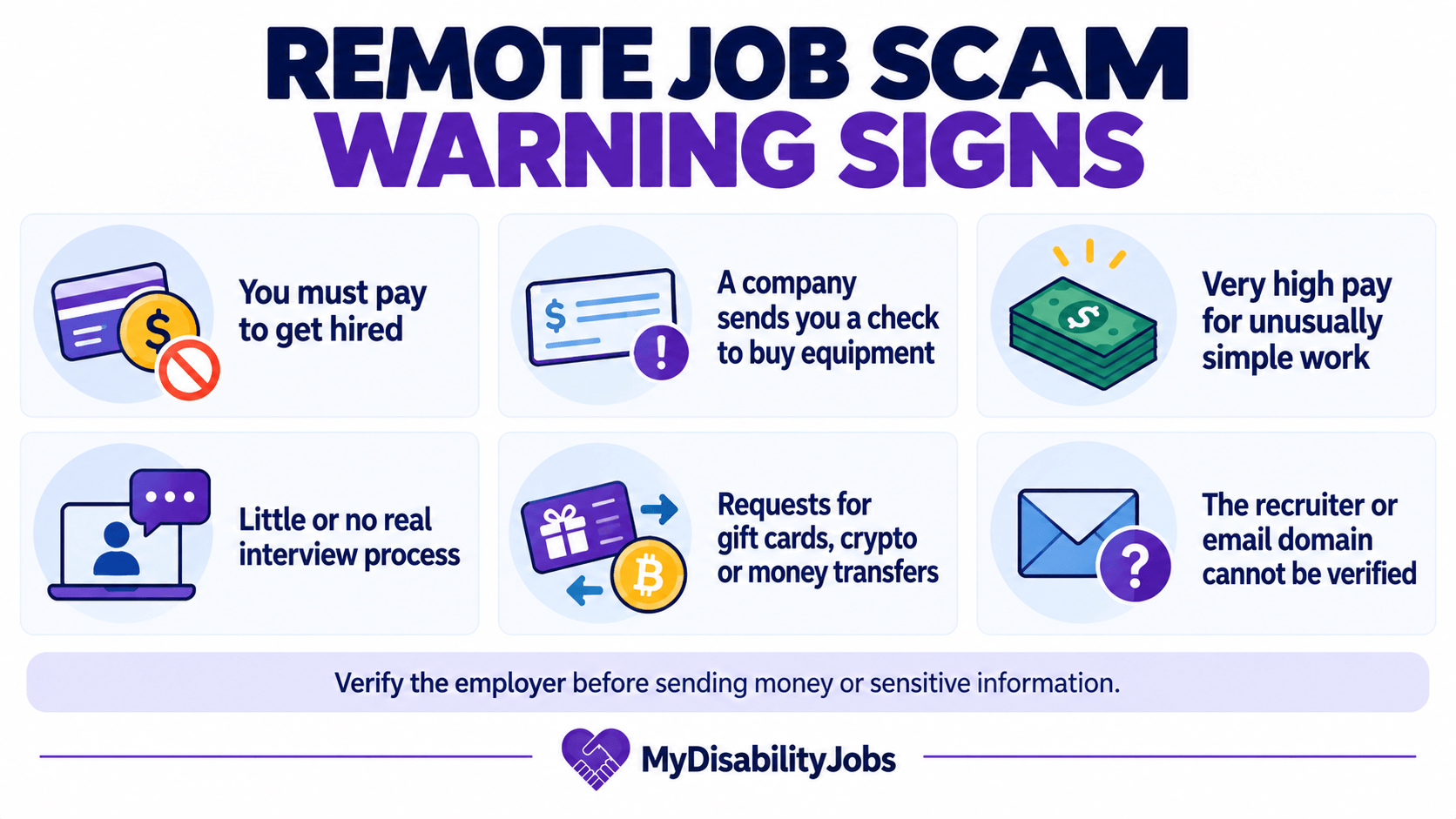
Remote-job searches attract fake recruiters, impersonation scams, fake checks, bogus equipment purchases, task scams, and schemes designed to collect personal or financial information.
A professional-looking website, recruiter profile, company logo, job-board listing, or interview does not by itself prove that an opportunity is legitimate.
Common warning signs
Be cautious if a supposed employer:
- contacts you unexpectedly with a vague remote-job offer;
- promises unusually high pay for very simple work;
- offers the job with little or no meaningful interview process;
- pressures you to respond immediately;
- asks you to pay for training, certification, software, equipment, or job placement;
- sends you a check and tells you to use the money to buy equipment;
- asks you to return part of a check payment;
- asks you to buy gift cards, transfer money, or send cryptocurrency;
- asks you to deposit your own money before completing online “tasks” or unlocking earnings;
- conducts the entire hiring process through text messages, WhatsApp, Telegram, Signal, or another private messaging platform;
- requests banking, Social Security, tax, or identity information before you can verify the employer and hiring process;
- uses an email address or website domain that does not match the real company.
The Federal Trade Commission warns that scammers may impersonate legitimate companies, post fake jobs on real employment sites, and use realistic-looking interviews or paperwork before asking for money or personal information.
How to verify a remote opportunity
Before accepting an offer:
- find the employer’s official website independently;
- check whether the role appears on its careers page;
- contact the company using verified contact information if necessary;
- search the company or recruiter name together with terms such as “scam,” “fraud,” “review,” or “complaint”;
- compare the advertised pay and duties with similar legitimate jobs;
- verify that the recruiter’s email domain matches the organization;
- avoid sending sensitive information until you have confirmed who you are dealing with.
A legitimate employer may request payroll, tax, identity, and banking information after hiring. The important difference is that the employer and hiring process should be independently verifiable first.
Never pay to get a job
Do not pay an employer or recruiter simply for the promise of employment.
The FTC advises that legitimate employers do not require applicants to pay money to obtain a job.
Be especially cautious if someone tells you to purchase equipment from a particular vendor using a check they sent you. Fake-check scams can appear convincing even when the bank initially makes the deposited funds available.
Be careful with “task jobs”
Some scams promise money for simple online tasks such as rating products, liking content, or completing repetitive activities.
The scammer may initially show fake earnings, then require you to deposit your own money or cryptocurrency to continue or withdraw the supposed balance.
Do not send money to unlock earnings from an online job.
If you think a job is fraudulent
Stop communicating if the offer appears suspicious.
Do not send additional money or personal information.
If you already paid money or shared sensitive information, contact the relevant bank, payment provider, or identity-protection service promptly.
Useful official U.S. resources:
- Federal Trade Commission — Job Scams
- FTC — Report Fraud
- IdentityTheft.gov
- FBI — Internet Crime Complaint Center
FTC guidance specifically warns about fake equipment checks, requests for payment, task scams, unexpected recruiter texts, and criminals impersonating legitimate employers.
Working From Home While on Disability Benefits: Support and Resources
Receiving disability benefits does not necessarily mean that you cannot work from home, but earning income can affect benefits differently depending on the program, your earnings, your work activity, and your individual circumstances.
In the United States, Social Security has separate rules for Social Security Disability Insurance (SSDI) and Supplemental Security Income (SSI). Work incentives may allow some beneficiaries to test their ability to work, keep certain benefits during a transition period, or receive employment support.
Because the rules can be detailed and the dollar thresholds change over time, do not rely on a generic earnings figure from a blog post when making decisions about work. Check current Social Security guidance or speak with a qualified benefits counselor before assuming how a new remote job will affect your benefits.
Ticket to Work
Social Security’s Ticket to Work program is a free and voluntary employment-support program for many people ages 18 through 64 who receive SSDI or SSI because of a disability and want to work.
Ticket to Work does not directly guarantee or provide a job. Instead, eligible participants can work with approved service providers that may offer services such as:
- career counseling;
- vocational rehabilitation;
- job-search assistance;
- job placement support;
- training;
- benefits counseling;
- ongoing employment support.
Social Security — Ticket to Work
Social Security currently describes Ticket to Work as free and voluntary for eligible beneficiaries ages 18–64, and its Find Help tool can connect users with providers offering counseling, training, placement and benefits support.
Work incentives
Social Security also provides work incentives intended to help eligible SSDI and SSI beneficiaries explore employment while managing the transition from benefits to earned income.
The rules differ between SSDI and SSI and can involve factors such as:
- earnings;
- work expenses related to a disability;
- the type of benefit received;
- trial or transition periods;
- continued access to Medicare or Medicaid in some circumstances.
Social Security — Work Incentives
Report work and earnings
If you receive Social Security disability benefits, you may have responsibilities to report work activity and earnings.
Do not assume that working remotely changes those reporting requirements. Income from a work-from-home employee job, freelance work, contract work, or self-employment may still be relevant to your benefits.
Use current Social Security guidance for your situation.
Social Security — Working While Disabled
State vocational rehabilitation services
State vocational rehabilitation agencies may provide eligible people with disabilities with employment-related services such as:
- career counseling;
- vocational training;
- assistive technology;
- job-search support;
- workplace accommodations or equipment;
- job placement;
- support when starting or returning to work.
Services and eligibility vary by state.
Rehabilitation Services Administration — State Agencies
Benefits counseling can help before you accept a job
If you receive SSI, SSDI, Medicare, Medicaid, or other disability-related benefits, consider getting individualized benefits counseling before making decisions based on assumptions about how much you can earn.
Ticket to Work service providers may offer benefits counseling, and the Find Help tool can be used to search for providers.
Benefits decisions can affect income, healthcare coverage, and other support, so individual questions should be addressed using current official information or qualified assistance rather than general online advice.
For broader context on employment outcomes, you can also review our disability and employment statistics.
How Can a Disabled Person Make Money From Home?
There is no single way for a disabled person to make money from home. The most practical option depends on your skills, experience, working capacity, schedule, access needs, and whether you want an employee job, freelance work, or self-employment.
For many people, the most stable route is a genuine remote employee position. The 15 careers in this guide include customer support, bookkeeping, medical coding, writing, recruiting, software development, teaching, and other jobs that may be available remotely depending on the employer.
Other ways to earn income from home can include:
- Freelancing: Offer services such as writing, graphic design, bookkeeping, marketing, translation, virtual assistance, or technical work through platforms such as Upwork or Fiverr.
- Selling handmade or physical products: Platforms such as Etsy can be used to sell crafts, artwork, printables, collectibles, or other products you create or source legitimately.
- Selling digital products: Create templates, ebooks, printables, courses, or other digital resources using platforms such as Gumroad, Teachable, or Etsy.
- Online teaching or tutoring: Offer lessons in a subject, language, or professional skill through platforms such as Preply or Superprof, subject to each platform’s qualification and availability requirements.
- Content creation: Build a website, newsletter, YouTube channel, or other audience-based business and potentially earn through advertising, sponsorships, memberships, or affiliate relationships. This usually takes time to develop and does not guarantee income.
- Remote contract work: Look for project-based opportunities in writing, design, administration, technology, customer support, or other fields through reputable freelance and remote-job platforms.
Freelancing, ecommerce, teaching platforms, and content creation can provide flexibility, but they do not guarantee stable earnings. Self-employment may also involve finding clients, paying platform or transaction fees, keeping records, handling taxes, and managing periods with little or no income.
Avoid any opportunity that requires you to pay money simply to receive work or promises unusually high income for very simple tasks.
If you receive disability benefits
Earning money can affect disability benefits differently depending on the program and your individual situation.
If you receive SSDI, SSI, Medicaid, Medicare, or another income-related benefit, review the official guidance and consider benefits counseling before making assumptions about how employment, freelance income, or self-employment will affect your support.
The section above on Working From Home While on Disability Benefits: Support and Resources provides official Social Security, Ticket to Work, and vocational-rehabilitation resources.
Start with skills you can demonstrate
If you are not sure which route to pursue, start with what you can already show an employer or client.
That may include:
- previous work experience;
- a portfolio;
- a professional qualification;
- software skills;
- writing or communication ability;
- bookkeeping or administrative experience;
- subject knowledge;
- technical projects;
- training or certifications.
You can also search current remote and disability-friendly jobs on MyDisabilityJobs rather than relying only on freelance or self-employment opportunities.
Frequently Asked Questions
There is no single remote job that is best for every disabled person. A suitable role depends on your skills, qualifications, access needs, preferred schedule, and the technology and working conditions offered by the employer.
Options in this guide include customer support, virtual assistance, writing, proofreading, bookkeeping, medical coding, online teaching, translation, recruiting, graphic design, software development, and other computer-based or freelance work.
Yes, some remote jobs have entry routes for people with limited professional experience, but “no experience required” does not mean no skills are required.
Customer support, virtual assistance, transcription, proofreading, some bookkeeping roles, and freelance services may have accessible entry routes. Employers may still expect computer skills, communication ability, a portfolio, coursework, certifications, or evidence that you can perform the work.
Possible options include a remote employee job, freelancing, contract work, online teaching or tutoring, selling professional services, ecommerce, digital products, or content creation.
Income stability varies substantially between these options. Remote employee jobs may provide more predictable pay, while freelancing and self-employment can involve irregular income, client acquisition, business expenses, and taxes.
Verify the employer independently, check whether the position appears on the company’s official careers page, confirm the recruiter’s identity and email domain, and compare the duties and pay with similar legitimate jobs.
Be cautious if someone asks you to pay money, sends a check for equipment, requests cryptocurrency or gift cards, offers unusually high pay for simple work, or cannot be independently connected to the employer they claim to represent.
Receiving disability benefits does not necessarily prevent you from working from home, but earnings and work activity can affect benefits differently depending on the program and your individual situation.
SSDI and SSI have different rules and work incentives. Use current Social Security guidance or qualified benefits counseling before assuming how a remote job, freelance work, or self-employment will affect your benefits.
Yes. Working from home does not automatically eliminate the need for workplace accommodations.
Depending on the employee and job, accommodations may involve accessible software, assistive technology, modified equipment, accessible training materials, schedule adjustments, communication changes, or other reasonable modifications. In some circumstances, telework itself may be considered as a reasonable accommodation.
Start with established job boards, employer career pages, government resources, and disability-focused employment platforms.
You can search current opportunities on MyDisabilityJobs, use mainstream sites such as LinkedIn and Indeed, explore CareerOneStop and USAJOBS, and check specialist remote-job boards relevant to your occupation. Always verify the employer and job independently before sending sensitive information or money.